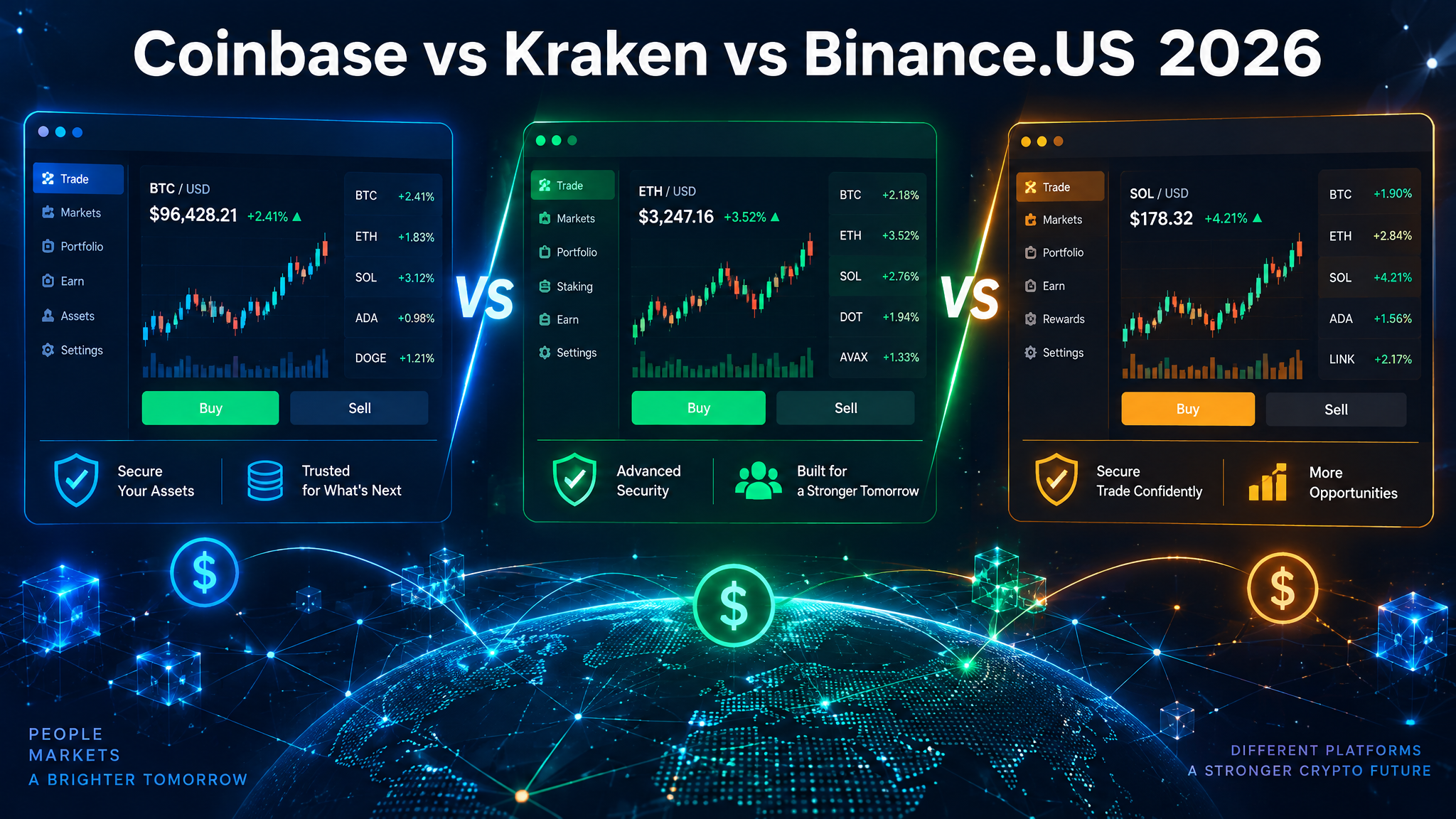
Coinbase vs Kraken vs Binance.US 2026: Which US Crypto Exchange Should You Use?
Affiliate Disclosure: This article may contain affiliate links. We may earn a commission at no extra cost to you. All opinions are our own.
Marcus Chen
Senior Crypto Analyst & Educator
Certified Blockchain Professional | Former Wall Street Analyst
Marcus Chen is a cryptocurrency analyst and educator with over 8 years of experience in digital asset trading. He has helped thousands of beginners navigate the crypto markets through practical, actionable education.
This article contains affiliate links. We may earn a commission at no extra cost to you if you make a purchase through these links. See our affiliate disclosure for details.
Coinbase vs Kraken vs Binance.US 2026: Which US Crypto Exchange Should You Use?
The Coinbase vs Kraken vs Binance.US debate is one of the most common questions US crypto investors face in 2026 — and the differences actually matter. Fees, security track records, staking options, and regulatory standing have all shifted meaningfully over the past year. This head-to-head comparison cuts through the marketing noise so you can pick the right platform for your situation.
Disclaimer: This content is for informational purposes only and should not be considered financial advice. Cryptocurrency investments carry significant risk. Always do your own research (DYOR) before making any investment decisions.
The Short Answer: Who Each Exchange Is For
Before we get into the weeds, here's the quick take:
- Coinbase — Best for beginners and anyone who values regulatory clarity and a polished app experience.
- Kraken — Best for security-conscious investors and active traders who want a wide asset selection with solid staking.
- Binance.US — Best for cost-focused spot traders who want the lowest fees and don't need staking or derivatives.
None of these is universally "best." The right answer depends on what you're actually trying to do with your crypto.
Regulatory Standing and Trust in 2026
After the SEC dropped its lawsuits against all three exchanges in early 2025, the regulatory fog lifted considerably. That said, each platform's legal posture is still quite different.
Coinbase
Coinbase is a publicly traded company on NASDAQ (ticker: COIN), which means quarterly earnings reports, SEC filings, and a level of financial transparency that no private exchange can match. It's licensed in all 50 US states — a meaningful distinction when you're talking about where your money lives. For investors who want the closest thing to a "regulated bank" experience in crypto, Coinbase is the obvious choice.
Kraken
Kraken holds a Wyoming Special Purpose Depository Institution (SPDI) banking charter — one of only a handful of crypto companies with actual bank-level licensing in the US. It's also fully MiCA-licensed in Europe, which matters if you ever travel or relocate. Kraken publishes quarterly, independently audited Proof of Reserves reports that users can verify individually. That's a level of transparency most exchanges don't bother with.
Binance.US
Binance.US operates as a separate entity from Binance Global and has undergone significant compliance restructuring since the 2023 DOJ settlement. It currently serves about 39 states — notably excluding New York and Texas. If you're in one of those states, Binance.US simply isn't an option. For everyone else, it's a legitimate, regulated platform, just with a smaller footprint and fewer features than its global parent.
Fee Structures: Where the Real Differences Show Up
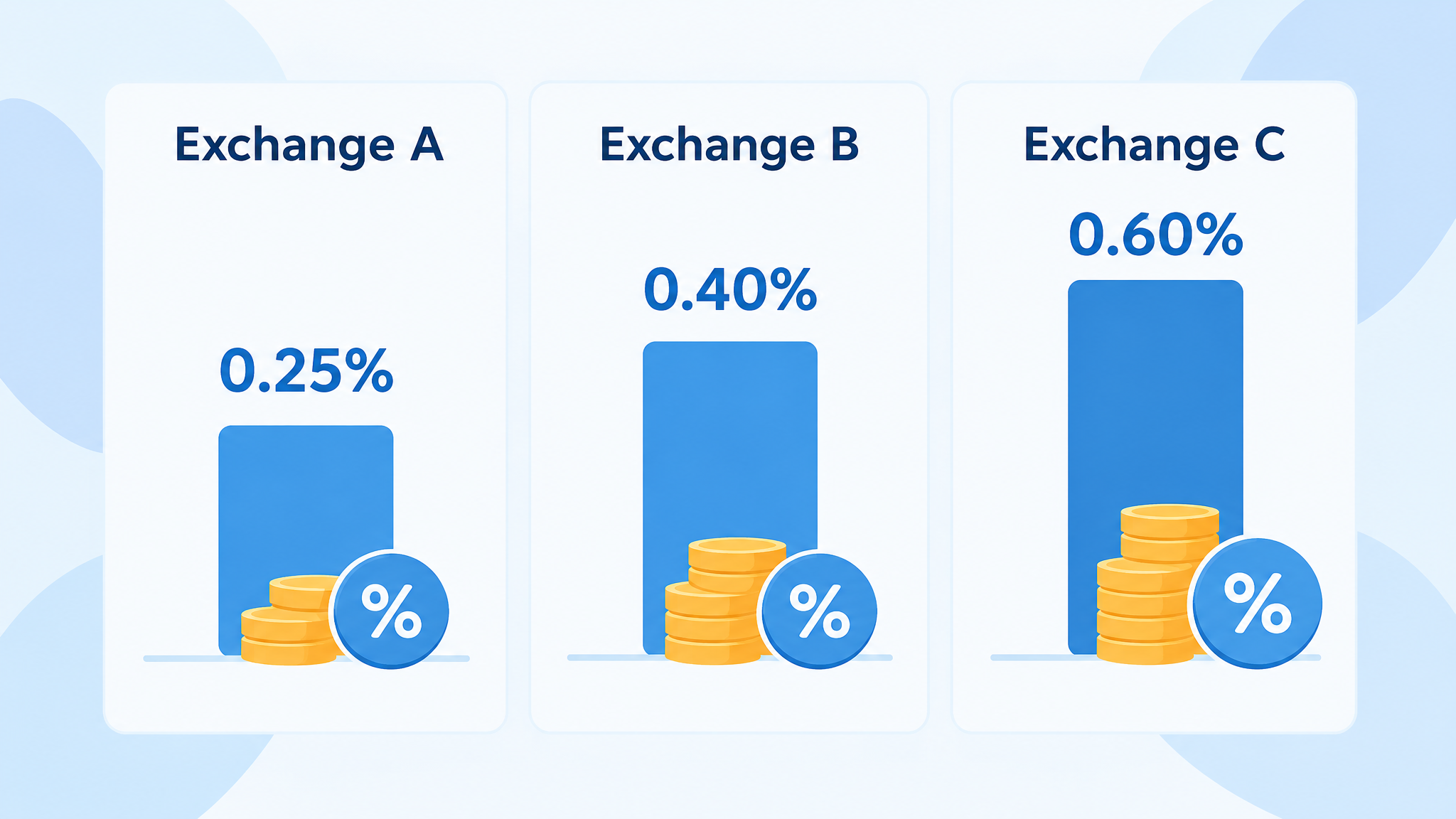
Fees are where most people make their decision — and where the marketing language gets slippery. Here's what you actually pay:
Coinbase Fees
The standard Coinbase app charges 0.8%–1.8% per trade depending on payment method and order size. That's expensive. The fix is switching to Coinbase Advanced Trade, which drops to a tiered maker/taker model starting around 0.40%–0.60% for low-volume users. Still not cheap, but far more reasonable. The lesson: never use the basic Coinbase interface for anything beyond tiny purchases.
Kraken Fees
Kraken standardized its fee structure in July 2026. On Kraken Pro, you're looking at 0.40% maker / 0.80% taker at the entry level, with fees dropping as your 30-day volume climbs. The instant buy feature on the standard app carries higher costs — same trap as Coinbase. Use the Pro interface. Kraken's fees are competitive for mid-volume traders and become genuinely attractive above $50K/month in volume.
Binance.US Fees
This is where Binance.US wins decisively: 0% maker / 0.01% taker on major pairs. For pure spot trading, nothing in the US market comes close. If you're buying and holding Bitcoin or Ethereum and want to minimize friction costs, Binance.US is the cheapest option by a wide margin.
One caveat: Binance.US doesn't offer staking, derivatives, or many of the "Earn" products available on Binance Global. You're paying less, but you're also getting less.
Security: The Track Record That Actually Matters
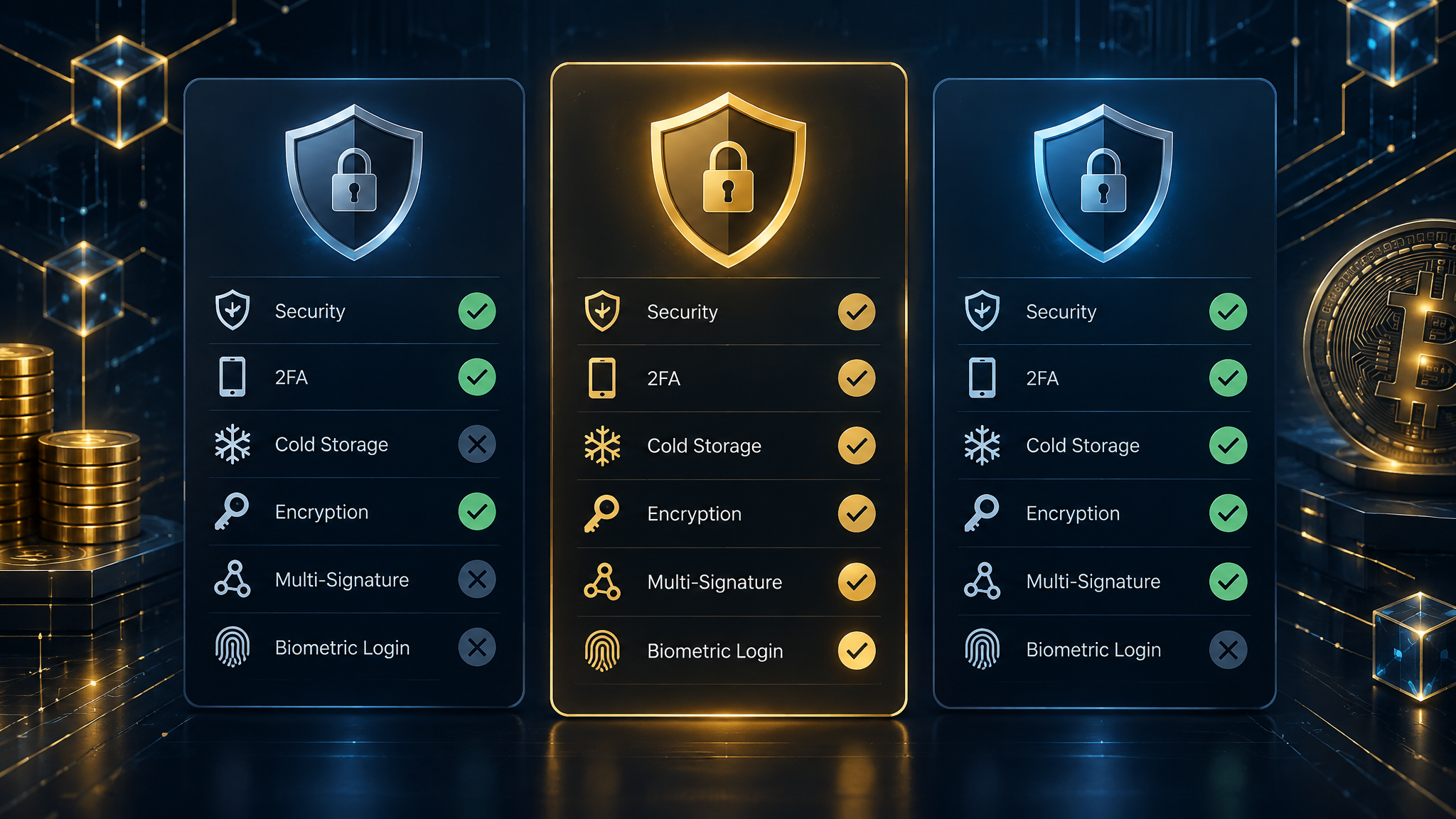
In crypto, security isn't just a feature — it's the whole ballgame. Exchanges have lost billions in user funds over the years. Here's how these three stack up:
Kraken's Security Edge
Kraken has operated since 2011 and has never suffered a major platform hack. That's 14+ years without a significant breach — an extraordinary record in an industry where exchange hacks are almost routine. It stores the vast majority of assets in air-gapped cold storage, runs regular third-party security audits, and offers individually verifiable Proof of Reserves. For security-first investors, Kraken is the clear winner.
Coinbase's Institutional Approach
Coinbase keeps approximately 98% of customer assets in cold storage and maintains crime insurance covering a portion of its hot wallet holdings. USD balances are FDIC-insured up to $250,000. As a public company, Coinbase also discloses its security practices in SEC filings — a level of accountability that private exchanges don't face. It's not as battle-tested as Kraken's 14-year clean record, but it's a serious, well-resourced operation.
Binance.US Security
Binance.US has implemented standard industry security measures — 2FA, cold storage, withdrawal whitelisting. Its smaller US footprint means it hasn't faced the same scale of attack attempts as the global Binance platform. That said, it doesn't publish Proof of Reserves with the same rigor as Kraken, and its track record is shorter. Adequate for most users, but not the security leader in this comparison.
Regardless of which exchange you use, keeping large holdings in a hardware wallet is smart practice. Protect your crypto assets with a Ledger hardware wallet — the gold standard in cold storage security.
Asset Selection and Trading Features
What's Available on Each Platform
Coinbase lists around 250+ cryptocurrencies, focusing on established projects with strong regulatory profiles. You won't find many obscure altcoins here, which is actually a feature for risk-averse investors. Coinbase also offers staking for ETH, SOL, ADA, and others, plus a "Learn and Earn" program that pays you small amounts of crypto for completing educational modules.
Kraken offers 300+ assets and arguably the best staking program among the three. ETH staking yields approximately 3.5%–4% APY, and Kraken supports flexible staking on many assets so you're not locked in. It also offers margin trading and regulated futures for eligible US users — features Coinbase doesn't match and Binance.US doesn't offer at all.
Binance.US lists around 150 assets — the smallest selection of the three. It's spot-only: no staking, no margin, no derivatives. If you want to do anything beyond buying and selling crypto, you'll need a different platform.
User Experience: Apps and Interfaces
Coinbase wins on onboarding. The app is genuinely beginner-friendly — clean design, clear navigation, and educational prompts that help new users understand what they're doing. The downside is that the simplicity comes at a cost (literally — higher fees on the basic interface).
Kraken's app has improved significantly in 2026 but still has a steeper learning curve. The Pro interface is powerful but can feel overwhelming if you're new to limit orders and order books. Give it a week and it becomes second nature.
Binance.US has a functional app that's straightforward for spot trading. Nothing flashy, but it gets the job done. The limited feature set actually makes it easier to navigate than the global Binance platform.
Staking Comparison: Earning Passive Income
If passive income from staking is part of your strategy, this section matters a lot.
- Kraken: ETH ~3.5–4% APY, SOL ~6–7%, flexible and bonded options available. Best staking program of the three.
- Coinbase: ETH ~3% APY, SOL ~4–5%, commission rates of 25–35% (meaning Coinbase keeps a significant cut of your rewards). Convenient but expensive.
- Binance.US: No staking available. Full stop.
For staking, Kraken is the clear winner — better rates, more assets, and more flexible terms than Coinbase. If staking is a priority, Binance.US isn't even in the conversation.
Want to accelerate your trading journey beyond just staking? Explore Icoinpro's daily trading signals and education platform — a structured way to develop real trading skills alongside your exchange account.
Customer Support: The Underrated Factor
Nobody thinks about customer support until they need it — and then it's all they think about.
Kraken consistently earns high marks for support quality. It offers 24/7 live chat and phone support, which is rare in crypto. Response times are generally fast, and the support team actually knows the product.
Coinbase support has improved but remains inconsistent. The volume of users means wait times can stretch during high-traffic periods. That said, the extensive help documentation and community forums cover most common issues.
Binance.US support is adequate for routine issues but has faced criticism for slow response times on complex account problems. Given its smaller team relative to the other two, this isn't surprising.
Which Exchange Should You Choose?
Here's the decision framework that actually works:
Choose Coinbase if: You're new to crypto, you want the most regulated and transparent US exchange, or you value a polished app experience over fee optimization. Just use Advanced Trade, not the basic interface.
Choose Kraken if: Security is your top priority, you want staking with competitive rates, or you're an active trader who needs margin and futures. Kraken's 14-year clean security record is genuinely hard to argue with.
Choose Binance.US if: You're a cost-focused spot trader in an eligible state, you're buying and holding major coins, and you don't need staking or advanced features. The fee advantage is real and meaningful for frequent traders.
Many experienced investors actually use two of these platforms — Kraken or Coinbase for staking and long-term holdings, Binance.US for cost-efficient spot trades. There's no rule that says you have to pick just one.
Key Takeaways
- Coinbase is the most beginner-friendly and regulatory-compliant US exchange, but fees on the basic app are high — always use Advanced Trade.
- Kraken has the strongest security track record (14+ years, no major breach), best staking rates, and most transparent Proof of Reserves program.
- Binance.US offers the lowest fees (0% maker / 0.01% taker) but is spot-only, available in only ~39 states, and lacks staking or derivatives.
- For most US investors, Kraken offers the best overall balance of security, features, and competitive pricing.
- Regardless of exchange, keep significant holdings in cold storage — a hardware wallet is non-negotiable for serious crypto investors.
Serious about security? The Trezor Model T offers top-tier security with an intuitive touchscreen interface — a solid complement to any exchange account.
Tools are only as good as the trader using them.
The best platform in the world won't help if your analysis is off. Before investing in more tools, consider investing in your trading education — it's the one thing that compounds everything else.
The program I recommend to people who ask me is this crypto trading course — it\'s the one I point friends and family to when they\'re serious about learning. Daily lessons, live analysis, and a community that actually helps.
Affiliate link — I may earn a commission at no extra cost to you. I only recommend what I genuinely use.
Disclaimer: The information provided on this website is for educational and informational purposes only. It should not be considered financial or investment advice. Cryptocurrency investments carry significant risk. Always do your own research and consult with a qualified financial advisor before making investment decisions.
Free Crypto Insights
Get weekly trading tips, market analysis, and exclusive strategies delivered to your inbox.