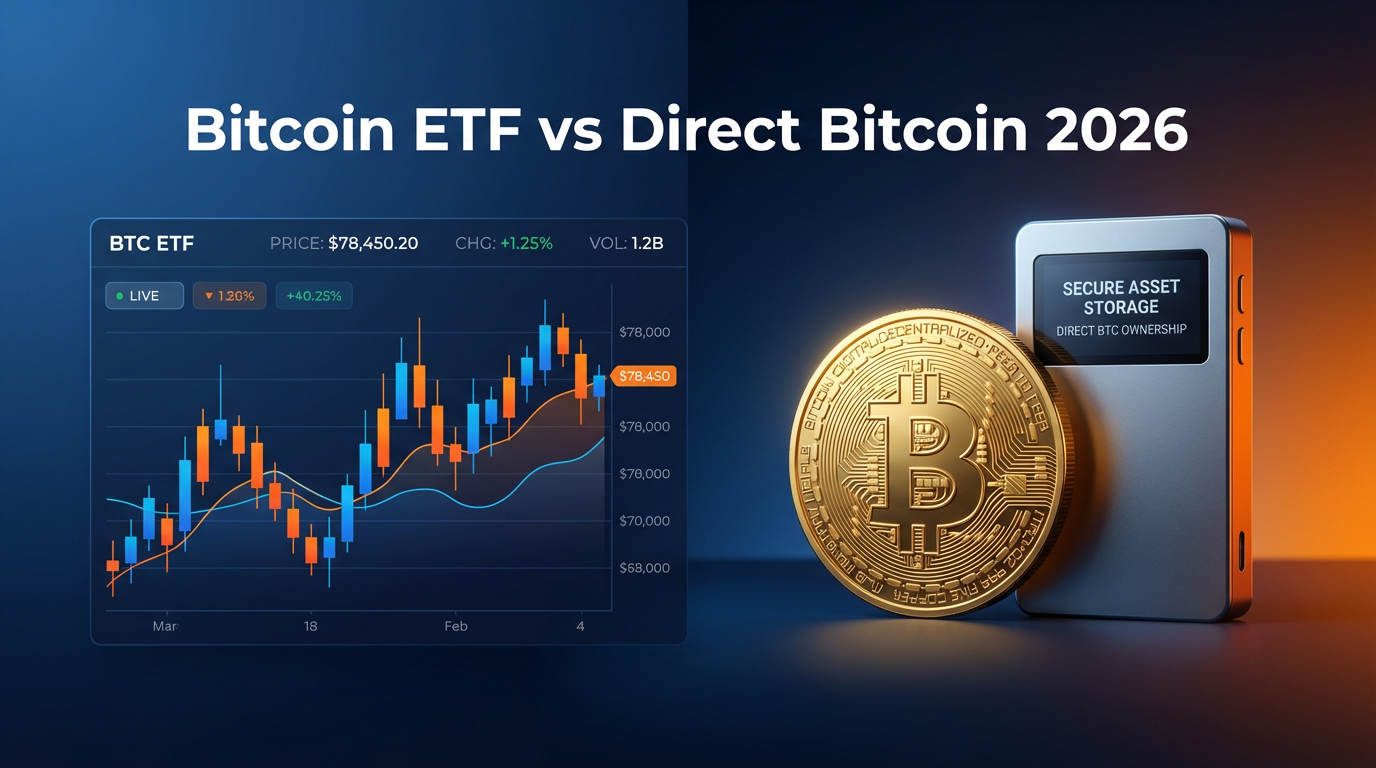
Bitcoin ETF vs Buying Bitcoin Directly: Which Is Right for You in 2026?
Affiliate Disclosure: This article may contain affiliate links. We may earn a commission at no extra cost to you. All opinions are our own.
Marcus Chen
Senior Crypto Analyst & Educator
Certified Blockchain Professional | Former Wall Street Analyst
Marcus Chen is a cryptocurrency analyst and educator with over 8 years of experience in digital asset trading. He has helped thousands of beginners navigate the crypto markets through practical, actionable education.
Disclaimer: This content is for informational purposes only and should not be considered financial advice. Cryptocurrency investments carry significant risk. Always do your own research (DYOR) before making any investment decisions.
This article contains affiliate links. We may earn a commission at no extra cost to you if you make a purchase through these links. See our affiliate disclosure for details.
Bitcoin ETF vs Buying Bitcoin Directly: Which Is Right for You in 2026?
The Bitcoin ETF vs direct ownership debate has sharpened considerably in 2026. With spot Bitcoin ETFs now firmly established in the US market and expense ratios as low as 0.14% for IBIT, the ETF route has never been more accessible. But direct Bitcoin ownership still offers advantages that no ETF can replicate — 24/7 trading, on-chain utility, and zero ongoing management fees. Here’s how to think through the decision.
Fee Structures: The Long-Term Math
This is where most people start — and where the comparison gets interesting.
Bitcoin ETFs charge an annual expense ratio. Major funds in August 2026:
- IBIT (BlackRock): 0.25% (0.12% for first $5B / first year, now at standard rate)
- FBTC (Fidelity): 0.25%
- ARKB (ARK/21Shares): 0.21%
- BITB (Bitwise): 0.20%
On a $50,000 position at 0.25%, that’s $125/year in fees. Over five years, assuming flat prices, you’ve paid $625 in management fees. The fees compound against you as the position grows.
Direct Bitcoin has no ongoing fees. You pay a one-time trading commission (0.16%–1%+ depending on the platform) and potentially a hardware wallet cost ($79–$249). After that, holding is free forever.
For long-term holders, direct ownership wins on cost. For frequent traders or small positions where brokerage commissions are zero, ETFs can be cheaper.
Custody and Security
ETF custody: Coinbase Custody holds the underlying Bitcoin for the majority of US spot ETFs. Your brokerage shares are covered by SIPC insurance up to $500,000. You don’t manage private keys — but you also don’t control the underlying asset.
Direct custody: You control your private keys. A hardware wallet like the Ledger Nano X keeps your keys offline and safe from exchange hacks. The tradeoff: lose your recovery phrase and your Bitcoin is gone permanently.
Tax Treatment: A Critical Difference
This is where the ETF route has a genuine structural advantage for retirement investors:
- Bitcoin ETFs can be held in standard IRAs, Roth IRAs, and 401(k) plans. Tax-advantaged or tax-free growth, depending on account type.
- Direct Bitcoin is not supported in standard retirement accounts. Self-directed IRAs can hold it, but they’re more complex and expensive to set up.
- Wash sale rules: Direct Bitcoin is currently treated as property by the IRS, so wash sale rules don’t apply — you can sell at a loss and immediately rebuy. ETF shares are securities and likely subject to wash sale rules.
Trading Hours and Flexibility
Bitcoin trades 24/7/365. ETFs trade Monday–Friday, 9:30 AM–4:00 PM ET. This creates real “gap risk” for ETF holders — if Bitcoin drops 15% on a Saturday, you can’t sell until Monday morning. Direct holders can react immediately.
On-Chain Utility: ETFs Can’t Compete Here
Direct Bitcoin lets you:
- Make Lightning Network payments
- Use BTCFi protocols for yield
- Transfer to any wallet globally, instantly
- Participate in Bitcoin-native DeFi
ETF shares are purely financial instruments. You get price exposure and nothing else.
For a deeper look at Bitcoin-native yield strategies, see our guide on BTCFi yield strategies in 2026.
The Hybrid Strategy Most Investors Use
Many experienced investors split the difference: ETFs in tax-advantaged retirement accounts for long-term passive growth, direct Bitcoin in a hardware wallet for flexibility, spending, and sovereign control. This captures the tax benefits of ETFs while preserving the utility and cost efficiency of direct ownership.
FAQ: Bitcoin ETF vs Direct Bitcoin 2026
Q: Which Bitcoin ETF has the lowest fees in 2026?
A: BITB (Bitwise) at 0.20% and ARKB at 0.21% are among the lowest. IBIT and FBTC are at 0.25%.
Q: Can I hold a Bitcoin ETF in my Roth IRA?
A: Yes. Bitcoin ETFs can be held in standard Roth IRAs through most major brokerages, allowing tax-free growth.
Q: Do Bitcoin ETFs pay dividends?
A: No. Bitcoin ETFs track the price of Bitcoin and do not generate income or pay dividends.
Q: What happens to my ETF shares if the fund closes?
A: The fund would liquidate its Bitcoin holdings and return cash to shareholders. You’d receive the NAV at the time of liquidation.
Q: Is direct Bitcoin subject to wash sale rules?
A: Currently no — the IRS treats Bitcoin as property, not a security. This may change with future legislation, so monitor tax law updates.
Actionable Takeaways
- Bitcoin ETFs (IBIT, FBTC) charge 0.20–0.25% annually — direct ownership has no ongoing fees.
- ETFs win for retirement accounts (IRA/Roth IRA/401k) and investors who want zero custody responsibility.
- Direct Bitcoin wins for long-term holders, on-chain utility, 24/7 trading, and wash sale tax flexibility.
- The hybrid approach — ETF in retirement accounts, direct Bitcoin in cold storage — is what most sophisticated investors use.
- Never store significant direct Bitcoin holdings on an exchange. Use a hardware wallet.
Want to understand the deeper economics of Bitcoin before deciding? The Bitcoin Standard is essential reading for every serious crypto investor.
The Institutional Custody Question
One detail that rarely gets discussed: the majority of US spot Bitcoin ETFs use Coinbase Custody as their custodian. BlackRock’s IBIT, Fidelity’s FBTC, ARK’s ARKB — most of them rely on Coinbase’s institutional custody infrastructure. This creates a concentration risk that’s easy to overlook. If Coinbase Custody experienced a catastrophic failure, multiple ETFs would be affected simultaneously.
This isn’t a reason to avoid ETFs — Coinbase Custody is one of the most secure institutional custodians in the world — but it’s worth understanding the systemic dependency before assuming ETFs are risk-free.
Bitcoin ETF Flows as a Market Signal
One underappreciated benefit of Bitcoin ETFs is the transparency of their daily flow data. When institutional money is flowing into IBIT and FBTC, it’s a bullish signal. When outflows accelerate, it often precedes or accompanies price corrections. Direct Bitcoin holders don’t have this institutional flow data as a signal — ETF holders can use it as a market intelligence tool.
For a deeper look at how ETF flows have moved markets in 2026, see our analysis of Bitcoin ETF outflows in June 2026.
Practical Decision Framework
Here’s a simple framework for deciding which approach fits your situation:
- Choose ETF if: You want exposure in a retirement account, you’re not comfortable managing private keys, or you’re investing less than $5,000 where hardware wallet costs are proportionally significant.
- Choose direct Bitcoin if: You’re a long-term holder (5+ years), you want on-chain utility, you’re comfortable with self-custody, or you want to avoid ongoing management fees on a large position.
- Choose both if: You have a retirement account where ETFs make sense AND a long-term holding you want full sovereignty over.
There’s no universally correct answer. The right choice depends on your tax situation, technical comfort level, investment horizon, and how you plan to use the asset.
Knowing what to buy is one thing. Knowing when — that's the skill.
I've watched people hold great coins and still lose money because their entries and exits were off. Structured trading education changed how I approach every position.
The program I recommend to people who ask me is this crypto trading course — it\'s the one I point friends and family to when they\'re serious about learning. Daily lessons, live analysis, and a community that actually helps.
Affiliate link — I may earn a commission at no extra cost to you. I only recommend what I genuinely use.
Disclaimer: The information provided on this website is for educational and informational purposes only. It should not be considered financial or investment advice. Cryptocurrency investments carry significant risk. Always do your own research and consult with a qualified financial advisor before making investment decisions.
Free Crypto Insights
Get weekly trading tips, market analysis, and exclusive strategies delivered to your inbox.