Solana vs Ethereum 2026: Which Blockchain Should You Invest In?
Affiliate Disclosure: This article may contain affiliate links. We may earn a commission at no extra cost to you. All opinions are our own.
Marcus Chen
Senior Crypto Analyst & Educator
Certified Blockchain Professional | Former Wall Street Analyst
Marcus Chen is a cryptocurrency analyst and educator with over 8 years of experience in digital asset trading. He has helped thousands of beginners navigate the crypto markets through practical, actionable education.
Solana vs Ethereum 2026: Which Blockchain Should You Invest In?
The Solana vs Ethereum 2026 debate has never been more relevant — or more heated. Both blockchains are posting impressive numbers, attracting institutional money, and launching major upgrades. But they're built on fundamentally different philosophies, and that matters enormously when you're deciding where to put your capital. One is the established giant with $55 billion locked in DeFi. The other is the scrappy speed demon processing more DEX volume than its rival. So which one actually belongs in your portfolio?
Let's cut through the noise and look at what actually matters in 2026.
The Core Difference: Speed vs. Security
Strip away the marketing and you're left with a fundamental architectural choice. Ethereum chose decentralization and security first — it has over 700,000 validators and a battle-tested track record going back to 2015. Solana chose raw performance first, running a monolithic architecture that processes transactions at blistering speed but requires more powerful hardware from validators (currently around 800–1,500 of them).
Neither approach is wrong. They're just optimized for different things. Ethereum is the Swiss bank vault — slow, deliberate, and trusted with enormous sums. Solana is the high-frequency trading floor — fast, efficient, and built for volume. Understanding this distinction is the foundation of any honest comparison.
In October 2026, both networks are undergoing significant technical transitions. Ethereum's Glamsterdam hard fork — featuring EIP-7732 (Enshrined Proposer-Builder Separation) and EIP-7928 (Block-Level Access Lists) — aims to raise the gas limit from 60 million to 200 million per block. The Sepolia testnet activated on October 6, 2026. Meanwhile, Solana's Alpenglow upgrade introduces "Votor," a consensus mechanism that moves validator voting off-chain, freeing up ~70% of block space for user transactions and targeting economic finality of 100–150 milliseconds.
Transaction Fees and Speed: A Clear Winner
On raw numbers, Solana wins this round decisively. But context matters.
Solana's Near-Zero Fees
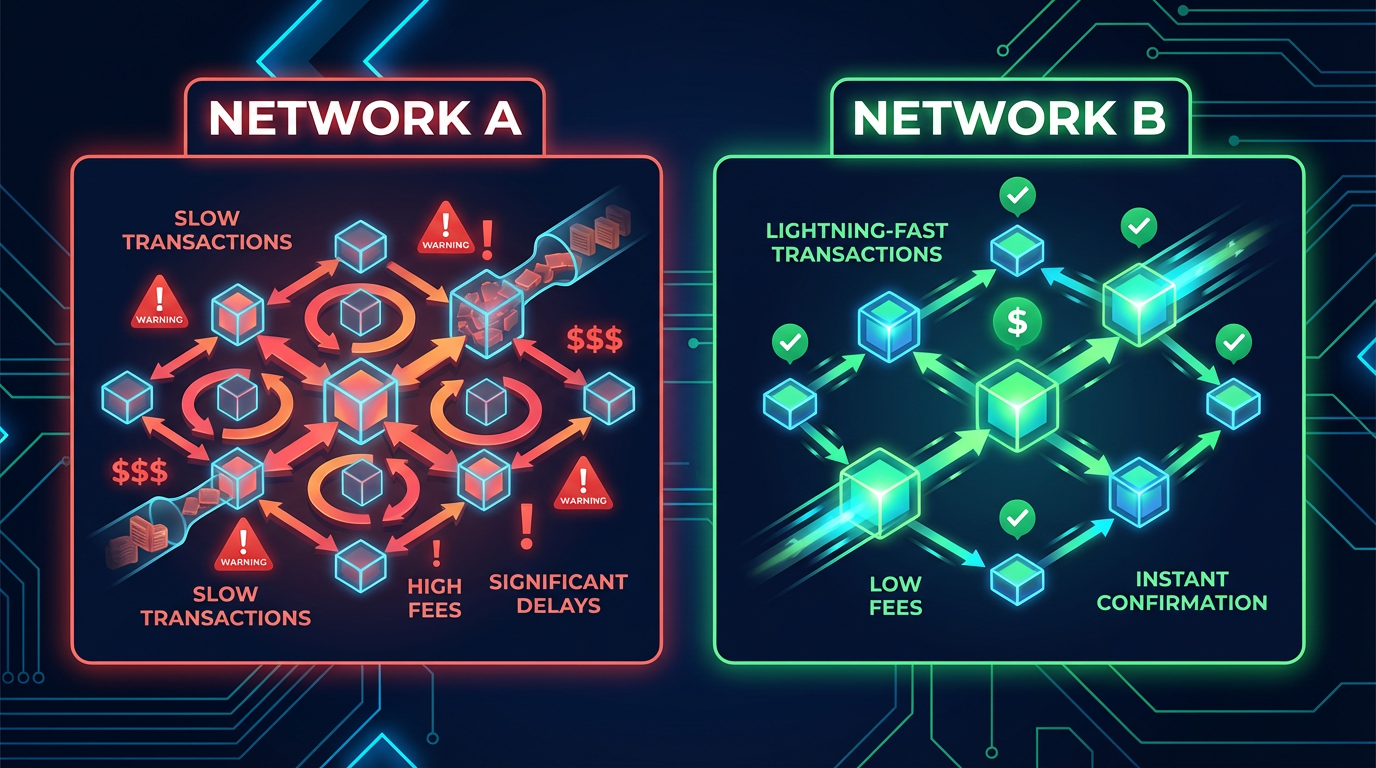
Solana transactions average around $0.00025 — that's a quarter of a cent. Even during network congestion, fees rarely exceed $0.01. This makes micro-transactions, high-frequency trading, and retail DeFi genuinely economical. If you're swapping tokens 50 times a day or minting NFTs in bulk, Solana's fee structure is a game-changer.
The Alpenglow upgrade is targeting sub-second settlement speeds with block times of 400ms and real-world throughput of 3,000–5,000 TPS. Once Agave 4.3 hits mainnet, those numbers should improve further. Solana now processes over 50% of global DEX volume — a remarkable achievement for a network that was written off after its 2022 outages.
Ethereum's Layer 2 Workaround
Ethereum mainnet still costs $0.10–$0.30 for simple transfers, spiking during peak demand. The answer? Layer 2 networks like Arbitrum, Optimism, and Base, which bring fees down significantly. The Glamsterdam upgrade's parallel execution improvements should reduce mainnet fee pressure further once it activates.
The catch: L2s fragment liquidity. You're not on "Ethereum" anymore — you're on Arbitrum, which is a different environment with its own bridges and quirks. For users who just want cheap, fast transactions, this adds friction. For institutions moving large sums where gas fees are irrelevant, Ethereum mainnet's security is worth every penny.
Ready to master crypto trading? Check out Icoinpro's comprehensive trading course.
DeFi and Ecosystem: Where the Money Lives
This is where the comparison gets genuinely interesting — because the two chains are winning in different ways.
Ethereum's TVL Dominance
Ethereum holds the lion's share of DeFi Total Value Locked, representing roughly 68% of the entire DeFi market. Its stablecoin base dwarfs every competitor. Protocols like Aave, Uniswap, and MakerDAO have been running on Ethereum for years, accumulating deep liquidity and institutional trust.
BlackRock, JPMorgan, and Franklin Templeton are all building real-world asset tokenization projects on Ethereum. That's not a coincidence. When you're tokenizing billions in Treasury bonds, you want the most battle-tested, regulated-friendly blockchain available. Ethereum holds the majority of all USDC supply — the stablecoin that powers much of institutional DeFi.
Protect your crypto assets with a Ledger hardware wallet — the gold standard in cold storage security.
Solana's DEX Volume Surge
Here's the plot twist: Solana is actually beating Ethereum on DEX trading volume. Solana now processes over 50% of global DEX volume, driven by retail-heavy applications, memecoins, and gaming. Near-zero fees enable high-frequency retail trading that simply isn't economical on Ethereum mainnet.
The ecosystem's TVL is smaller than Ethereum's, but the velocity of capital is remarkable. Solana's developer community is smaller (roughly 17,700 active developers vs Ethereum's 20,000+) but growing rapidly, attracted by its performance-oriented toolkit and Rust-based environment.
Developer Activity and Ecosystem Growth
Ethereum has the largest developer pool and the most mature tooling. Solana's developer count grew significantly year-over-year — that's the kind of momentum that reshapes ecosystems over time.
The tooling difference matters too. Ethereum developers use Solidity, which is similar to JavaScript and has a massive talent pool. Solana uses Rust, which has a steeper learning curve but attracts systems programmers who care deeply about performance. Both communities are passionate and productive — they're just building different things.
Ethereum's ecosystem depth is unmatched for complex financial applications. Solana's ecosystem is better suited for consumer-facing apps, gaming, DePIN (Decentralized Physical Infrastructure Networks), and anything requiring high transaction throughput. The Alpenglow upgrade's off-chain voting mechanism is a particularly clever innovation — freeing up block space for actual user transactions rather than validator overhead.
Investment Case: ETH vs SOL in 2026
Now for the question most readers actually care about: which one makes more sense to buy?
Ethereum as the Blue-Chip Bet
Ethereum's investment thesis is straightforward: it's the settlement layer for institutional DeFi, real-world asset tokenization, and the broader crypto economy. The Glamsterdam upgrade — with its Sepolia testnet activation on October 6, 2026 — is a major catalyst. If the gas limit increase to 200 million per block succeeds, Ethereum's throughput improves dramatically without sacrificing decentralization.
The risk? Ethereum's L2 strategy may dilute ETH's value capture. If most activity happens on Arbitrum or Base, the demand for ETH as gas on mainnet decreases. The Ethereum Economic Zone initiative aims to address this by enabling synchronous calls across rollups, but it's still a work in progress.
Solana's High-Growth Upside
Solana's smaller market cap means a given dollar of new investment moves the price more. The Alpenglow upgrade targeting 100–150ms finality would make Solana genuinely competitive for payment applications and enterprise use cases — markets Ethereum currently dominates. Institutional interest is clearly building, with major financial firms filing for Solana ETF products.
The risks are also real. Solana's validator centralization — requiring high-spec hardware — is a genuine decentralization concern. And its revenue is heavily tied to meme coin trading volume, which can evaporate quickly in a bear market.
Want to understand the economics behind Bitcoin? The Bitcoin Standard is essential reading for every crypto enthusiast.
Which One Should You Buy?
The honest answer: it depends on your goals and risk tolerance. Here's a simple framework:
- Buy ETH if: You want institutional-grade exposure to the DeFi ecosystem, you're investing $10,000+ and want deep liquidity, or you believe real-world asset tokenization is the next big wave.
- Buy SOL if: You're comfortable with higher volatility for higher upside, you believe in the consumer crypto thesis (gaming, payments, retail DeFi), or you want asymmetric exposure to a fast-growing ecosystem.
- Buy both if: You want diversified exposure to the smart contract layer without betting on a single winner. Many experienced crypto investors hold both — ETH as the anchor, SOL as the growth position.
One thing both camps agree on: store whatever you buy securely. A quality hardware wallet offers top-tier security and supports both ETH and SOL.
Final Verdict
Solana vs Ethereum 2026 isn't a zero-sum game. These two blockchains have carved out distinct niches — Ethereum as the institutional liquidity vault, Solana as the high-performance trading engine. The data backs this up: Ethereum dominates TVL and stablecoin settlement; Solana dominates DEX volume and user growth metrics.
For investors, the smarter question isn't "which one wins?" but "which one fits my strategy?" Ethereum offers stability and institutional credibility. Solana offers speed, growth, and asymmetric upside. Both have real risks. Both have real catalysts in Q4 2026 — Glamsterdam for Ethereum, Alpenglow for Solana.
Do your research, size your positions appropriately, and — whatever you decide — keep your private keys offline.
Key Takeaways
- Solana processes 3,000–5,000 TPS at $0.00025/tx; Ethereum mainnet fees range $0.10–$0.30 (L2s reduce this significantly)
- Ethereum holds ~68% of DeFi TVL market share; Solana leads in DEX volume with 50%+ of global activity
- Ethereum's Glamsterdam upgrade (Sepolia testnet Oct 6, 2026) targets 200M gas/block; Solana's Alpenglow targets 100–150ms finality
- Ethereum has 20,000+ active developers; Solana has ~17,700 with strong growth momentum
- Many experienced investors hold both for diversified smart-contract exposure
October 2026 Update: Ethereum's Glamsterdam hard fork (EIP-7732 + EIP-7928) activated on Sepolia testnet October 6, 2026, targeting a gas limit increase from 60M to 200M per block. Solana's Alpenglow upgrade introduces off-chain validator voting ("Votor") targeting 100–150ms economic finality. Solana now processes 50%+ of global DEX volume. Both networks are at critical technical inflection points heading into Q4 2026.
Frequently Asked Questions: Solana vs Ethereum 2026
Q: What is Ethereum's Glamsterdam upgrade?
Glamsterdam is Ethereum's Q4 2026 hard fork featuring EIP-7732 (Enshrined Proposer-Builder Separation) and EIP-7928 (Block-Level Access Lists). It aims to raise the block gas limit from 60 million to 200 million, enabling parallel execution and dramatically improved throughput. The Sepolia testnet activated on October 6, 2026.
Q: What is Solana's Alpenglow upgrade?
Alpenglow replaces Solana's consensus layer with "Votor," which moves validator voting off-chain to free up ~70% of block space for user transactions. This targets economic finality of 100–150 milliseconds — down from the current 12.8 seconds. Mainnet activation is targeted for the Agave 4.3 release.
Q: Which blockchain is better for DeFi in 2026?
Ethereum dominates high-value DeFi with the majority of global TVL and battle-tested protocols. Solana leads in DEX volume (50%+ of global DEX activity) and is preferred for high-frequency trading applications. For most retail DeFi users, Solana's lower fees make it more practical for everyday use.
Q: How does Solana's validator count compare to Ethereum's?
Ethereum has over 700,000 validators, making it the most decentralized proof-of-stake network. Solana operates with approximately 800–1,500 validators, prioritizing performance and low-latency execution. This centralization trade-off is a genuine concern for some institutional investors.
Q: Should I hold both ETH and SOL?
Many experienced crypto investors hold both — ETH as the institutional anchor and SOL as the higher-growth position. This gives diversified exposure to the smart contract layer without betting on a single winner. Check our Best Crypto Research Tools guide to track both in real time.
Knowing what to buy is one thing. Knowing when — that's the skill.
I've watched people hold great coins and still lose money because their entries and exits were off. Structured trading education changed how I approach every position.
The program I recommend to people who ask me is this crypto trading course — it\'s the one I point friends and family to when they\'re serious about learning. Daily lessons, live analysis, and a community that actually helps.
Affiliate link — I may earn a commission at no extra cost to you. I only recommend what I genuinely use.
Disclaimer: The information provided on this website is for educational and informational purposes only. It should not be considered financial or investment advice. Cryptocurrency investments carry significant risk. Always do your own research and consult with a qualified financial advisor before making investment decisions.
Free Crypto Insights
Get weekly trading tips, market analysis, and exclusive strategies delivered to your inbox.