Coinbase vs Robinhood Crypto 2026: Which Platform Should You Use?
Affiliate Disclosure: This article may contain affiliate links. We may earn a commission at no extra cost to you. All opinions are our own.
Marcus Chen
Senior Crypto Analyst & Educator
Certified Blockchain Professional | Former Wall Street Analyst
Marcus Chen is a cryptocurrency analyst and educator with over 8 years of experience in digital asset trading. He has helped thousands of beginners navigate the crypto markets through practical, actionable education.

This article contains affiliate links. We may earn a commission at no extra cost to you if you make a purchase through these links. See our affiliate disclosure for details.
Coinbase vs Robinhood Crypto 2026: Which Platform Should You Use?
The Coinbase vs Robinhood debate is one of the most common questions new crypto investors ask in 2026 — and the answer isn't as obvious as you'd think. Both platforms are legitimate, regulated, and beginner-friendly. But they're built for very different types of crypto users. Coinbase is a crypto-native exchange with hundreds of assets, robust staking, and DeFi integration. Robinhood is a multi-asset brokerage that added crypto as a feature — and has been quietly improving it ever since.
I've used both platforms extensively. Here's the honest breakdown of where each one wins, where it falls short, and which one actually fits your situation in 2026.
Quick Verdict: Who Should Use Which Platform?
Before diving into the details, here's the short version:
- Choose Coinbase if you want access to hundreds of altcoins, serious staking yields, DeFi wallet integration, or you're building a dedicated crypto portfolio.
- Choose Robinhood if you already invest in stocks and ETFs there, want a simple all-in-one app, and mainly trade Bitcoin, Ethereum, or a handful of major coins.
Neither platform is objectively "better." They serve different needs. Let's break down exactly why.
Trading Fees: The Real Cost of Each Platform
This is where things get interesting — and a little confusing. Both platforms advertise low costs, but the actual fee structure is more nuanced.
Robinhood's Fee Structure
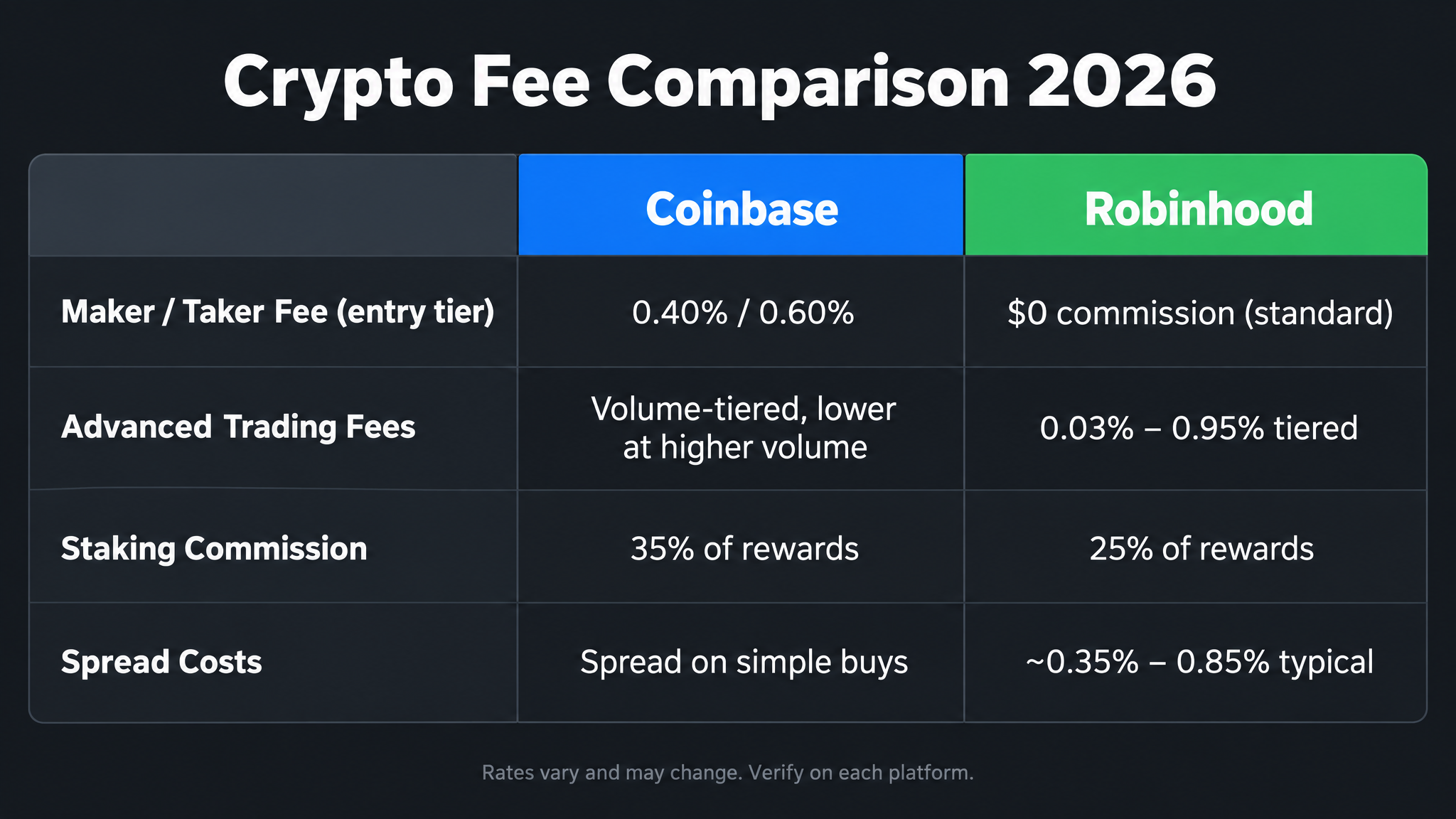
Robinhood markets itself as commission-free, which is technically true for its default routing. But "commission-free" doesn't mean "cost-free." The platform earns revenue through spreads — the gap between the price you see and the actual market price. For casual buyers making small purchases, this spread is usually manageable. For larger trades, it adds up.
If you use Robinhood's Exchange Routing (available to more active traders), you'll see actual maker-taker fees. Entry-level taker fees run around 0.95% for low-volume accounts. That's actually higher than Coinbase Advanced for frequent traders.
Coinbase's Fee Structure
Coinbase has two modes. The simple "buy" interface charges a spread plus a variable transaction fee — often 1.5% to 2.5% for small purchases. That's expensive. But Coinbase Advanced (formerly Coinbase Pro) uses a transparent maker-taker model starting at 0.40% maker / 0.60% taker, dropping significantly as your volume increases.
Bottom line: for small, occasional purchases, Robinhood's spread-based model is often cheaper. For active traders doing $10,000+ monthly volume, Coinbase Advanced wins on fees.
Staking: Earning Passive Income on Your Crypto
Both platforms offer staking, but there's a meaningful difference in cost and selection.
Robinhood Staking
Robinhood supports staking for Ethereum (ETH), Solana (SOL), and Cardano (ADA). You can start with as little as $1 worth of crypto. The platform charges a 25% commission on your staking rewards — so if the protocol pays 5% APY, you'd net roughly 3.75% after Robinhood's cut. That's actually a better deal than Coinbase's standard rate.
Coinbase Staking
Coinbase offers a wider range of stakeable assets — ETH, SOL, ADA, and several others. The standard commission is 35% on rewards, though Coinbase One subscribers get a reduced rate. If you're staking significant amounts, that 10-percentage-point difference in commission between the two platforms matters.
For staking specifically, Robinhood's lower commission gives it an edge — assuming you're staking one of the three assets it supports. If you want to stake less common assets, Coinbase is your only option of the two.
Asset Selection: 30 Coins vs 400+ Coins
This is the biggest practical difference between the two platforms.
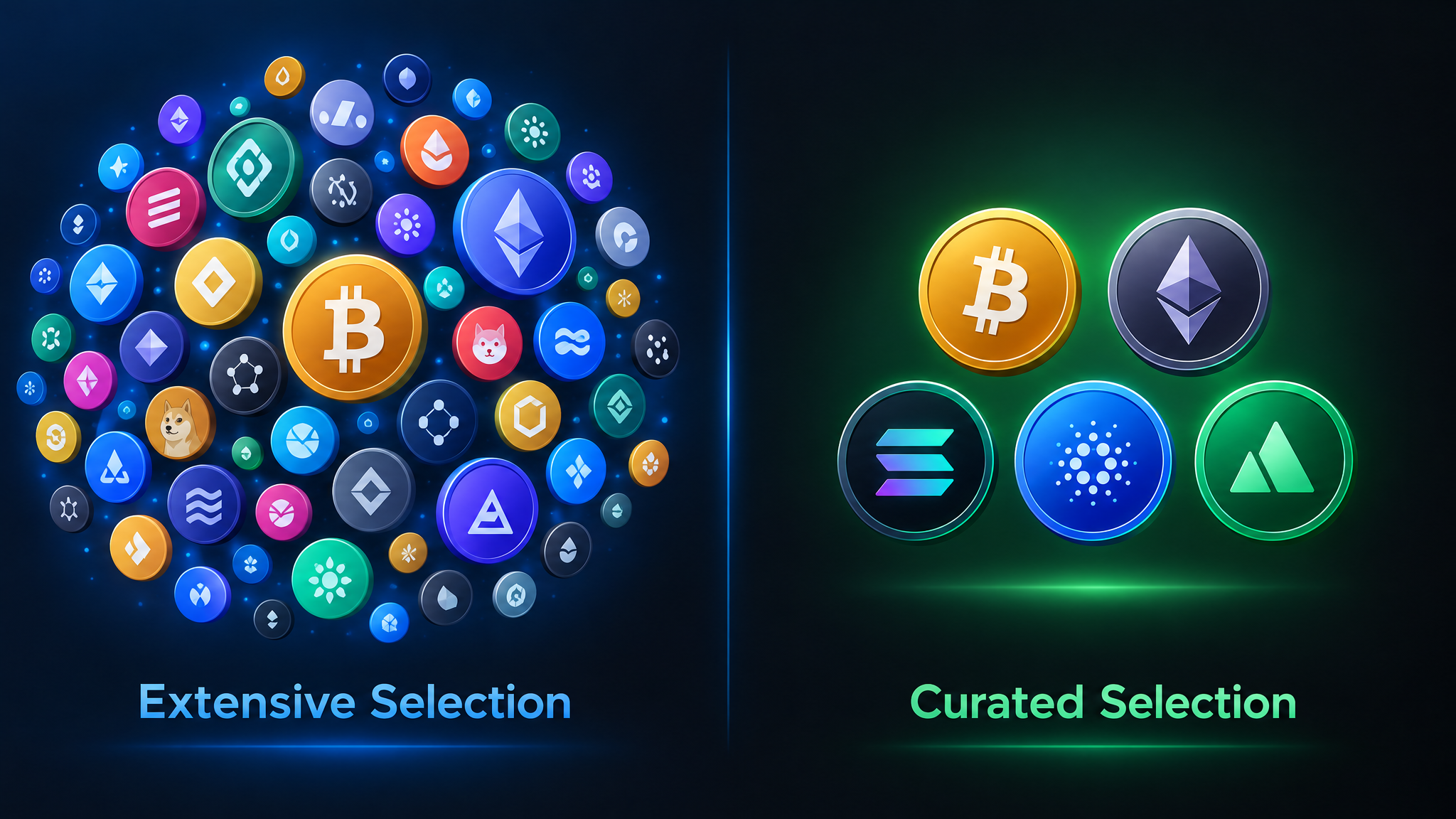
Robinhood offers roughly 30 to 90 cryptocurrencies depending on your region — primarily the major, high-liquidity assets: Bitcoin, Ethereum, Solana, Dogecoin, Cardano, Polygon, and similar. If you're focused on blue-chip crypto, that's probably enough.
Coinbase lists 250 to 400+ assets, including mid-cap altcoins, DeFi tokens, and newer projects. If you want exposure to emerging Layer 2 tokens, DeFi protocols, or anything beyond the top 20 by market cap, Coinbase is the only option of the two.
Platform Experience: All-in-One vs Crypto-First
Robinhood: The Unified Brokerage
Robinhood's biggest advantage is integration. If you already use it for stocks, ETFs, or options, adding crypto to your portfolio is seamless. One app, one account, one tax form. For investors who think of crypto as one piece of a broader portfolio — not their entire financial life — this convenience is genuinely valuable.
The interface is clean and intuitive. Buying Bitcoin on Robinhood takes about 30 seconds. There's no learning curve, no confusing order types, no overwhelming dashboard. That simplicity is by design.
The tradeoff: Robinhood lacks advanced crypto tools. No stop-loss orders for crypto, no limit orders on the simple interface, no DeFi integration, no NFT marketplace. It's built for buy-and-hold investors, not active traders.
Coinbase: The Crypto Ecosystem
Coinbase is built from the ground up for crypto. Beyond trading, it offers Coinbase Wallet (a self-custody DeFi wallet), integration with the Base Layer-2 network, staking, an NFT marketplace, and Coinbase One (a subscription that reduces fees and provides staking benefits).
Coinbase Advanced gives you real order books, charting tools, API access, and professional-grade execution. If you're serious about crypto trading — not just holding — Coinbase has the infrastructure for it.
The downside: Coinbase is crypto-only. You can't manage your stock portfolio here. And the simple interface's fees are genuinely high for small purchases.
Security and Custody: How Safe Is Your Crypto?
Both platforms are regulated, established companies with strong security track records. Here's how they compare:
Coinbase is a publicly traded company (NASDAQ: COIN), which means SEC-audited financials and a high level of institutional accountability. It stores the majority of customer assets in cold storage and offers Coinbase Wallet for users who want full self-custody. It has not suffered a major hack of customer funds.
Robinhood also uses cold storage for most crypto assets and provides a self-custody wallet option (Robinhood Wallet) for on-chain transfers. It's regulated as a broker-dealer and has crime insurance covering a portion of assets against theft or cybersecurity breaches.
Important note for both: crypto holdings are not FDIC or SIPC insured. If either platform were to fail catastrophically, your crypto could be at risk. This is why serious long-term holders often move assets to a hardware wallet after purchase.
Protect your crypto assets with a Ledger hardware wallet — the gold standard in cold storage security.
Robinhood's 2026 Improvements: Closing the Gap
Robinhood has made meaningful strides in crypto over the past two years. The Bitstamp acquisition expanded its institutional infrastructure. MiCA compliance efforts opened European markets. The Robinhood Wallet now supports on-chain transfers to external wallets and hardware devices.
It's no longer accurate to dismiss Robinhood as a "toy" crypto platform. For mainstream investors who want simple, regulated crypto exposure alongside their stock portfolio, it's a legitimate choice in 2026.
That said, it still lags Coinbase on asset variety, staking breadth, and DeFi integration. The gap has narrowed, but it hasn't closed.
Tax Reporting: A Practical Consideration
Both platforms generate tax forms for crypto transactions. Robinhood's advantage here is consolidation — if you trade stocks and crypto on the same platform, you get one 1099 form covering everything. That simplifies tax season considerably.
Coinbase generates a separate 1099-DA for crypto transactions. If you also use Coinbase Wallet for DeFi activity, you'll need crypto tax software to track those on-chain transactions separately.
For investors who want to minimize tax complexity, Robinhood's unified reporting is a genuine convenience. For those doing complex DeFi strategies, you'll need dedicated crypto tax tools regardless of which exchange you use.
Which Platform Wins for Beginners?
Honestly? Both are fine for beginners. But they're fine in different ways.
If you're a complete newcomer to investing and want to start with crypto alongside stocks, Robinhood's unified interface removes friction. You don't need to learn a new platform — just add crypto to what you're already doing.
If you're new to investing but crypto is your primary focus, Coinbase's educational resources (Coinbase Earn, Learn section) and broader ecosystem make it the better starting point. You'll have room to grow into more advanced features as your knowledge develops.
Want to accelerate your trading journey? Explore Icoinpro's daily trading signals and education platform — a structured way to build real crypto trading skills.
Side-by-Side Comparison Summary
| Feature | Coinbase | Robinhood |
|---|---|---|
| Crypto Assets | 250–400+ | ~30–90 |
| Advanced Trading Fees | 0.40% maker / 0.60% taker | Spread-based (0.95% taker routed) |
| Staking Commission | 35% (25% with Coinbase One) | 25% |
| Stocks & ETFs | No | Yes |
| DeFi Wallet | Yes (Coinbase Wallet) | Limited (Robinhood Wallet) |
| Self-Custody Option | Yes | Yes |
| Best For | Dedicated crypto investors | Multi-asset retail investors |
Key Takeaways
- Fees: Robinhood is cheaper for small casual buys; Coinbase Advanced wins for high-volume active trading.
- Staking: Robinhood's 25% commission beats Coinbase's standard 35% — but Coinbase offers more stakeable assets.
- Asset variety: Coinbase wins decisively with 250–400+ coins vs Robinhood's curated ~30–90.
- Convenience: Robinhood wins if you already use it for stocks — one app, one tax form.
- DeFi & advanced crypto: Coinbase is the clear choice for anyone going beyond basic buy-and-hold.
- Security: Both are solid. Neither is a substitute for a hardware wallet for large holdings.
The Trezor Model T offers top-tier security with an intuitive touchscreen interface — worth considering if you're holding significant crypto on either platform.
Disclaimer: This content is for informational purposes only and should not be considered financial advice. Cryptocurrency investments carry significant risk. Always do your own research (DYOR) before making any investment decisions.
Tools are only as good as the trader using them.
The best platform in the world won't help if your analysis is off. Before investing in more tools, consider investing in your trading education — it's the one thing that compounds everything else.
The program I recommend to people who ask me is this crypto trading course — it\'s the one I point friends and family to when they\'re serious about learning. Daily lessons, live analysis, and a community that actually helps.
Affiliate link — I may earn a commission at no extra cost to you. I only recommend what I genuinely use.
Disclaimer: The information provided on this website is for educational and informational purposes only. It should not be considered financial or investment advice. Cryptocurrency investments carry significant risk. Always do your own research and consult with a qualified financial advisor before making investment decisions.
Free Crypto Insights
Get weekly trading tips, market analysis, and exclusive strategies delivered to your inbox.