Kraken vs Coinbase 2026: Which US Crypto Exchange Should You Choose?
Affiliate Disclosure: This article may contain affiliate links. We may earn a commission at no extra cost to you. All opinions are our own.
Marcus Chen
Senior Crypto Analyst & Educator
Certified Blockchain Professional | Former Wall Street Analyst
Marcus Chen is a cryptocurrency analyst and educator with over 8 years of experience in digital asset trading. He has helped thousands of beginners navigate the crypto markets through practical, actionable education.
Disclaimer: This content is for informational purposes only and should not be considered financial advice. Cryptocurrency investments carry significant risk. Always do your own research (DYOR) before making any investment decisions.
This article contains affiliate links. We may earn a commission at no extra cost to you if you make a purchase through these links. See our affiliate disclosure for details.
Kraken vs Coinbase 2026: Which US Crypto Exchange Should You Choose?
The Kraken vs Coinbase 2026 debate is one of the most common questions US crypto investors face — and for good reason. Both exchanges are regulated, reputable, and built for American users. But they serve very different types of traders. Coinbase is the friendly front door to crypto. Kraken is the professional's trading desk. Choosing the wrong one costs you money — either in fees or in missed features. This guide breaks down exactly where each platform wins, where it falls short, and which one fits your situation.
Quick Verdict: Who Each Exchange Is For
Before we get into the numbers, here's the short version:
- Coinbase — Best for beginners, casual buyers, and anyone who values simplicity over cost. If you're buying $500 of Bitcoin once a month and don't want to think about order books, Coinbase is your platform.
- Kraken — Best for active traders, fee-conscious investors, and anyone who wants access to 500+ assets with professional-grade tools. If you're placing multiple trades per week, Kraken's lower fees will save you real money over time.
Neither exchange is objectively "better." The right choice depends entirely on how you trade. Let's dig into the specifics.
Fee Comparison: Kraken vs Coinbase 2026
Fees are where the gap between these two platforms is most visible — and most consequential for active traders.
Coinbase Fee Structure
Coinbase runs two interfaces: the simplified "Simple Buy" flow and Coinbase Advanced Trade (formerly Coinbase Pro). The difference in cost between them is dramatic.
- Simple Buy: Coinbase charges a spread (typically 0.5%–2%) plus a flat transaction fee that varies by payment method. A $100 purchase via debit card can cost $3.99 or more. That's nearly 4% before your crypto even moves.
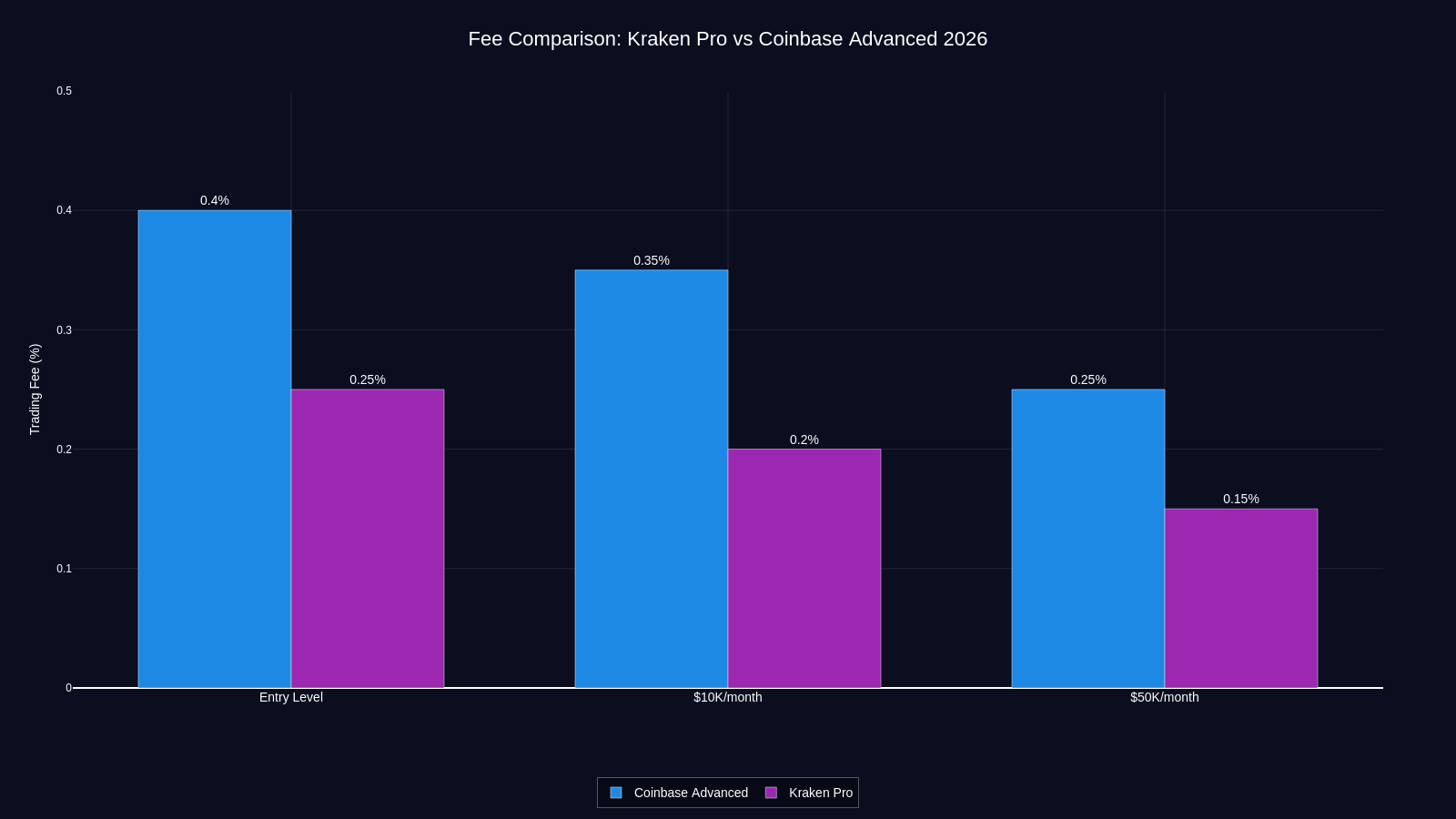
- Coinbase Advanced Trade: Maker fees start at 0.40%, taker fees at 0.60% for the entry tier. These drop as your 30-day volume increases. At $50,000+ monthly volume, maker fees fall to 0.20%.
- Coinbase One: A subscription plan ($29.99/month) that offers zero-fee trading up to a monthly limit. Worth it if you trade frequently in smaller amounts.
The takeaway: if you're using Coinbase's default interface, you're paying a premium for convenience. Switching to Advanced Trade cuts your costs significantly — but many casual users never make that switch.
Kraken Fee Structure
Kraken's fee structure is more straightforward and consistently cheaper for active traders.
- Kraken Pro (Instant Buy): Charges a flat 1% fee — more expensive than Kraken Pro's maker-taker model, but cheaper than Coinbase's Simple Buy for most transactions.
- Kraken Pro (Maker-Taker): Entry-level maker fees of 0.25%, taker fees of 0.40%. At $50,000+ monthly volume, maker fees drop to 0.14%.
- Kraken+: Subscription plan offering a monthly allowance of fee-free instant buys.
Side by side, Kraken Pro beats Coinbase Advanced on every volume tier. A trader doing $10,000/month in volume saves roughly $15–$20 per month on Kraken — that's $180–$240 per year just from the fee difference. Small numbers individually, but they compound.
User Experience and Platform Design
This is where Coinbase genuinely earns its reputation. The platform is polished in a way that few crypto exchanges match. The mobile app is clean, the onboarding is smooth, and buying your first Bitcoin takes about three minutes. Coinbase also runs a "Learn and Earn" program where you can earn small amounts of crypto by watching educational videos — a nice touch for newcomers.
Kraken's default interface is functional but less refined. It gets the job done, but it doesn't hold your hand. Kraken Pro, however, is a different story — it's a proper trading terminal with real-time order books, advanced charting, multiple order types (stop-loss, take-profit, trailing stops), and a clean layout that experienced traders will appreciate.
The honest assessment: if you've never bought crypto before, Coinbase's UX will feel familiar and reassuring. If you've been trading for a year or more, Kraken Pro's interface will feel more like a professional tool and less like a consumer app.
Ready to master crypto trading? Check out Icoinpro's comprehensive trading course — it covers exchange mechanics, order types, and risk management in a structured format.
Security and Regulatory Standing
Both exchanges have strong security records, but they achieve it differently.
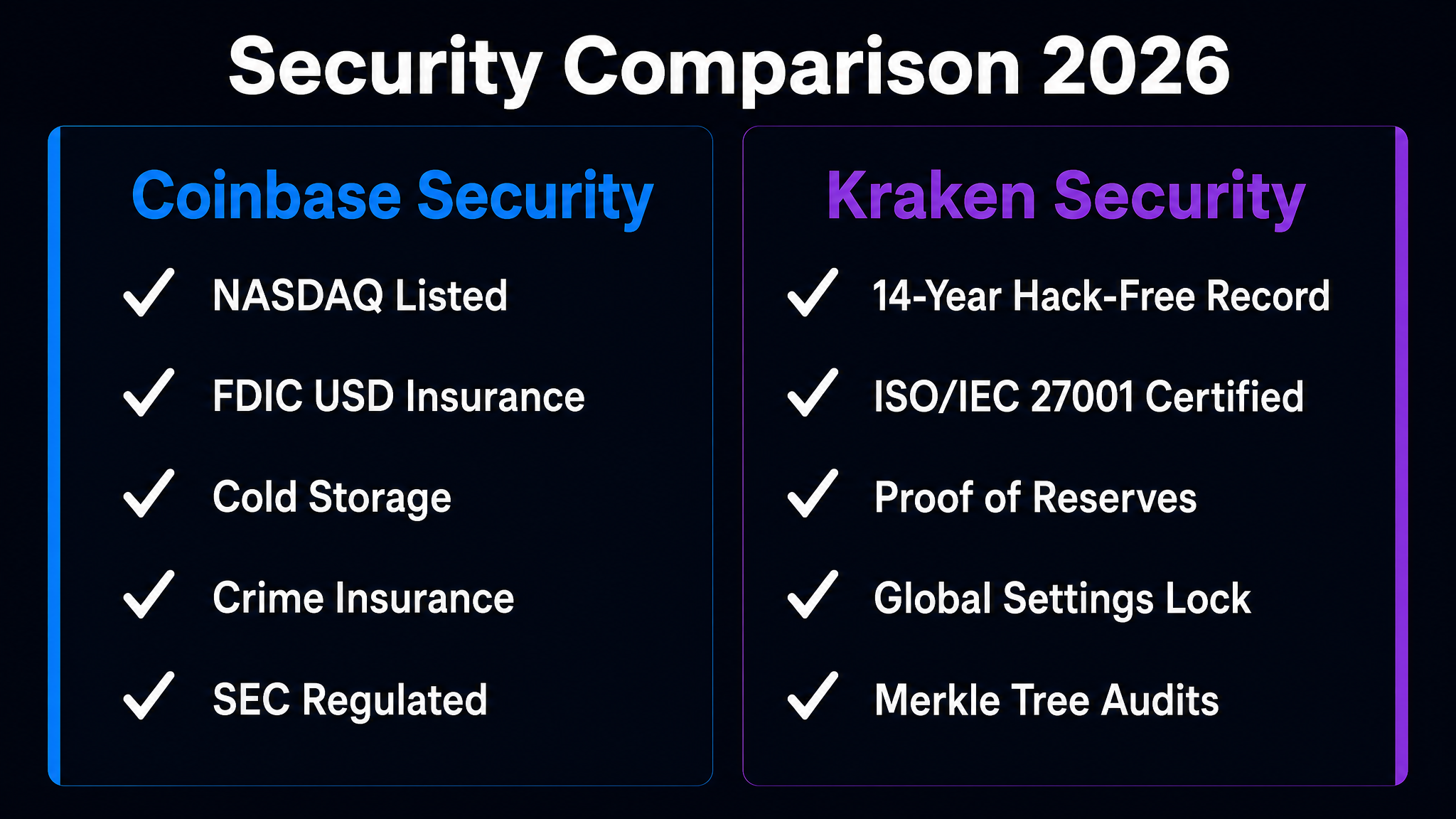
Coinbase is a publicly traded company on NASDAQ (ticker: COIN), which means it files quarterly reports with the SEC and operates under significant regulatory scrutiny. That transparency is a genuine security signal — it's hard to run a fraudulent operation when your financials are public. Coinbase stores the vast majority of customer assets in cold storage and carries crime insurance for digital assets held online. USD balances are FDIC-insured up to $250,000.
Kraken takes a different approach to trust: it has never suffered a major platform hack in its 14-year history. That's a remarkable record in an industry where exchange hacks are distressingly common. Kraken holds ISO/IEC 27001:2013 certification for information security management and publishes regular Proof-of-Reserves audits using Merkle tree verification — meaning you can independently verify that your assets are actually held 1:1. Kraken also offers a "Global Settings Lock" feature that prevents account changes for a set period, adding a layer of protection against social engineering attacks.
Both exchanges have had regulatory friction with the SEC over staking services. Coinbase settled and continues to offer staking with a commission (typically 25–35%). Kraken settled and significantly restricted its staking program for US users, though international users still have full access.
Serious about security? The Ledger Nano X keeps your private keys offline and safe — regardless of which exchange you use, moving significant holdings to cold storage is always the smarter long-term play.
Asset Selection and Features
Kraken lists 500+ cryptocurrencies. Coinbase lists around 240–300, with a more selective, curated listing process. For most investors, Coinbase's selection is more than sufficient — it covers Bitcoin, Ethereum, Solana, and the top 200 assets by market cap. But if you're hunting for early-stage altcoins or niche tokens, Kraken's broader catalog gives you more options.
Staking Options
For US users, Coinbase currently offers the better staking experience. You can stake ETH, SOL, ADA, and several other assets directly through the platform, earning yield with no technical setup required. The commission Coinbase takes (25–35%) is higher than what you'd pay on a dedicated staking platform, but the convenience factor is real.
Kraken's US staking is limited following its SEC settlement. International users have access to Kraken's full staking suite, which historically offered lower commission rates than Coinbase. If you're outside the US, Kraken's staking is worth a serious look.
Advanced Trading Tools
Kraken pulls ahead here. Kraken Pro offers margin trading (up to 5x leverage for eligible users), futures contracts, and a full suite of advanced order types. Coinbase Advanced Trade is solid for spot trading but doesn't match Kraken's derivatives offerings for US users.
Kraken also offers OTC (over-the-counter) trading for large orders, which is useful for institutional buyers or high-net-worth individuals who don't want to move markets with large spot orders.
Which Exchange Is Better for Beginners?
Coinbase wins this category without much debate. The onboarding process is genuinely excellent — you can link a bank account, verify your identity, and buy Bitcoin in under 10 minutes. The mobile app is intuitive, the educational content is solid, and the "Learn and Earn" program gives you a low-stakes way to explore different assets.
The main risk for beginners on Coinbase is defaulting to the Simple Buy interface and paying unnecessarily high fees. The fix is simple: switch to Coinbase Advanced Trade as soon as you're comfortable. The interface is slightly more complex, but the fee savings are immediate.
For a structured approach to learning crypto trading, Icoinpro offers step-by-step training that has helped thousands of beginners understand exchange mechanics, risk management, and portfolio strategy before they start trading with real money.
Which Exchange Is Better for Active Traders?
Kraken is the stronger platform for anyone trading regularly. The fee advantage compounds quickly — at $5,000/month in trading volume, you're saving roughly $75–$100 per year compared to Coinbase Advanced. At $50,000/month, that gap widens to $600–$1,000 annually.
Beyond fees, Kraken Pro's advanced order types give active traders more precision. Stop-loss orders, take-profit targets, and trailing stops are standard tools for managing risk — and Kraken's implementation of these is clean and reliable. The platform's API is also well-documented, making it a solid choice for algorithmic traders who want to automate strategies.
One practical note: Kraken's customer support has historically been slower than Coinbase's. If you run into an account issue, expect longer resolution times. Coinbase's support infrastructure, backed by its public company resources, tends to be more responsive.
Final Verdict: Kraken vs Coinbase 2026
Here's the bottom line on the Kraken vs Coinbase 2026 comparison:
- Choose Coinbase if: You're new to crypto, value a polished mobile experience, want FDIC-insured USD balances, or prefer the transparency of a publicly traded company. Just make sure you use Coinbase Advanced Trade — not the Simple Buy interface — to avoid overpaying on fees.
- Choose Kraken if: You're an active trader, want access to 500+ assets, need advanced order types and margin trading, or prioritize Kraken's unblemished security record and Proof-of-Reserves transparency.
- Use both if: You want the best of both worlds. Many experienced crypto investors keep a Coinbase account for easy fiat on/off-ramps and a Kraken account for active trading. There's no rule that says you have to pick just one.
Both platforms are legitimate, regulated, and safe for US users. The choice comes down to your trading frequency, technical comfort level, and how much you care about minimizing fees. Either way, you're in good hands — which is more than can be said for most of the crypto exchange landscape.
Key Takeaways
- Kraken's maker fees (0.25%) are consistently lower than Coinbase Advanced (0.40%) at entry level
- Coinbase is the better beginner platform; Kraken is better for active and professional traders
- Both exchanges are regulated and secure — Coinbase via public company transparency, Kraken via 14-year hack-free record and Proof-of-Reserves
- Kraken lists 500+ assets vs Coinbase's ~240–300
- US staking is more accessible on Coinbase following Kraken's SEC settlement
- Using Coinbase's Simple Buy interface instead of Advanced Trade is the most common (and costly) mistake new users make
Tools are only as good as the trader using them.
The best platform in the world won't help if your analysis is off. Before investing in more tools, consider investing in your trading education — it's the one thing that compounds everything else.
The program I recommend to people who ask me is this crypto trading course — it\'s the one I point friends and family to when they\'re serious about learning. Daily lessons, live analysis, and a community that actually helps.
Affiliate link — I may earn a commission at no extra cost to you. I only recommend what I genuinely use.
Disclaimer: The information provided on this website is for educational and informational purposes only. It should not be considered financial or investment advice. Cryptocurrency investments carry significant risk. Always do your own research and consult with a qualified financial advisor before making investment decisions.
Free Crypto Insights
Get weekly trading tips, market analysis, and exclusive strategies delivered to your inbox.