Robinhood Crypto Review 2026: Fees, Features, Robinhood Chain & Is It Worth It?
Affiliate Disclosure: This article may contain affiliate links. We may earn a commission at no extra cost to you. All opinions are our own.
Marcus Chen
Senior Crypto Analyst & Educator
Certified Blockchain Professional | Former Wall Street Analyst
Marcus Chen is a cryptocurrency analyst and educator with over 8 years of experience in digital asset trading. He has helped thousands of beginners navigate the crypto markets through practical, actionable education.
Disclaimer: This content is for informational purposes only and should not be considered financial advice. Cryptocurrency investments carry significant risk. Always do your own research (DYOR) before making any investment decisions.
This article contains affiliate links. We may earn a commission at no extra cost to you if you make a purchase through these links. See our affiliate disclosure for details.
Robinhood Crypto Review 2026: Fees, Features, Robinhood Chain & Is It Worth It?
Robinhood Crypto has come a long way from its "commission-free stock trading" roots. In 2026, it's a genuinely competitive crypto platform — one that launched its own Layer 2 blockchain, added self-custody wallets, and now lets you stake ETH, SOL, and ADA without leaving the app. But is it actually good for crypto investors, or just a convenient add-on for people who already use Robinhood for stocks? That's what this review answers.
I've spent time digging into Robinhood's crypto fee structure, its new Robinhood Chain L2, staking mechanics, and how it stacks up against dedicated exchanges like Coinbase and Kraken. Here's the honest breakdown.
Robinhood Crypto at a Glance (2026)
- Supported assets: 70–84 cryptocurrencies (US market)
- Fee model: Commission-free via spread; maker/taker fees for smart-exchange routing
- Staking: ETH, SOL, ADA — 25% commission on rewards
- Self-custody: Robinhood Wallet (standalone app)
- Robinhood Chain: Arbitrum-based L2, launched July 1, 2026
- Regulation: FINRA/SEC regulated; available in all 50 US states
- Best for: Casual investors who want crypto alongside stocks in one app
Fees: What "Commission-Free" Actually Means
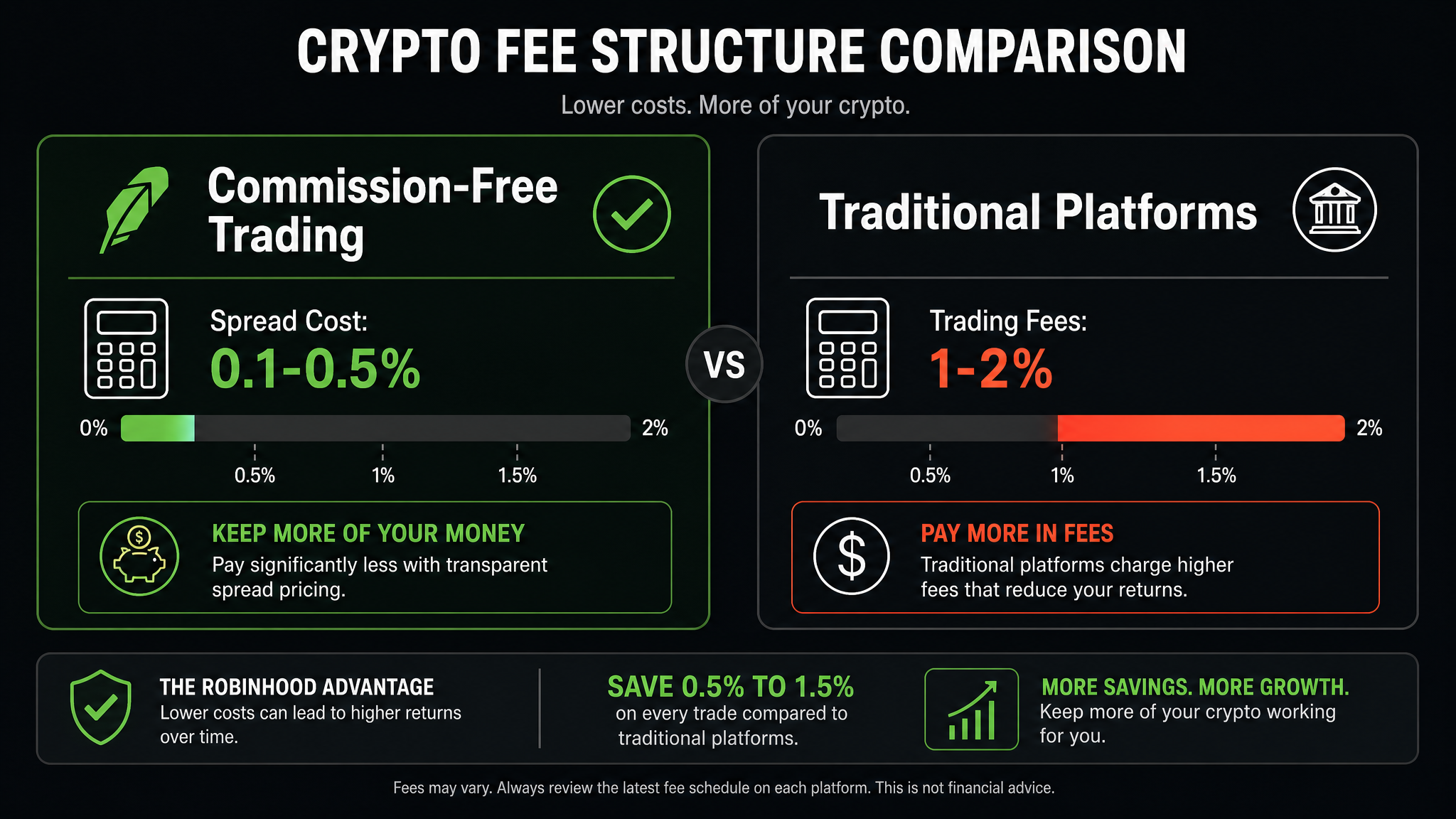
Robinhood's headline is "commission-free crypto trading." That's technically true — there's no explicit fee line item when you buy Bitcoin. But the cost is baked into the spread, which is the gap between the buy and sell price you see. Robinhood doesn't publish exact spread percentages, which makes it harder to compare directly with exchanges that list their fees upfront.
From what independent analysts have measured, spreads on major assets like BTC and ETH typically run 0.5% to 1.5% depending on market conditions. For altcoins, spreads can be wider. That's not terrible for small, casual buys — but if you're trading $10,000+ regularly, those hidden costs add up fast.
For more active traders, Robinhood now offers smart-exchange routing with a visible maker/taker fee schedule:
- Taker fee: 0.95% (low volume) down to 0.03% (over $25M/month)
- Maker fee: 0.50% (low volume) down to 0.00% (high volume)
That's actually competitive at higher volumes. But most Robinhood users aren't trading $25M a month — they're buying $500 of ETH and checking back in a week. For that use case, the spread model is fine, just not as transparent as Coinbase Advanced or Kraken Pro.
Asset Selection: Curated, Not Comprehensive
Robinhood supports roughly 70–84 cryptocurrencies in the US. That sounds like a lot until you compare it to Coinbase (250+ assets) or Kraken (700+ coins). You'll find all the major names — Bitcoin, Ethereum, Solana, XRP, Cardano, Dogecoin, Polygon, Chainlink — but don't expect to find mid-cap DeFi tokens or new altcoin launches here.
This is a deliberate choice. Robinhood curates its listings carefully, partly for regulatory reasons and partly because its user base skews toward mainstream investors who want the top 20 coins, not obscure DeFi protocols. If you're a crypto native who wants access to the long tail of altcoins, you'll need a different exchange.
Staking: Convenient but Expensive
Robinhood offers staking for three assets: ETH, SOL, and ADA. The process is dead simple — toggle it on in the app, and your assets start earning. No validator selection, no technical setup, no minimum beyond $1.
The catch? Robinhood takes a 25% commission on all staking rewards. That's steep. If the base ETH staking rate is 3.5% APY, you're netting around 2.6% after Robinhood's cut. Kraken charges around 30% for its staking service, so Robinhood isn't the worst offender — but dedicated liquid staking protocols like Lido or Rocket Pool charge 10% or less.
The other limitation: no liquid staking tokens. When you stake ETH on Robinhood, those assets are locked. You can't use them as collateral in DeFi or trade them while staked. For users who want to maximize capital efficiency, this is a real constraint.
That said, for someone who just wants to earn something on their ETH without touching DeFi, Robinhood's staking is genuinely convenient. It's the difference between a savings account and a money market fund — less yield, but zero friction.
Robinhood Chain: The Biggest 2026 Development
This is where things get genuinely interesting. On July 1, 2026, Robinhood launched Robinhood Chain — a permissionless, EVM-compatible Layer 2 blockchain built on Arbitrum technology. It's designed specifically for tokenized financial assets and settles to Ethereum mainnet.
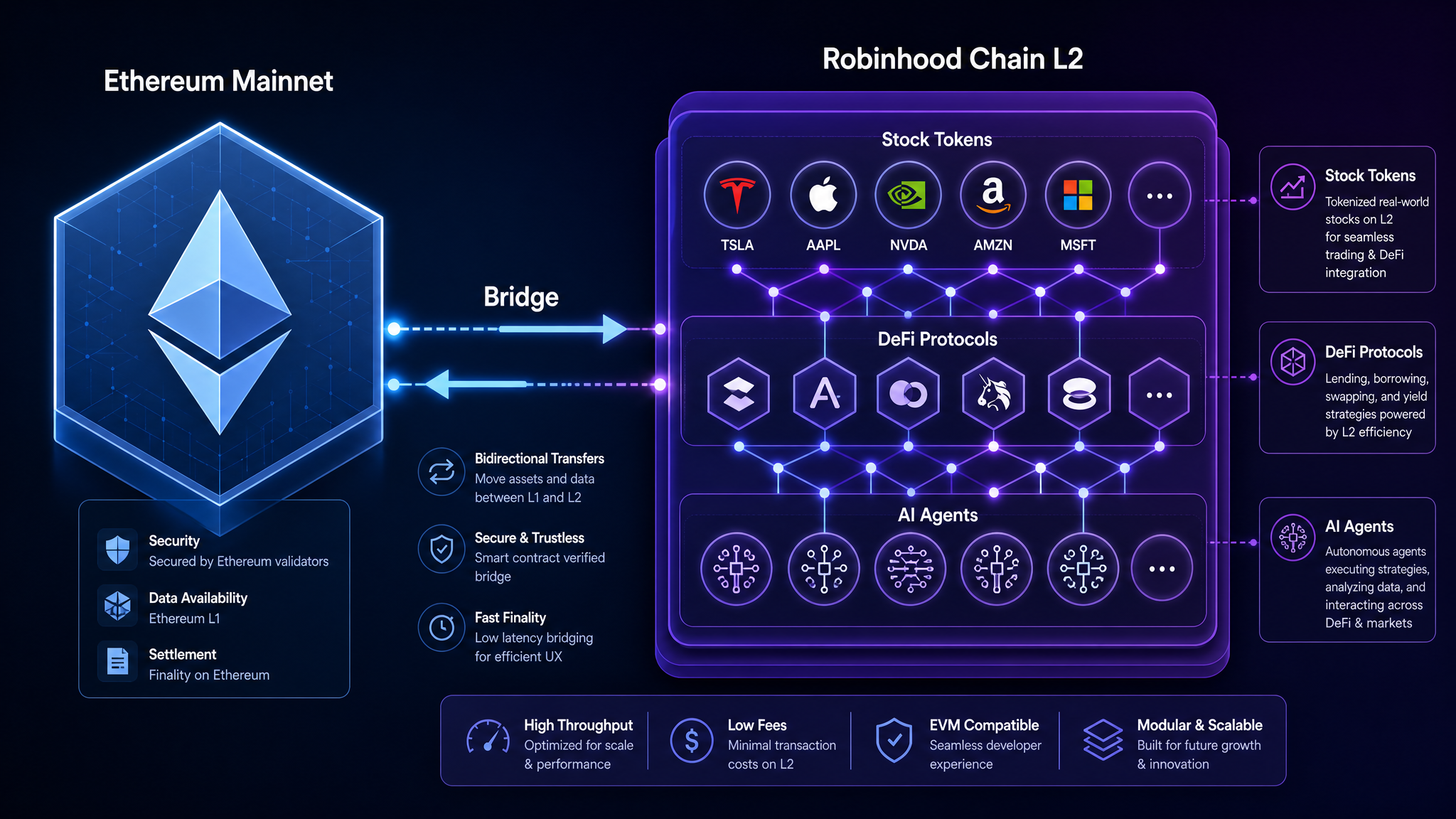
Key technical specs:
- Block time: ~100 milliseconds (extremely fast)
- Gas token: ETH
- Oracle: Chainlink (Data Streams, CCIP)
- Account abstraction: Native ERC-4337 support
- Ecosystem: Uniswap, Morpho, Fireblocks, Bitgo at launch
The flagship product on Robinhood Chain is Stock Tokens — debt instruments that track the price of US equities like NVIDIA, Apple, and Google, tradable 24/7. These aren't actual shares; they don't carry voting rights or dividends. But they let crypto-native users get equity exposure without opening a traditional brokerage account.
The chain is also marketed as "AI-native," with tooling designed for AI agents to interact with on-chain data, execute trades, and manage lending positions autonomously. That's a forward-looking bet on where crypto infrastructure is heading.
Is Robinhood Chain a game-changer? It's too early to say. The sequencer is currently centralized (operated by Robinhood), which is a meaningful trust assumption. But the technical foundation is solid, and the integration of traditional finance assets with DeFi infrastructure is genuinely novel.
Self-Custody: The Robinhood Wallet
Robinhood offers a standalone self-custody app called Robinhood Wallet. It's separate from the main brokerage app and gives you actual control over your private keys. You can swap tokens, interact with dApps, and manage assets across multiple chains.
This is a meaningful upgrade from a few years ago when Robinhood didn't support crypto withdrawals at all. Now you can move your assets off-platform whenever you want. That said, the Robinhood Wallet is still relatively basic compared to MetaMask or Rabby — it lacks the advanced transaction simulation and security features that power users expect.
For long-term storage of significant crypto holdings, a dedicated hardware wallet remains the gold standard. Protect your assets with a Ledger hardware wallet — the gold standard in cold storage security. Or if you prefer open-source transparency, the Trezor Model T offers top-tier security with an intuitive touchscreen interface.
Security and Regulation
Robinhood is regulated by FINRA and the SEC, which provides a meaningful layer of consumer protection compared to offshore exchanges. Your USD cash balances are FDIC-insured up to $250,000. Crypto assets themselves aren't FDIC-insured (no crypto is), but Robinhood maintains insurance coverage for digital assets held in custody.
The platform supports two-factor authentication, biometric login, and has significantly improved its infrastructure since the 2021 GameStop volatility incident that exposed platform stability issues. Crypto withdrawals are now fully supported, which was a major gap in earlier versions.
One thing to note: Robinhood's crypto services aren't available in all states for all features. Staking is restricted in California, Maryland, New Jersey, and Wisconsin. Always check current availability for your state.
Robinhood Crypto vs. Coinbase: Which Should You Choose?
Here's the honest comparison:
| Feature | Robinhood | Coinbase |
|---|---|---|
| Asset variety | 70–84 coins | 250+ coins |
| Fee model | Spread-based (opaque) | Maker/taker (transparent) |
| Staking options | ETH, SOL, ADA only | Dozens of assets |
| Multi-asset (stocks + crypto) | ✅ Yes | ❌ Crypto only |
| Own blockchain | ✅ Robinhood Chain (L2) | ✅ Base (L2) |
| Best for | Casual, multi-asset investors | Active crypto traders |
The bottom line: if you already use Robinhood for stocks and want to add some crypto exposure without opening another account, Robinhood Crypto is perfectly fine. If crypto is your primary focus and you want deep asset selection, advanced trading tools, and better staking yields, Coinbase or Kraken will serve you better.
Who Should Use Robinhood Crypto?
Robinhood Crypto is a good fit if you:
- Already use Robinhood for stocks and want crypto in the same app
- Stick to mainstream coins (BTC, ETH, SOL, XRP, DOGE)
- Prefer simplicity over advanced trading tools
- Want to stake ETH or SOL without technical complexity
- Are interested in Robinhood Chain's tokenized stock products
Look elsewhere if you:
- Want access to 200+ altcoins and DeFi tokens
- Need transparent, low-fee trading for large volumes
- Want liquid staking or DeFi integration
- Prioritize self-custody and decentralization
Verdict: Solid for Casual Investors, Limited for Crypto Natives
Robinhood Crypto earns a solid 3.5 out of 5 for 2026. The platform has genuinely improved — self-custody support, staking, and the Robinhood Chain L2 are meaningful additions. The fee transparency issue remains a real drawback, and the asset selection is thin compared to dedicated exchanges.
Where Robinhood shines is convenience. If you want to buy $1,000 of Bitcoin, stake some ETH, and check your stock portfolio all in one app, it's hard to beat. For serious crypto investors who want to explore DeFi, trade altcoins, or maximize staking yields, you'll quickly hit its limits.
Ready to level up your crypto trading skills regardless of which platform you use? Check out Icoinpro's comprehensive trading course — it covers everything from reading charts to executing advanced strategies across any exchange.
Key Takeaways
- Robinhood Crypto is commission-free but uses spread-based pricing — costs are real, just less visible
- Asset selection (70–84 coins) is limited vs. dedicated exchanges
- Staking is available for ETH, SOL, ADA with a 25% commission on rewards
- Robinhood Chain launched July 2026 — an Arbitrum-based L2 with tokenized stocks and DeFi protocols
- Best for casual investors who want crypto alongside traditional assets in one app
- For serious crypto trading, Coinbase Advanced or Kraken Pro offer better tools and transparency
Tools are only as good as the trader using them.
The best platform in the world won't help if your analysis is off. Before investing in more tools, consider investing in your trading education — it's the one thing that compounds everything else.
The program I recommend to people who ask me is this crypto trading course — it\'s the one I point friends and family to when they\'re serious about learning. Daily lessons, live analysis, and a community that actually helps.
Affiliate link — I may earn a commission at no extra cost to you. I only recommend what I genuinely use.
Disclaimer: The information provided on this website is for educational and informational purposes only. It should not be considered financial or investment advice. Cryptocurrency investments carry significant risk. Always do your own research and consult with a qualified financial advisor before making investment decisions.
Free Crypto Insights
Get weekly trading tips, market analysis, and exclusive strategies delivered to your inbox.