Solana vs Avalanche 2026: Which L1 Blockchain Should You Invest In?
Affiliate Disclosure: This article may contain affiliate links. We may earn a commission at no extra cost to you. All opinions are our own.
Marcus Chen
Senior Crypto Analyst & Educator
Certified Blockchain Professional | Former Wall Street Analyst
Marcus Chen is a cryptocurrency analyst and educator with over 8 years of experience in digital asset trading. He has helped thousands of beginners navigate the crypto markets through practical, actionable education.
Solana vs Avalanche 2026: Which L1 Blockchain Should You Invest In?
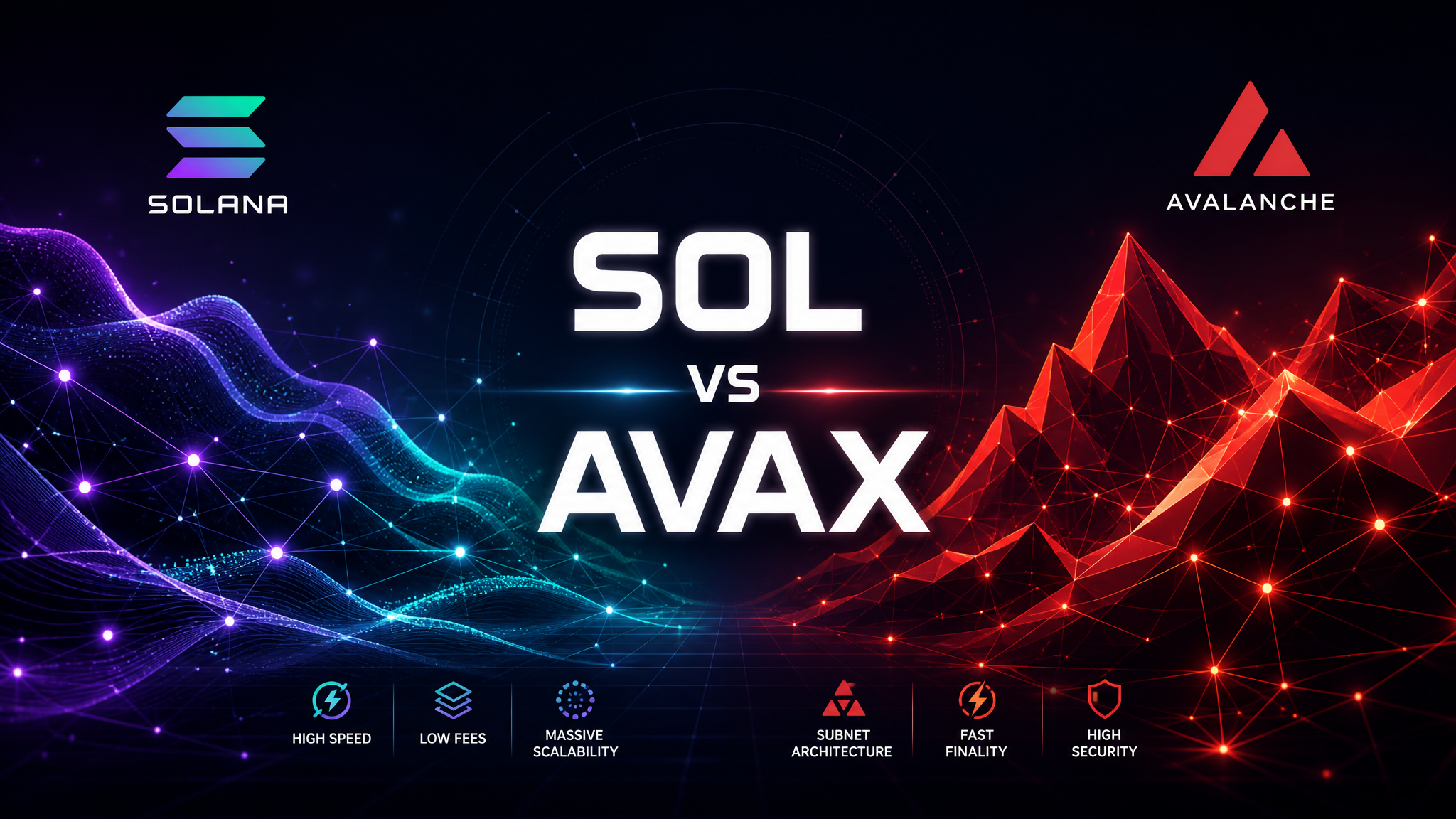
The Solana vs Avalanche debate has never been sharper than it is right now in 2026. Both blockchains have survived brutal bear markets, shipped major upgrades, and carved out distinct niches — yet they represent fundamentally different bets on where crypto infrastructure is headed. If you're trying to decide whether SOL or AVAX deserves a spot in your portfolio, this breakdown cuts through the noise with real numbers, honest trade-offs, and a clear verdict for different investor types.
The Core Difference: One Chain vs. Many Chains
Before comparing prices or ecosystems, you need to understand the architectural philosophy driving each network — because it shapes everything else.
Solana is monolithic. One global state, one chain, one shared execution environment. Every app on Solana talks to every other app natively, without bridges. That's why Jupiter DEX can route a swap through five liquidity pools in a single transaction. The trade-off? If the chain gets congested or hits a bug, everything feels it.
Avalanche is modular. Think of it as a blockchain factory. The Primary Network (three chains: P-Chain, X-Chain, C-Chain) handles core consensus, while developers can spin up custom "subnets" — sovereign Layer-1 blockchains with their own rules, fee tokens, and validator sets. A gaming subnet congesting doesn't touch a DeFi subnet. The trade-off? Liquidity fragments across chains, and composability requires bridges.
Neither approach is wrong. They're solving different problems for different users.
Performance: Raw Numbers in 2026
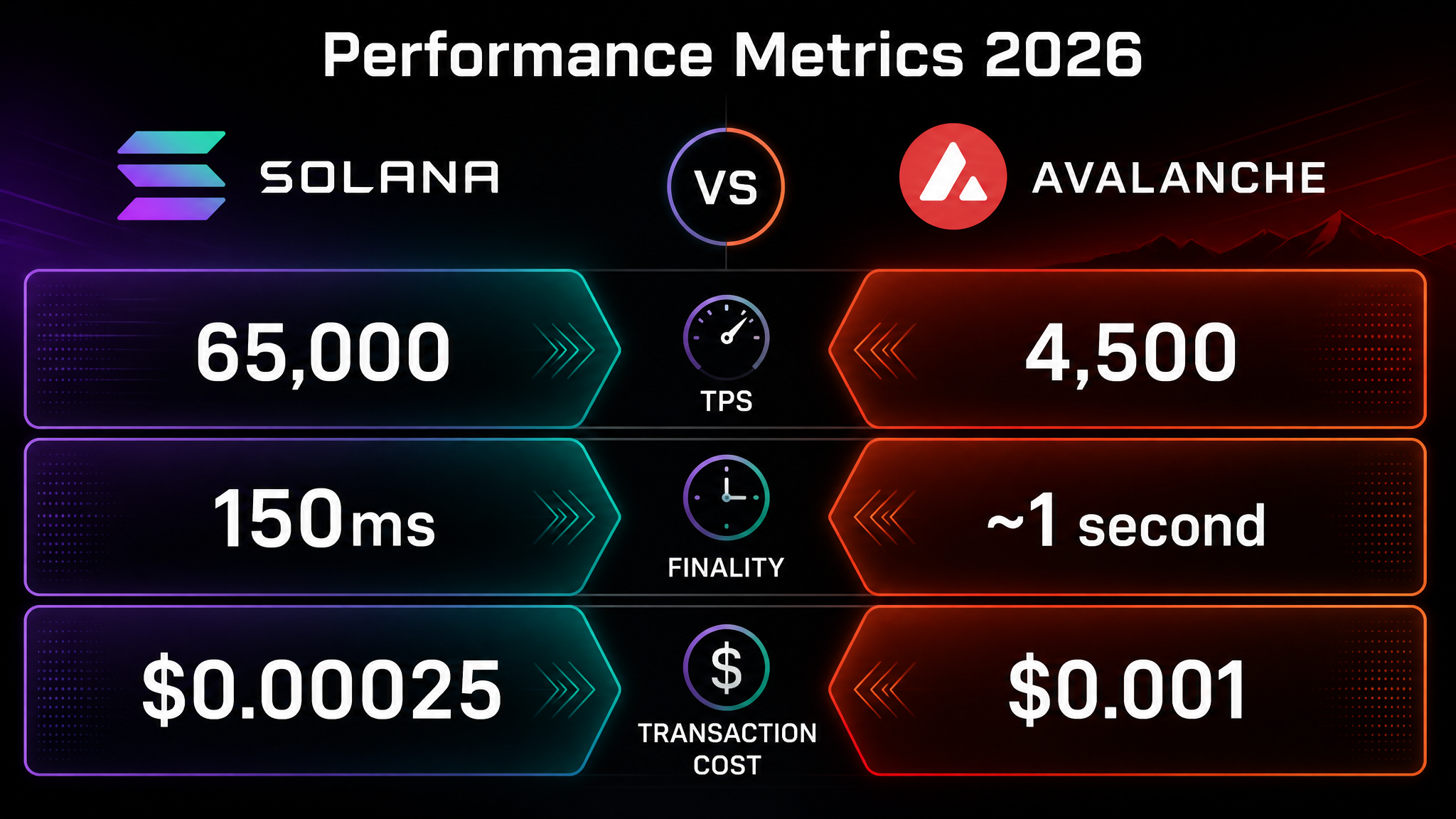
Let's get concrete. Here's where each network stands on the metrics that actually matter for users and developers:
Transaction Speed and Finality
Solana's headline upgrade this year is Alpenglow — a complete consensus overhaul replacing Proof of History and Tower BFT with two new components called Votor and Rotor. The result is transaction finality dropping from roughly 12.8 seconds to 100–150 milliseconds. That's not a typo. Sub-second finality on a public blockchain with 65,000 TPS capacity is genuinely remarkable.
Avalanche isn't slow either. Its randomized subsampling consensus achieves sub-second finality (typically around 1 second) on the C-Chain, with roughly 4,500 TPS. The aggregate throughput across all subnets is theoretically unlimited — each new subnet adds capacity without burdening the others.
Winner on raw speed: Solana. But Avalanche's subnet model means it scales horizontally in ways Solana can't.
Transaction Costs
Both networks are cheap. Solana averages around $0.00025 per transaction. Avalanche C-Chain fees hover near $0.001. For everyday users, neither is a meaningful cost. Where it matters is for high-frequency trading bots and DeFi protocols running thousands of transactions per hour — Solana's edge here is real.
Network Reliability
Solana's historical Achilles heel has been outages. The network has suffered multiple downtime events since 2021. The 2026 response has been two-pronged: the Firedancer validator client (an independent codebase from Jump Crypto) reduces single-point-of-failure risk, and the Solana Incident Response Network (SIRN) provides coordinated recovery protocols. It's better — but the track record exists.
Avalanche has maintained stronger uptime consistency. Its subnet architecture means a problem in one subnet doesn't cascade to others, and the Primary Network has been notably stable.
Ecosystem and DeFi: Where the Money Lives
Performance specs are only half the story. The ecosystem — the apps, the liquidity, the users — is what actually drives value.
Solana's Ecosystem in 2026
Solana has become the go-to chain for high-velocity consumer crypto. Jupiter DEX handles billions in monthly volume. Meme coin trading is almost entirely Solana-native. The Solana Seeker smartphone is pushing mobile-first crypto adoption. Stablecoin settlement — particularly USDC — has found a major home on Solana, with institutional players using it for near-instant payment rails.
The "Nasdaq of blockchains" label isn't just marketing. Solana's TVL and daily active users consistently outpace Avalanche in consumer-facing metrics. If you want exposure to the retail crypto boom, Solana is where that activity concentrates.
Avalanche's Ecosystem in 2026
Avalanche has made a deliberate pivot toward institutional finance and Real-World Assets (RWAs). Its "evergreen" subnets allow banks and asset managers to run KYC-compliant, permissioned blockchains — something Solana's open architecture can't easily replicate. Major financial institutions have launched tokenized securities and regulated derivatives on Avalanche subnets.
The Avalanche9000 upgrade (specifically the Etna hard fork) dramatically lowered the cost to launch a custom L1, removing the heavy AVAX lockup requirement that previously made subnet creation expensive. This has accelerated enterprise adoption significantly.
Avalanche's DeFi ecosystem — Trader Joe, Benqi, GMX — is solid but smaller than Solana's. The real Avalanche story in 2026 is institutional infrastructure, not retail DeFi.
Developer Experience
This matters for long-term ecosystem growth. More developers = more apps = more users = more value.
Solana uses Rust and the Solana Virtual Machine (SVM). Rust is powerful but has a steep learning curve. Developers who master it build extremely efficient programs, but the onboarding friction is real. The SVM's parallel execution model is also conceptually different from Ethereum's sequential model, requiring a mental shift.
Avalanche's C-Chain is fully EVM-compatible. Any Solidity developer can deploy an Ethereum dApp on Avalanche with minimal changes. Given that Ethereum has the largest developer community in crypto, this is a significant advantage for attracting talent. The subnet model also lets developers customize their execution environment entirely — a flexibility Solana doesn't offer.
For raw developer count, Ethereum's ecosystem feeds Avalanche. Solana has built its own developer community from scratch, which is impressive but smaller.
Tokenomics: SOL vs AVAX
How each token is structured affects long-term price dynamics.
SOL operates on an inflationary model with a decreasing issuance rate — starting at 8% annually and declining 15% per year toward a long-run rate of 1.5%. Staking rewards come from this inflation. Network growth needs to outpace issuance to maintain price appreciation. With Alpenglow reducing validator costs by an estimated 98%, the economics for validators improve dramatically.
AVAX has a fixed supply cap of 720 million tokens with a deflationary mechanism: transaction fees are burned. Every transaction on the network permanently removes AVAX from circulation. This creates natural deflationary pressure as network usage grows — a model that appeals to investors who've watched Bitcoin's supply dynamics play out.
AVAX's tokenomics are arguably more Bitcoin-like in their scarcity mechanics. SOL's model requires sustained growth to offset inflation, but the network's activity levels have historically supported that.
Want to sharpen your understanding of how to evaluate blockchain investments like these? The Icoinpro Trading Course covers on-chain analysis, tokenomics evaluation, and how to build a thesis around Layer-1 assets — practical skills for anyone serious about crypto investing.
Investment Case: Who Should Buy SOL vs AVAX?
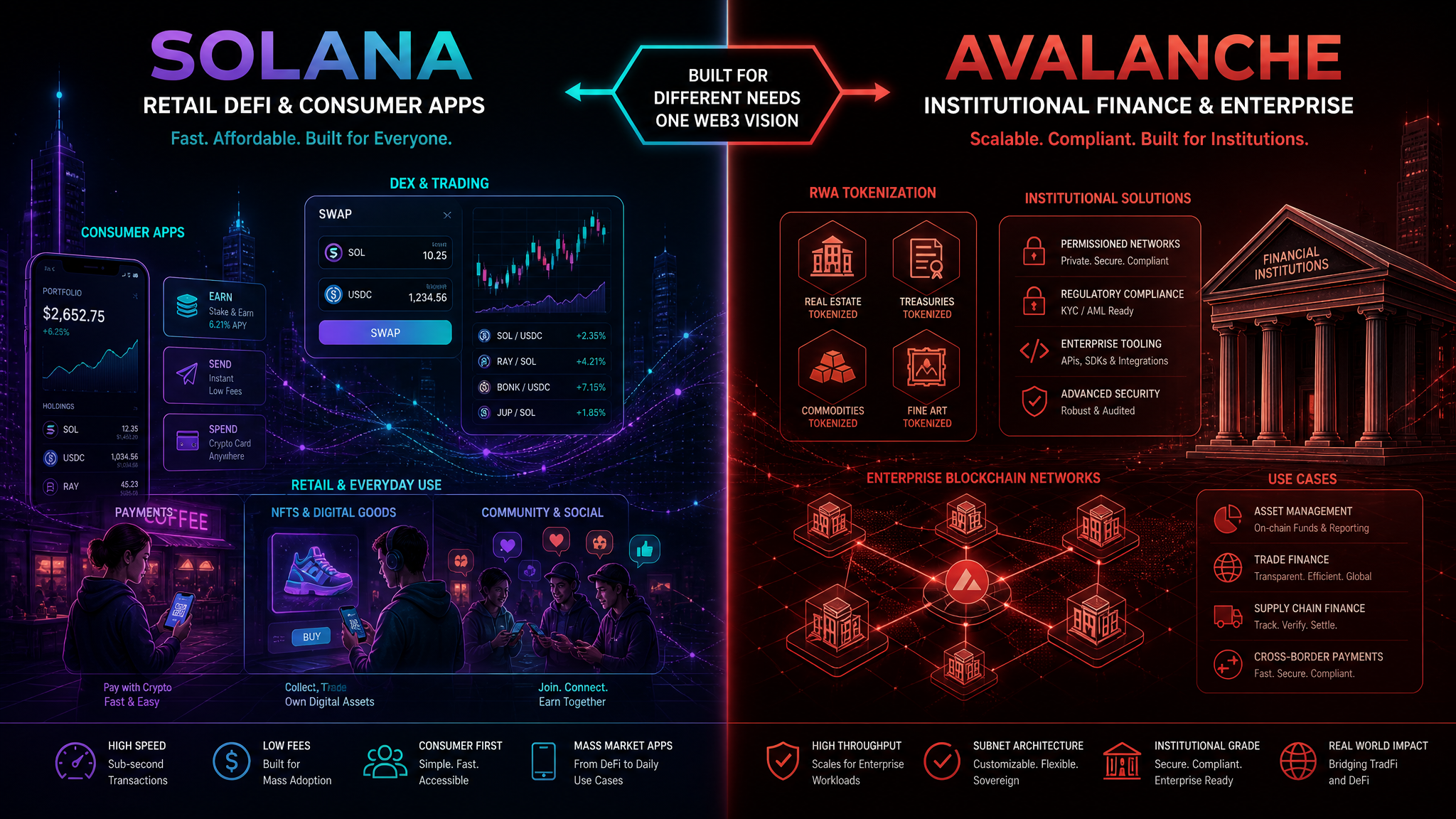
The Case for Solana (SOL)
Buy SOL if you believe retail crypto adoption continues accelerating. Solana is the chain where consumer apps live — payments, gaming, meme coins, mobile crypto. The Alpenglow upgrade is a genuine technical leap that could attract more institutional settlement activity. Spot Solana ETF approval (still pending in the US) would be a major catalyst.
The risk: Solana's history of outages and its relatively centralized validator set (Firedancer helps, but it's still concentrated) are legitimate concerns. And the meme coin association cuts both ways — it drives volume but also volatility and reputational risk.
The Case for Avalanche (AVAX)
Buy AVAX if you're betting on institutional blockchain adoption and RWA tokenization. Avalanche has positioned itself as the enterprise-friendly L1, and that market is growing fast. The deflationary tokenomics provide a cleaner supply story. The subnet model means Avalanche can serve use cases that Solana's architecture simply can't accommodate.
The risk: Avalanche's retail DeFi ecosystem is smaller, and institutional adoption moves slowly. If the RWA narrative stalls or institutions choose private chains over public ones, AVAX's thesis weakens.
Can You Hold Both?
Yes — and many serious crypto investors do. SOL and AVAX have a correlation of roughly 0.82, meaning they often move together in broad market swings. But their divergence in use cases means they can outperform each other in different market environments. A portfolio holding both captures the retail DeFi boom (SOL) and the institutional infrastructure buildout (AVAX).
If you're building a long-term crypto portfolio and want a structured approach to position sizing across L1 assets, The Bitcoin Standard by Saifedean Ammous provides the foundational monetary theory that helps contextualize why Layer-1 blockchains compete the way they do. Pick up a copy on Amazon — it's required reading for anyone serious about crypto investing.
Security: Protecting Your SOL and AVAX
Whichever you choose, keeping your assets secure matters more than picking the right chain. Both SOL and AVAX are supported by major hardware wallets. A cold storage device keeps your private keys offline and away from exchange hacks or phishing attacks.
The Ledger hardware wallet supports both Solana and Avalanche natively through Ledger Live, making it a practical choice if you're holding both assets long-term.
Key Takeaways
- Speed: Solana wins on raw TPS (65,000) and finality (150ms with Alpenglow). Avalanche is fast enough for most use cases at ~1 second finality.
- Scalability: Avalanche's subnet model scales horizontally without limit. Solana scales vertically on one chain.
- Ecosystem: Solana dominates retail DeFi, DEX volume, and consumer apps. Avalanche leads in institutional finance and RWA tokenization.
- Tokenomics: AVAX is deflationary (fee burning, fixed supply). SOL is inflationary with a declining issuance rate.
- Developer access: Avalanche's EVM compatibility lowers the barrier for Ethereum developers. Solana's Rust/SVM environment is more specialized.
- Best for: SOL suits investors bullish on retail crypto adoption and high-frequency on-chain activity. AVAX suits investors bullish on institutional blockchain infrastructure and RWAs.
Neither Solana nor Avalanche is going away. Both have real technology, real users, and real institutional interest. The question isn't which one is "better" — it's which thesis aligns with your investment horizon and risk tolerance. Do your research, size your positions appropriately, and don't let short-term price action distract from the long-term infrastructure story both chains are building.
Knowing what to buy is one thing. Knowing when — that's the skill.
I've watched people hold great coins and still lose money because their entries and exits were off. Structured trading education changed how I approach every position.
The program I recommend to people who ask me is this crypto trading course — it\'s the one I point friends and family to when they\'re serious about learning. Daily lessons, live analysis, and a community that actually helps.
Affiliate link — I may earn a commission at no extra cost to you. I only recommend what I genuinely use.
Disclaimer: The information provided on this website is for educational and informational purposes only. It should not be considered financial or investment advice. Cryptocurrency investments carry significant risk. Always do your own research and consult with a qualified financial advisor before making investment decisions.
Free Crypto Insights
Get weekly trading tips, market analysis, and exclusive strategies delivered to your inbox.