Sui vs Aptos 2026: Which Move-Based Blockchain Is Worth Your Money?
Affiliate Disclosure: This article may contain affiliate links. We may earn a commission at no extra cost to you. All opinions are our own.
Marcus Chen
Senior Crypto Analyst & Educator
Certified Blockchain Professional | Former Wall Street Analyst
Marcus Chen is a cryptocurrency analyst and educator with over 8 years of experience in digital asset trading. He has helped thousands of beginners navigate the crypto markets through practical, actionable education.
Sui vs Aptos 2026: Which Move-Based Blockchain Is Worth Your Money?
The Sui vs Aptos 2026 debate has become one of the most compelling matchups in crypto right now. Both chains share the same DNA — born from Meta's abandoned Diem project, both built on the Move programming language — yet they've evolved into very different beasts. One is a DeFi powerhouse with elite throughput. The other is quietly becoming the institutional blockchain of choice. So which one deserves a spot in your portfolio? Let's break it down.
The Origin Story: Same Roots, Different Paths
In 2022, when Meta's Diem stablecoin project collapsed under regulatory pressure, two teams walked away with the same codebase and very different visions. The Sui team (backed by Mysten Labs) and the Aptos team (backed by Aptos Labs) both chose Move — a Rust-based smart contract language originally designed for Diem — as their foundation.
That's where the similarities end. Sui went object-centric. Aptos stayed account-based. Those architectural choices, made years ago, now define everything: how fast each chain runs, who builds on it, and what kind of investor it attracts.
By June 2026, both tokens are trading in the $0.74–$0.83 range — a far cry from their all-time highs, but still representing live, actively developed ecosystems with real institutional money flowing in.
Architecture Deep Dive: How They Actually Work
Sui's Object-Centric Model
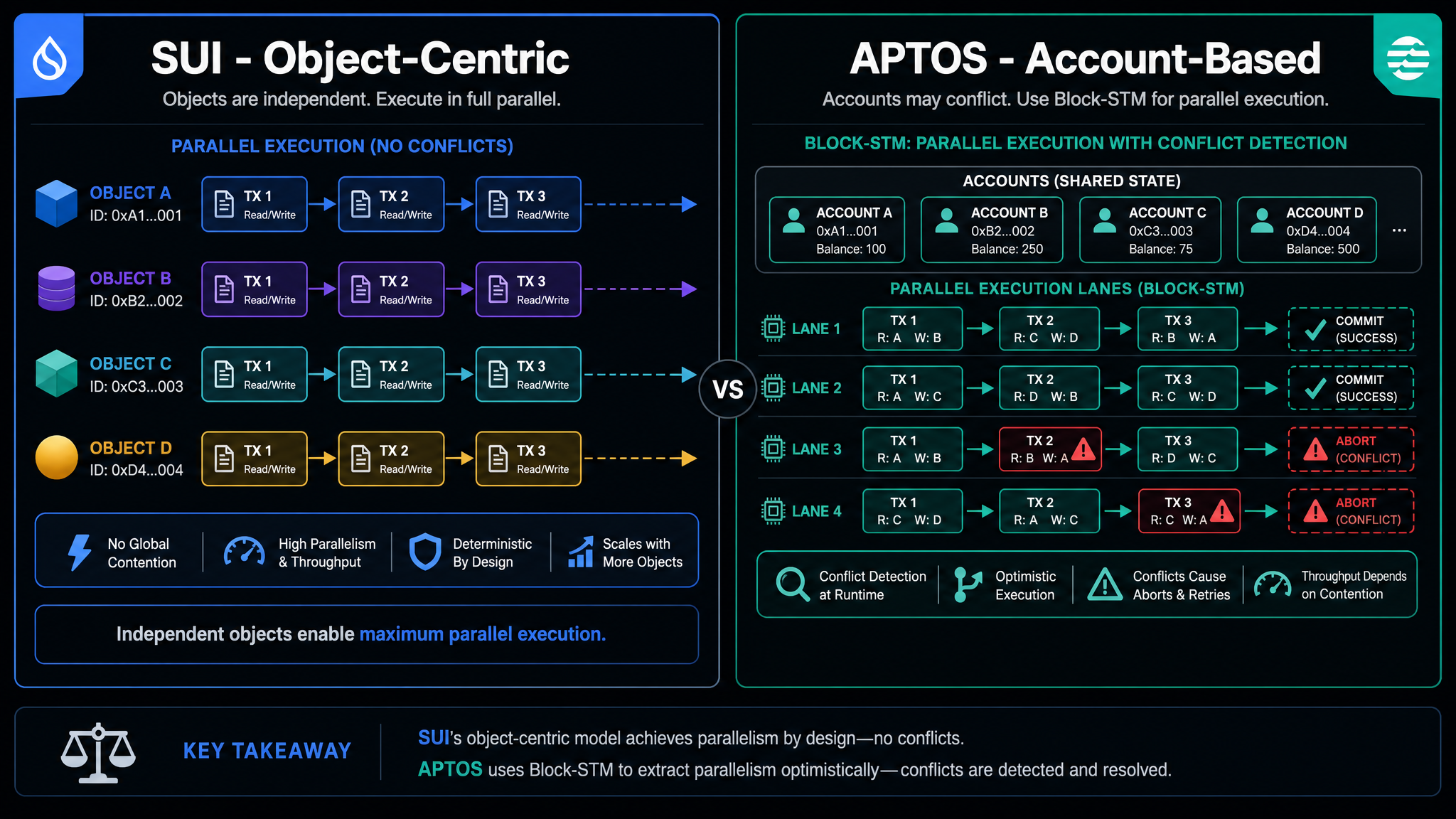
Sui treats every asset — every NFT, every token balance, every smart contract state — as a distinct "object" with a unique identifier. Before executing any transaction, the network can see exactly which objects are involved and whether they conflict with each other. No conflict? Run them in parallel. It's deterministic parallelism, and it's fast.
The consensus engine powering this is called Mysticeti, built on a directed acyclic graph (DAG) structure. The result: sub-second finality and throughput that can handle gaming, AI agents, and high-frequency DeFi without breaking a sweat. Sui also recently launched gasless stablecoin transfers — a UX improvement that removes one of the biggest friction points for new users.
Aptos's Account-Based Model with Block-STM
Aptos keeps the familiar account-based structure you'd recognize from Ethereum. But it adds Block-STM (Software Transactional Memory) — an optimistic concurrency system that assumes transactions can run in parallel and only re-executes the ones that actually conflict. Think of it as "parallel first, fix conflicts later."
This approach is more intuitive for developers migrating from EVM chains. You don't need to rethink your mental model of how state works. That familiarity has made Aptos a natural landing spot for institutional developers who want Move's security guarantees without a steep learning curve.
Ecosystem Metrics: Where the Money Actually Is
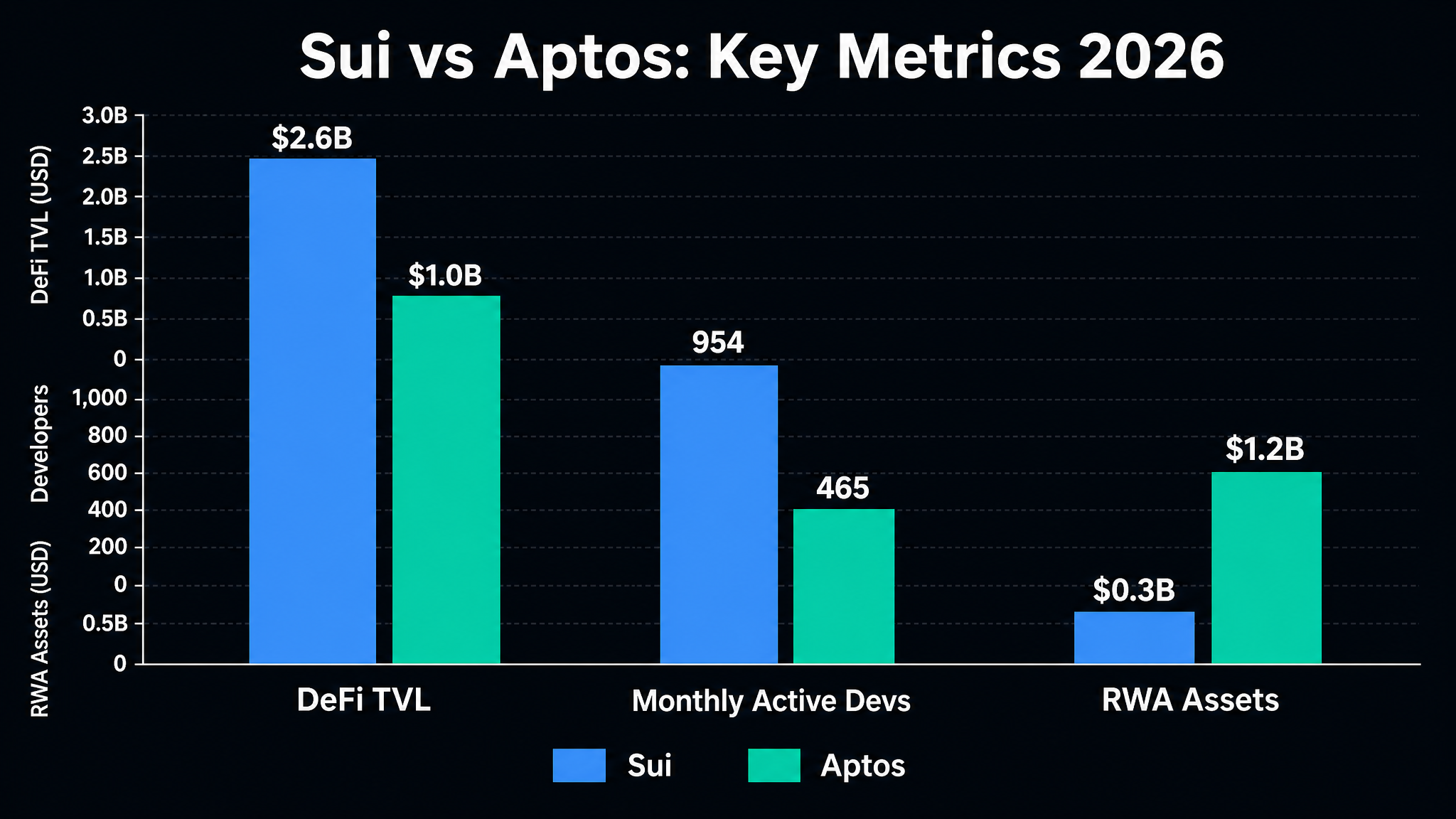
Numbers don't lie. Here's where each chain stands as of Q2 2026:
- DeFi TVL: Sui leads with approximately $2.6 billion locked vs. Aptos at roughly $1 billion
- Market Cap: Sui's market cap is approximately 4x that of Aptos
- Monthly Active Developers: Sui ~954 vs. Aptos ~465 — nearly a 2:1 ratio
- Staking APR: Sui offers ~7% nominal staking yield; Aptos reduced its staking rewards from 5.19% to 2.6% in its February 2026 tokenomics overhaul
- RWA Tokenization: Aptos leads with $1.2B+ in tokenized real-world assets, including deployments from BlackRock and Franklin Templeton
Sui wins on DeFi and developer momentum. Aptos wins on institutional RWA adoption. Neither is a clear knockout — it depends entirely on what you're betting on.
Tokenomics: The Supply Problem and How Each Chain Handles It
This is where things get interesting — and where a lot of retail investors get burned.
SUI Token Supply Dynamics
Sui has a total supply of 10 billion tokens. As of mid-2026, only about 40% is circulating. That means 6 billion tokens are still locked — in team allocations, investor vesting schedules, and ecosystem funds. When those unlock, they create selling pressure. Recent mainnet outages combined with large token unlocks triggered panic selling earlier this year, contributing to SUI's current price weakness.
The bull case: Sui's Storage Fund model generates staking rewards from one-time storage fees, creating a usage-driven floor for validator incentives that doesn't rely purely on inflation. As the network grows, this becomes more meaningful.
APT Token: The Deflationary Pivot
Aptos made a bold move in February 2026: the community voted to cap total supply at 2.1 billion APT (a nod to Bitcoin's 21 million), increase gas fees for burning, and permanently lock 210 million APT from the foundation treasury. Staking rewards were cut from 5.19% to 2.6%.
This is a deliberate shift toward scarcity. Lower staking rewards mean less inflation. A hard cap means no infinite dilution. For long-term holders, this is a meaningful structural change — though it also means less passive income for stakers in the near term.
Ready to master crypto trading? Check out Icoinpro's comprehensive trading course.
Institutional Adoption: Two Very Different Strategies
Sui Goes Financial
Sui has pursued what you might call a "financial productization" strategy. It became the fourth Layer-1 blockchain to gain CME Group futures access — joining Bitcoin, Ethereum, and Solana in that exclusive club. Multiple spot SUI staking ETFs have launched (Canary SUIS, Grayscale GSUI), giving traditional investors regulated exposure to SUI staking yields. The chain also launched USDsui, a native stablecoin designed to keep yield within the Sui ecosystem.
This is a play for retail and institutional investors who want crypto exposure through familiar financial products.
Aptos Goes Compliance-First
Aptos has taken a different route: regulatory clarity first, then institutional deployment. US authorities have classified APT as a digital commodity — a significant legal distinction that reduces regulatory risk. The network has integrated FIX and CCXT protocols (standard institutional trading infrastructure), and it's attracted Archax (a UK-regulated digital securities exchange) and Vertalo (an SEC-registered transfer agent) to build on-chain.
BlackRock and Franklin Templeton deploying on Aptos isn't a small thing. These are trillion-dollar asset managers. Their presence signals that Aptos has cleared the compliance bar that most blockchains haven't.
Protect your crypto assets with a Ledger hardware wallet — the gold standard in cold storage security.
Price Analysis: Where SUI and APT Stand in June 2026
Both tokens are in a rough patch. SUI is trading around $0.76–$0.83, with technical analysts watching $0.80 as a critical support level. Failure to hold that level could push it toward $0.57–$0.61 in the near term. Long-term forecasts range from $0.80 to $3.21 for 2026, depending on ecosystem adoption and token unlock schedules.
APT is trading around $0.74–$0.75, also below its 200-day EMA. The broader "risk-off" environment — Bitcoin ETF outflows, macro uncertainty — has weighed on both. Some analysts project APT could reach $2.72–$3.54 by year-end if institutional RWA momentum continues.
Neither token is a "safe" investment right now. Both are high-beta altcoins in a market that's punishing anything that isn't Bitcoin or Ethereum. Position sizing matters enormously here.
September 2026 Update: Sui Pulls Ahead, Aptos Goes Institutional
The Sui vs. Aptos race has clarified considerably since this article was first published. Here's where things stand as of September 2026:
- Sui leads on market metrics: Sui holds a clear advantage in total market capitalization, daily active addresses, and developer engagement (higher commit counts and repository activity). It's become the dominant platform for consumer-facing Web3 apps — gaming, social, and DePIN.
- Both chains have crossed 100,000 TPS in controlled environments: Real-world throughput varies, but both networks offer sub-second finality that makes them genuinely competitive with traditional payment rails for specific use cases.
- Aptos doubles down on enterprise: Aptos has secured major institutional partnerships — Google Cloud, Microsoft, Franklin Templeton, and Mastercard — positioning itself as the compliance-ready infrastructure layer for RWA tokenization and institutional DeFi. Its Block-STM execution engine handles complex DeFi composability better than Sui's object-centric model for certain use cases.
- Governance divergence: Aptos uses on-chain governance; Sui has historically operated with off-chain governance. This matters for institutional partners who need predictable, auditable decision-making processes.
- Move language security advantage holds: Both chains benefit from Move's formal verification capabilities, which have kept both networks largely free of the re-entrancy exploits that have plagued Solidity-based chains.
The bottom line for September 2026: if you're betting on consumer Web3 adoption and developer momentum, Sui has the edge. If you're more interested in institutional infrastructure and enterprise partnerships, Aptos is the more focused play.
Frequently Asked Questions: Sui vs. Aptos in 2026
- Which has better performance: Sui or Aptos?
- Both have exceeded 100,000 TPS in controlled environments and offer sub-second finality. In practice, Sui's object-centric model gives it lower latency for simple consumer transactions, while Aptos's Block-STM handles complex DeFi composability more efficiently. Neither is definitively "faster" — it depends on the use case.
- Is Sui or Aptos better for DeFi?
- Aptos has an edge for complex DeFi protocols like limit order books and cross-chain aggregators due to Block-STM's dynamic dependency detection. Sui's ecosystem has more consumer-facing DeFi apps and gaming integrations. Both have growing TVL, though neither approaches Solana or Ethereum's DeFi depth yet.
- Which blockchain has more institutional backing?
- Aptos has secured more high-profile institutional partnerships: Google Cloud, Microsoft, Franklin Templeton, and Mastercard. Sui has stronger developer community metrics and consumer app adoption. For institutional use cases, Aptos is currently the more established choice.
- What is the Move programming language and why does it matter?
- Move is a resource-oriented programming language originally developed for Meta's Diem project. Its key advantage is formal verification — the language is designed to prevent common smart contract vulnerabilities like re-entrancy attacks. Both Sui and Aptos use Move, giving them a security edge over Solidity-based chains.
- Should I invest in SUI or APT in September 2026?
- This is not financial advice, but the data shows Sui has stronger market momentum and developer activity right now. Aptos has more institutional backing but lower retail engagement. Both are high-risk, high-volatility assets. If you invest in either, keep it a small portion of a diversified portfolio and use dollar-cost averaging.
Sui vs Aptos: Which One Is Right for You?
Here's the honest breakdown:
Choose Sui if:
- You believe DeFi and consumer crypto apps are the future
- You want exposure to a chain with CME futures and staking ETFs
- You're comfortable with higher supply dilution risk in exchange for stronger ecosystem momentum
- You're interested in gaming, AI agents, or high-frequency DeFi applications
Choose Aptos if:
- You believe institutional RWA tokenization is the next major crypto wave
- You want a deflationary tokenomics model with a hard supply cap
- You're betting on regulatory clarity and traditional finance integration
- You prefer a more conservative, compliance-first blockchain narrative
Consider both if: You want diversified exposure to the Move ecosystem without picking a winner. At current prices, both represent speculative positions — not core holdings.
Want to understand the economics behind Bitcoin? The Bitcoin Standard is essential reading for every crypto enthusiast.
Key Takeaways
- Sui leads on DeFi TVL ($2.6B), developer count (~954/month), and market cap — it's the more active ecosystem right now
- Aptos leads on institutional RWA adoption ($1.2B+) with BlackRock and Franklin Templeton deployments
- Sui's tokenomics carry more dilution risk — 60% of supply still unlocking; Aptos has pivoted to a deflationary hard cap of 2.1B APT
- Both tokens are trading near multi-month lows (~$0.74–$0.83) in a risk-off market environment
- Sui has CME futures and staking ETFs; Aptos has regulatory commodity classification and institutional compliance infrastructure
- Neither is a "safe" bet — both are high-conviction, high-risk altcoin plays that require careful position sizing
Knowing what to buy is one thing. Knowing when — that's the skill.
I've watched people hold great coins and still lose money because their entries and exits were off. Structured trading education changed how I approach every position.
The program I recommend to people who ask me is this crypto trading course — it\'s the one I point friends and family to when they\'re serious about learning. Daily lessons, live analysis, and a community that actually helps.
Affiliate link — I may earn a commission at no extra cost to you. I only recommend what I genuinely use.
Disclaimer: The information provided on this website is for educational and informational purposes only. It should not be considered financial or investment advice. Cryptocurrency investments carry significant risk. Always do your own research and consult with a qualified financial advisor before making investment decisions.
Free Crypto Insights
Get weekly trading tips, market analysis, and exclusive strategies delivered to your inbox.