Bitcoin vs Altcoins: What Every Beginner Needs to Know in 2026
Affiliate Disclosure: This article may contain affiliate links. We may earn a commission at no extra cost to you. All opinions are our own.
Marcus Chen
Senior Crypto Analyst & Educator
Certified Blockchain Professional | Former Wall Street Analyst
Marcus Chen is a cryptocurrency analyst and educator with over 8 years of experience in digital asset trading. He has helped thousands of beginners navigate the crypto markets through practical, actionable education.
Bitcoin vs Altcoins: What Every Beginner Needs to Know in 2026

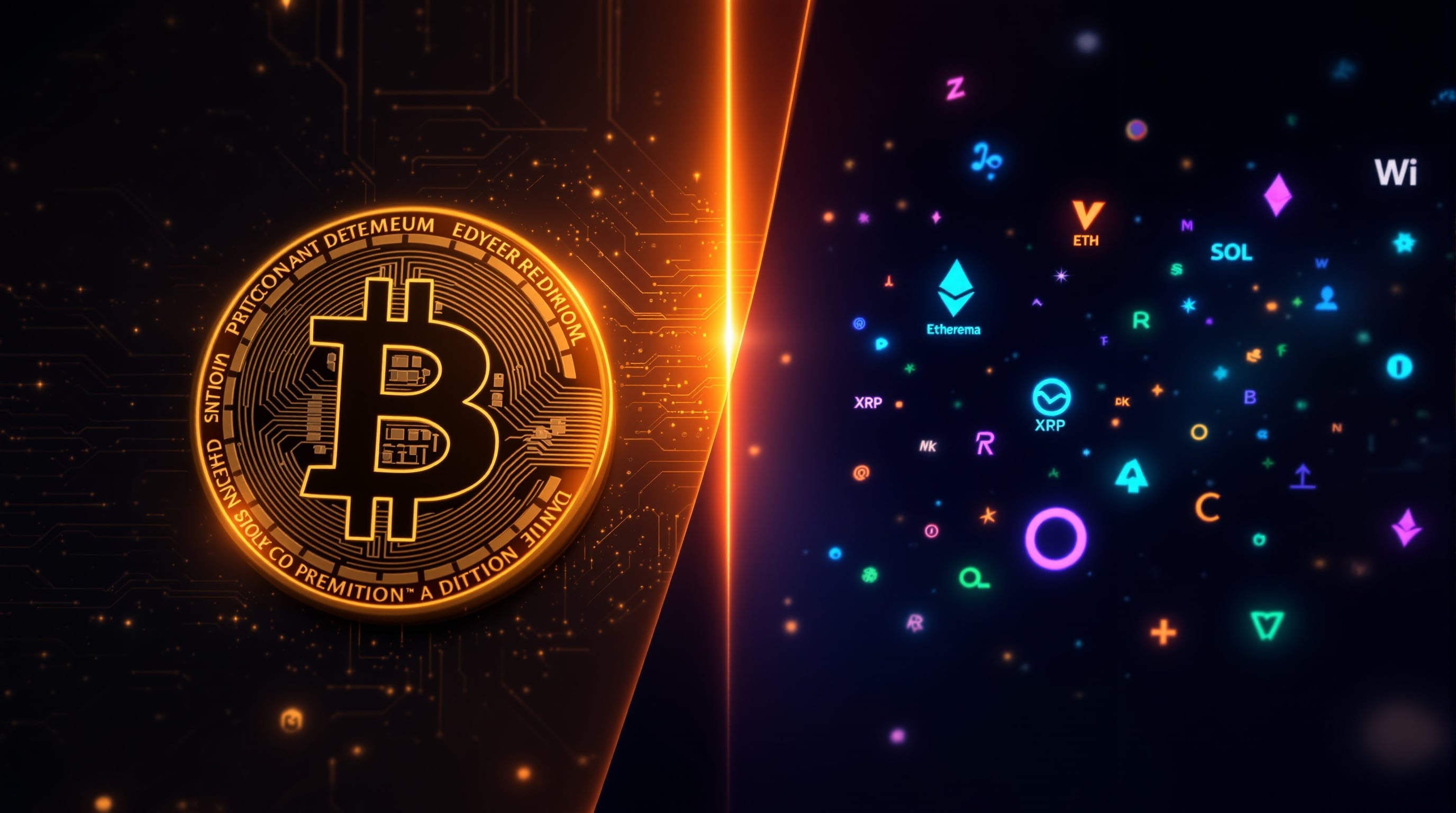
The Bitcoin vs altcoins debate is one of the first questions every new crypto investor faces — and in 2026, the answer is more nuanced than ever. Bitcoin dominance sits at 59–60%, reflecting institutional preference for the market's most liquid asset. But isolated pockets of altcoin strength are emerging in sectors with real utility: decentralized AI infrastructure, real-world asset tokenization, and high-performance Layer-1 blockchains. Here's what you need to know to make an informed decision.
This article contains affiliate links. We may earn a commission at no extra cost to you if you make a purchase through these links. See our affiliate disclosure for details.
Bitcoin in 2026: The Institutional Anchor
Bitcoin's role in the 2026 market is clearer than it's ever been: it's the defensive anchor. When macro uncertainty rises — geopolitical tensions, ETF outflows, regulatory ambiguity — capital flows into Bitcoin first. This is why BTC dominance has remained elevated at 59–60% even as the broader market has matured.
The numbers tell the story. Bitcoin spot ETFs attracted massive inflows in Q1 2026, though May saw $2.30 billion in net outflows — the largest monthly exit of the year. Despite this, Bitcoin held the $72,000–$74,000 range entering June, demonstrating the resilience that comes from deep institutional ownership and a fixed supply schedule.
For beginners, Bitcoin's case is simple: it's the most liquid, most regulated, and most institutionally supported crypto asset in existence. It's the foundation of any serious crypto portfolio.
Altcoins in 2026: Where the Opportunities Are
The 2026 altcoin market is not the 2021 altcoin market. The era of "everything pumps" is over. What's replaced it is a more selective environment where protocols with verifiable revenue, real-world utility, and institutional backing outperform, while speculative tokens without fundamentals get crushed.
The sectors showing genuine strength in June 2026:
Layer-1 Blockchains
Solana (SOL) remains the standout performer, favored for its high throughput and integration into traditional fintech platforms like Visa and PayPal. Analyst price targets for SOL range from $180 to $220 for the current cycle.
Decentralized AI Infrastructure
This is the primary narrative of 2026. Bittensor (TAO) — with its distributed node architecture and supply scarcity following its 2025 halving — has targets between $450 and $500. Near Protocol (NEAR) is gaining traction for enabling autonomous AI agents and cross-chain "user intents," with targets of $8.50–$11.00.
Real-World Asset (RWA) Tokenization
Ondo Finance (ONDO) leads this category by bridging institutional-grade financial products — US Treasuries, money market funds — onto public blockchains. As interest rates shift, RWA protocols that offer on-chain yield become increasingly attractive to institutional capital. Price targets: $2.50–$3.10.

Bitcoin Dominance: What It Tells You About Market Phase
Bitcoin dominance is one of the most useful indicators for timing altcoin exposure. Here's how to read it:
- Dominance rising (above 60%): Capital is flowing into Bitcoin, away from altcoins. This is a "risk-off" phase — stick to BTC and ETH.
- Dominance falling (below 55%): Capital is rotating into altcoins. This is when selective altcoin positions can generate outsized returns.
- Current reading (59–60%): We're in a transitional phase. Bitcoin is still dominant, but the Altcoin Season Index is showing early rotation signals. Selective altcoin exposure in high-conviction sectors makes sense.
The key word is "selective." A broad-based altcoin season hasn't materialized in 2026 — instead, we're seeing isolated pockets of strength in sectors with real fundamentals. Chasing random altcoins based on social media hype remains a losing strategy.
How to Allocate: A Framework for Beginners
Here's a practical allocation framework based on risk tolerance:
Conservative (Low Risk Tolerance)
- 70% Bitcoin
- 20% Ethereum
- 10% cash/stablecoins for buying dips
Moderate (Medium Risk Tolerance)
- 50% Bitcoin
- 25% Ethereum
- 15% Large-cap altcoins (SOL, XRP)
- 10% Mid-cap sector plays (AI, RWA)
Aggressive (High Risk Tolerance)
- 40% Bitcoin
- 20% Ethereum
- 25% Large-cap altcoins
- 15% Mid-cap/emerging sector plays
Whatever your allocation, securing your assets is non-negotiable. Protect your crypto assets with a Ledger hardware wallet — the gold standard in cold storage security. For more on portfolio tracking across Bitcoin and altcoins, see our guide on Best Crypto Portfolio Trackers in 2026.

How to Evaluate an Altcoin Before Buying
Before putting money into any altcoin, run through this checklist:
- What problem does it solve? If you can't explain the use case in one sentence, skip it.
- Does it have protocol revenue? In 2026, the market rewards protocols that generate real fees, not just token inflation.
- Who's building it? Check the team's track record. Anonymous teams with no accountability are a red flag.
- What's the token distribution? High insider/VC allocations with short vesting periods create selling pressure.
- Is there institutional interest? ETF filings, venture backing, and exchange listings signal legitimacy.
- What's the liquidity? Low-liquidity tokens are easy to pump and dump. Stick to assets with meaningful daily trading volume.
For a structured approach to analyzing crypto assets, Icoinpro offers step-by-step training that covers both Bitcoin fundamentals and altcoin evaluation frameworks.
Frequently Asked Questions
Should I buy Bitcoin or altcoins as a beginner in 2026?
Start with Bitcoin. It's the most liquid, most regulated, and most institutionally supported asset in crypto. Once you understand how Bitcoin works and have a stable position, you can selectively add altcoins in sectors you understand well.
What is Bitcoin dominance and why does it matter?
Bitcoin dominance is Bitcoin's market cap as a percentage of total crypto market cap. In June 2026, it sits at 59–60%. Rising dominance signals capital flowing into Bitcoin (risk-off); falling dominance signals rotation into altcoins (risk-on). It's one of the best indicators for timing altcoin exposure.
Is altcoin season happening in 2026?
Not broadly. The 2026 market is showing "isolated pockets of strength" in specific sectors (AI infrastructure, RWA tokenization, high-performance L1s) rather than a broad-based altcoin season. Selective exposure to fundamentally strong projects is the right approach.
Which altcoins are performing best in June 2026?
Solana (SOL), Bittensor (TAO), Near Protocol (NEAR), and Ondo Finance (ONDO) are among the standout performers in their respective sectors. XRP is consolidating ahead of the CLARITY Act catalyst.
How much of my portfolio should be in altcoins?
For beginners, keep altcoin exposure to 10–25% of your crypto portfolio. The higher the risk tolerance, the higher the altcoin allocation — but never at the expense of your Bitcoin and Ethereum core positions.
September 2026 Market Update: Bitcoin Season Is Here
The Bitcoin vs. altcoins debate looks very different in September 2026 than it did earlier this year. Here's the current picture:
- Bitcoin dominance sits at ~59–60%: Capital is concentrating in Bitcoin, not rotating broadly into altcoins. This is a "Bitcoin Season" by every metric that matters.
- Altcoin Season Index: 27–39: Well below the 75 threshold needed to confirm an altseason. Fewer than 40% of the top 50 altcoins are outperforming Bitcoin over the past 90 days.
- Selective strength in large-caps: ETH and XRP have shown relative strength due to specific catalysts — Ethereum's continued institutional adoption and XRP's regulatory clarity. But this isn't a broad altcoin rally.
- FOMC September 15–16 is the key catalyst: The Federal Reserve meeting this week could shift the macro picture significantly. A hawkish surprise (rate hike probability near 60%) would likely pressure risk assets including altcoins harder than Bitcoin.
- GENIUS Act and MiCA filtering the field: Regulatory frameworks in the US and EU are pushing investors toward assets listed on compliant exchanges. Unregulated or low-liquidity altcoins face increasing headwinds.
For beginners right now, the data supports a conservative core-satellite approach: 50–60% Bitcoin, 25–35% Ethereum, 10–15% stablecoins, and no more than 5–10% in higher-risk altcoins like Solana. Dollar-cost averaging remains the most sensible entry strategy in this environment.
Updated FAQ: Bitcoin vs. Altcoins in September 2026
- Is it still a good time to buy altcoins in September 2026?
- The data says proceed with caution. Bitcoin dominance at 59–60% and an Altcoin Season Index below 40 suggest capital is not rotating into altcoins broadly. Large-caps like ETH and SOL may offer selective opportunities, but speculative small-cap altcoins carry elevated risk right now.
- What is Bitcoin dominance and why does it matter?
- Bitcoin dominance measures Bitcoin's market cap as a percentage of total crypto market cap. When it's high (above 55%), it typically means investors prefer Bitcoin's relative safety over altcoin speculation. When it falls below 45%, it often signals an altcoin season is underway.
- How does the FOMC meeting affect Bitcoin vs. altcoins?
- Federal Reserve rate decisions affect all risk assets, but altcoins typically react more violently than Bitcoin. A rate hike or hawkish signal tends to hit smaller-cap altcoins harder. Bitcoin, with its institutional ETF backing, has shown more resilience to macro shocks in 2026.
- Should beginners focus on Bitcoin only?
- Not necessarily, but Bitcoin should be the foundation. A 50–60% Bitcoin allocation gives you exposure to the market's most liquid and institutionally-backed asset. Adding Ethereum (25–35%) gives smart-contract exposure. Keep speculative altcoin bets small — 5–10% maximum — until you understand the risks.
Key Takeaways
- Bitcoin dominance sits at 59–60% in June 2026 — BTC remains the institutional anchor and portfolio foundation.
- Altcoin season hasn't broadly materialized; strength is concentrated in AI infrastructure, RWA tokenization, and high-performance L1s.
- Evaluate altcoins on protocol revenue, team credibility, token distribution, and institutional interest — not hype.
- Use Bitcoin dominance as a timing indicator: falling dominance signals rotation into altcoins.
- Beginners should start with BTC/ETH and add altcoins selectively as their knowledge grows.
Disclaimer: This content is for informational purposes only and should not be considered financial advice. Cryptocurrency investments carry significant risk. Always do your own research (DYOR) before making any investment decisions.
Want structured training instead of piecing it together yourself?
Self-education works, but it's slow. The course that accelerated my learning the most gave me a daily framework — real market analysis, real setups, real accountability.
The program I recommend to people who ask me is this crypto trading course — it\'s the one I point friends and family to when they\'re serious about learning. Daily lessons, live analysis, and a community that actually helps.
Affiliate link — I may earn a commission at no extra cost to you. I only recommend what I genuinely use.
Disclaimer: The information provided on this website is for educational and informational purposes only. It should not be considered financial or investment advice. Cryptocurrency investments carry significant risk. Always do your own research and consult with a qualified financial advisor before making investment decisions.
Free Crypto Insights
Get weekly trading tips, market analysis, and exclusive strategies delivered to your inbox.