Best Crypto Portfolio Trackers in 2026: Track Every Coin, Wallet & DeFi Position
Affiliate Disclosure: This article may contain affiliate links. We may earn a commission at no extra cost to you. All opinions are our own.
Marcus Chen
Senior Crypto Analyst & Educator
Certified Blockchain Professional | Former Wall Street Analyst
Marcus Chen is a cryptocurrency analyst and educator with over 8 years of experience in digital asset trading. He has helped thousands of beginners navigate the crypto markets through practical, actionable education.
Disclaimer: This content is for informational purposes only and should not be considered financial advice. Cryptocurrency investments carry significant risk. Always do your own research (DYOR) before making any investment decisions.
This article contains affiliate links. We may earn a commission at no extra cost to you if you make a purchase through these links. See our affiliate disclosure for details.
Best Crypto Portfolio Trackers in 2026: Track Every Coin, Wallet & DeFi Position
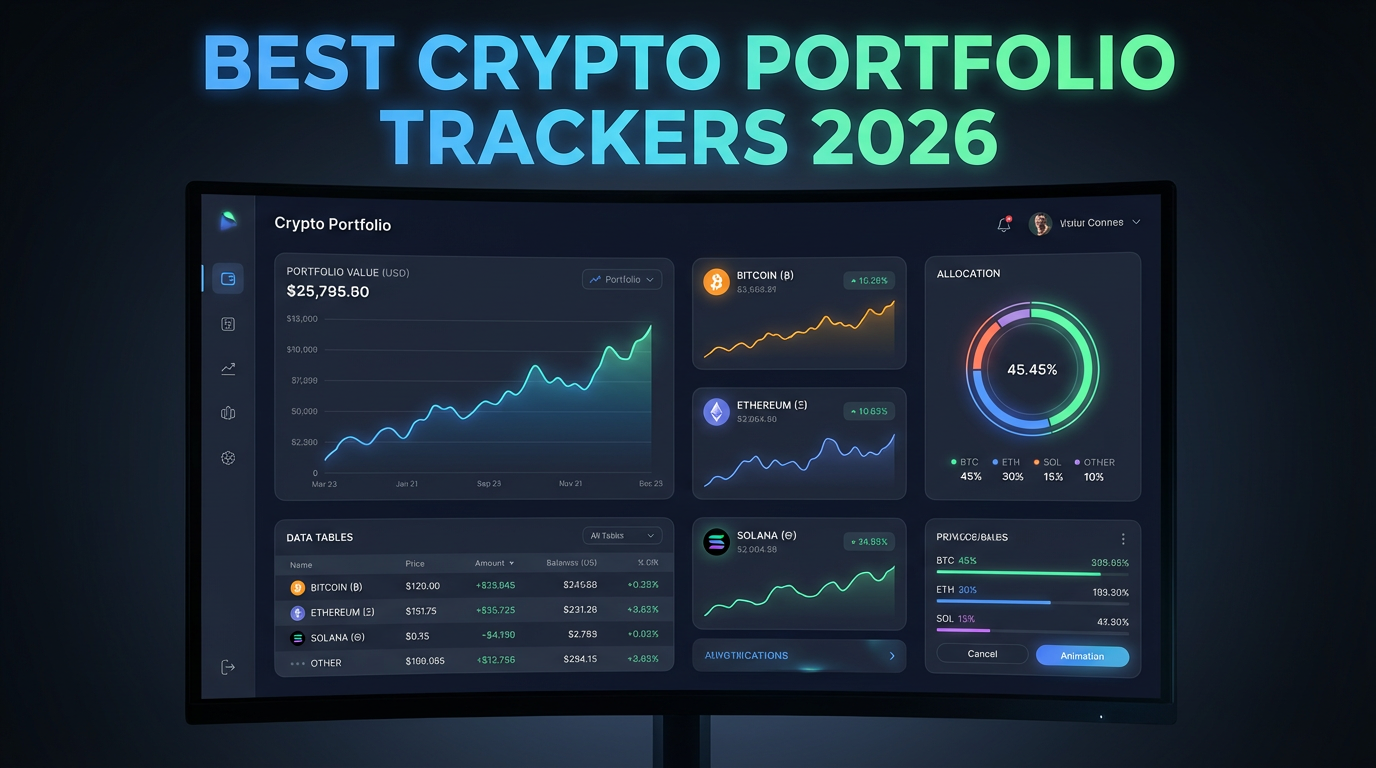
The best crypto portfolio trackers in 2026 do a lot more than show you a price chart. With hundreds of blockchains, thousands of DeFi protocols, and NFT positions scattered across wallets, you need a tool that actually keeps up. This updated guide covers the top options as of August 2026 — including new AI features, DeFi coverage improvements, and which tracker fits which type of investor.
What to Look for in a Crypto Portfolio Tracker
Before diving into specific tools, here’s what separates a good tracker from a great one in 2026:
- Multi-chain support: You need coverage across Ethereum, Solana, Base, Arbitrum, Avalanche, and more.
- DeFi protocol integration: Staked positions, LP tokens, and lending positions should show up automatically.
- Read-only API keys only: Never grant withdrawal or trading permissions to a tracker. This is non-negotiable.
- Tax reporting: If you’re in a jurisdiction with crypto capital gains tax, integrated tax reporting saves hours.
- Privacy: Free services may monetize your data. Subscription-based trackers are generally more privacy-respecting.
Best All-Around: CoinStats
CoinStats remains the top pick for most crypto investors in August 2026. It supports over 120 blockchains, 300+ wallets and exchanges, and 1,000+ DeFi protocols. The unified dashboard shows coins, tokens, NFTs, and staked positions in one place, with real-time updates and an AI assistant for research and risk scanning.
The free tier is genuinely useful. The paid tier unlocks advanced analytics and priority support. For anyone with a multi-chain DeFi portfolio, CoinStats is the most comprehensive option available.
Best for Tax Compliance: CoinLedger
If tax reporting is your primary concern, CoinLedger is the clear choice. It integrates directly with TurboTax and H&R Block, supports FIFO, LIFO, and other cost-basis methods, and offers automated tax-loss harvesting alerts. The data import from major exchanges is seamless, and the user ratings are consistently high.
CoinLedger doesn’t have the DeFi depth of CoinStats, but for straightforward exchange-based portfolios with tax reporting needs, it’s the most polished option.
Best for Total Net Worth: Kubera
Kubera is less a crypto tracker and more a personal balance sheet. It tracks crypto alongside traditional bank accounts, brokerages, real estate, and physical assets. High-net-worth individuals who want a single “big picture” view of their entire financial life — including estate planning features — will find Kubera invaluable.
It lacks the granular DeFi protocol analytics of dedicated crypto trackers, but that’s not its purpose. If you want to see your Bitcoin, your brokerage account, and your rental property value in one dashboard, Kubera is the tool.
Best for AI-Driven Analysis: Portfolio Genius
Portfolio Genius is the newest entrant making waves in 2026. It tracks both crypto and traditional assets (stocks/ETFs) and uses AI to analyze the entire portfolio — flagging concentration risk, suggesting rebalancing moves, and providing specific recommendations. For investors who don’t want to silo their financial life between a crypto tracker and a stock tracker, Portfolio Genius is the most integrated option.
Best for Mobile: Delta (by eToro)
Delta, owned by eToro, is the strongest mobile-first option. It supports both crypto and traditional assets, offers detailed trade insights, and has a clean interface that doesn’t feel cluttered on a phone screen. If you check your portfolio on your phone more than your desktop, Delta is worth a look.
Best for DeFi-Native Users: Zerion
Zerion is built for users who live on-chain. It’s wallet-first — connect your address and see all your EVM-based positions instantly, no account creation required. Real-time DeFi analytics, deep support for Ethereum and L2 networks, and a clean interface make it the go-to for DeFi power users.
The tradeoff: Zerion’s coverage is primarily EVM chains. If you have significant Solana or Bitcoin positions, you’ll need a supplementary tool.
Comparison Table
| Tracker | Best For | Stocks+Crypto | AI Insights | Price |
|---|---|---|---|---|
| CoinStats | All-in-one / DeFi | No | Yes | Free / Paid |
| CoinLedger | Tax Reporting | No | No | Paid |
| Kubera | Net Worth | Yes | No | Subscription |
| Portfolio Genius | AI Analysis | Yes | Yes | Free / Paid |
| Delta | Mobile | Yes | No | Free / Paid |
| Zerion | DeFi-Native | No | No | Free / Paid |
For a broader look at crypto research tools, see our guide on best crypto research tools in 2026.
Security Best Practices for Portfolio Trackers
A few rules that apply regardless of which tracker you choose:
- Read-only API keys only. Never grant withdrawal or trading permissions.
- Wallet address tracking is safer than API keys. Most trackers can read your on-chain positions just from your public address.
- Be cautious with free services. If you’re not paying, your data may be the product.
- Keep your actual assets in cold storage. A tracker shows you your portfolio; a hardware wallet protects it.
Protect your actual holdings with the Ledger Nano X — the gold standard in cold storage security.
FAQ: Crypto Portfolio Trackers 2026
Q: Which crypto portfolio tracker is best for DeFi?
A: CoinStats for broad multi-chain DeFi coverage; Zerion for EVM-native DeFi users who want a wallet-first experience.
Q: Can portfolio trackers access my funds?
A: Only if you grant them trading or withdrawal API permissions — which you should never do. Use read-only API keys or wallet address tracking only.
Q: Is CoinStats free?
A: CoinStats has a free tier with solid functionality. The paid tier unlocks advanced analytics and priority support.
Q: Which tracker is best for tax reporting?
A: CoinLedger. It integrates directly with TurboTax and H&R Block and supports multiple cost-basis methods.
Q: Does Zerion support Solana?
A: Zerion’s primary focus is EVM chains. Solana coverage is limited — use CoinStats or Delta for multi-chain including Solana.
Actionable Takeaways
- CoinStats is the best all-around tracker for multi-chain DeFi portfolios in August 2026.
- CoinLedger is the top choice for tax reporting and TurboTax integration.
- Kubera is best for high-net-worth investors who want crypto + traditional assets in one view.
- Portfolio Genius adds AI-driven analysis across crypto and stocks.
- Always use read-only API keys or wallet address tracking — never grant withdrawal permissions.
Want to accelerate your crypto investing knowledge? Icoinpro offers step-by-step training that has helped thousands of beginners build a structured approach to crypto markets.
How to Set Up Your Portfolio Tracker Securely
Getting the most out of a portfolio tracker without compromising security requires a few deliberate steps:
- Use wallet address tracking where possible. Most trackers can read your on-chain positions just from your public wallet address. No API key needed, no security risk.
- For exchange tracking, create read-only API keys. Every major exchange lets you create API keys with specific permissions. Enable only “read” or “view” permissions. Never enable withdrawal or trading permissions for a tracker.
- Audit your connected apps quarterly. Review which apps have API access to your exchange accounts and revoke any you no longer use.
- Use a dedicated email for tracker accounts. Separating your tracker login from your exchange login reduces the blast radius if either account is compromised.
Free vs Paid Trackers: Is the Upgrade Worth It?
Most trackers offer a free tier that covers basic portfolio tracking. The paid tiers typically unlock:
- More connected wallets and exchanges
- Advanced analytics and performance attribution
- Tax reporting features
- Priority customer support
- Ad-free experience
For casual investors with a simple portfolio (one or two exchanges, no DeFi), the free tier of CoinStats or Delta is usually sufficient. For active DeFi users or anyone with tax reporting needs, the paid tier pays for itself quickly in time saved.
Want structured training instead of piecing it together yourself?
Self-education works, but it's slow. The course that accelerated my learning the most gave me a daily framework — real market analysis, real setups, real accountability.
The program I recommend to people who ask me is this crypto trading course — it\'s the one I point friends and family to when they\'re serious about learning. Daily lessons, live analysis, and a community that actually helps.
Affiliate link — I may earn a commission at no extra cost to you. I only recommend what I genuinely use.
Disclaimer: The information provided on this website is for educational and informational purposes only. It should not be considered financial or investment advice. Cryptocurrency investments carry significant risk. Always do your own research and consult with a qualified financial advisor before making investment decisions.
Free Crypto Insights
Get weekly trading tips, market analysis, and exclusive strategies delivered to your inbox.