Best Crypto Research Tools 2026: 7 Platforms That Give You the Real Edge
Affiliate Disclosure: This article may contain affiliate links. We may earn a commission at no extra cost to you. All opinions are our own.
Marcus Chen
Senior Crypto Analyst & Educator
Certified Blockchain Professional | Former Wall Street Analyst
Marcus Chen is a cryptocurrency analyst and educator with over 8 years of experience in digital asset trading. He has helped thousands of beginners navigate the crypto markets through practical, actionable education.
Best Crypto Research Tools 2026: 7 Platforms That Give You the Real Edge
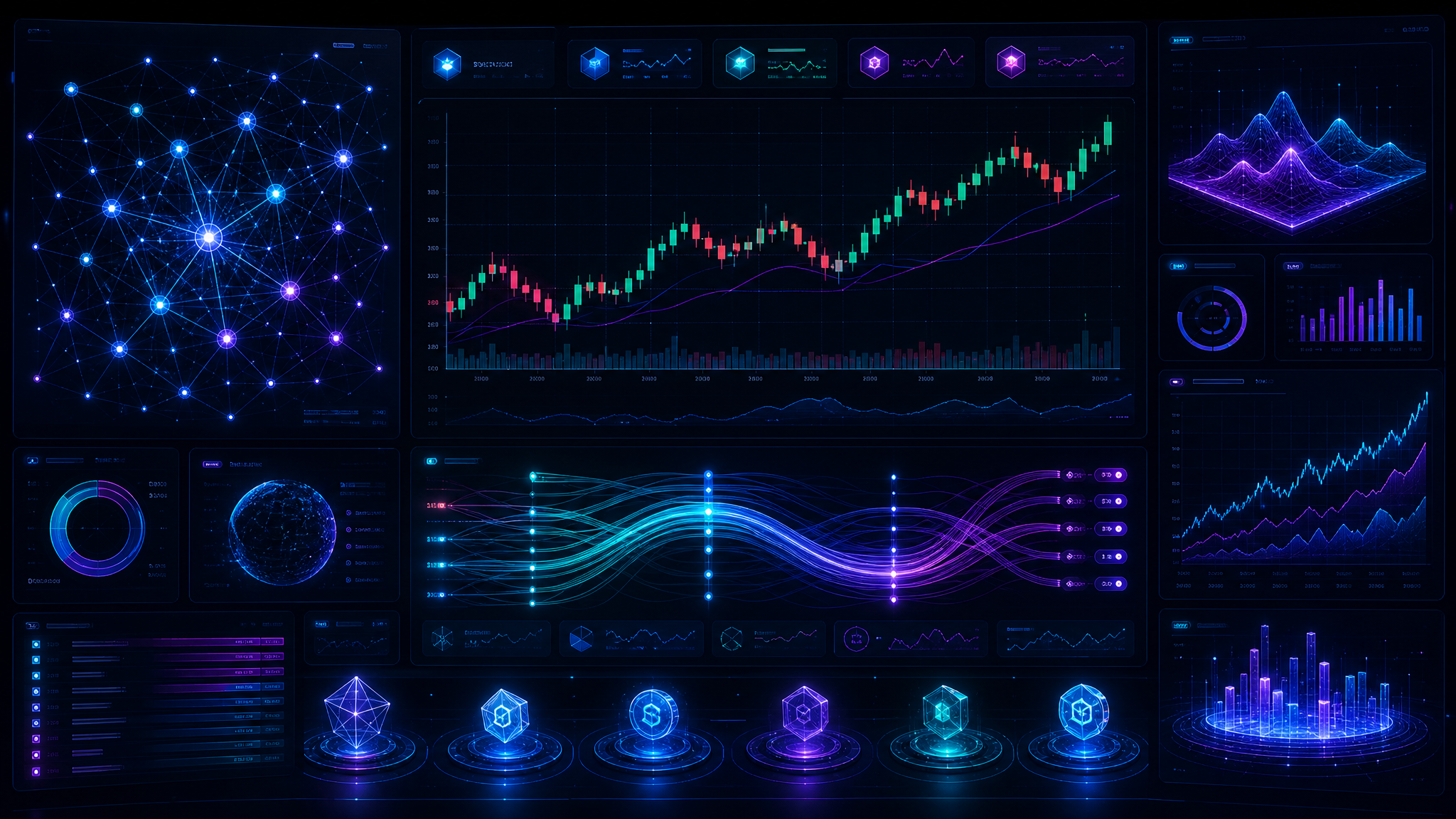
If you're serious about crypto in 2026, the right crypto research tools aren't optional—they're the difference between reacting to price moves and actually anticipating them. The market has matured. Retail traders who rely on Twitter sentiment and CoinMarketCap price checks are competing against funds running Glassnode dashboards, Nansen wallet trackers, and custom Dune queries. That gap is real, and it's widening.
The good news? You don't need a Bloomberg terminal or a quant team. The seven platforms in this guide cover every analytical layer—macro cycle analysis, smart money tracking, DeFi fundamentals, derivatives positioning, and technical charting. Some are free. Some cost money. All of them are worth knowing.
Why Your Research Stack Matters More Than Ever in 2026
The 2024-2025 bull cycle changed something fundamental. Institutional capital—ETF inflows, corporate treasuries, sovereign wealth funds—now moves markets in ways that pure technical analysis can't capture. When BlackRock's Bitcoin ETF sees $800M in daily inflows, that shows up on-chain before it shows up in price. When a major DeFi protocol's TVL quietly drops 30% over two weeks, that's a signal most retail traders miss entirely.
The analysts who caught these moves early weren't lucky. They were watching the right data. Here's what they were using.
The 7 Best Crypto Research Tools in 2026
1. Glassnode — Best for Macro Cycle Analysis
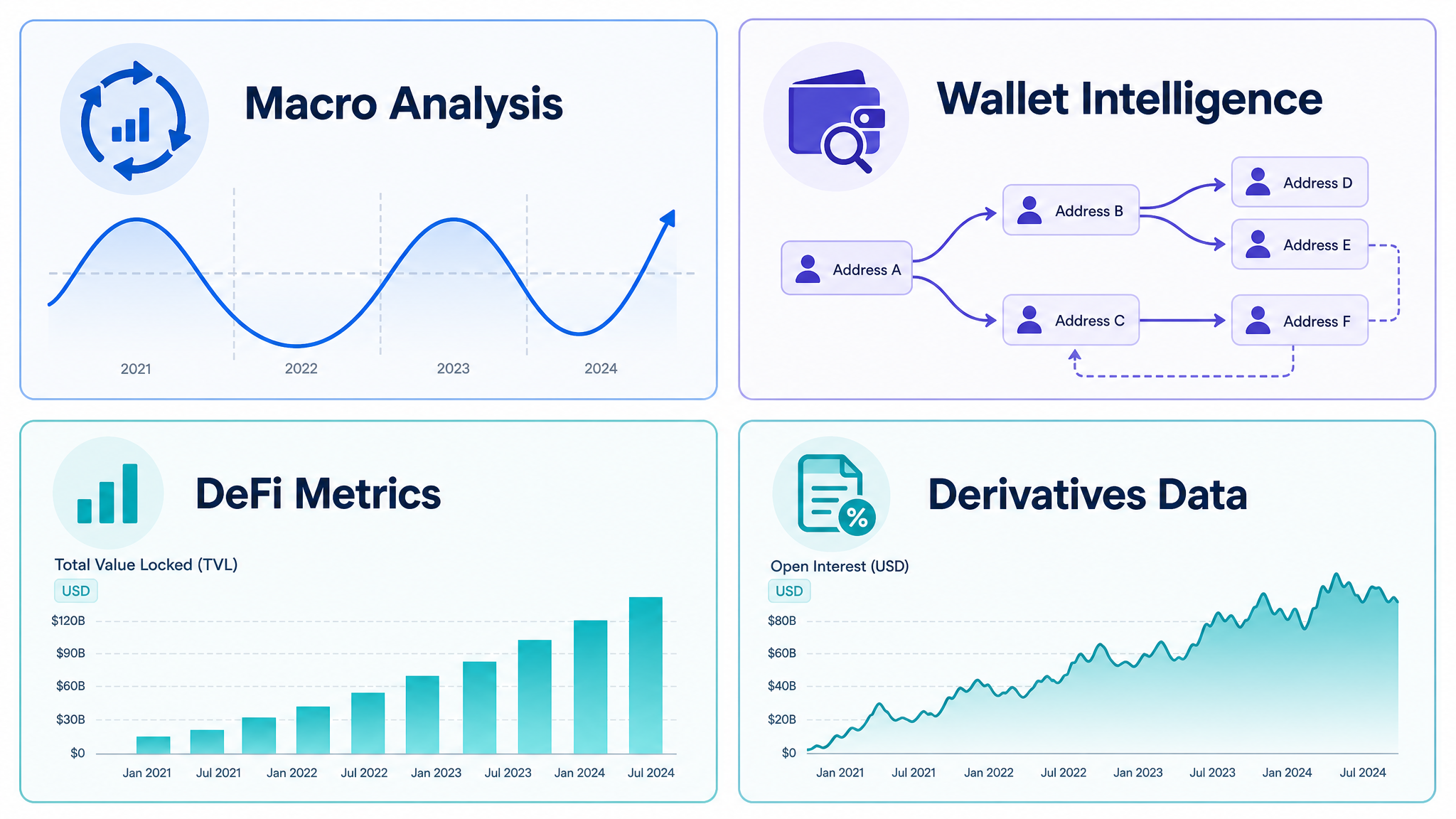
Glassnode is the gold standard for understanding where we are in the Bitcoin and Ethereum market cycle. It doesn't track individual wallets—it aggregates behavior across the entire network to give you a macro picture that's genuinely hard to get anywhere else.
The platform's signature metrics include the MVRV Z-Score (which historically identifies market tops and bottoms), the SOPR (Spent Output Profit Ratio, showing whether holders are selling at a profit or loss), and Exchange Net Position Change (tracking whether coins are flowing onto exchanges—a bearish signal—or off them).
In practical terms: during the May 2026 Bitcoin rally past $80K, Glassnode's MVRV data showed the market was approaching but hadn't yet hit the "overheated" zone that preceded the 2021 top. That context matters when deciding whether to take profits or hold.
Pricing: Free tier available. Advanced metrics start at ~$29/month. Institutional plans run higher.
Best for: Long-term investors, swing traders, anyone trying to time market cycles.
2. Nansen — Best for Smart Money Tracking
Nansen's core insight is simple but powerful: not all wallets are equal. Some belong to top-performing funds, early protocol insiders, and sophisticated traders who consistently get in before the crowd. Nansen has labeled over 500 million wallet addresses, turning raw blockchain data into "Smart Money" signals. When labeled fund wallets quietly accumulate a mid-cap altcoin over two weeks, that's information. When those same wallets start distributing, that's also information.
The platform covers 30+ chains, which matters in 2026's multi-chain environment. You can track capital rotating from Ethereum to Solana to Base in near real-time. The "Token God Mode" dashboard shows you exactly which wallets hold a given token and what they've been doing with it.
Pricing: Starter plan around $150/month. Not cheap, but serious traders treat it as a cost of doing business.
Best for: Active traders, altcoin researchers, anyone who wants to follow institutional-grade capital flows.
3. DeFiLlama — Best Free DeFi Analytics Tool
DeFiLlama is the rare tool that's both free and genuinely excellent. It tracks Total Value Locked (TVL), protocol revenue, DEX volumes, stablecoin flows, and yields across thousands of protocols and hundreds of chains. The data is open-source and methodology is transparent—no inflated numbers, no double-counting borrowed capital.
For DeFi research, it's indispensable. Want to know if a protocol's TVL growth is organic or just incentive farming? DeFiLlama's revenue vs. TVL comparison tells you. Trying to find the best stablecoin yield across chains? The yields aggregator does that in seconds.
The platform also tracks token unlocks—critical for altcoin investors. A project with $200M in tokens unlocking next month has a very different risk profile than one with a clean vesting schedule.
Pricing: Free. Completely free. Bookmark it now.
Best for: DeFi investors, yield farmers, anyone evaluating protocol fundamentals.
4. CoinGlass — Best for Derivatives Data
Most retail traders ignore the derivatives market until it bites them. CoinGlass makes that ignorance inexcusable. It aggregates real-time data on perpetual futures and options across major exchanges—open interest, funding rates, liquidation heatmaps, and long/short ratios.
Here's why this matters: when Bitcoin's open interest hits extreme highs while funding rates are deeply positive, the market is overleveraged long. That's a setup for a liquidation cascade, not a continuation. CoinGlass shows you this before it happens.
The liquidation heatmap is particularly useful. It shows price levels where large clusters of leveraged positions would get wiped out, which often act as magnets for price action. Experienced traders use these levels to set entries and exits.
Pricing: Free tier covers most use cases. Pro plan adds historical data and API access.
Best for: Futures traders, options traders, anyone who wants to understand market structure and leverage dynamics.
5. Token Terminal — Best for Protocol Fundamentals
Token Terminal treats crypto protocols like businesses—because that's what they are. It tracks revenue, fees, active users, and valuation ratios (like Price-to-Sales) across blockchains and DeFi protocols. This is equity-style fundamental analysis applied to crypto.
The insight it provides is genuinely different from price-based analysis. A protocol trading at a high P/S ratio relative to its revenue might be overvalued. One generating consistent fee revenue with a low market cap might be undervalued. These are the kinds of comparisons that Token Terminal makes easy.
In 2026, with more institutional capital applying traditional valuation frameworks to crypto assets, understanding protocol fundamentals has become a real edge. Token Terminal is where you build that understanding.
Pricing: Free tier available. Pro access with full historical data and API starts around $50/month.
Best for: Fundamental analysts, long-term investors, anyone evaluating DeFi protocols as investments.
6. Arkham Intelligence — Best for Entity Investigation
Arkham does something the other tools don't: it tries to de-anonymize blockchain activity by linking wallet addresses to real-world entities. Exchanges, funds, protocols, known individuals—Arkham maps the connections between them.
The platform's Visualizer tool is genuinely impressive. You can trace fund flows between entities, see how capital moved after a hack, or understand the relationship between a project's treasury and its market activity. The Intel Exchange lets users buy and sell on-chain research, creating a marketplace for blockchain intelligence.
For most retail investors, Arkham is more of a "when you need it" tool than a daily driver. But when a major exchange collapse or protocol exploit happens, it's the first place serious researchers go to understand what actually occurred.
Pricing: Free tier available. Premium features require ARKM token or subscription.
Best for: Investigative research, tracking hacked funds, understanding entity-level market dynamics.
7. TradingView — Best for Technical Analysis and Charting
No research stack is complete without a charting platform, and TradingView remains the industry standard. It's not crypto-specific—it covers stocks, forex, commodities, and crypto—which is actually a feature. Seeing Bitcoin's price action in the context of the broader macro environment (DXY, gold, S&P 500) adds context that crypto-only charts miss.
The platform's community-built indicator library is enormous. Pine Script lets you code custom indicators. Multi-chart layouts let you monitor multiple assets simultaneously. Alerts can be set on price levels, indicator crossovers, or custom conditions.
For crypto specifically, TradingView's integration with major exchanges means you can execute trades directly from the chart on some platforms. The free tier is genuinely useful; the Pro tier ($14.95/month) removes ads and adds more indicators per chart.
Pricing: Free tier available. Pro starts at $14.95/month.
Best for: Technical traders, anyone who uses chart-based analysis as part of their strategy.
How to Build Your Crypto Research Stack
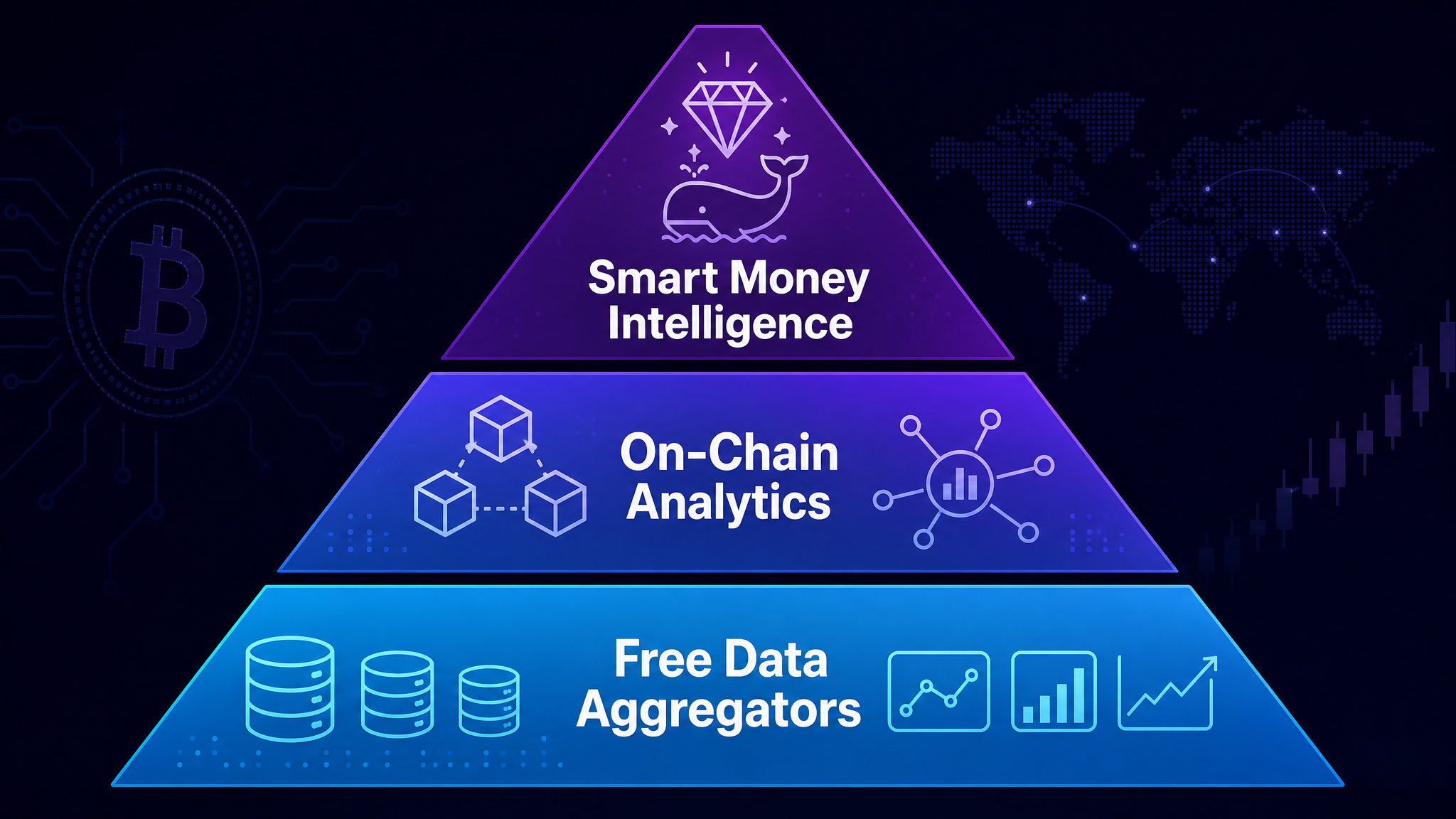
You don't need all seven tools running simultaneously. The right stack depends on your trading style and goals. Here's how to think about it:
If you're a long-term investor: Start with Glassnode (macro cycle context) + DeFiLlama (DeFi fundamentals) + Token Terminal (protocol valuation). Add TradingView for entry/exit timing. Total cost: potentially free if you use the free tiers.
If you're an active altcoin trader: Nansen (smart money flows) + DeFiLlama (TVL and yield data) + CoinGlass (derivatives positioning) + TradingView (technical analysis). This stack gives you both fundamental and market structure context.
If you're a DeFi yield farmer: DeFiLlama is your primary tool. Add Token Terminal to evaluate protocol sustainability. Arkham is useful for checking if a protocol's treasury is being managed responsibly.
The key principle: each tool should answer a specific question. "Where are we in the cycle?" (Glassnode). "Where is smart money going?" (Nansen). "Is this protocol generating real revenue?" (Token Terminal). "Is the market overleveraged?" (CoinGlass). Stack the answers, and you have a research process most retail traders lack.
Want to pair your research skills with structured trading education? Check out Icoinpro's comprehensive trading course.
Free vs. Paid: What's Actually Worth Paying For?
The free tiers of DeFiLlama, CoinGlass, TradingView, and Arkham cover a lot of ground. If you're just starting out, you can build a solid research foundation without spending a dollar.
The paid tools that justify their cost: Glassnode's advanced metrics (the MVRV Z-Score and SOPR data alone are worth the entry-level subscription for cycle investors) and Nansen (if you're actively trading altcoins and want smart money signals). Token Terminal's Pro tier is worth it if you're doing serious fundamental analysis.
Nansen at $150/month sounds steep until you consider that one well-timed trade based on smart money signals can pay for years of subscription. The math works if you're actively using the data—and if you're not, you probably don't need it yet.
Protect your research-backed gains with proper security. Protect your crypto assets with a Ledger hardware wallet — the gold standard in cold storage security.
Key Takeaways
- Glassnode is the best tool for macro cycle analysis—essential for timing entries and exits in Bitcoin and Ethereum.
- Nansen gives you smart money signals by tracking labeled wallet behavior across 30+ chains.
- DeFiLlama is the best free DeFi analytics platform—TVL, yields, revenue, token unlocks, all in one place.
- CoinGlass shows you derivatives market structure—open interest, funding rates, and liquidation levels that drive price action.
- Token Terminal applies fundamental analysis to crypto protocols, tracking revenue and valuation ratios.
- Arkham de-anonymizes blockchain activity and maps entity-level fund flows.
- TradingView remains the standard for technical charting and multi-asset analysis.
- Build your stack based on your trading style—you don't need all seven tools, but you need the right ones for your strategy.
For a deep dive into Bitcoin's monetary philosophy, grab a copy of The Bitcoin Standard—essential context for why on-chain metrics matter.
About the Author
Marcus Chen is a Senior Crypto Analyst & Educator with 8+ years of experience in digital asset markets. A Certified Blockchain Professional and Former Wall Street Analyst, Marcus has guided thousands of investors through multiple crypto market cycles. His research combines on-chain data analysis with traditional financial frameworks to provide actionable, evidence-based crypto insights.
Frequently Asked Questions: Crypto Research Tools in 2026
Q: What's the best free crypto research tool in 2026?
DeFiLlama remains the best free tool for DeFi data — tracking TVL, yields, fees, and protocol activity across thousands of protocols. For on-chain analytics, Dune Analytics offers a powerful free tier with community-built dashboards. CoinGecko and CoinMarketCap are still the go-to for broad market tracking and initial asset discovery.
Q: Has Glassnode remained the top on-chain analytics platform?
Yes. Glassnode continues to be the industry standard for institutional-grade Bitcoin and Ethereum macro analysis in 2026. Its proprietary metrics — MVRV Z-Score, SOPR, NUPL — remain essential for identifying market cycle turning points. It's best suited for long-term investors and institutional traders rather than short-term speculators.
Q: What new tools have emerged since this article was published?
Deep Blue Alpha has gained traction as an Ethereum-focused whale intelligence platform with a generous free tier. Bubblemaps has become widely used for visual token supply analysis — particularly for identifying insider clusters and rug pull risks in new token launches. Arkham Intelligence's "Intel Exchange" has expanded its community-driven entity attribution capabilities significantly.
Q: How should I build a crypto research stack on a budget?
Start with free tools: DeFiLlama (DeFi data), Dune Analytics (custom queries), CoinGecko (market data), and TradingView's free tier (charting). If you're actively trading, Nansen's entry-level plan is worth the cost for Smart Money tracking. Add Glassnode's paid tier when you're managing a portfolio large enough to benefit from macro cycle analysis.
Q: Are AI-powered research tools worth using in 2026?
Increasingly, yes. Token Metrics has integrated AI-driven screening and sentiment analysis that can surface emerging opportunities faster than manual research. However, AI tools work best as a first-pass filter — always validate signals with on-chain data from Glassnode or Nansen before making investment decisions. AI tools are prone to hallucinating data, so treat their outputs as hypotheses, not conclusions.
Want structured training instead of piecing it together yourself?
Self-education works, but it's slow. The course that accelerated my learning the most gave me a daily framework — real market analysis, real setups, real accountability.
The program I recommend to people who ask me is this crypto trading course — it\'s the one I point friends and family to when they\'re serious about learning. Daily lessons, live analysis, and a community that actually helps.
Affiliate link — I may earn a commission at no extra cost to you. I only recommend what I genuinely use.
Disclaimer: The information provided on this website is for educational and informational purposes only. It should not be considered financial or investment advice. Cryptocurrency investments carry significant risk. Always do your own research and consult with a qualified financial advisor before making investment decisions.
Free Crypto Insights
Get weekly trading tips, market analysis, and exclusive strategies delivered to your inbox.