Crypto Gas Fees Explained: What They Are and How to Pay Less in 2026
Affiliate Disclosure: This article may contain affiliate links. We may earn a commission at no extra cost to you. All opinions are our own.
Marcus Chen
Senior Crypto Analyst & Educator
Certified Blockchain Professional | Former Wall Street Analyst
Marcus Chen is a cryptocurrency analyst and educator with over 8 years of experience in digital asset trading. He has helped thousands of beginners navigate the crypto markets through practical, actionable education.
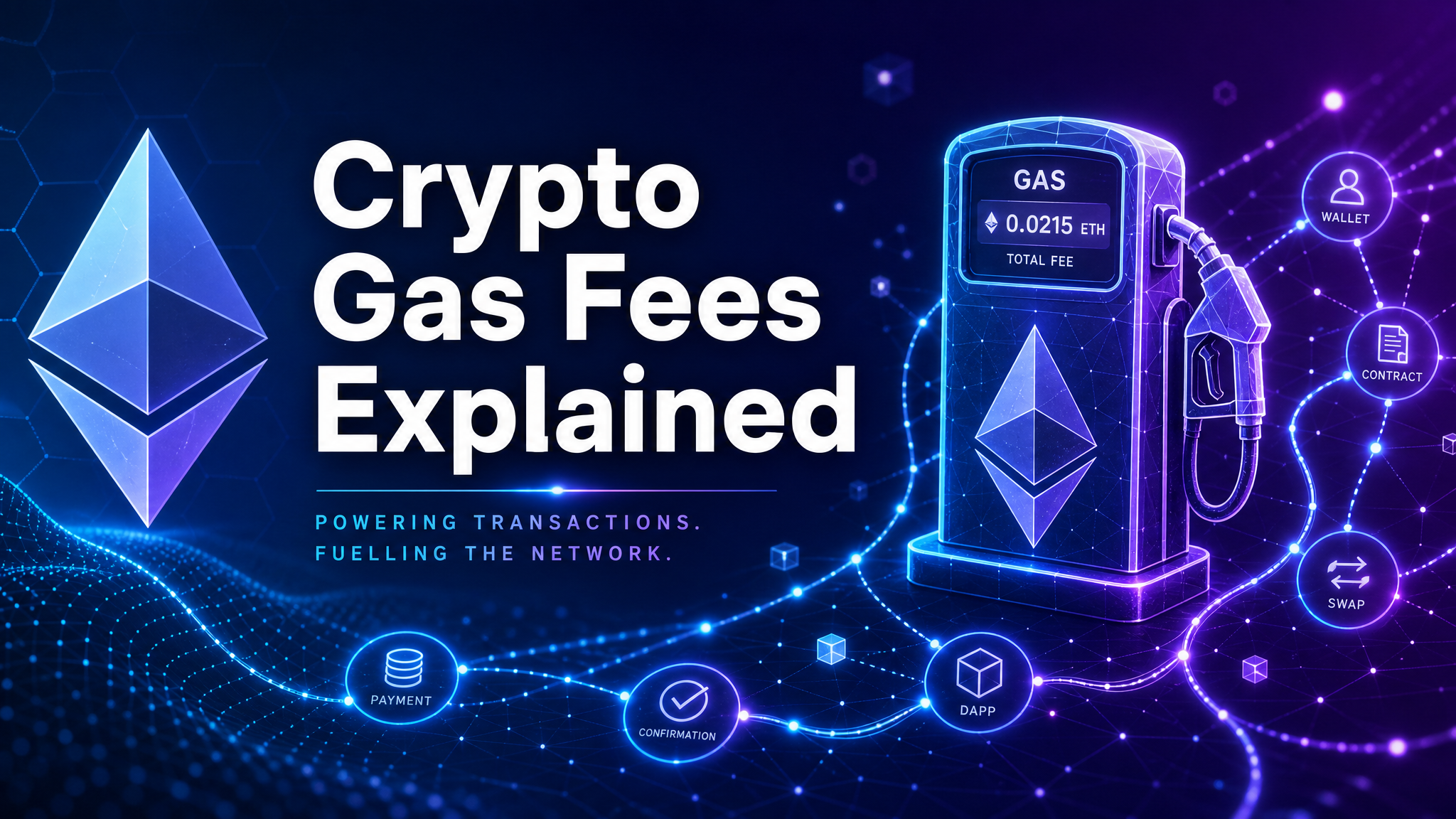
Crypto Gas Fees Explained: What They Are and How to Pay Less in 2026
If you've ever tried to swap tokens on Uniswap or send ETH to a friend and watched a $40 fee appear out of nowhere, you've met crypto gas fees — and they probably left you confused. You're not alone. Gas fees are one of the most common stumbling blocks for new crypto users, and understanding them can save you real money. This guide breaks down exactly what gas fees are, why they exist, how they're calculated, and — most importantly — five practical ways to pay less in 2026.
Disclaimer: This content is for informational purposes only and should not be considered financial advice. Cryptocurrency investments carry significant risk. Always do your own research (DYOR) before making any investment decisions.
Affiliate Disclosure: This article contains affiliate links. We may earn a commission at no extra cost to you if you make a purchase through these links. See our affiliate disclosure for details.
What Are Crypto Gas Fees, Exactly?
Think of gas fees as the toll you pay to use a blockchain highway. Every time you send crypto, swap tokens, interact with a smart contract, or mint an NFT, you're asking a network of computers (validators or miners) to process your transaction. Gas fees are the payment those computers receive for doing that work.
The term "gas" comes from Ethereum, where it was introduced as a unit measuring the computational effort required to execute specific operations. A simple ETH transfer uses 21,000 gas units. A complex DeFi interaction — like providing liquidity to a pool or executing a multi-step swap — can consume hundreds of thousands of gas units.
Here's the key thing beginners miss: gas fees are paid in the blockchain's native currency, not in the token you're sending. On Ethereum, you pay gas in ETH. On Solana, you pay in SOL. On BNB Chain, you pay in BNB. So even if you're just moving USDC from one wallet to another on Ethereum, you still need ETH in your wallet to cover the gas.
Why Do Gas Fees Exist?
Gas fees serve three critical functions that keep blockchains running properly.
Compensating validators. Someone has to process your transaction and add it to the blockchain. Validators (or miners on proof-of-work chains) do this work and earn gas fees as their reward. Without this incentive, there'd be no one to keep the network running.
Preventing spam. If transactions were free, bad actors could flood the network with millions of worthless transactions, grinding everything to a halt. Gas fees create a cost barrier that makes spam economically impractical.
Prioritizing transactions. When the network is busy, gas fees act as a bidding system. Users who need their transaction processed quickly can pay more; those who aren't in a rush can pay less and wait.
How Gas Fees Are Calculated (The Simple Version)
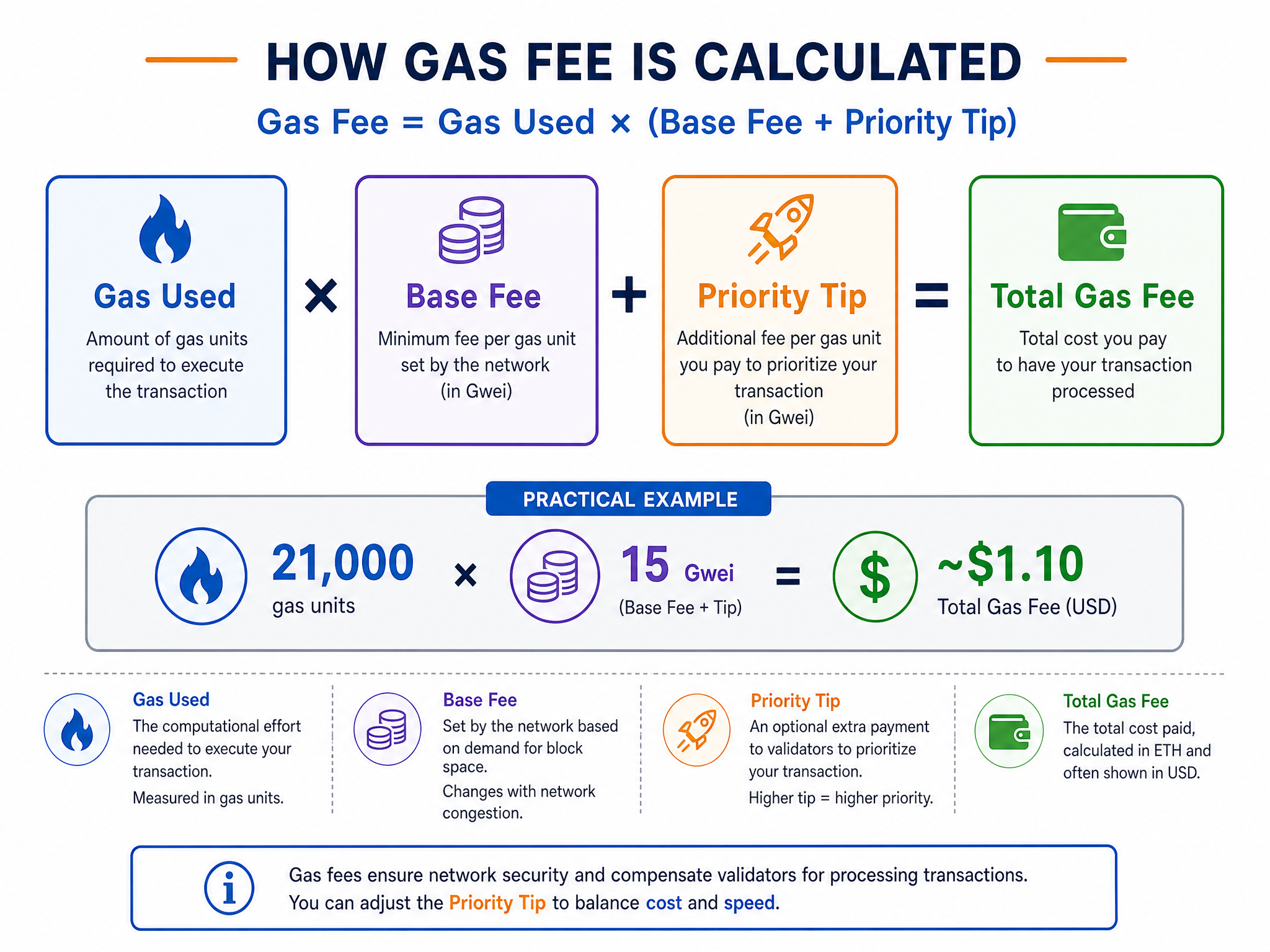
Ethereum's fee model, updated by EIP-1559 in 2021, uses this formula:
Total Fee = Gas Used × (Base Fee + Priority Fee)
Base Fee vs. Priority Fee
The Base Fee is set automatically by the network based on how busy it is. When lots of people are transacting, the base fee rises. When activity slows, it drops. This portion of your fee is actually burned — permanently removed from circulation — which is one reason ETH has deflationary properties during high-activity periods.
The Priority Fee (also called a "tip") is optional but practical. It goes directly to the validator who includes your transaction in the next block. If you're in a hurry, bumping up your tip gets you to the front of the line. If you can wait, setting a low tip saves money.
What Is Gwei?
Gas prices are quoted in Gwei, which is one billionth of an ETH (0.000000001 ETH). So when your wallet says the gas price is "15 Gwei," that means each gas unit costs 0.000000015 ETH. For a standard transfer using 21,000 gas units at 15 Gwei, the math looks like this:
21,000 × 0.000000015 ETH = 0.000315 ETH
At an ETH price of $3,500, that's about $1.10 for a simple transfer. Not bad. But during peak congestion, that same transfer might cost 150 Gwei — suddenly you're looking at $11. And complex DeFi interactions can run 10–20x higher than a simple transfer.
Why Gas Fees Spike — and When They're Cheapest
Gas fees are entirely demand-driven. The Ethereum mainnet can only process a limited number of transactions per block, so when demand exceeds capacity, fees skyrocket as users outbid each other for block space.
The biggest fee spikes historically happen during:
- Major NFT drops — thousands of users minting simultaneously
- Market volatility events — everyone rushing to buy, sell, or liquidate positions
- Popular token launches — bots and traders competing for early access
- US/European peak trading hours — roughly 1 PM to 9 PM UTC
The cheapest windows? Early morning UTC hours — typically 2 AM to 6 AM UTC — and weekends, when global trading activity is at its lowest. If your transaction isn't urgent, waiting for these windows can cut your fees by 50–80%.
5 Proven Ways to Reduce Your Crypto Gas Fees in 2026
Good news: in 2026, you have more tools than ever to avoid paying full Ethereum mainnet prices. Here's what actually works.
1. Use Layer 2 Networks
This is the single biggest lever you can pull. Layer 2 networks like Arbitrum, Optimism, and Base process transactions off the Ethereum mainnet and batch them together before settling on-chain. The result? Fees that are 95–99% cheaper than mainnet, often just fractions of a cent.
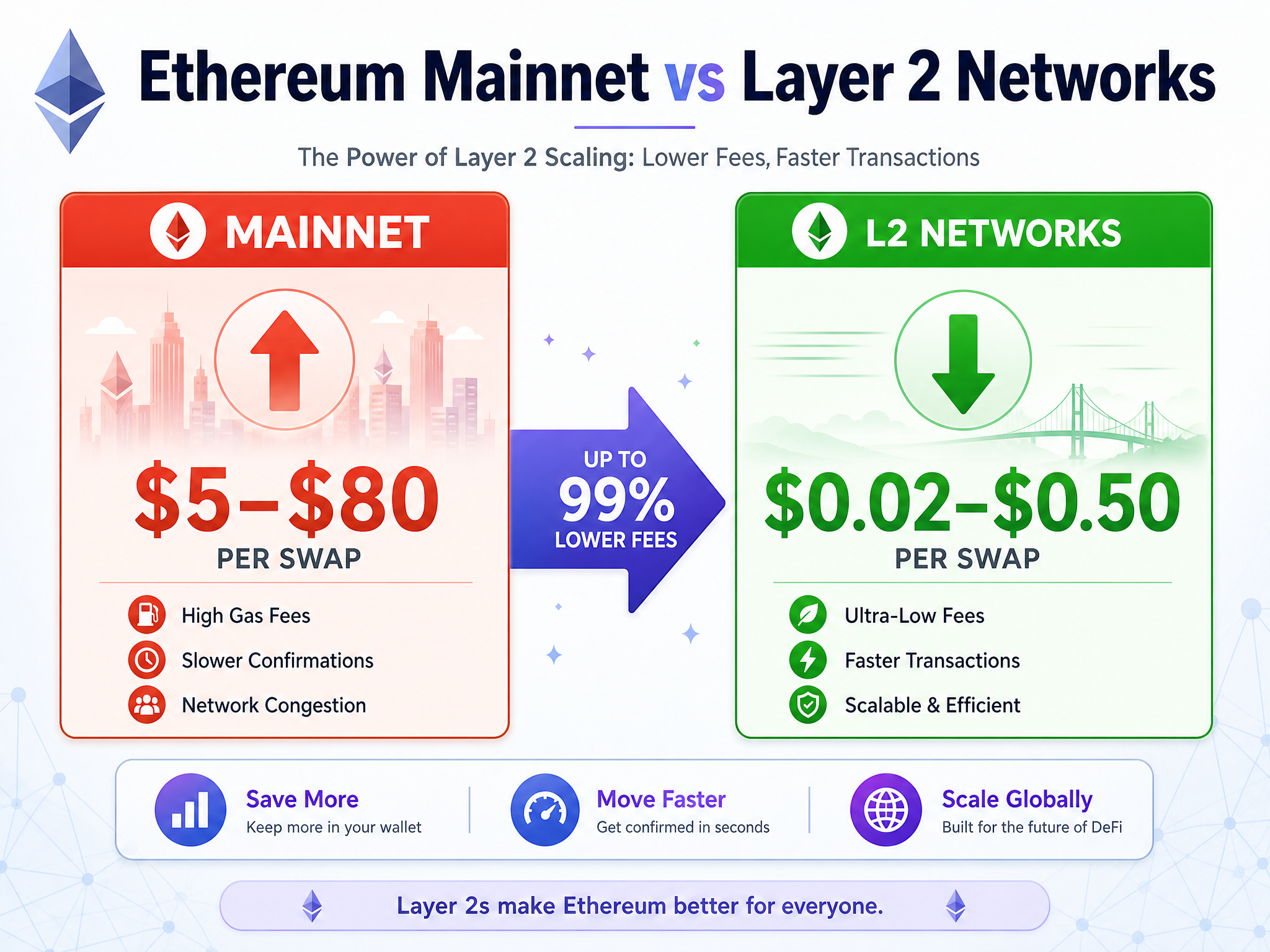
The 2024 Dencun upgrade (EIP-4844) made L2 fees even cheaper by introducing "blob transactions" — a dedicated, lower-cost data lane specifically for rollups. A swap that might cost $8 on Ethereum mainnet now costs $0.02 on Arbitrum.
Most major DeFi protocols — Uniswap, Aave, Curve — are fully deployed on L2s. You get the same functionality at a fraction of the cost. The only catch: you need to bridge your assets from mainnet to the L2 first, which costs a small one-time gas fee. For multiple transactions, the savings add up fast.
Ready to master crypto trading? Check out Icoinpro's comprehensive trading course — it covers DeFi navigation, gas optimization, and much more for beginners.
2. Time Your Transactions
Not every transaction is urgent. If you're rebalancing a portfolio or moving assets to cold storage, there's no reason to pay peak-hour prices. Use Etherscan's Gas Tracker (etherscan.io/gastracker) to see real-time fee levels and wait for a "Low" reading before executing.
For a $500 DeFi interaction, the difference between 200 Gwei and 20 Gwei is real money.
3. Use a Gas Tracker
Several free tools give you real-time gas data so you're never flying blind:
- Etherscan Gas Tracker — the standard, shows slow/standard/fast estimates
- Blocknative — more granular, shows predicted fees for the next few blocks
- L2Beat — tracks fees across all major Layer 2 networks
Most modern wallets display gas estimates before you confirm. Always check before clicking "Confirm."
4. Adjust Your Wallet Settings
MetaMask and most other wallets let you manually set your gas limit and priority tip. For non-urgent transactions, select the "Slow" or "Low" option — you'll wait a bit longer, but you'll pay significantly less. Just don't set the gas limit too low, or your transaction might fail and you'll still lose the gas spent up to that point.
A failed transaction is one of the most frustrating gas fee experiences. The network still charges you for the computational work it did before the failure. Always make sure you have enough ETH for gas, and don't set your gas limit below the wallet's recommended minimum.
5. Consider Alternative Blockchains
If you're doing simple transfers or using apps that exist on multiple chains, consider networks with structurally lower fees. Solana processes transactions for fractions of a cent. BNB Chain offers low fees with a large DeFi ecosystem. Polygon remains a popular low-cost option for NFTs and gaming.
The tradeoff: these chains have different security models. For large amounts, Ethereum's security track record is hard to beat; for everyday small transactions, alternatives make sense.
Protect your crypto assets with a Ledger hardware wallet — the gold standard in cold storage security. Keeping your private keys offline is essential.
Gas Fees on Different Blockchains (Quick Comparison)
Here's a rough snapshot of typical transaction costs across major networks in 2026. Note that these fluctuate constantly based on network activity:
| Network | Typical Simple Transfer | Typical DeFi Swap | Security Level |
|---|---|---|---|
| Ethereum Mainnet | $0.50 – $15 | $5 – $80 | Highest |
| Arbitrum (L2) | $0.01 – $0.10 | $0.05 – $0.50 | Very High (ETH-backed) |
| Optimism (L2) | $0.01 – $0.10 | $0.05 – $0.50 | Very High (ETH-backed) |
| Base (L2) | $0.01 – $0.05 | $0.02 – $0.30 | Very High (ETH-backed) |
| Solana | $0.0001 – $0.01 | $0.001 – $0.05 | High |
| BNB Chain | $0.05 – $0.30 | $0.10 – $1.00 | Medium |
The takeaway: if you're doing most of your DeFi activity on Ethereum mainnet in 2026, you're leaving money on the table. Layer 2 networks offer the same Ethereum security guarantees at a tiny fraction of the cost.
Common Gas Fee Mistakes Beginners Make
Avoid these common patterns:
Not keeping ETH for gas. You can have $10,000 in USDC on Ethereum and be completely stuck if you have zero ETH. Always keep a small ETH buffer in any Ethereum wallet you actively use.
Setting the gas limit too low. Wallets estimate the gas limit automatically, and they're usually right. Lowering it to save a few cents can cause your transaction to fail — and you still pay for the failed attempt.
Paying mainnet fees for small transactions. Sending $50 worth of tokens and paying $15 in gas is a 30% fee. That's brutal. For small amounts, use an L2 or wait for low-fee windows.
Ignoring the network you're on. Some beginners bridge assets to an L2 and then try to send them back to mainnet without realizing the bridge itself costs gas. Plan your transactions in batches when possible.
Want to understand the economics behind Bitcoin? The Bitcoin Standard is essential reading for every crypto enthusiast — it gives you the foundational knowledge to make smarter decisions across all of crypto.
Key Takeaways
- Crypto gas fees are payments to validators for processing your transactions — they're unavoidable on most blockchains, but very manageable.
- Fees are calculated as: Gas Used × (Base Fee + Priority Fee), denominated in Gwei on Ethereum.
- Fees spike during high-demand events and peak trading hours; they're cheapest in the early morning UTC hours and on weekends.
- Layer 2 networks (Arbitrum, Optimism, Base) cut fees by 95–99% while maintaining Ethereum's security — this is the most impactful change you can make.
- Always keep a small ETH buffer in your wallet, use gas trackers before transacting, and never set your gas limit below the recommended minimum.
- For small transactions, consider Solana or BNB Chain as lower-cost alternatives.
About the Author
Marcus Chen is a Senior Crypto Analyst & Educator with 8+ years of experience in digital assets and blockchain technology. A Certified Blockchain Professional and Former Wall Street Analyst, Marcus has helped thousands of investors navigate the crypto markets through clear, actionable education. His work focuses on making complex crypto concepts accessible to everyday investors.
Want structured training instead of piecing it together yourself?
Self-education works, but it's slow. The course that accelerated my learning the most gave me a daily framework — real market analysis, real setups, real accountability.
The program I recommend to people who ask me is this crypto trading course — it\'s the one I point friends and family to when they\'re serious about learning. Daily lessons, live analysis, and a community that actually helps.
Affiliate link — I may earn a commission at no extra cost to you. I only recommend what I genuinely use.
Disclaimer: The information provided on this website is for educational and informational purposes only. It should not be considered financial or investment advice. Cryptocurrency investments carry significant risk. Always do your own research and consult with a qualified financial advisor before making investment decisions.
Free Crypto Insights
Get weekly trading tips, market analysis, and exclusive strategies delivered to your inbox.