7 Crypto Mistakes Every Beginner Makes in 2026
Affiliate Disclosure: This article may contain affiliate links. We may earn a commission at no extra cost to you. All opinions are our own.
Marcus Chen
Senior Crypto Analyst & Educator
Certified Blockchain Professional | Former Wall Street Analyst
Marcus Chen is a cryptocurrency analyst and educator with over 8 years of experience in digital asset trading. He has helped thousands of beginners navigate the crypto markets through practical, actionable education.
Disclaimer: This content is for informational purposes only and should not be considered financial advice. Cryptocurrency investments carry significant risk. Always do your own research (DYOR) before making any investment decisions.
This article contains affiliate links. We may earn a commission at no extra cost to you if you make a purchase through these links. See our affiliate disclosure for details.
7 Crypto Mistakes Beginners Make (And How to Avoid Them in 2026)
The most common crypto beginner mistakes aren't about bad luck — they're about predictable patterns that cost new investors real money. After 8+ years watching thousands of people enter this market, I've seen the same errors repeat over and over. The good news? Every single one of these crypto beginner mistakes is avoidable once you know what to look for.
This guide breaks down the seven most common errors new crypto investors make in 2026, why they happen, and exactly what to do instead. Whether you've just bought your first Bitcoin or you're still on the fence about getting started, this is the reality check you need.
Mistake #1: Buying on FOMO (Fear of Missing Out)
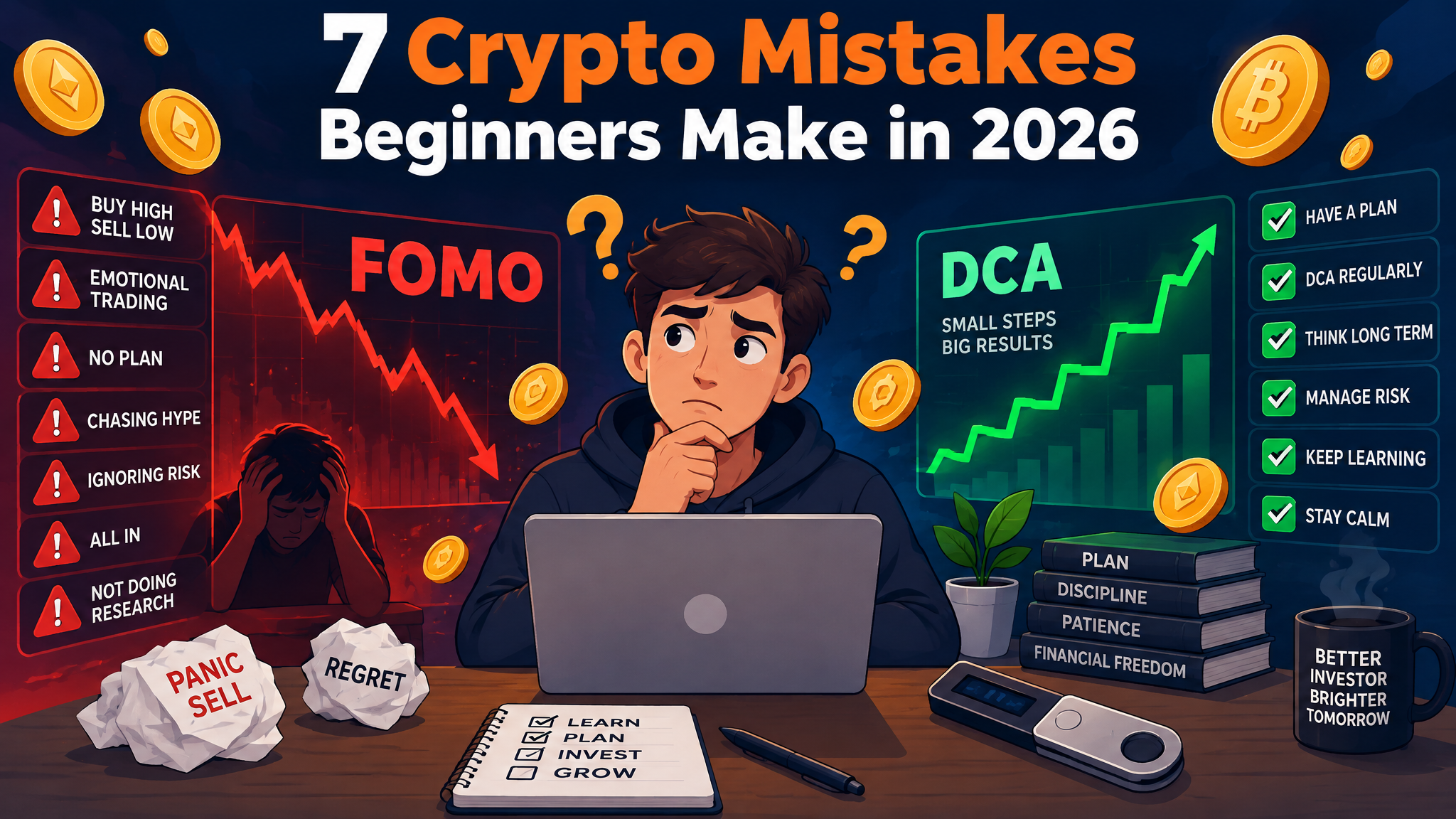
FOMO is probably the single most expensive mistake in crypto. You see a coin up 300% in a week, your group chat is going crazy, and suddenly you're convinced you're about to miss the trade of the decade. So you buy — right at the top.
Here's the brutal truth: in roughly 75% of FOMO-driven purchases, the price drops 20–30% within days of the buy. By the time something is trending on TikTok or Reddit, the early adopters are already selling into your excitement. You're not catching a wave — you're becoming the exit liquidity.
The fix is simple but hard to execute emotionally: write down your investment thesis before you buy anything. Ask yourself: "Would I still buy this if nobody was talking about it and the price hadn't moved in a week?" If the answer is no, walk away. Use dollar-cost averaging (DCA) — set up automatic recurring buys on a schedule — so you're never scrambling to time the market based on hype.

Mistake #2: Panic Selling During Normal Corrections
Crypto drops 15% in a day and suddenly it feels like the whole market is collapsing. New investors hit sell, lock in their losses, and then watch the price recover over the next two weeks. This cycle repeats constantly, and it's one of the main reasons most retail investors underperform the assets they're actually holding.
Here's some perspective: Bitcoin has had over 30 corrections of 20% or more since 2015, and it's recovered from every single one. A 15% dip isn't a crisis — it's Tuesday in crypto. Investors who panic-sold during major corrections between 2020 and 2023 missed out on more than 50% of potential long-term gains.
The solution is to only invest money you genuinely don't need for 1–3 years. When you're not financially stressed about the position, you can hold through volatility without flinching. Set a simple rule: no selling unless your original investment thesis has fundamentally changed — not just because the price went down.
Mistake #3: Leaving Crypto on Exchanges
Exchanges get hacked. It's not a question of if — it's when. In 2026 alone, we've seen major exchange security incidents that cost users hundreds of millions of dollars. When your crypto sits on an exchange, you don't actually own it. You own an IOU from a company that could be hacked, go bankrupt, or freeze withdrawals at any moment.
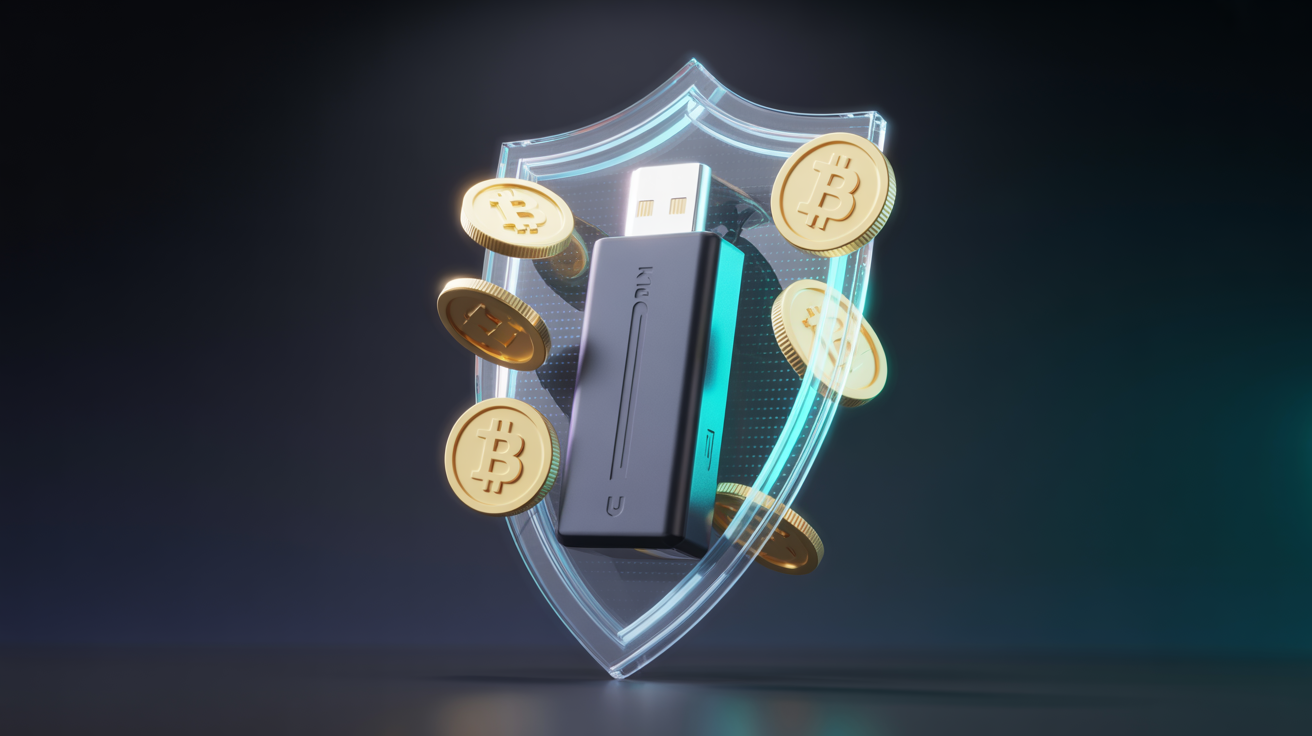
"Not your keys, not your coins" isn't just a catchy phrase — it's the foundational security principle of crypto. For any amount you're not actively trading, move it to a hardware wallet where your private keys are stored offline and completely out of reach from hackers.
Protect your crypto assets with a Ledger hardware wallet — the gold standard in cold storage security. For under $100, you get military-grade protection for potentially thousands of dollars in assets. That's the best risk/reward trade in crypto.
Mistake #4: Falling for Crypto Scams
Scams in 2026 are more sophisticated than ever. AI-generated deepfakes of Elon Musk or Vitalik Buterin promoting "guaranteed 2x returns." Fake customer support agents sliding into your DMs on Telegram. "Pig butchering" romance scams that spend weeks building trust before asking you to invest in a fraudulent platform. Phishing sites that look pixel-perfect like Coinbase or MetaMask.
The red flags are always the same, even when the packaging changes:
- Guaranteed returns — no legitimate investment guarantees anything
- Urgency and pressure — "This offer expires in 2 hours!" is a manipulation tactic
- Unsolicited contact — real support teams don't DM you first
- Requests for your seed phrase — no legitimate entity will ever ask for this, ever
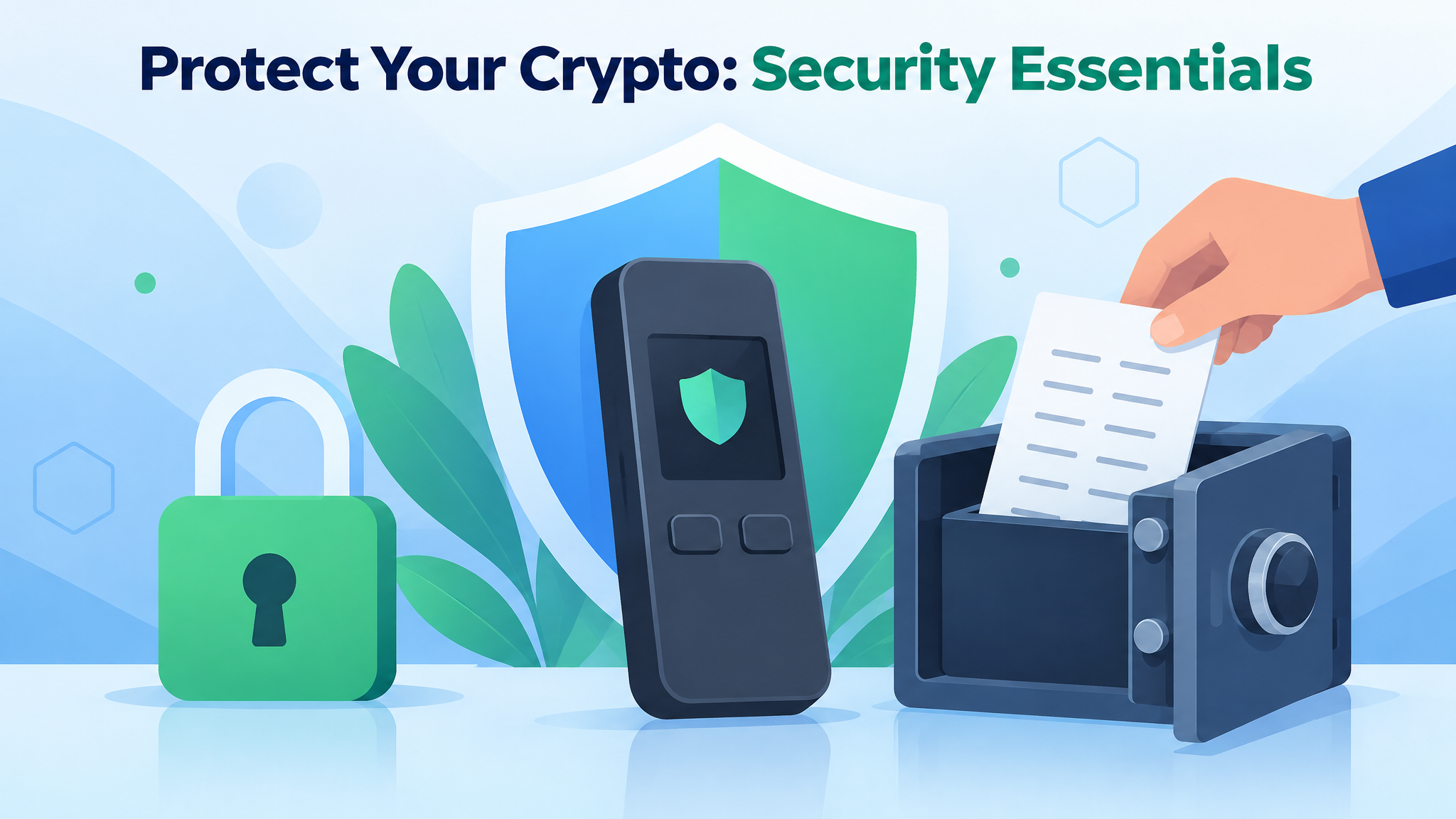
Your seed phrase is the master key to your entire wallet. Write it down on paper, store it somewhere physically secure, and never type it into any website or app. Enable authenticator-app-based 2FA (not SMS — SIM swapping is a real attack vector) on every exchange account. Bookmark official sites and never click links from emails or DMs.
For a deep dive into Bitcoin's monetary philosophy and security principles, grab a copy of The Bitcoin Standard — essential reading that gives you the foundational knowledge to spot bad actors and understand what you're actually investing in.
Mistake #5: Ignoring Fees and Hidden Costs
New investors often focus entirely on price action and completely ignore the cost of actually using crypto. This is a mistake that quietly bleeds your portfolio.
Consider a beginner who buys $500 of a token on a DEX during a gas spike, bridges it to another chain, swaps it again, and then sells. By the time they're done, they might have paid $40–80 in fees on a $500 position — that's 8–16% just in transaction costs before the market even moves against them.
What to watch for:
- Exchange spreads — "zero-fee" platforms often make money on the spread between buy and sell prices
- Gas fees — Ethereum mainnet can spike to $20–50+ per transaction during congestion; use Layer 2 networks like Arbitrum or Base for smaller trades
- Bridge fees — moving assets between blockchains costs money and time
- Withdrawal fees — exchanges charge flat fees to move crypto off-platform, which can be significant on smaller amounts
Always calculate your total cost basis including fees before entering a trade. On centralized exchanges, compare the "maker" vs "taker" fee structure — placing limit orders (maker) is almost always cheaper than market orders (taker).
Mistake #6: Putting Everything in One Coin
Concentration risk is real. Putting your entire crypto budget into a single altcoin because you're "sure" it's going to 10x is one of the fastest ways to lose everything. Even legitimate, well-researched projects can drop 80–90% in a bear market. Meme coins can go to zero overnight when the team disappears with the liquidity.
A sensible beginner allocation looks something like this: 60–70% in Bitcoin (BTC), 20–30% in Ethereum (ETH), and no more than 10% in higher-risk altcoins. Bitcoin and Ethereum have the longest track records, the deepest liquidity, the most institutional support, and the clearest regulatory status. They're not "boring" — they're the foundation.
If you want exposure to higher-upside plays, keep that allocation small enough that a total loss doesn't derail your financial life. The 5% rule is a good starting point: never put more than 5% of your total investable assets into any single speculative position.
Mistake #7: Skipping the Education Phase
Most beginners want to skip straight to "how do I make money" without understanding what they're actually buying. That's like trying to drive a car without knowing what the pedals do. You might get lucky for a while, but eventually something goes wrong and you have no idea how to respond.
The good news is that crypto education in 2026 is better than it's ever been. Free resources like Binance Academy, CoinMarketCap Learn, and YouTube channels like Coin Bureau and Whiteboard Crypto can take you from zero to competent in a few weeks. Structured courses go even deeper.
For a structured approach to learning crypto trading, Icoinpro offers step-by-step training that has helped thousands of beginners understand market mechanics, risk management, and how to read price action without getting wrecked by emotion.
Spend at least 2–4 weeks learning before you put significant money in. Understand what blockchain actually is, how wallets work, what gas fees are, and how to read a basic chart. This foundation will save you from 90% of the mistakes on this list.
Quick-Reference: The 7 Mistakes and Their Fixes
| Mistake | The Fix |
|---|---|
| Buying on FOMO | Write your thesis first; use DCA |
| Panic selling corrections | Only invest what you can hold for 1–3 years |
| Leaving crypto on exchanges | Use a hardware wallet for long-term holdings |
| Falling for scams | Never share seed phrases; verify everything |
| Ignoring fees | Calculate total cost basis before every trade |
| Over-concentrating in one coin | 60–70% BTC, 20–30% ETH, max 10% altcoins |
| Skipping education | Learn for 2–4 weeks before investing seriously |
The Bottom Line
None of these mistakes are unique to you — every experienced crypto investor has made at least a few of them. The difference between those who build real wealth in crypto and those who blow up their accounts isn't intelligence or luck. It's discipline, patience, and a willingness to learn before you leap.
Start small. Secure your assets properly. Ignore the noise. And keep learning — the market rewards those who put in the work to understand it.
Key Takeaways
- FOMO buying is the #1 cause of beginner losses — always write your investment thesis before buying
- Crypto corrections are normal; only invest money you can hold for 1–3 years without panic
- Hardware wallets are non-negotiable for any serious crypto holder — exchanges get hacked
- Scams in 2026 use AI deepfakes and sophisticated social engineering — your seed phrase is sacred
- Hidden fees can cost 8–16% of a position; always calculate total cost basis
- Diversify: anchor in BTC and ETH before touching altcoins
- Spend 2–4 weeks learning before investing significant capital
Want structured training instead of piecing it together yourself?
Self-education works, but it's slow. The course that accelerated my learning the most gave me a daily framework — real market analysis, real setups, real accountability.
The program I recommend to people who ask me is this crypto trading course — it\'s the one I point friends and family to when they\'re serious about learning. Daily lessons, live analysis, and a community that actually helps.
Affiliate link — I may earn a commission at no extra cost to you. I only recommend what I genuinely use.
Disclaimer: The information provided on this website is for educational and informational purposes only. It should not be considered financial or investment advice. Cryptocurrency investments carry significant risk. Always do your own research and consult with a qualified financial advisor before making investment decisions.
Free Crypto Insights
Get weekly trading tips, market analysis, and exclusive strategies delivered to your inbox.