Crypto Taxes for Beginners 2026: What You Owe, When You Owe It, and How to Stay Out of Trouble
Affiliate Disclosure: This article may contain affiliate links. We may earn a commission at no extra cost to you. All opinions are our own.
Marcus Chen
Senior Crypto Analyst & Educator
Certified Blockchain Professional | Former Wall Street Analyst
Marcus Chen is a cryptocurrency analyst and educator with over 8 years of experience in digital asset trading. He has helped thousands of beginners navigate the crypto markets through practical, actionable education.

Crypto Taxes for Beginners 2026: What You Owe, When You Owe It, and How to Stay Out of Trouble
Crypto taxes in 2026 are no longer a gray area — the IRS has made that crystal clear. With Form 1099-DA now mandatory for brokers and cost-basis reporting expanding this year, the days of "I didn't know I had to report that" are officially over. Whether you bought your first Bitcoin last month or you've been stacking sats for years, understanding your crypto tax obligations is essential.
This guide breaks down everything a beginner needs to know: what counts as a taxable event, how to calculate your gains, what forms you'll need, and how to keep records that won't give your accountant a headache.
The IRS Treats Crypto as Property — Not Currency
Here's the foundational rule that trips up most newcomers: the IRS classifies cryptocurrency as property, not money. That single classification changes everything about how your crypto activity gets taxed.
Think of it like owning stock. When you buy shares of Apple and later sell them for a profit, you pay capital gains tax. Crypto works the same way. Buy Bitcoin at $50,000, sell at $70,000 — you owe tax on that $20,000 gain. Simple enough. But the property classification also means that swapping one crypto for another is a taxable event, and so is using crypto to buy a cup of coffee.
That last part surprises a lot of people. Spending crypto is treated as selling it at its current market value. So if you bought ETH at $2,000 and used it to pay for a $3,500 laptop when ETH was worth $3,500, you just realized a $1,500 capital gain — even though you never touched a dollar.
What Counts as a Taxable Event in 2026?
Not every crypto action triggers a tax bill. Knowing the difference saves you from over-reporting (and unnecessary stress) or under-reporting (and potential penalties).
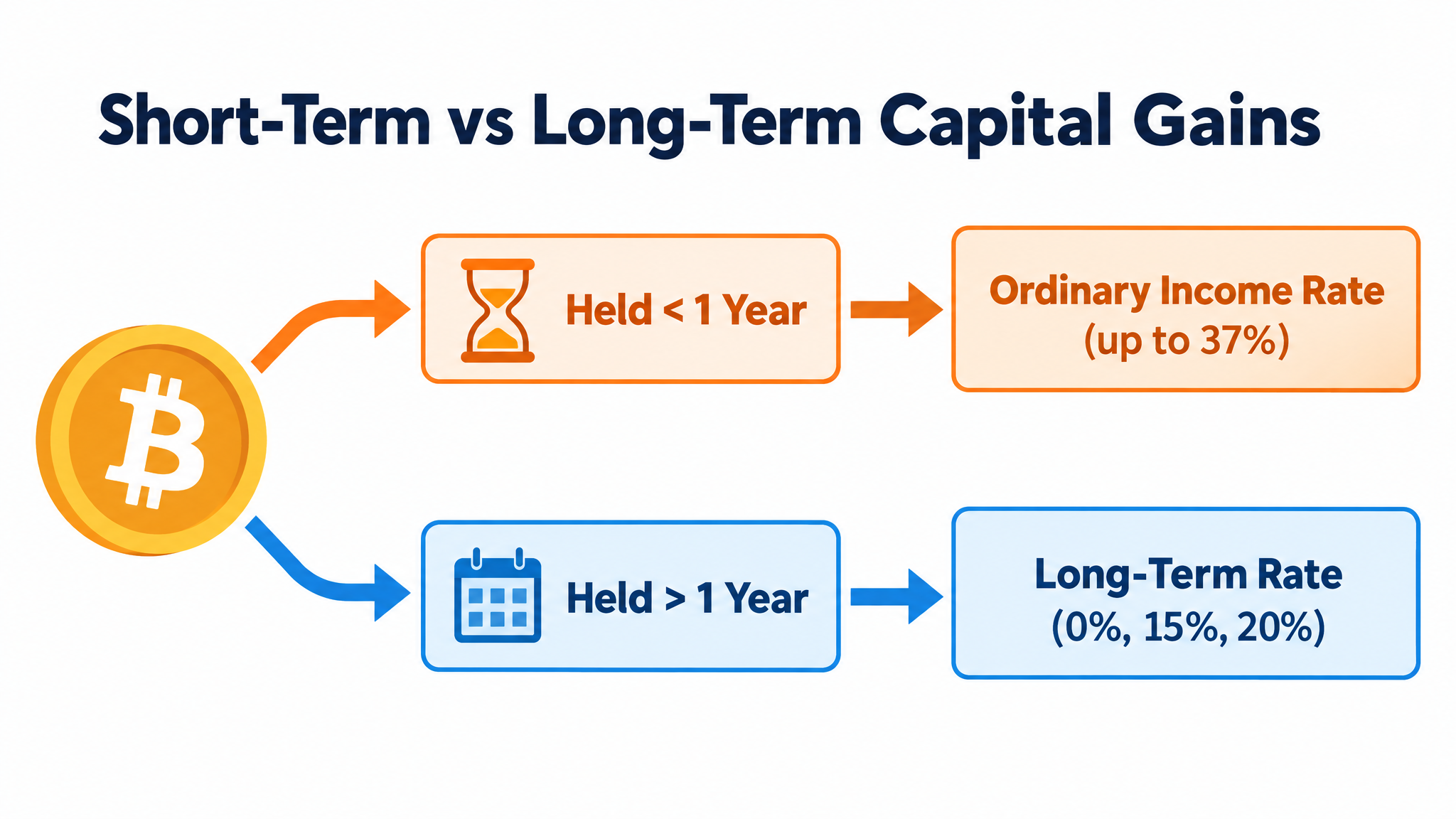
Taxable Events
- Selling crypto for fiat (USD, EUR, etc.) — the most obvious one
- Trading one crypto for another — swapping ETH for SOL is a disposal of ETH at its current market value
- Using crypto to pay for goods or services — treated as a sale at fair market value
- Receiving staking rewards or mining income — taxed as ordinary income at the time you receive it
- Receiving airdrops — generally taxed as income when you gain control of the tokens
- Getting paid in crypto — treated as ordinary income at fair market value on the date received
Non-Taxable Events
- Buying crypto with dollars and holding it — no tax until you dispose of it
- Transferring crypto between your own wallets — moving BTC from Coinbase to your Ledger is not a sale
- Gifting crypto (up to the annual exclusion limit) — the recipient inherits your cost basis
- Donating crypto to a qualified charity — you may even get a deduction
Short-Term vs. Long-Term Capital Gains: The Holding Period Matters
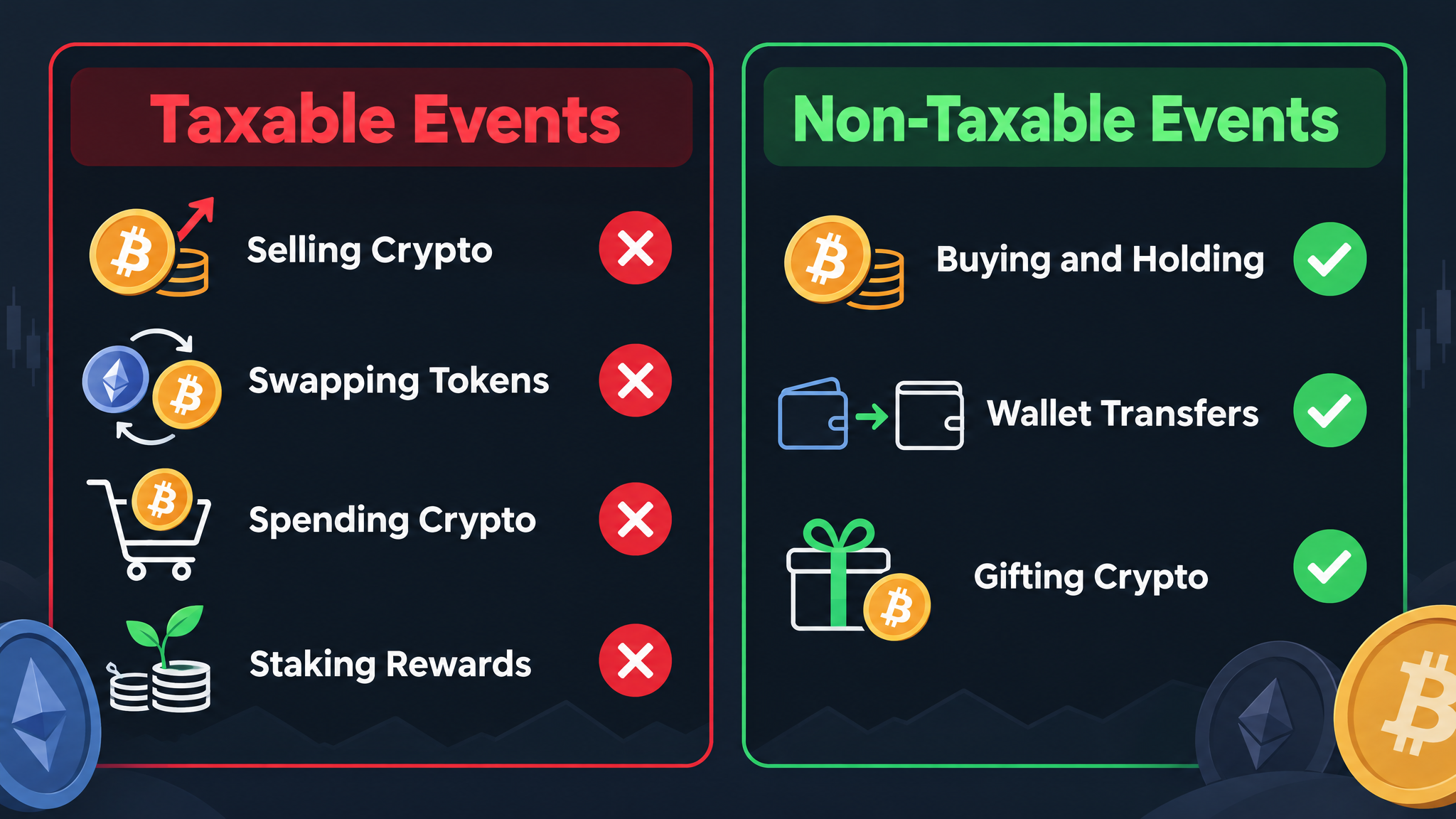
How long you hold a crypto asset before selling determines which tax rate applies — and the difference can be substantial.
Short-term gains apply to assets held for one year or less. These are taxed at your ordinary income rate, which can be as high as 37% for high earners. If you're day-trading or flipping altcoins frequently, most of your profits fall here.
Long-term gains apply to assets held for more than one year. The rates are 0%, 15%, or 20% depending on your income. For most middle-income earners, that's 15% — significantly lower than short-term rates.
The math is stark. Say you made $10,000 profit on a crypto trade. If you held less than a year and you're in the 24% bracket, you owe $2,400. Hold that same position for 13 months and you might owe just $1,500. That's $900 saved by waiting a few extra months. It's not always practical — markets don't care about your tax calendar — but it's worth factoring into your strategy.
Want to build a solid foundation for understanding these strategies? For a structured approach to learning crypto trading, Icoinpro offers step-by-step training that has helped thousands of beginners navigate both markets and tax implications.
Form 1099-DA: The New Tax Form Every Crypto Holder Needs to Know
Starting with the 2025 tax year (returns filed in 2026), crypto exchanges and brokers are required to issue Form 1099-DA — "Digital Asset Proceeds From Broker Transactions." Think of it as the crypto equivalent of the 1099-B you'd get from a stock brokerage.
Here's what it reports:
- Gross proceeds from sales, swaps, and disposals
- Cost basis (for assets purchased on that platform in 2026 or later)
- The date of acquisition and disposal
A few important caveats. The 1099-DA only covers transactions on custodial platforms — Coinbase, Kraken, Gemini, and similar exchanges. If you trade on decentralized exchanges like Uniswap or hold assets in a self-custody wallet, no form gets generated. You're still legally required to report those transactions; the IRS just won't have a paper trail handed to them automatically.
Also: don't assume the 1099-DA is always accurate. If you transferred crypto from another wallet or exchange, the platform may not have your original cost basis. Always cross-reference the form against your own records before filing.
How to Calculate Your Cost Basis
Cost basis is the original price you paid for a crypto asset, including any fees. It's the number you subtract from your sale price to determine your gain or loss.
Example: You buy 0.5 BTC for $27,500 (including a $50 transaction fee). Your cost basis is $27,550. Six months later you sell that 0.5 BTC for $35,000. Your taxable gain is $35,000 − $27,550 = $7,450.
Things get complicated when you've bought the same asset multiple times at different prices. The IRS requires you to track cost basis on a per-wallet, per-account basis as of January 2025. The most common accounting methods are:
- FIFO (First In, First Out) — the default method; assumes you sell your oldest coins first
- HIFO (Highest In, First Out) — sells your highest-cost coins first, minimizing gains; requires specific identification
- Specific Identification — you choose exactly which coins you're selling; most flexible but requires meticulous records
Most crypto tax software handles this automatically. But you need to feed it accurate data — every transaction, every wallet, every exchange.
The Forms You'll Actually File
When tax season arrives, here's where your crypto activity shows up on your federal return:
- Form 8949 — lists every capital asset sale or disposal; this is where your crypto trades go, line by line
- Schedule D — summarizes your total capital gains and losses from Form 8949
- Schedule 1 — reports ordinary income from staking, mining, airdrops, and crypto payments
- Form 1040 — includes a digital asset question on page 1 that you must answer honestly, even if you only held and didn't sell
The Form 1040 question is easy to overlook. It asks whether you received, sold, exchanged, or otherwise disposed of any digital asset during the year. If you did anything beyond simply holding, check "Yes."
Record-Keeping: The Habit That Saves You Later
The IRS can audit returns up to three years back — or six years if they suspect substantial underreporting. That means records from 2023 could still matter in 2029. Good habits now prevent headaches later.
For every transaction, track:
- Date of purchase and sale
- Amount of crypto bought or sold
- USD value at the time of each transaction
- Transaction fees paid
- The exchange or wallet involved
Export your transaction history from every exchange you use — most platforms let you download a CSV. Do this regularly, not just at tax time. Exchanges have been known to limit historical data access, and some have shut down entirely.
For long-term holders with significant assets, protecting those assets is equally important. Protect your crypto assets with a Ledger hardware wallet — the gold standard in cold storage security — so your holdings stay safe while you focus on compliance.
Staking, Mining, and DeFi Income: The Tricky Stuff
Passive crypto income has its own tax treatment, and it's worth understanding before you dive into yield-generating strategies.
Staking rewards are taxed as ordinary income when you receive them, based on fair market value at that moment. When you later sell those tokens, you'll also owe capital gains tax on any appreciation. So staking income gets taxed twice — once as income, once as capital gains when sold.
Mining income works similarly. Hobby mining is reported as other income; business mining is self-employment income — but you can deduct equipment and electricity costs.
DeFi activity is the most complex area. Providing liquidity, earning yield, and receiving governance tokens all have tax implications. The IRS hasn't issued comprehensive DeFi guidance as of late 2026, but the general principle holds: if you receive something of value, it's likely taxable income.
Tax-Loss Harvesting: Turning Losses Into Savings
Here's one of the few tax advantages crypto has over stocks: as of late 2026, crypto is not subject to wash sale rules. With stocks, selling at a loss and buying back within 30 days disallows the loss. With crypto, you can sell Bitcoin at a loss, immediately buy it back, and still claim the loss.
This strategy — tax-loss harvesting — lets you offset capital gains elsewhere. If you made $5,000 on ETH but lost $3,000 on an altcoin, you can harvest that loss to reduce your net taxable gain to $2,000. Note: wash sale rules for crypto are actively debated in Congress and could change.
Actionable Takeaways for Crypto Tax Beginners
- Track every transaction from day one — don't wait until April to reconstruct your history
- Know your taxable events — selling, swapping, spending, and earning crypto all trigger taxes
- Hold longer when possible — the long-term capital gains rate is significantly lower than short-term
- Review your 1099-DA carefully — it may be missing cost basis for transferred assets
- Use crypto tax software — tools like CoinLedger, Koinly, or TaxBit automate the heavy lifting
- Consider a tax professional — especially if you have DeFi activity, staking income, or significant gains
- Don't ignore the Form 1040 question — answer it honestly every year
For a deeper understanding of Bitcoin's monetary principles and why so many investors are drawn to it in the first place, grab a copy of The Bitcoin Standard — essential reading for every crypto enthusiast who wants to understand the bigger picture.
Frequently Asked Questions
Do I owe taxes if I just bought crypto and didn't sell?
No. Simply buying and holding crypto is not a taxable event. You only owe taxes when you dispose of it — by selling, swapping, spending, or transferring to someone else.
What if I lost money on crypto — do I still have to report it?
Yes, you must report losses. The good news: capital losses offset capital gains, and up to $3,000 of net losses can offset ordinary income per year. Excess losses carry forward to future years.
Does the IRS know about my crypto?
Increasingly, yes. Form 1099-DA means exchanges report your transactions directly to the IRS. The agency has also used blockchain analytics firms to identify unreported crypto income. Assume your activity is visible.
What happens if I don't report crypto taxes?
Failure to report can result in penalties, interest, and in serious cases, criminal charges for tax evasion. The IRS has made crypto compliance a clear priority.
Want structured training instead of piecing it together yourself?
Self-education works, but it's slow. The course that accelerated my learning the most gave me a daily framework — real market analysis, real setups, real accountability.
The program I recommend to people who ask me is this crypto trading course — it\'s the one I point friends and family to when they\'re serious about learning. Daily lessons, live analysis, and a community that actually helps.
Affiliate link — I may earn a commission at no extra cost to you. I only recommend what I genuinely use.
Disclaimer: The information provided on this website is for educational and informational purposes only. It should not be considered financial or investment advice. Cryptocurrency investments carry significant risk. Always do your own research and consult with a qualified financial advisor before making investment decisions.
Free Crypto Insights
Get weekly trading tips, market analysis, and exclusive strategies delivered to your inbox.