How to Rebalance Your Crypto Portfolio in 2026 (Step-by-Step Guide)
Affiliate Disclosure: This article may contain affiliate links. We may earn a commission at no extra cost to you. All opinions are our own.
Marcus Chen
Senior Crypto Analyst & Educator
Certified Blockchain Professional | Former Wall Street Analyst
Marcus Chen is a cryptocurrency analyst and educator with over 8 years of experience in digital asset trading. He has helped thousands of beginners navigate the crypto markets through practical, actionable education.
How to Rebalance Your Crypto Portfolio in 2026 (Step-by-Step Guide)
This article contains affiliate links. We may earn a commission at no extra cost to you if you make a purchase through these links. See our affiliate disclosure for details.
Learning how to rebalance your crypto portfolio is one of the most underrated skills in this market — and one of the most profitable. Most investors obsess over which coins to buy. Far fewer think about what to do after prices move 40%, 80%, or 200% in a single quarter. That's where rebalancing comes in, and it's the difference between a portfolio that compounds wealth and one that quietly concentrates all your risk into yesterday's winner.
I've been managing crypto portfolios since 2018, through two full bear markets and three explosive bull runs. The investors who came out ahead weren't necessarily the ones with the best picks — they were the ones who had a system. Rebalancing is that system.
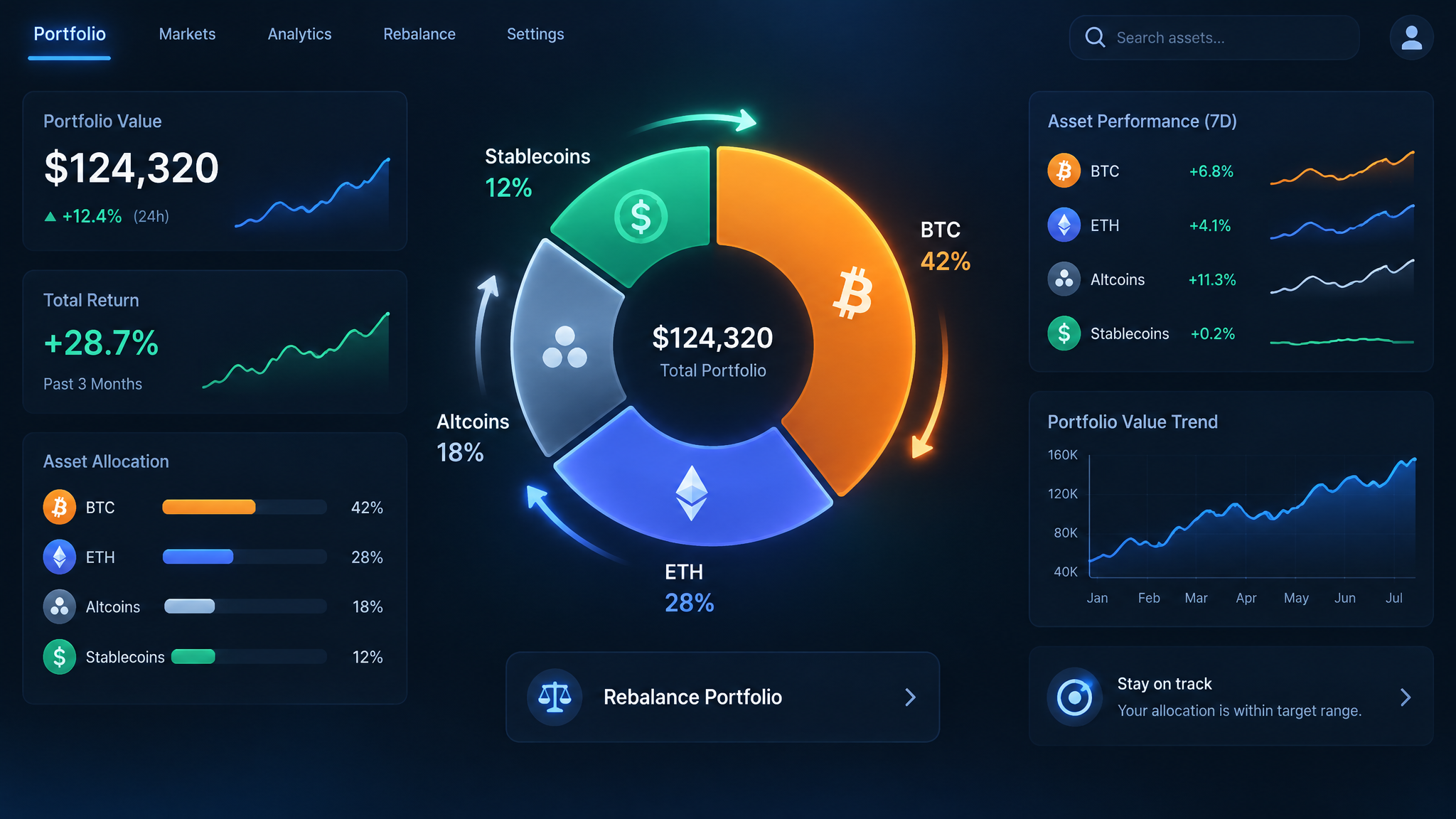
A disciplined rebalancing system keeps your crypto portfolio aligned with your risk tolerance through every market cycle.
What Is Crypto Portfolio Rebalancing (and Why It Matters)?
Rebalancing means periodically adjusting your holdings back to a target allocation. Say you started the year with 60% Bitcoin, 30% Ethereum, and 10% altcoins. After a strong altcoin rally, that 10% slice might now be 35% of your portfolio. Suddenly you're carrying far more risk than you intended — and you didn't make a single active decision to get there.
Rebalancing forces you to sell what's run up and buy what's lagged. That sounds counterintuitive, but it's essentially a systematic "sell high, buy low" mechanism. Over multiple market cycles, this discipline tends to outperform pure buy-and-hold for volatile assets like crypto.
There's also a psychological benefit. When you have a rule-based system, you're less likely to panic-sell during crashes or FOMO-buy at the top. The rules do the thinking for you.
Step 1: Define Your Target Allocation
Before you can rebalance, you need a target to rebalance to. This is your baseline — the percentage of your portfolio you want in each asset class during normal market conditions.
A common framework used by institutional crypto managers is the core-satellite model:
- Core (60–70%): Bitcoin and Ethereum — the most liquid, most established assets
- Satellite (20–30%): Large-cap altcoins with real utility (Solana, Chainlink, XRP)
- Speculative (5–15%): Higher-risk plays — emerging L1s, DeFi tokens, AI crypto projects
- Stablecoins (5–10%): USDC or USDT as dry powder for opportunities
Your exact split depends on your risk tolerance and time horizon. A 25-year-old with a 10-year horizon can afford more satellite and speculative exposure. Someone 5 years from retirement should probably keep 70%+ in BTC/ETH and stablecoins.
Write your target allocation down. Seriously — put it in a spreadsheet or a notes app. The act of committing to numbers before the market moves is what separates disciplined investors from reactive ones.
Step 2: Choose Your Rebalancing Method
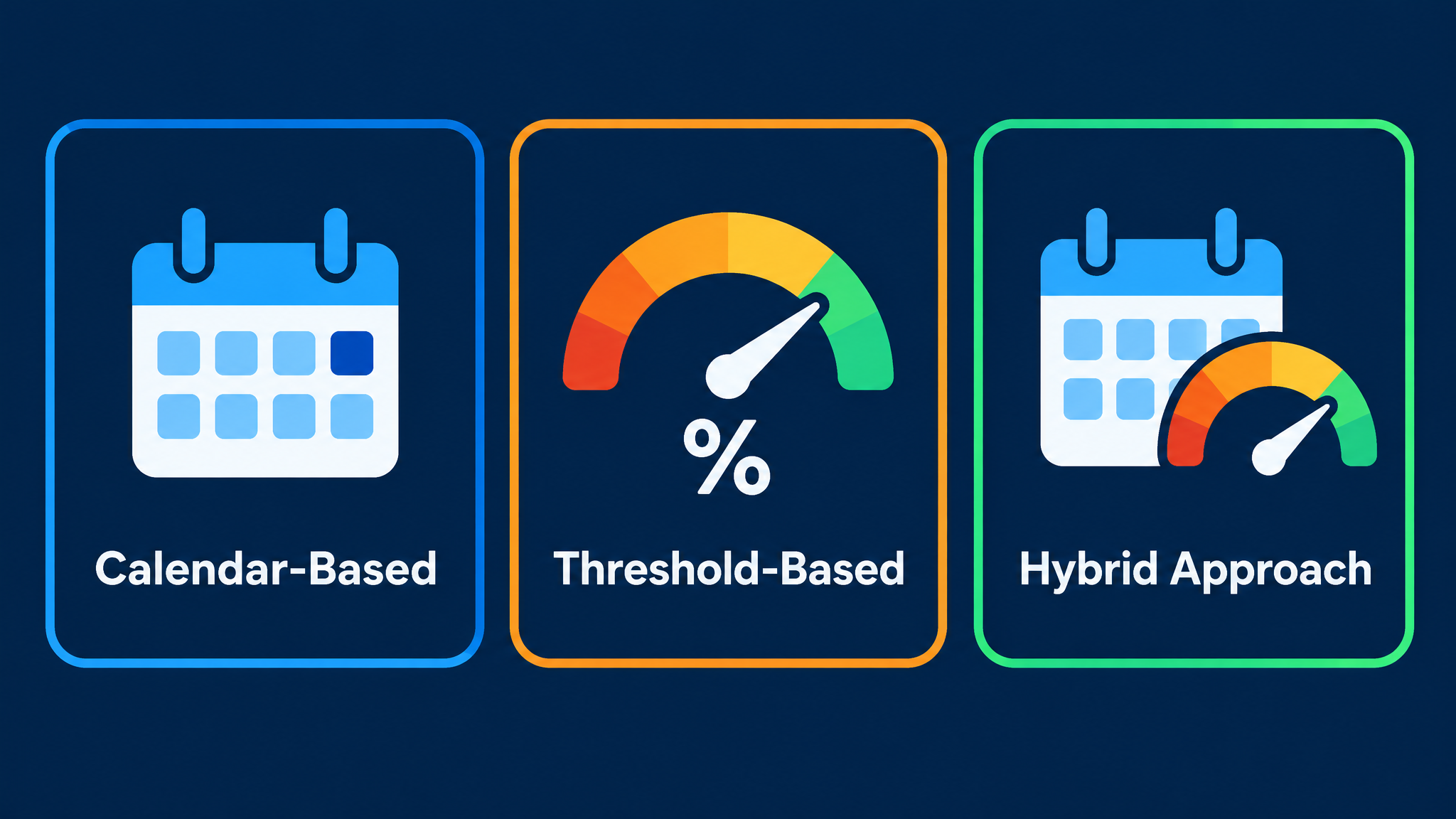
There are three main approaches, each with real trade-offs:
Calendar-Based Rebalancing
You rebalance on a fixed schedule — monthly, quarterly, or annually. Simple, predictable, low-maintenance. The downside is that it ignores what the market is actually doing. If Bitcoin drops 30% in February and you're not due to rebalance until April, you miss the chance to buy more at a discount.
Best for: passive investors who don't want to monitor markets constantly.
Threshold-Based Rebalancing
You rebalance whenever any asset drifts more than X% from its target weight. Common thresholds are 5–15%. So if Bitcoin is supposed to be 60% of your portfolio and it drops to 48%, that 12-point drift triggers a rebalance.
This method is more responsive to actual market conditions. The catch: in a volatile market, you might trigger rebalances constantly, racking up fees and tax events.
Best for: active investors comfortable monitoring their portfolio weekly.
Hybrid Approach (Recommended)
Review your portfolio on a fixed schedule (quarterly), but also set threshold alerts. If a threshold is breached between reviews, act immediately. Otherwise, wait for the scheduled review.
This is what most institutional crypto managers use. It balances discipline with responsiveness, and it keeps transaction costs manageable.
Step 3: Track Your Portfolio Accurately
You can't rebalance what you can't measure. If your crypto is spread across three exchanges, two hardware wallets, and a DeFi protocol, you need a consolidated view before you can calculate drift.
Tools worth using in 2026:
- CoinGecko Portfolio: Free, tracks prices across thousands of assets, simple to set up
- DeBank: Essential if you have DeFi positions — shows your LP tokens, lending positions, and staked assets in one dashboard
- Koinly or CoinTracker: Better for tax tracking alongside portfolio management
- Spreadsheet (manual): Still the most flexible option for cold storage holders who don't want API exposure
The formula for calculating current weight is straightforward: divide each asset's current value by your total portfolio value. If Bitcoin is worth $18,000 in a $30,000 portfolio, it's 60% of your holdings.
Do this calculation before every rebalance. Don't rely on memory or rough estimates — small errors compound over time.
Step 4: Calculate What Needs to Move
Once you know your current weights and your target weights, the math is simple. For each asset:
- If current weight > target weight → sell the excess
- If current weight < target weight → buy more
Example: You have a $50,000 portfolio. Target is 60% BTC, 30% ETH, 10% stablecoins. After a strong ETH rally, your actual split is 50% BTC ($25,000), 42% ETH ($21,000), 8% stablecoins ($4,000).
To rebalance: sell $6,000 of ETH (bringing it from $21,000 to $15,000 = 30%), and use $5,000 to buy BTC (bringing it to $30,000 = 60%) and $1,000 to top up stablecoins.
Always try to use new capital first. If you're adding $500/month to your portfolio, direct that new money to underweight assets before selling anything. This avoids triggering taxable events unnecessarily.
Step 5: Execute Tax-Efficiently
Every time you sell crypto, you potentially trigger a taxable event. In the US, assets held less than a year are taxed as ordinary income; assets held over a year qualify for lower long-term capital gains rates.
A few strategies to minimize the tax hit:
- Use new deposits first: Buy underweight assets with fresh capital before selling overweight ones
- Harvest losses: If you have positions sitting at a loss, sell those first to offset gains from your winners
- Prioritize long-term positions: When you do need to sell, sell assets you've held over a year to qualify for long-term rates
- Use tax-advantaged accounts: If you hold crypto ETFs in an IRA or 401(k), rebalancing inside those accounts has no immediate tax consequence
Keep meticulous records. Every trade needs a date, cost basis, and sale price. Tools like Koinly automate most of this, but you still need to verify the data is accurate.
Ready to master crypto trading? Check out Icoinpro's comprehensive trading course — it covers portfolio management, risk sizing, and execution strategies in depth.
Step 6: Automate Where It Makes Sense
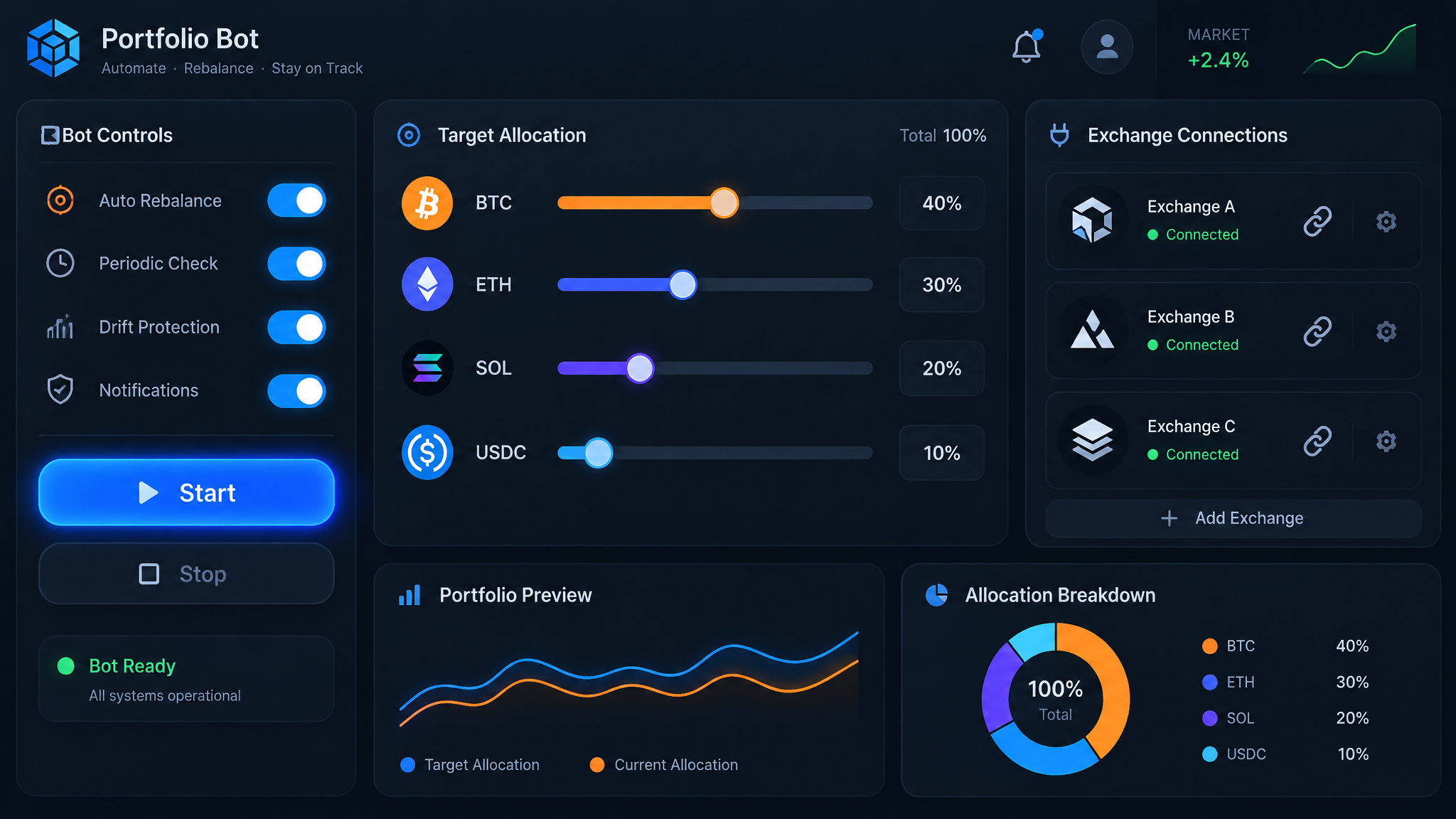
Manual rebalancing works fine for portfolios under $50,000 or investors who check in quarterly. But if you're managing larger sums, trading across multiple exchanges, or want to remove emotion entirely, automation is worth considering.
Popular rebalancing tools in 2026:
- 3Commas: Connects to most major exchanges via API, supports custom rebalancing intervals and threshold triggers. Good for active traders.
- Shrimpy: Designed specifically for portfolio rebalancing, with social portfolio features and smart indexing. More beginner-friendly than 3Commas.
- Binance Rebalancing Bot: Native to Binance, low cost (just trading fees), supports both time and threshold triggers. Only works within Binance.
- Pionex: Built-in rebalancing bots with multi-coin modes. Good for passive, long-term holders who want set-and-forget automation.
One caution: automated tools require API access to your exchange accounts. Use read-only API keys where possible, and never give withdrawal permissions to third-party tools. The convenience isn't worth the security risk if you're not careful about key management.
Adjusting Your Strategy for Market Cycles
A static rebalancing strategy works, but a cycle-aware one works better. Here's how to adapt:
Bull Market Adjustments
When everything is going up, your speculative positions will balloon quickly. Tighten your rebalancing threshold to 5–8% so you're locking in profits more frequently. Consider gradually increasing your stablecoin allocation as prices reach historically elevated levels — not because you're trying to time the top, but because your risk tolerance should decrease as valuations stretch.
Bear Market Adjustments
Widen your threshold to 15–20% to avoid selling into weakness. Focus on accumulating BTC and ETH when they fall below target weights. This is where the "buy low" part of rebalancing actually happens — and it's psychologically hard, which is exactly why having a rule-based system matters.
Sideways/Choppy Markets
Reduce rebalancing frequency. In a range-bound market, frequent rebalancing just generates fees without meaningful benefit. Quarterly reviews are usually sufficient.
Common Rebalancing Mistakes to Avoid
After watching hundreds of investors manage their portfolios, these are the errors I see most often:
- Rebalancing too frequently: Monthly rebalancing in a volatile market can eat 2–5% of your portfolio in fees and taxes annually. Quarterly is usually the sweet spot.
- Ignoring DeFi positions: If you have assets staked, in liquidity pools, or in lending protocols, they need to be included in your total portfolio calculation. Forgetting them skews your weights.
- Chasing performance: Rebalancing is not about moving money into whatever performed best last quarter. It's about returning to your predetermined target. Don't let recent returns change your target allocation mid-cycle.
- No written plan: If your rebalancing rules only exist in your head, they'll bend under market pressure. Write them down. Commit to them.
- Forgetting cold storage: Assets on a hardware wallet need to be included in your portfolio tracking, even if they're not actively traded.
Protect your crypto assets with a Ledger hardware wallet — the gold standard in cold storage security. Keeping long-term holdings offline while you rebalance active positions is a smart operational setup.
A Simple Rebalancing Checklist
Use this every time you sit down to rebalance:
- Pull current portfolio values from all exchanges, wallets, and DeFi protocols
- Calculate current weight for each asset (value ÷ total portfolio)
- Compare to target weights — identify which assets are over/underweight
- Check if any threshold has been breached (or if it's your scheduled review date)
- Use new capital to buy underweight assets first
- If selling is needed, prioritize long-term positions and tax-loss opportunities
- Execute trades using limit orders to minimize slippage
- Update your records with dates, amounts, and cost basis
- Set your next review date or threshold alerts
Key Takeaways
- Rebalancing is a systematic "sell high, buy low" mechanism that works across market cycles
- Define your target allocation before markets move — not during them
- The hybrid approach (quarterly reviews + threshold alerts) balances discipline with responsiveness
- Use new capital to rebalance before selling anything — it's more tax-efficient
- Automation tools like 3Commas and Shrimpy can help, but require careful API key management
- Adjust your threshold and frequency based on market cycle — tighter in bull markets, wider in bear markets
For a structured approach to learning crypto trading, Icoinpro offers step-by-step training that has helped thousands of beginners build disciplined, systematic approaches to the market.
Disclaimer: This content is for informational purposes only and should not be considered financial advice. Cryptocurrency investments carry significant risk. Always do your own research (DYOR) before making any investment decisions.
Want structured training instead of piecing it together yourself?
Self-education works, but it's slow. The course that accelerated my learning the most gave me a daily framework — real market analysis, real setups, real accountability.
The program I recommend to people who ask me is this crypto trading course — it\'s the one I point friends and family to when they\'re serious about learning. Daily lessons, live analysis, and a community that actually helps.
Affiliate link — I may earn a commission at no extra cost to you. I only recommend what I genuinely use.
Disclaimer: The information provided on this website is for educational and informational purposes only. It should not be considered financial or investment advice. Cryptocurrency investments carry significant risk. Always do your own research and consult with a qualified financial advisor before making investment decisions.
Free Crypto Insights
Get weekly trading tips, market analysis, and exclusive strategies delivered to your inbox.