Bitcoin at $76,900: How the Binance Hack, US Midterm Elections, and Fed Rate Fears Are Shaping Crypto in November 2026
Affiliate Disclosure: This article may contain affiliate links. We may earn a commission at no extra cost to you. All opinions are our own.
Marcus Chen
Senior Crypto Analyst & Educator
Certified Blockchain Professional | Former Wall Street Analyst
Marcus Chen is a cryptocurrency analyst and educator with over 8 years of experience in digital asset trading. He has helped thousands of beginners navigate the crypto markets through practical, actionable education.
This article contains affiliate links. We may earn a commission at no extra cost to you if you make a purchase through these links. See our affiliate disclosure for details.
Disclaimer: This content is for informational purposes only and should not be considered financial advice. Cryptocurrency investments carry significant risk. Always do your own research (DYOR) before making any investment decisions.
Bitcoin at $76,900: How the Binance Hack, US Midterm Elections, and Fed Rate Fears Are Shaping Crypto in November 2026
Bitcoin is trading at roughly $76,900 this Tuesday — and if you're wondering why the market feels so heavy right now, you're not imagining it. Three separate forces are pressing down on crypto simultaneously: the catastrophic $6.3 billion Binance hack that's still reverberating through the industry, today's US midterm elections whose outcome could reshape crypto legislation for years, and a Federal Reserve that's signaling another rate hike could land in December. Any one of these would be enough to rattle markets. All three at once? That's a stress test most portfolios weren't built for.
Let's break down what's actually happening, what it means for your holdings, and — critically — what to watch over the next few weeks.
The Binance Hack: $6.3 Billion Gone, and the Fallout Isn't Over
The numbers are staggering. In late October, Binance suffered what the FBI has confirmed is the largest crypto exchange hack in history — $6.3 billion in unauthorized outflows from its hot wallets, attributed to North Korea's "TraderTraitor" hacking group. To put that in perspective, the previous record was the $620 million Ronin Network breach in 2022. This is ten times larger.
Binance reopened withdrawals on November 1, reporting it had replaced roughly 95% of stolen funds from its own reserves. That's actually impressive — most exchanges couldn't absorb a fraction of that hit. But the market's reaction tells a different story. By November 2, customers had pulled a net $4.72 billion from the exchange. That's not panic selling; that's rational risk management by institutional players who can't afford to be caught in a liquidity crunch.
The ripple effects hit Bitcoin ETFs hard. Spot Bitcoin ETFs recorded $643 million in net outflows on October 30 — the largest single-day exit since June — followed by another $399 million out the door on November 2. When institutions pull money from ETFs at that pace, it creates sustained selling pressure on spot Bitcoin prices.
There's also a secondary story worth watching: the Liquid Network, which suffered a $320 million exploit back in September, announced it has fully restored 1:1 backing for all LBTC tokens. The federation closed the gap with a final 250 BTC transfer, though they haven't disclosed where the roughly 600 BTC needed to fill the shortfall came from. Transparency questions linger.
Meanwhile, the Brazilian exchange Mercado Bitcoin disclosed a $40–46 million hack across at least 10 blockchains, with partners including Tether, Circle, and Chainalysis helping freeze $11 million of the stolen assets. The exchange has pledged to cover all customer losses.
The pattern here is clear: exchange security is the defining vulnerability of this market cycle. If you're holding significant crypto on any centralized exchange right now, the risk calculus has changed.
Protect your assets with a hardware wallet — keeping your crypto off exchanges is the single most effective security upgrade most investors can make. The Ledger hardware wallet remains one of the most trusted cold storage options available.
US Midterm Elections: What Today's Vote Means for Crypto Regulation

Today's midterm elections are being watched closely by every serious crypto investor, and for good reason. All 435 House seats and 35 Senate seats are up for grabs, and the balance of power in Congress will directly determine the fate of crypto-friendly legislation like the CLARITY Act.
The stakes are concrete. A Bloomberg survey found that 29% of investors expected Bitcoin to exceed $100,000 by year-end under a Republican-controlled Congress, compared to just 8% under Democratic control. That's not a partisan statement — it's a reflection of where each party currently stands on digital asset regulation.
Prediction markets heading into today indicated a high probability of a Democratic-controlled House and Senate. If that holds, the CLARITY Act — which would establish clear regulatory frameworks for digital assets — faces a much steeper path to passage. A divided government, paradoxically, might offer more room for bipartisan crypto legislation to advance.
Here's the nuance most coverage misses: the election results won't move markets immediately. The real impact plays out over 2027 as the new Congress shapes regulatory priorities. What today's vote does is set the probability distribution for what crypto regulation looks like 12–18 months from now. That's the timeframe serious investors should be thinking about.
Crypto futures trading volume jumped 51% to $168.1 billion in the 24 hours leading up to today's vote, even as open interest fell 1.63%. That combination — high volume, falling open interest — suggests traders are closing positions rather than building new ones. Classic pre-event risk reduction.
The Federal Reserve: December Rate Hike Probability at 71–85%
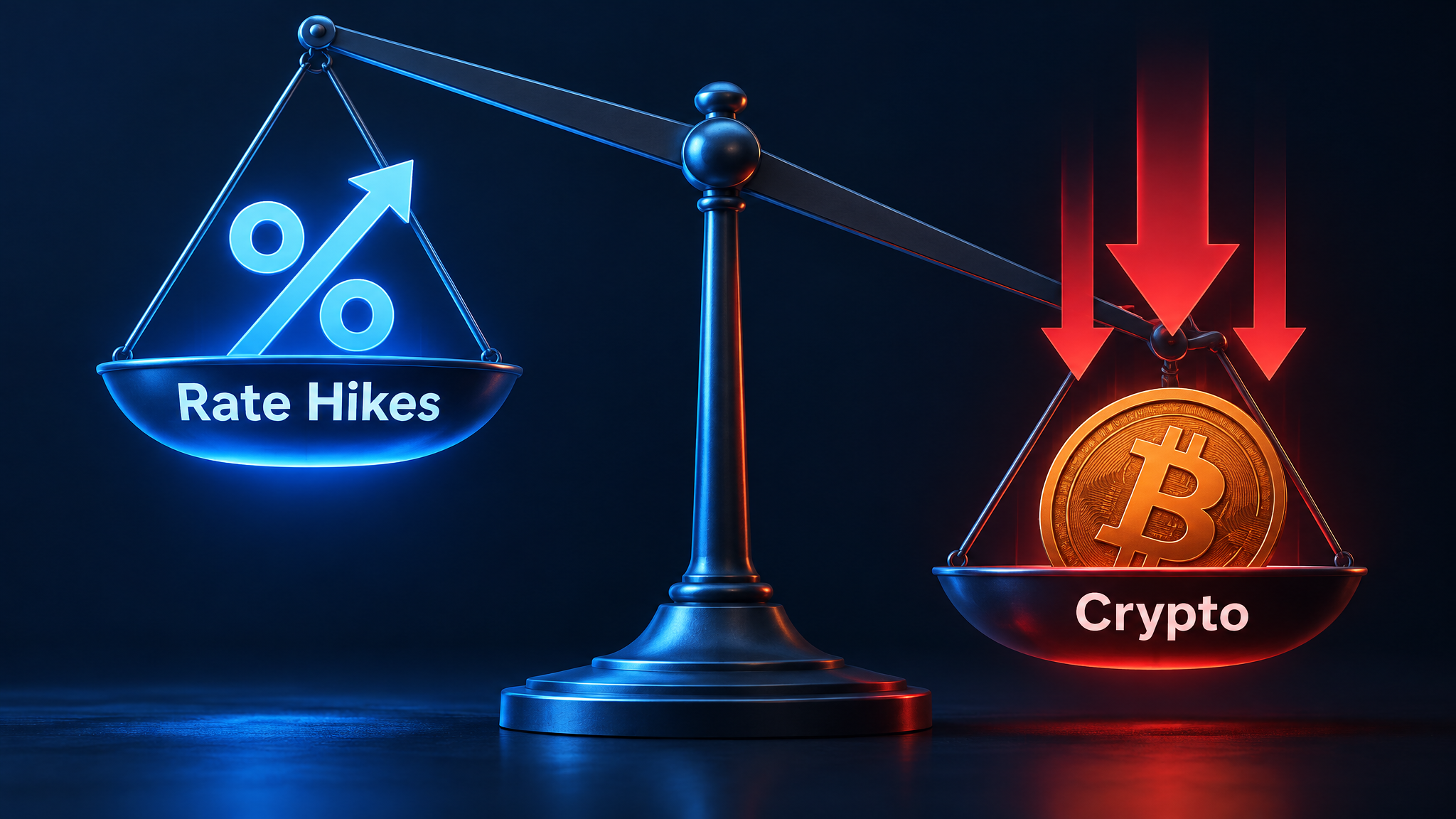
The Federal Reserve held rates steady at 3.75%–4.00% on October 28, but the vote was 10–2 — two dissenters wanted to hike immediately. Chair Kevin Warsh declined to provide guidance for the December 9 meeting, which is Fed-speak for "we're watching the data and we're not ruling anything out."
The data isn't cooperating with crypto bulls. Q3 GDP came in at 3.4% annualized. September CPI showed 3.7% year-over-year inflation. Core PCE is running at 3.1%. These are not numbers that give the Fed cover to pause. Markets are currently pricing in a 71–85% probability of a December rate hike, depending on which prediction market you check.
The October jobs report drops on Friday, November 6. Consensus estimates are for 55,000–65,000 new jobs. A strong number — say, above 80,000 — would likely cement the December hike and push Bitcoin lower. A weak number, or unemployment ticking up to 4.4% or higher, could shift the calculus toward a pause and give crypto a relief rally.
Then on November 10, the October CPI print arrives. That's the second major catalyst this month. If inflation shows signs of cooling, the Fed has more room to hold. If it stays sticky, December becomes a near-certainty.
Bitcoin's correlation with tech stocks has been tight throughout this cycle. High real yields compress valuations on non-income-producing assets — and Bitcoin, whatever else it is, doesn't pay a dividend. That's the fundamental headwind that doesn't go away until the Fed pivots.
Strategy (formerly MicroStrategy) isn't blinking. Michael Saylor's firm purchased another 811 BTC between October 26 and November 1 for $65.5 million, bringing total holdings to 849,327 BTC. Bitmine Immersion Technologies also increased its Ethereum holdings by 8,573 ETH, now controlling approximately 4.9% of total supply. Institutional conviction at the corporate treasury level remains intact even as ETF flows turn negative.
Global Regulatory Developments Worth Watching
Beyond the US, several regulatory developments are shaping the global crypto landscape this week:
UK Tax Reform: The Finance Bill 2026–27 proposes exempting stablecoin disposals by individuals from capital gains tax, effective April 2027. It also establishes a "no gain, no loss" basis for certain crypto lending and liquidity pool transfers. This is a meaningful shift that could make the UK a more attractive jurisdiction for DeFi activity.
Taiwan Licensing Rules: Taiwan's FSC released draft rules on November 3 proposing a capital floor of NT$100 million for trading platforms and custodians, and NT$200 million for lenders. This signals Asia-Pacific regulators are moving toward formal licensing frameworks rather than outright bans.
Ripple National Trust Bank: The OCC consummated the charter for Ripple National Trust Bank on October 26, intended to hold reserves for the RLUSD stablecoin. This is a significant milestone — a crypto-native entity now holds a federal banking charter.
FATF Review: The Financial Action Task Force has initiated a targeted review of jurisdictions with "materially important" crypto activity, with findings expected in June 2027. This will likely result in tighter AML requirements globally.
Want to understand the deeper economic forces driving these regulatory shifts? The Bitcoin Standard by Saifedean Ammous remains the essential text for understanding why Bitcoin's monetary properties make it a target for both institutional adoption and regulatory scrutiny.
What This Means for Your Portfolio Right Now
Bitcoin has now posted five consecutive weekly losses. That's not a crash — it's a grinding correction driven by macro headwinds, not fundamental deterioration. The distinction matters.
Here's how to think about the next 30–60 days:
Short-term (November): Volatility is elevated. The jobs report on November 6 and CPI on November 10 are the two biggest near-term catalysts. If both come in soft, expect a relief rally. If both come in hot, $72,000–$74,000 becomes the next support zone to watch.
Medium-term (December): The Fed meeting on December 9 is the macro event of the quarter. A hike is largely priced in at current levels, which means the actual announcement may be less impactful than the data leading up to it. Watch for any shift in the Fed's language about the pace of future hikes.
Security posture: The Binance hack is a reminder that exchange risk is real. If you're holding more than you can afford to lose on any single centralized platform, this is the moment to reassess. Hardware wallets aren't optional for serious holders — they're table stakes.
If you want to sharpen your trading skills to navigate volatile markets like this one, Icoinpro's comprehensive trading course covers risk management frameworks specifically designed for high-volatility crypto environments.
Key Takeaways
- Bitcoin at $76,900 faces three simultaneous headwinds: the $6.3B Binance hack fallout, US midterm election uncertainty, and a 71–85% probability of a December Fed rate hike.
- ETF outflows hit $643M on October 30 and $399M on November 2 — institutional risk reduction, not panic, but sustained selling pressure nonetheless.
- Today's midterm elections set the legislative trajectory for crypto regulation in 2027; results won't move markets immediately but matter enormously for the CLARITY Act's prospects.
- November 6 jobs report and November 10 CPI are the two data points that will most directly influence the Fed's December decision.
- Corporate buyers remain active: Strategy added 811 BTC at current prices, signaling long-term conviction despite short-term headwinds.
- Security risk is elevated: Move significant holdings off centralized exchanges and into cold storage.
Understanding the market is step one. Profiting from it is step two.
Reading analysis is valuable, but knowing how to generate your own — and act on it with discipline — is where real results come from. That skill is trainable.
The program I recommend to people who ask me is this crypto trading course — it\'s the one I point friends and family to when they\'re serious about learning. Daily lessons, live analysis, and a community that actually helps.
Affiliate link — I may earn a commission at no extra cost to you. I only recommend what I genuinely use.
Disclaimer: The information provided on this website is for educational and informational purposes only. It should not be considered financial or investment advice. Cryptocurrency investments carry significant risk. Always do your own research and consult with a qualified financial advisor before making investment decisions.
Free Crypto Insights
Get weekly trading tips, market analysis, and exclusive strategies delivered to your inbox.