Bitcoin's $81K Short Squeeze Rally: What the Treasury Buyback, CLARITY Act Push, and SEC's New Crypto Framework Mean for Investors
Affiliate Disclosure: This article may contain affiliate links. We may earn a commission at no extra cost to you. All opinions are our own.
Marcus Chen
Senior Crypto Analyst & Educator
Certified Blockchain Professional | Former Wall Street Analyst
Marcus Chen is a cryptocurrency analyst and educator with over 8 years of experience in digital asset trading. He has helped thousands of beginners navigate the crypto markets through practical, actionable education.
Disclaimer: Analysis of Bitcoin's short squeeze rally and related market events is for informational purposes only and should not be considered financial advice. Cryptocurrency investments carry significant risk. Always do your own research (DYOR) before making any investment decisions.
This article contains affiliate links. We may earn a commission at no extra cost to you if you make a purchase through these links. See our affiliate disclosure for details.
Bitcoin's $81K Short Squeeze Rally: What the Treasury Buyback, CLARITY Act Push, and SEC's New Crypto Framework Mean for Investors
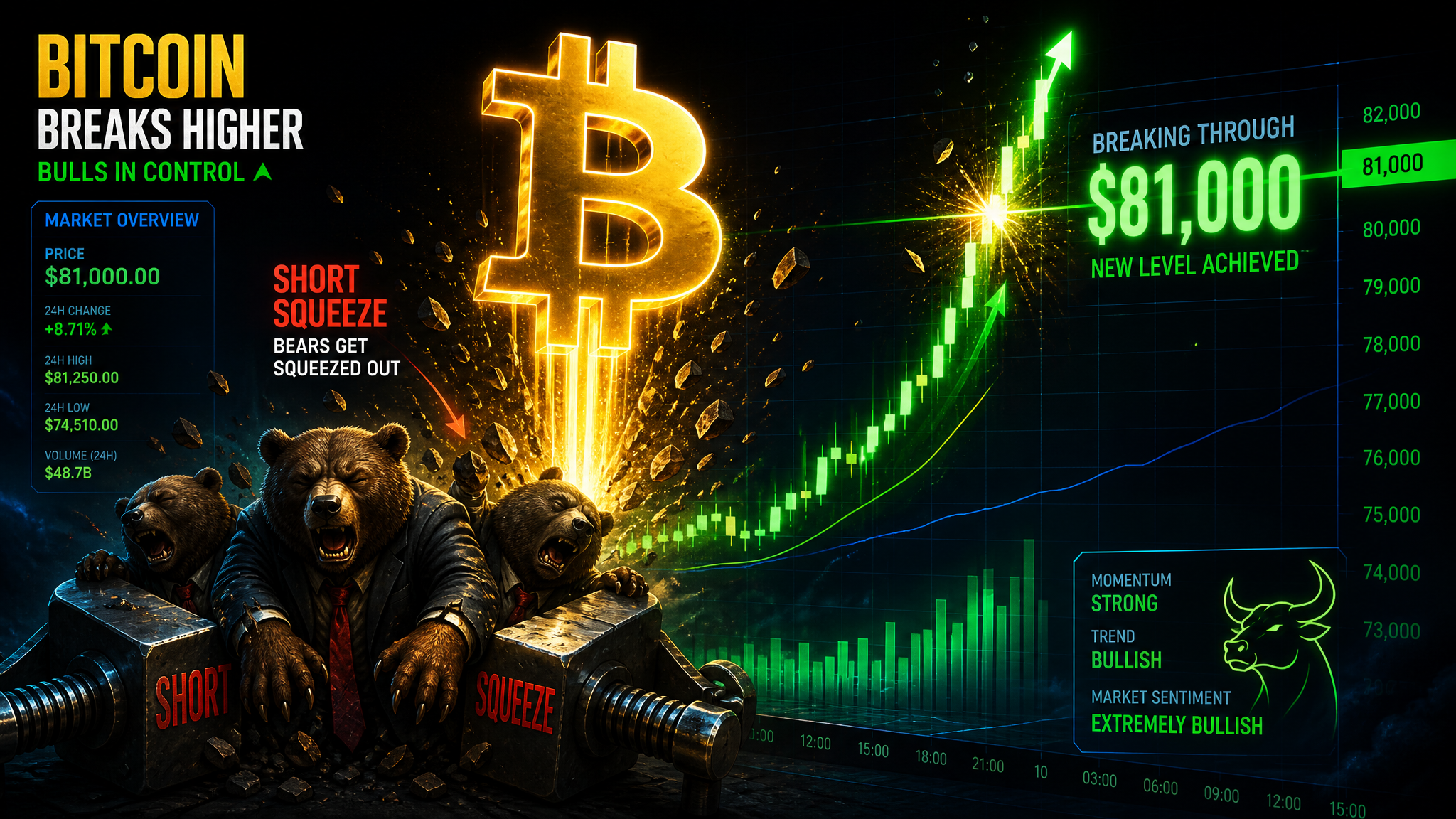
Bitcoin's short squeeze rally to $81,000 in August 2026 wasn't just another price spike — it was a collision of macro policy, regulatory momentum, and forced liquidations that reshaped the market in under two weeks. If you've been watching the charts and wondering what actually happened, here's the full picture: a U.S. Treasury bond buyback decision lit the fuse, a $7 billion short squeeze did the heavy lifting, and a White House crypto summit plus a landmark SEC proposal gave the move legs. Let's break it all down.
The Spark: U.S. Treasury Doubles Bond Buyback Operations
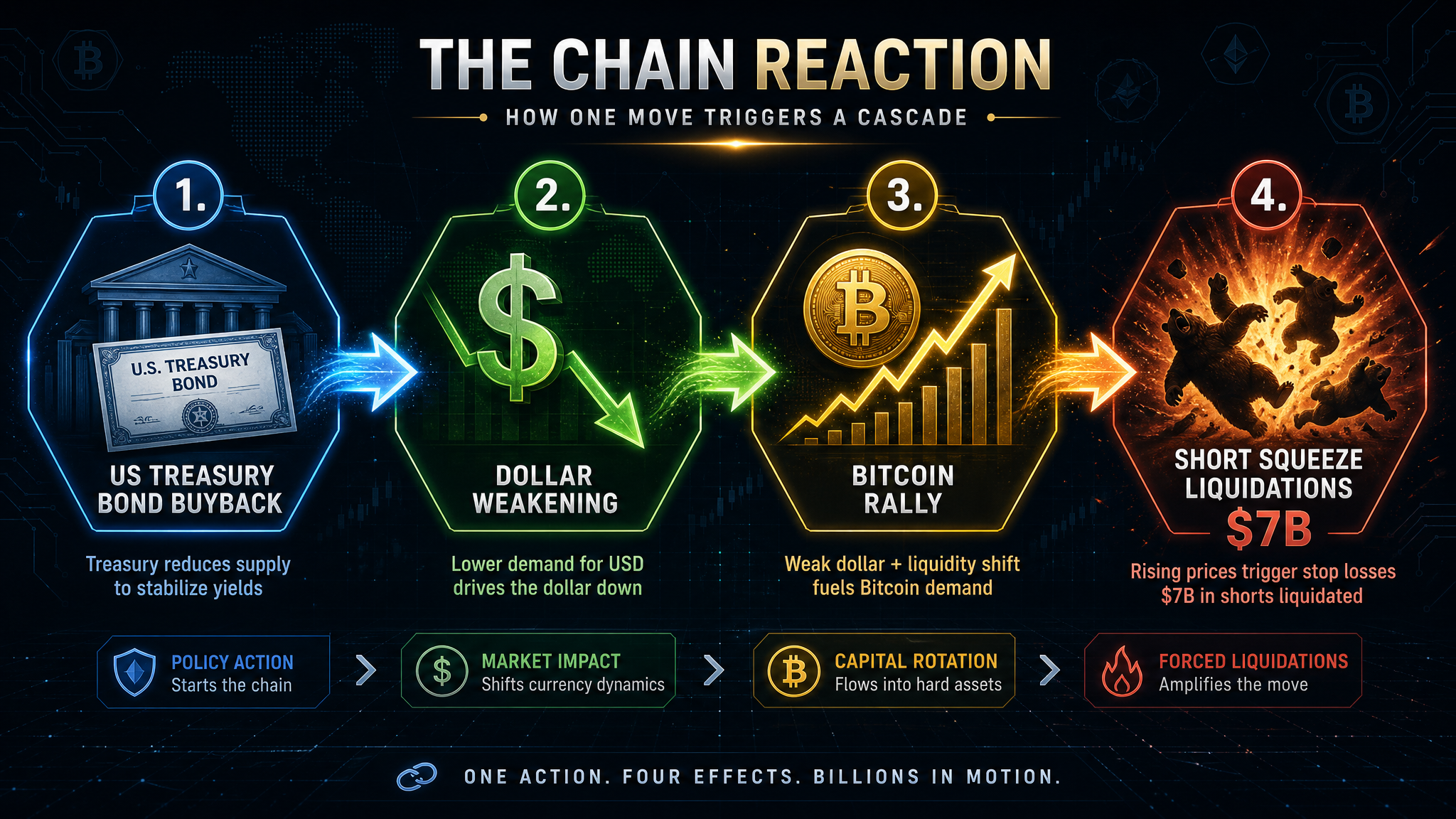
The rally's origin story starts not in crypto, but in the bond market. In mid-August 2026, the U.S. Treasury announced it would double the maximum size of certain long-dated bond buyback operations — from $2 billion to $4 billion per operation. The stated goal was to enhance liquidity in the Treasury market. The unintended consequence? A weaker dollar and a flood of capital into scarce assets.
Bitcoin traders recognized the pattern immediately. When the dollar weakens and real yields compress, the "debasement trade" kicks in — investors rotate out of fiat-denominated assets and into hard assets like gold and Bitcoin. After trading in the $65,000–$72,000 range for most of early August, Bitcoin broke above $75,000 on August 21 as the Treasury news filtered through markets.
That breakout triggered something far more powerful than organic buying.
The Short Squeeze: $7 Billion in Forced Liquidations
Here's where it gets interesting. Heading into mid-August, a significant portion of the derivatives market was positioned short — traders betting Bitcoin would fall or stay range-bound. When the price broke through key resistance levels, those short positions started getting liquidated automatically.
Forced liquidations create a feedback loop. Each liquidation pushes the price higher, which triggers more liquidations, which pushes the price higher still. By August 21, over $3.1 billion in short positions had been wiped out across the crypto market. By August 25, that figure had climbed past $7 billion — one of the largest short squeeze events in crypto history.
Bitcoin peaked at $81,235 on August 25. Ethereum surged 18–23% in a single day, climbing from under $1,950 to nearly $2,300. Solana outperformed, rising to roughly $97.75. Even meme coins caught a bid, though those moves were purely speculative.
By August 26, Bitcoin had pulled back to the $78,000–$79,000 range — a healthy consolidation after a 22% weekly gain. Analysts broadly characterized the pullback as profit-taking and position digestion rather than a fundamental reversal. Institutional demand remained intact, with U.S. spot Bitcoin ETFs recording $338 million in net inflows on August 24 alone — the sixth consecutive day of buying — and over $2.2 billion in net inflows between August 17 and August 25.
The White House Crypto Summit: CLARITY Act Gets a Presidential Push
On August 19, right in the middle of the rally, President Trump hosted a White House summit with the biggest names in crypto. Coinbase CEO Brian Armstrong, Kraken Co-CEO Arjun Sethi, Robinhood's Vlad Tenev, and the Winklevoss twins from Gemini were all in the room. So were SEC Chairman Paul Atkins and CFTC Chairman Michael Selig.
The message from Trump was direct: pass the Digital Asset Market Clarity Act. The CLARITY Act, which cleared the House in July 2025 and the Senate Banking Committee in May 2026, aims to create a unified regulatory framework defining which digital assets fall under SEC jurisdiction versus CFTC oversight. Trump framed it as essential for keeping the U.S. ahead of China in the global digital asset race.
Markets responded immediately. Bitcoin jumped roughly 5% following the summit. Coinbase stock and other crypto-adjacent equities saw significant gains.
The bill's path isn't smooth, though. Senate holdouts — particularly retiring Senator Thom Tillis — are demanding ethics provisions that would grant state attorneys general enforcement authority over senior officials' crypto holdings. Trump has publicly pushed back, calling those provisions unfairly targeted. A critical procedural vote is expected in mid-September 2026, with a narrow window before the October recess and November midterms.
If Congress fails to act, regulators have signaled they'll move independently. CFTC Chairman Selig has directed staff to explore codifying a crypto market structure using existing agency authority. Which brings us to the SEC's own major move.
SEC Proposes "Regulation Crypto Assets": What It Actually Means
On August 18, 2026 — one day before the White House summit — the SEC proposed "Regulation Crypto Assets," a framework that represents a genuine shift from the agency's previous "regulation by enforcement" approach. SEC Chairman Atkins described it as a "fit-for-purpose" regime designed to stop forcing modern digital assets into 1930s-era securities laws.
The proposal has three main pillars:
- Startup Exemption: Early-stage crypto projects can raise up to $5 million over four years with principles-based narrative disclosures — no full securities registration required.
- Fundraising Exemption: A two-tier system modeled after Regulation A. Tier 1 allows up to $20 million; Tier 2 allows up to $75 million in any 12-month period (with audited financials required for Tier 2).
- Investment Contract Safe Harbor: If an issuer certifies that all "essential managerial efforts" promised under an investment contract are complete, the crypto asset can exit SEC jurisdiction as a security. This is the "off-ramp" the industry has been asking for.
Critically, tokens issued under these exemptions are not restricted securities — they can be freely traded, which helps network effects develop. State-level "blue sky" registration requirements are also preempted, reducing compliance friction for secondary markets.
The public comment period runs until October 20, 2026. Atkins has stated the proposal is designed to complement — and potentially be superseded by — the CLARITY Act if Congress passes it.

For investors, the practical impact is significant. More legitimate crypto projects will be able to raise capital in the U.S. without going offshore. Clearer definitions reduce the risk of surprise enforcement actions. And the safe harbor mechanism gives mature protocols a defined path to regulatory exit — something that's been missing since the ICO era.
Want to understand the deeper economics driving these regulatory shifts? The Bitcoin Standard remains essential reading for grasping why Bitcoin's monetary properties make it a natural focal point for both institutional demand and regulatory attention.
What's Next: PCE Data, Jackson Hole, and the September Outlook
As of August 26, markets are in a holding pattern ahead of two key catalysts: the Q2 real GDP revision and July PCE inflation data, plus commentary from the Federal Reserve at the Jackson Hole Symposium. These will determine whether the current consolidation resolves higher or triggers a deeper pullback.
The bull case is straightforward. If PCE comes in soft (suggesting inflation is cooling), the Fed has room to cut rates — which historically benefits Bitcoin. Continued ETF inflows and the regulatory tailwinds from the SEC proposal and CLARITY Act momentum provide structural support.
The bear case centers on leverage. Aggregated futures open interest has risen to approximately $31.94 billion, with a heavy concentration of long positions. That crowding creates vulnerability to sharp downside moves if macro data disappoints. Ethereum faces technical resistance at $2,500–$2,600; failure to hold $2,400 could see a retracement toward $2,150.
Japan is also worth watching. The country is considering easing stablecoin restrictions for high-value payments and exploring a blockchain-based settlement system for government bonds and equities. Thailand's SEC is seeking public feedback on a crypto ETF framework. Global regulatory momentum is building — and that's a medium-term positive for the asset class.
Practical Takeaways for Investors
Here's what this week's events actually mean for your portfolio decisions:
- The macro driver is real, but the squeeze mechanics are temporary. The Treasury buyback trade is a legitimate macro catalyst. The $7 billion in short liquidations amplified the move but won't repeat at the same scale. Organic demand — ETF inflows, institutional accumulation — is the more durable signal.
- Regulatory clarity is coming, one way or another. Whether through the CLARITY Act or the SEC's new framework, the era of pure enforcement-by-ambiguity is ending. That's structurally positive for legitimate projects and reduces one of the biggest risk factors for institutional allocators.
- Manage leverage carefully. With open interest at elevated levels and crowded longs, volatility in both directions is elevated. If you're trading derivatives, position sizing matters more than ever right now.
- Watch the September CLARITY Act vote. A successful cloture vote in mid-September would be a significant catalyst. A failure would likely cause short-term disappointment but wouldn't derail the broader regulatory progress already underway at the SEC and CFTC.
If you're serious about navigating these market conditions with a structured approach, Ready to master crypto trading? Check out Icoinpro's comprehensive trading course — it covers macro-driven trading strategies, risk management, and how to position around major market events like this one.
And if you're holding significant crypto positions, protecting them with cold storage is non-negotiable. Protect your crypto assets with a Ledger hardware wallet — the gold standard in cold storage security.
The Bottom Line
Bitcoin's run to $81,000 in August 2026 was a confluence of macro policy, forced liquidations, and regulatory momentum — not a single-factor move. The Treasury buyback weakened the dollar and triggered the debasement trade. The short squeeze amplified the move to levels that surprised even bulls. And the White House summit plus the SEC's new framework gave the rally a regulatory narrative that institutional investors could get behind.
The consolidation at $78,000–$79,000 is healthy. The real question is whether the September PCE data and Jackson Hole commentary give the market permission to push higher — or whether elevated leverage creates a shakeout first. Either way, the structural picture for crypto has improved materially this month. That's the story worth paying attention to.
Understanding the market is step one. Profiting from it is step two.
Reading analysis is valuable, but knowing how to generate your own — and act on it with discipline — is where real results come from. That skill is trainable.
The program I recommend to people who ask me is this crypto trading course — it\'s the one I point friends and family to when they\'re serious about learning. Daily lessons, live analysis, and a community that actually helps.
Affiliate link — I may earn a commission at no extra cost to you. I only recommend what I genuinely use.
Disclaimer: The information provided on this website is for educational and informational purposes only. It should not be considered financial or investment advice. Cryptocurrency investments carry significant risk. Always do your own research and consult with a qualified financial advisor before making investment decisions.
Free Crypto Insights
Get weekly trading tips, market analysis, and exclusive strategies delivered to your inbox.