CFTC Approves Bitcoin Perpetual Futures: What the Kalshi and Coinbase Ruling Means for US Traders in 2026
Affiliate Disclosure: This article may contain affiliate links. We may earn a commission at no extra cost to you. All opinions are our own.
Marcus Chen
Senior Crypto Analyst & Educator
Certified Blockchain Professional | Former Wall Street Analyst
Marcus Chen is a cryptocurrency analyst and educator with over 8 years of experience in digital asset trading. He has helped thousands of beginners navigate the crypto markets through practical, actionable education.
CFTC Approves Bitcoin Perpetual Futures: What the Kalshi and Coinbase Ruling Means for US Traders in 2026
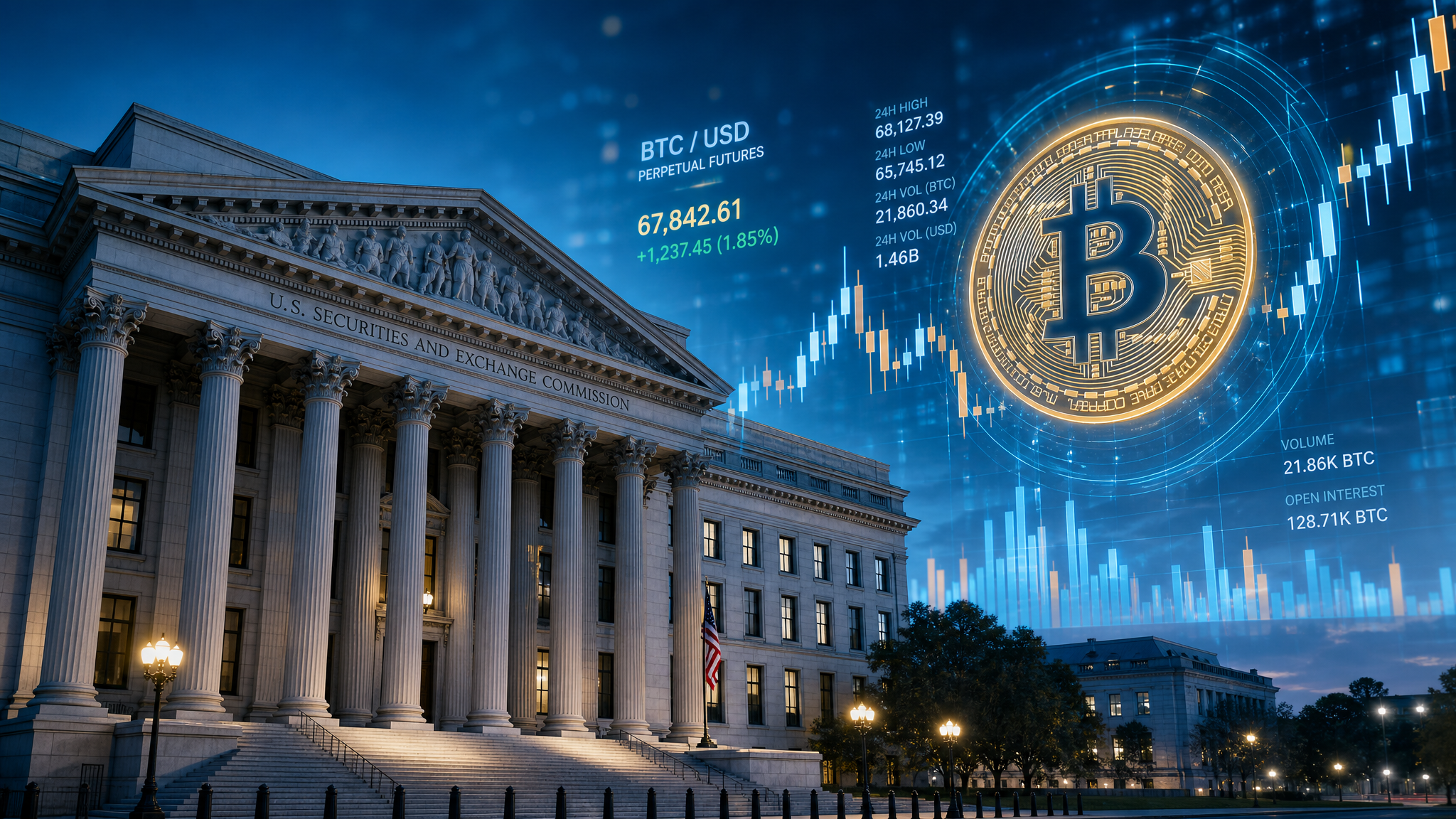
On May 29, 2026, the U.S. Commodity Futures Trading Commission made history. For the first time ever, Bitcoin perpetual futures — the dominant derivative instrument in global crypto markets — received regulatory approval for domestic U.S. trading. Kalshi won the first-ever CFTC authorization to list a BTCPERP contract, while Coinbase received a no-action letter allowing its U.S. affiliate to route customers to perpetual products on its Bermuda exchange. This is not a minor policy tweak. It's a structural shift that could reshape how American traders access crypto derivatives.
What Are Bitcoin Perpetual Futures?
If you've spent any time on offshore exchanges like Binance or Bybit, you've probably traded perps without thinking much about what makes them special. But for the millions of U.S. traders locked out of these instruments — or forced to use offshore platforms with real legal gray-area risk — this ruling matters enormously.
How Perps Differ from Traditional Futures
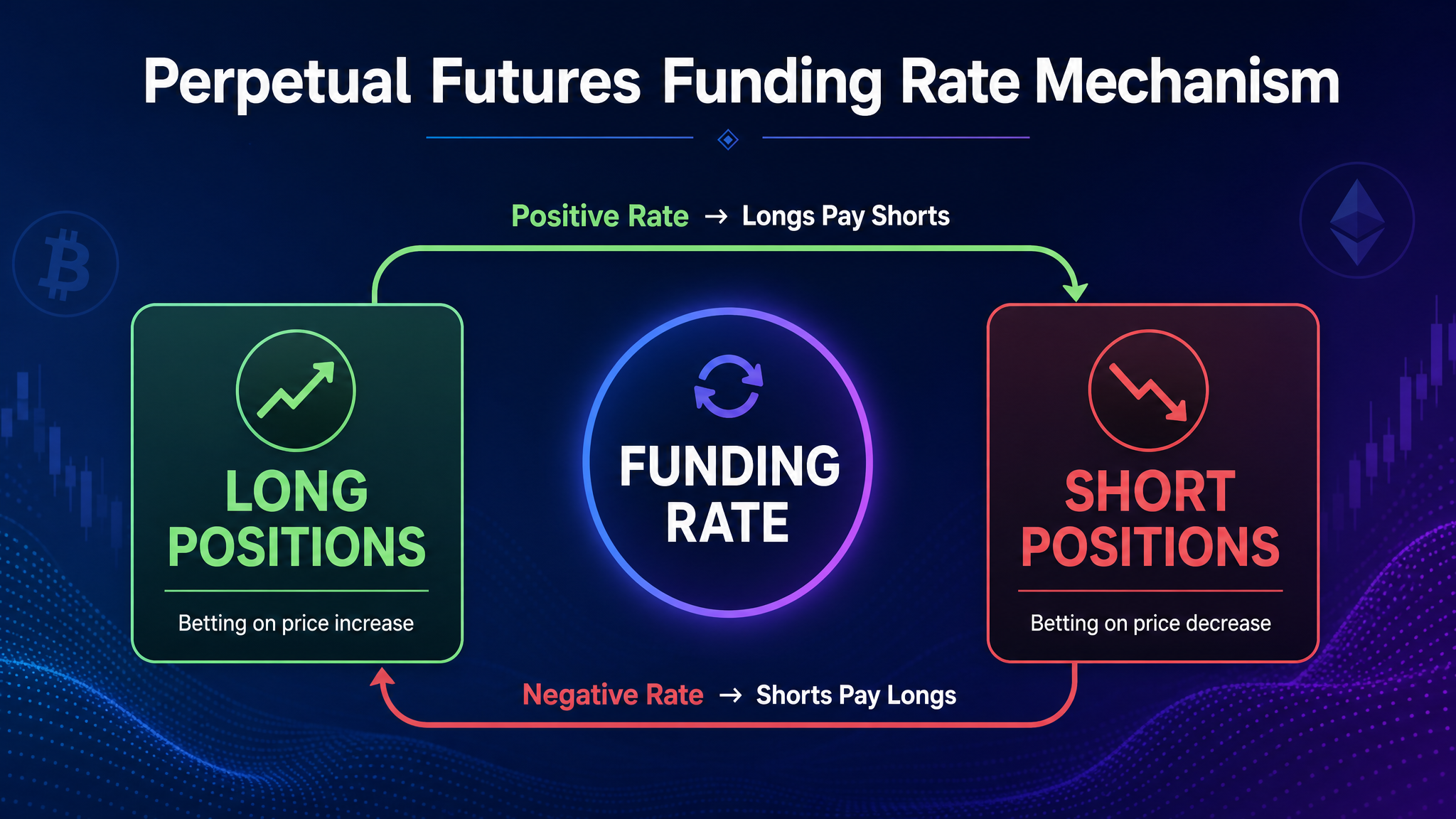
Standard futures contracts have an expiration date. You buy a December Bitcoin futures contract, and it settles in December — period. Perpetual futures, by contrast, never expire. They track the spot price of Bitcoin through a mechanism called the funding rate: every eight hours, traders on the long side pay traders on the short side (or vice versa) a small fee based on how far the perp price deviates from spot. This keeps the contract price anchored to reality without ever needing to roll over.
The result? Traders can hold leveraged positions indefinitely, adjusting exposure as market conditions change. It's a cleaner, more flexible instrument than traditional futures — which is exactly why it became the backbone of crypto derivatives trading globally.
Why Perps Dominate Global Crypto Volume
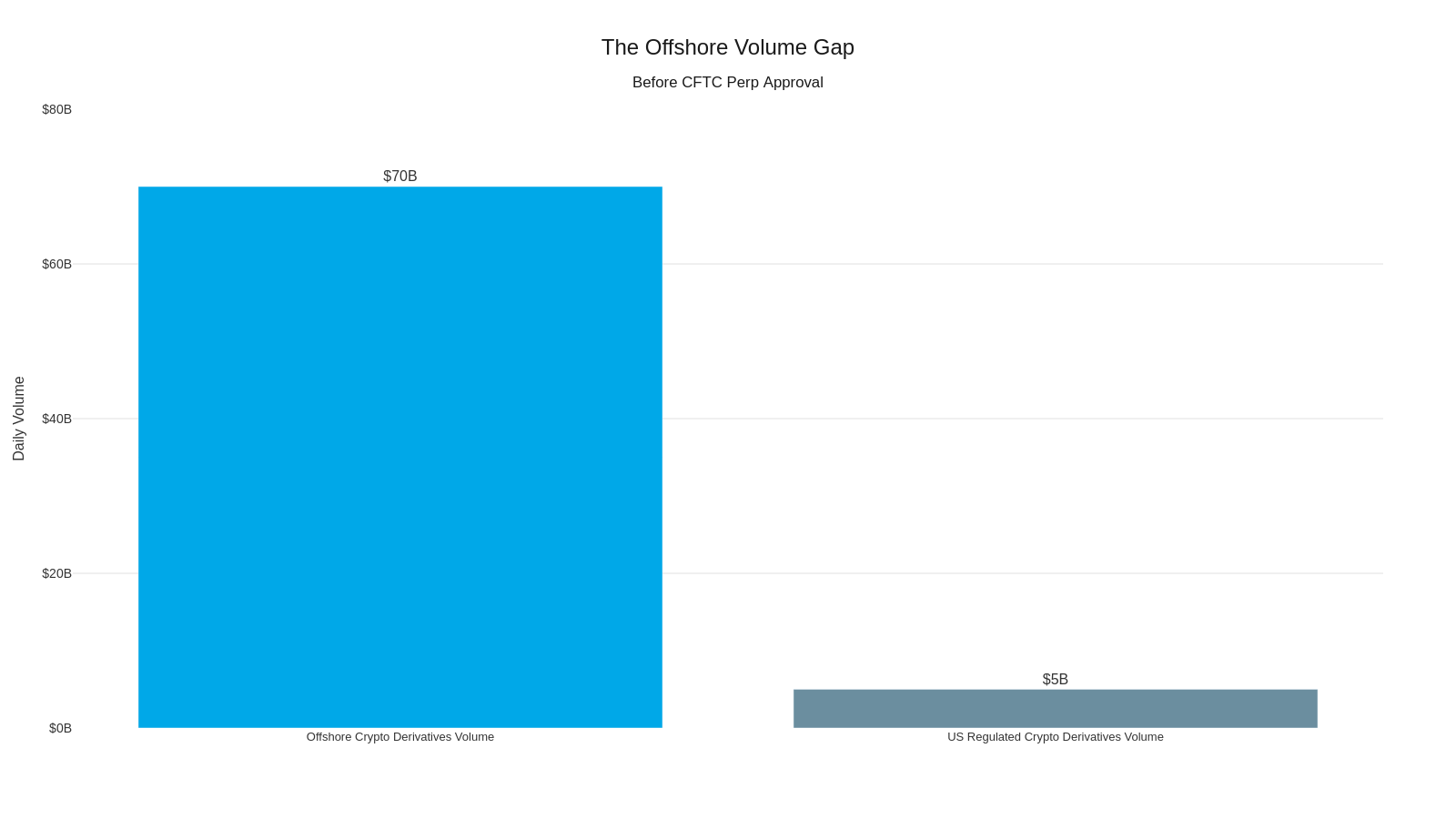
Here's a number that puts this in perspective: perpetual futures account for more than 70% of all centralized exchange volume in crypto. On a typical day, global perp markets process $50–$80 billion in notional volume. The CME's Bitcoin futures — the gold standard of U.S.-regulated crypto derivatives — handle a fraction of that. American traders who wanted access to perps had two choices: use an offshore exchange (with all the counterparty and regulatory risk that entails) or simply go without. Until now.
The CFTC Ruling Explained
The May 29 decision covers two separate but related approvals, each with different implications for U.S. traders.
Kalshi Gets the Green Light
Kalshi — originally a prediction market platform — received formal CFTC approval under Regulation 40.3 to list its BTCPERP contract. This is the first true perpetual futures contract authorized for domestic U.S. trading. The contract will be cleared through Kalshi's affiliated futures commission merchant, Kinetic Markets, and will operate under full CFTC oversight including real-time surveillance requirements and 24/7 staffing mandates.
CFTC Chairman Mike Selig framed the decision as a "major step forward" in making the U.S. the "crypto capital of the world" — a pointed acknowledgment that years of regulatory ambiguity had pushed this massive market offshore. Kalshi has already opened a waitlist for the product, which saw significant interest within hours of the announcement.
One important constraint: the CFTC made clear that self-certification (the faster Reg 40.2 process) is not permitted for perpetual contracts. Every new perp product requires a full case-by-case review. Agricultural perps are explicitly off the table. For now, Bitcoin is the only approved underlying asset.
Coinbase Gets a No-Action Letter
Coinbase's situation is slightly different. Its U.S. affiliate, Coinbase Financial Markets (CFM), received a no-action letter allowing it to route U.S. customers to perpetual products listed on Coinbase Bermuda. These are treated as "foreign futures" under U.S. law, with nine specific conditions attached — including the requirement that all entities involved remain wholly-owned Coinbase subsidiaries and that margin be fully segregated.
Think of it as a "regulated wrapper" around offshore access. U.S. traders get the global perp market, but with U.S. regulatory protections layered on top. It's not as clean as a fully domestic product, but it's a massive improvement over the current situation where traders use offshore platforms with zero U.S. oversight.
Why This Is a Big Deal for US Crypto Markets
Bringing $70B+ in Daily Volume Onshore
The regulatory arbitrage that's existed for years has been genuinely damaging to U.S. market competitiveness. American traders have been sending billions in fees to offshore exchanges — Binance, OKX, Bybit — because those platforms offered instruments that U.S. regulators hadn't approved. That capital, and the price discovery that comes with it, has been happening outside U.S. jurisdiction.
Bringing even a fraction of that volume into regulated domestic venues changes the game. It means better price discovery, more transparent markets, and — critically — U.S. traders who can access leverage without worrying about whether their exchange will freeze withdrawals or get sanctioned tomorrow.
What Changes for Retail Traders
Practically speaking, here's what shifts for the average U.S. crypto trader:
- Legitimate leverage access: Trade leveraged Bitcoin positions on a CFTC-regulated exchange without the legal gray area of offshore platforms.
- Segregated margin: Your collateral will be held under U.S. regulatory standards — not on an offshore exchange where "proof of reserves" is the only assurance you get.
- Tax clarity: Regulated futures contracts have clearer tax treatment under U.S. law (Section 1256 contracts get 60/40 long-term/short-term treatment), a meaningful advantage for active traders.
- Tighter spreads over time: As liquidity builds on domestic venues, bid-ask spreads should compress, reducing trading costs.
Ready to master crypto trading? Check out Icoinpro's comprehensive trading course — it covers derivatives, risk management, and the fundamentals you need before touching leveraged products.
Bitcoin Market Reaction and Context
The CFTC announcement landed in the middle of a rough week for Bitcoin. Understanding the market context shapes how traders should interpret the news.
ETF Outflows and Price Pressure in May 2026
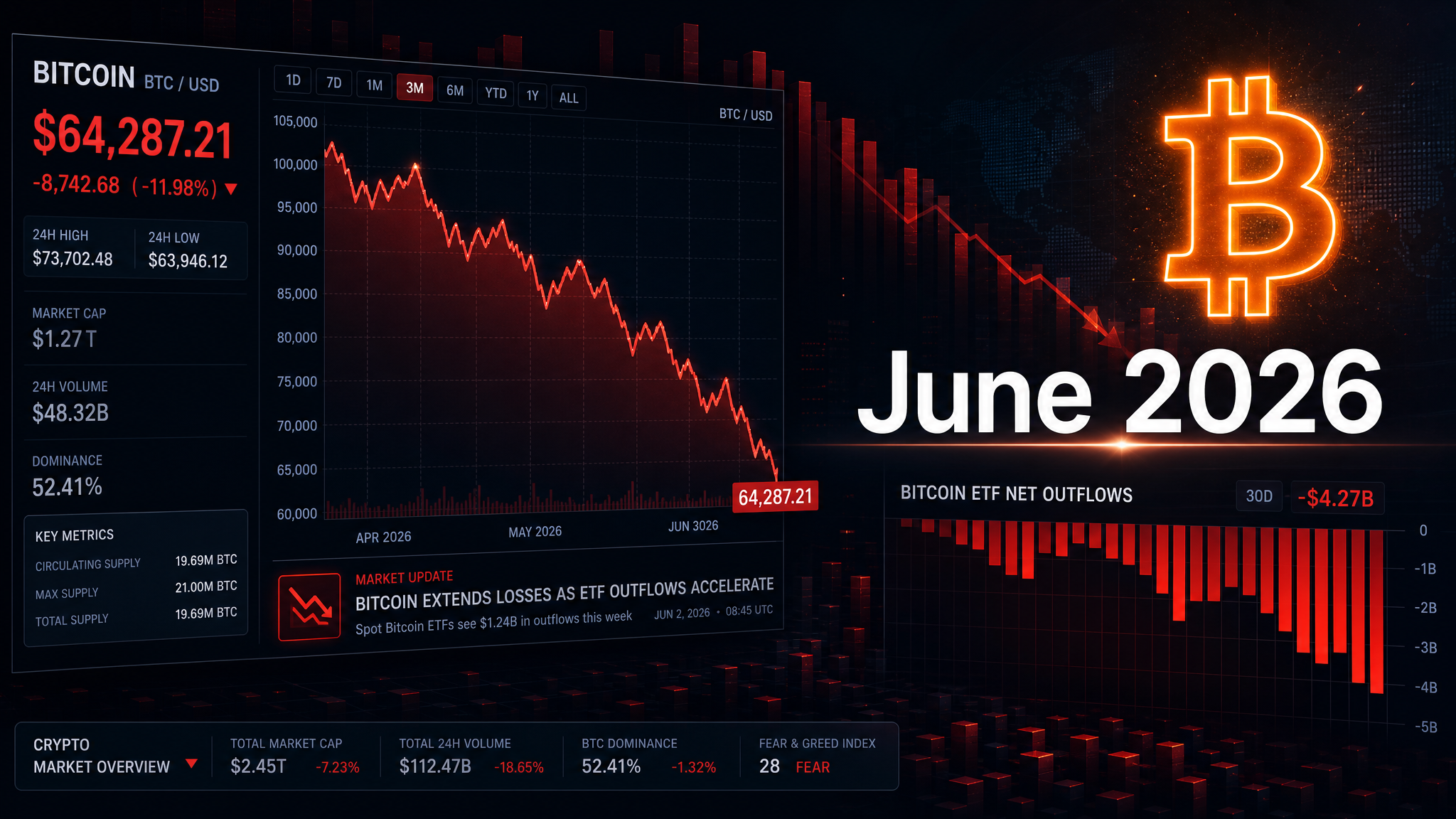
May 2026 has been challenging. Bitcoin started near $77,000 and retreated to the low $72,000–$73,500 range, putting a two-month winning streak at risk. The primary culprit: a historic nine-day streak of outflows from U.S. spot Bitcoin ETFs totaling $2.8 billion. BlackRock's IBIT alone shed $527.84 million on May 27 — the second-largest single-day outflow in the fund's history.
What's driving the selling? A combination of geopolitical tensions around U.S.-Iran negotiations, a hawkish Federal Reserve keeping the 30-year Treasury yield above 5.1%, and institutional portfolio rebalancing after a strong Q1. The Fear & Greed Index dropped to 25 — "extreme fear" territory — and approximately $897 million in long liquidations hit the market in a single 24-hour window. A notable $1.29 billion dark pool block trade in IBIT shares on May 26 signaled that at least one large institutional holder was repositioning at scale.
What Analysts Are Saying About June Outlook
Despite the near-term pain, the medium-term picture looks more constructive. Standard Chartered, JPMorgan, and Bernstein all maintain year-end Bitcoin targets in the $100,000–$150,000 range. Technical analysts are watching the $72,000–$73,000 level closely — a sustained hold above that zone is seen as the key signal for a trend reversal. The EU's MiCA licensing framework goes fully live on June 30, 2026, which should unlock additional institutional capital from European asset managers.
Risks and Limitations of the New Framework
Let's be honest about what this ruling doesn't do. It's not a blanket approval for all crypto derivatives. Each new perpetual product requires a full CFTC review. Altcoin perps — ETH, SOL, XRP — are not approved and won't be anytime soon without separate applications.
There's also the question of liquidity. Kalshi is not Binance. Building the order book depth needed to make a perp market genuinely useful for large traders takes time. Early adopters may face wider spreads and less favorable execution than they'd get on established offshore venues. That gap will close as volume migrates, but it won't happen overnight.
Finally, leverage limits on regulated U.S. venues will almost certainly be lower than what offshore exchanges offer. Binance allows up to 125x leverage on Bitcoin perps. U.S. regulators are unlikely to permit anything close to that. Expect initial limits in the 10x–20x range — more appropriate for most retail traders, but a real difference for those accustomed to offshore leverage.
Protect your crypto assets with a Ledger hardware wallet — the gold standard in cold storage security. As you engage with more sophisticated trading instruments, keeping your underlying holdings secure becomes even more critical.
How to Position Yourself as a Trader
So what should you actually do with this information? A few practical thoughts:
Get on the Kalshi waitlist. Even if you're not ready to trade perps immediately, being an early user of a regulated domestic venue positions you well as liquidity builds. Early adopters often benefit from promotional fee structures.
Understand the funding rate before you trade. Perpetual futures are not a "set and forget" instrument. The funding rate can eat into your position significantly during trending markets. If Bitcoin is in a strong uptrend and everyone is long, funding rates can run at 0.1% per 8 hours — roughly 109% annualized. Know your holding costs before you enter.
Consider the tax implications. If Kalshi's BTCPERP qualifies as a Section 1256 contract, you'd get the 60/40 tax treatment regardless of holding period. That's a meaningful advantage over spot trading for active traders in higher tax brackets. Consult a crypto-savvy CPA before making decisions based on this.
Want to understand the economics behind Bitcoin? The Bitcoin Standard is essential reading for every crypto enthusiast — it provides the foundational framework for understanding why Bitcoin's monetary properties make it the natural anchor for a derivatives market.
Key Takeaways
- The CFTC approved Kalshi to list the first-ever regulated Bitcoin perpetual futures contract in the U.S. on May 29, 2026.
- Coinbase received a no-action letter allowing its U.S. affiliate to route customers to offshore perp products under a regulated framework.
- Perpetual futures account for 70%+ of global crypto derivatives volume — this ruling begins the process of bringing that market onshore.
- Bitcoin is trading near $72,000–$73,500 amid $2.8B in ETF outflows and geopolitical uncertainty, but medium-term analyst targets remain $100K–$150K.
- Key risks: limited initial liquidity on domestic venues, lower leverage caps than offshore, and no altcoin perps approved yet.
- Practical steps: join the Kalshi waitlist, understand funding rate mechanics, and consult a CPA about Section 1256 tax treatment.
Frequently Asked Questions (September 2026 Update)
Is CME's lawsuit against the CFTC likely to succeed?
Legal analysts are divided. CME argues the CFTC exceeded its authority by approving perpetual contracts without proper rulemaking. The CFTC counters that its existing DCM framework covers these products. Most observers expect the case to take 12–18 months to resolve, meaning Kalshi's BTCPERP can continue operating during litigation unless a court issues an injunction — which hasn't happened as of September 2026.
Can I trade Kalshi's Bitcoin perpetual futures right now?
Kalshi opened a waitlist after the May 2026 approval. As of September 2026, access is being rolled out gradually to U.S. retail traders. You'll need to complete KYC verification and meet Kalshi's eligibility requirements. Leverage caps are lower than offshore venues — typically 10x maximum versus 100x on Binance — reflecting the CFTC's conservative approach to retail risk.
How does the Coinbase-Deribit arrangement work for U.S. traders?
Coinbase Financial Markets (CFM) received a CFTC no-action letter allowing it to route U.S. customer collateral to Deribit, which Coinbase acquired in 2025. U.S. traders access Deribit's perpetual products through Coinbase's interface, with collateral held under Coinbase Global's regulatory umbrella. This arrangement is conditional — CFM must maintain common ownership with Deribit and comply with SEC disclosure requirements.
Will other altcoin perpetual futures get CFTC approval?
Not immediately. The CFTC's May 2026 policy statement explicitly prohibits self-certification for perpetual contracts — every new product requires individual Commission review under Regulation 40.3. Ethereum perps are the most likely next candidate, but no formal applications have been publicly filed as of September 2026. The CME lawsuit adds further uncertainty to the timeline.
What are the tax implications of trading regulated Bitcoin perps?
Regulated Bitcoin perpetual futures on a CFTC-designated contract market likely qualify as Section 1256 contracts, meaning gains and losses are taxed at a blended 60% long-term / 40% short-term capital gains rate — regardless of how long you held the position. This is a significant advantage over spot trading for active traders in higher tax brackets. Always consult a crypto-specialized CPA before trading, as IRS guidance on perpetual futures specifically is still evolving.
For more on crypto derivatives and advanced trading strategies, see our guide on Perpetual Funding Rate Arbitrage and our Deribit Exchange Review 2026.
Understanding the market is step one. Profiting from it is step two.
Reading analysis is valuable, but knowing how to generate your own — and act on it with discipline — is where real results come from. That skill is trainable.
The program I recommend to people who ask me is this crypto trading course — it\'s the one I point friends and family to when they\'re serious about learning. Daily lessons, live analysis, and a community that actually helps.
Affiliate link — I may earn a commission at no extra cost to you. I only recommend what I genuinely use.
Disclaimer: The information provided on this website is for educational and informational purposes only. It should not be considered financial or investment advice. Cryptocurrency investments carry significant risk. Always do your own research and consult with a qualified financial advisor before making investment decisions.
Free Crypto Insights
Get weekly trading tips, market analysis, and exclusive strategies delivered to your inbox.