CLARITY Act Senate Recess August 2026: What the Delay Means for Crypto Investors
Affiliate Disclosure: This article may contain affiliate links. We may earn a commission at no extra cost to you. All opinions are our own.
Marcus Chen
Senior Crypto Analyst & Educator
Certified Blockchain Professional | Former Wall Street Analyst
Marcus Chen is a cryptocurrency analyst and educator with over 8 years of experience in digital asset trading. He has helped thousands of beginners navigate the crypto markets through practical, actionable education.
Disclaimer: This CLARITY Act analysis and all content on this site is for informational purposes only and should not be considered financial advice. Cryptocurrency investments carry significant risk. Always do your own research (DYOR) before making any investment decisions.
This article contains affiliate links. We may earn a commission at no extra cost to you if you make a purchase through these links. See our affiliate disclosure for details.
CLARITY Act Senate Recess August 2026: What the Delay Means for Crypto Investors
The CLARITY Act just missed its biggest window yet. As the U.S. Senate entered its August recess on August 10, 2026, the landmark crypto regulation bill failed to reach a final floor vote — leaving the digital asset market in a familiar state of regulatory limbo. For crypto investors watching Bitcoin hover around $65,000, the question isn't just whether the bill passes. It's what this delay actually costs you, and how to position your portfolio while Washington figures itself out.
What the CLARITY Act Actually Does (And Why It Matters)
The Digital Asset Market Clarity Act — officially H.R. 3633 — is designed to end the decade-long turf war between the SEC and the CFTC over who regulates crypto. Right now, that ambiguity is the single biggest structural risk hanging over the U.S. crypto market.
The bill would create a clear two-lane system: assets classified as "digital commodities" fall under CFTC oversight, while those deemed "investment contracts" stay with the SEC. On March 17, 2026, the two agencies jointly named 16 assets — including Ethereum, Solana, and XRP — as digital commodities, which was a meaningful step. But agency guidance isn't law. A future administration could reverse it overnight. The CLARITY Act would lock that framework into statute.
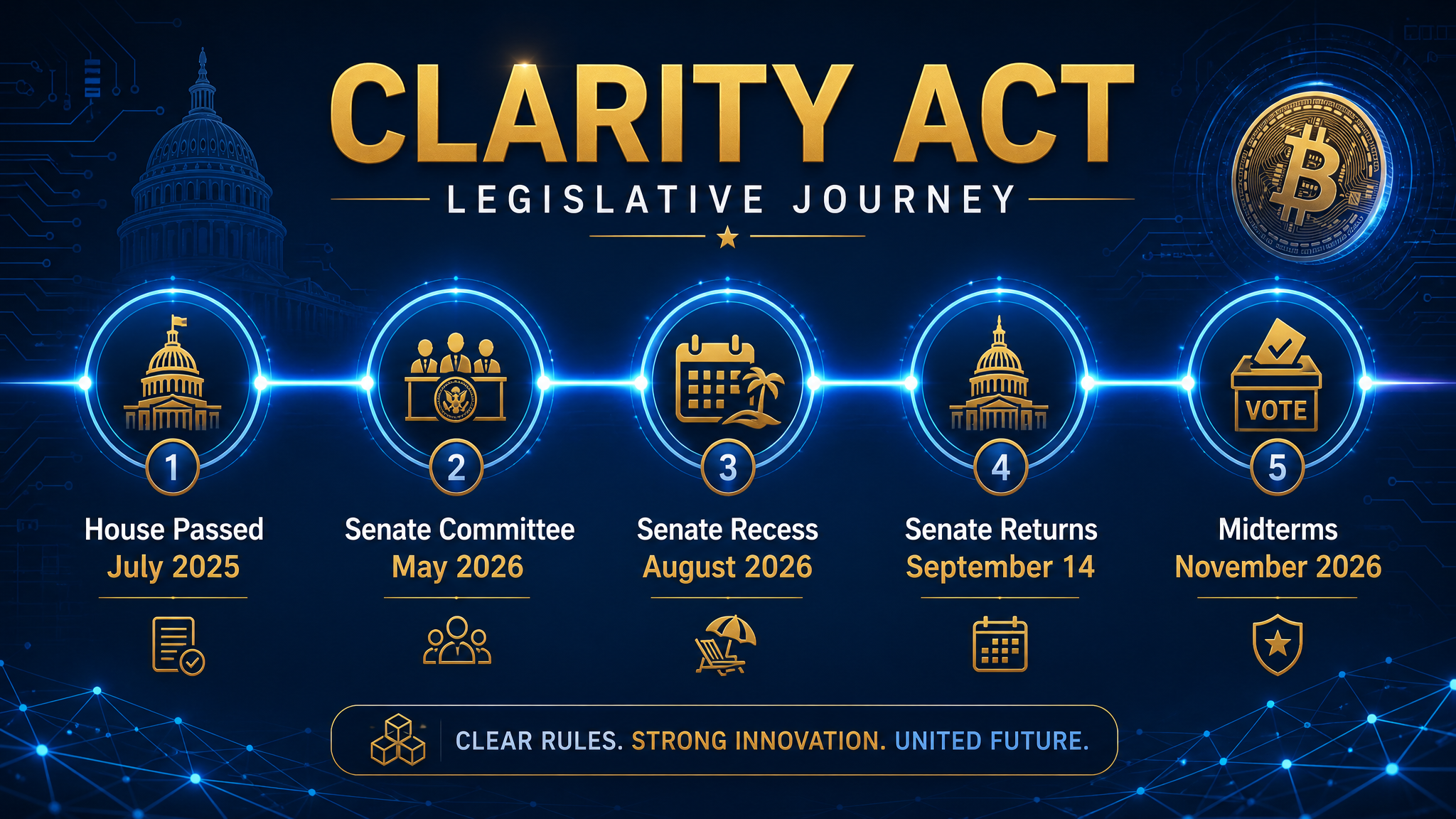
The House passed the bill in July 2025 with a strong bipartisan vote of 294 to 134. The Senate Banking Committee advanced it 15-9 in May 2026. Then it sat on the legislative calendar for months while political disputes festered.
Why the Senate Punted — Again
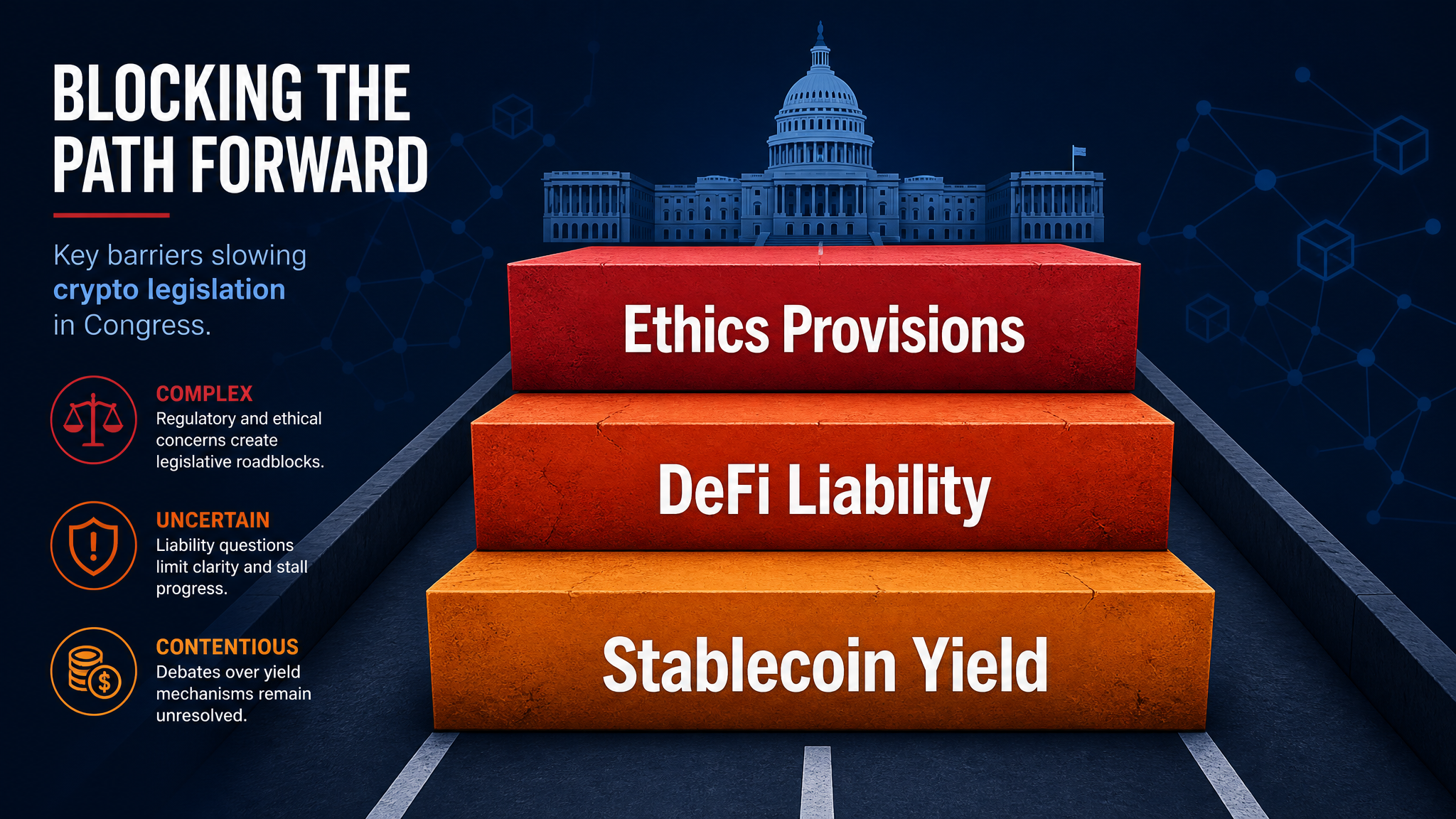
Three issues killed the August timeline. None of them are new, which is part of what makes this frustrating.
The ethics provision. Democrats want strict conflict-of-interest rules covering the President and senior officials who hold or sponsor crypto. Republicans offered a compromise in late July — a temporary ban on officials profiting from digital assets while in office, with a 2029 sunset clause. Democrats called it toothless. The standoff held.
DeFi developer liability. Should non-custodial software developers be exempt from money-transmitter registration? The crypto industry says yes — you can't regulate open-source code like a bank. Some senators aren't convinced. This one has no easy middle ground.
Stablecoin yield. The GENIUS Act, signed in July 2025, prohibits interest-bearing stablecoins for issuers. Now there's a fight over whether exchanges can pay rewards on stablecoin balances. Banks want that loophole closed. Crypto platforms want it open. Neither side is blinking.
Senate Majority Leader John Thune filed a cloture motion on August 8 — a procedural move to limit debate — but the bill still needs 60 votes to clear the chamber. As of the recess, sponsors don't have them.
The Market's Reaction: Muted, But Not Meaningless
Bitcoin's response to the delay has been notably calm. After the announcement, BTC traded in a tight band between $64,000 and $65,000. On August 10, the price sat at roughly $65,003 at the open — barely moved from the prior day.
That's not indifference. That's a market that already priced in the bad news. Prediction markets on Kalshi and Polymarket had the bill's 2026 passage odds at just 20-27% heading into August. Traders weren't surprised; they were already positioned for delay.
The assets most exposed to this regulatory limbo are the ones whose legal classification the bill would settle. XRP is the clearest example — its status as a commodity vs. security has been contested for years, and the CLARITY Act would resolve that definitively. Without the bill, XRP and similar assets remain in a gray zone that institutional investors are reluctant to touch at scale.
JPMorgan has warned that failure to pass the bill could push institutional tokenization efforts toward traditional infrastructure rather than public blockchains. That's a real cost — not to Bitcoin, which already has ETF approval and institutional backing, but to the broader ecosystem.
What Happens Next: The September Window
The Senate returns September 14, 2026. That gives lawmakers roughly six weeks before the November midterm elections dominate the political calendar. After that, only about five session weeks remain in the year.
The math is tight. If the bill doesn't pass in September, analysts put 2026 enactment odds at near zero. The legislation would then need to restart in the new Congress — potentially with a different House majority if midterms shift the balance of power.
There's a scenario where the CLARITY Act gets attached to a must-pass year-end spending package, but that's a long shot. More likely, the industry is looking at 2027 at the earliest for statutory clarity.
In the meantime, the SEC and CFTC are continuing to build out their parallel framework through joint guidance, no-action letters, and rulemaking. It's not nothing — but it's also not permanent. Agency rules can be reversed; laws can't.
How to Think About Your Portfolio Right Now
Here's the honest take: for most retail crypto investors, the CLARITY Act delay changes very little in the short term. Bitcoin and Ethereum already have spot ETFs. Institutional money is already flowing. The regulatory environment, while imperfect, is functional.
Where the delay matters more is in altcoin exposure. Assets whose regulatory status remains genuinely unclear — particularly those that haven't been named in the SEC-CFTC joint classification — carry more legal risk than they did a year ago. If you're holding significant positions in smaller-cap tokens, that's worth factoring into your risk assessment.
For long-term holders, the bigger picture is still intact. The direction of U.S. crypto regulation is clearly toward legitimization, not prohibition. The CLARITY Act will pass eventually. The question is timing, not outcome.
Want to sharpen your understanding of how regulation affects crypto markets and trading decisions? Icoinpro's comprehensive trading course covers market structure, regulatory risk, and how to build a resilient crypto strategy regardless of the political environment.
The Coldcard Exploit: A Separate But Related Warning
While the CLARITY Act drama played out in Washington, a different kind of crisis hit the crypto security world. A firmware vulnerability in Coldcard hardware wallets — traced to a coding error in a March 2021 update — allowed attackers to predict seed phrases and drain funds without physical access to the devices. Losses reached approximately $89 million across more than 4,500 addresses, with some estimates putting total exposure above $130 million.
This isn't directly related to the CLARITY Act, but it's a useful reminder: regulatory clarity doesn't protect your private keys. Self-custody security matters regardless of what Congress does.
If you're using a hardware wallet, check your firmware version and manufacturer guidance immediately. Coinkite has released patched firmware, but users who initialized wallets with the flawed software need to generate entirely new seed phrases and migrate funds — updating firmware alone isn't sufficient.
For those looking to upgrade their cold storage setup, the Ledger Nano X keeps your private keys offline and safe — and remains one of the most widely trusted hardware wallets on the market. Alternatively, Trezor wallets have been trusted by millions since 2014 and offer a strong alternative for cold storage.
Key Takeaways
- The CLARITY Act failed to reach a Senate floor vote before the August 10 recess. The Senate returns September 14.
- Three unresolved issues — ethics provisions, DeFi liability, and stablecoin yield — are blocking the 60 votes needed for passage.
- Bitcoin's market reaction has been muted; the delay was largely priced in, with prediction markets at 20-27% odds for 2026 passage.
- Assets with unresolved regulatory classification carry elevated legal risk; altcoin exposure warrants extra scrutiny.
- If the bill doesn't pass in September, 2026 enactment is effectively off the table. 2027 becomes the realistic target.
- The Coldcard exploit ($89M+ in losses) is a timely reminder to audit your hardware wallet security regardless of regulatory developments.
- Long-term, the direction of U.S. crypto regulation remains toward legitimization. The CLARITY Act delay is a setback, not a reversal.
Understanding the market is step one. Profiting from it is step two.
Reading analysis is valuable, but knowing how to generate your own — and act on it with discipline — is where real results come from. That skill is trainable.
The program I recommend to people who ask me is this crypto trading course — it\'s the one I point friends and family to when they\'re serious about learning. Daily lessons, live analysis, and a community that actually helps.
Affiliate link — I may earn a commission at no extra cost to you. I only recommend what I genuinely use.
Disclaimer: The information provided on this website is for educational and informational purposes only. It should not be considered financial or investment advice. Cryptocurrency investments carry significant risk. Always do your own research and consult with a qualified financial advisor before making investment decisions.
Free Crypto Insights
Get weekly trading tips, market analysis, and exclusive strategies delivered to your inbox.