FOMC July 2026: What the Fed Rate Decision Means for Bitcoin and Crypto
The FOMC July 2026 meeting — scheduled for July 28–29 — is the single biggest macro event for Bitcoin and crypto this month — and possibly this quarter. With BTC trading near $63,000 and the Fear & Greed Index sitting at a cautious 29, every word out of Fed Chair Kevin Warsh's press conference on Wednesday could send prices sharply in either direction. Here's what you actually need to know before the decision drops.

Disclaimer: This content is for informational purposes only and should not be considered financial advice. Cryptocurrency investments carry significant risk. Always do your own research (DYOR) before making any investment decisions.
Affiliate Disclosure: This article contains affiliate links. We may earn a commission at no extra cost to you if you make a purchase through these links. See our affiliate disclosure for details.
Why This FOMC Meeting Is Different
Most FOMC meetings come and go without much drama. This one is different. July 28–29 marks the first major policy meeting under new Fed Chair Kevin Warsh, who took over in May 2026. Markets don't yet have a clear read on his communication style — and that uncertainty alone is enough to keep crypto traders on edge.
The base case is a rate hold at 3.50%–3.75%, the level the Fed has maintained since January 2026. Prediction markets on CME FedWatch, Polymarket, and Kalshi all put the probability of a hold between 82% and 93%. So the headline decision itself is unlikely to shock anyone.
What will move markets is the language. Specifically: does Warsh signal that a September rate hike is on the table? Does he sound satisfied with inflation progress, or does he leave the door open for further tightening? Those nuances — not the rate number — are what traders are actually trading.
Where Bitcoin Stands Right Now
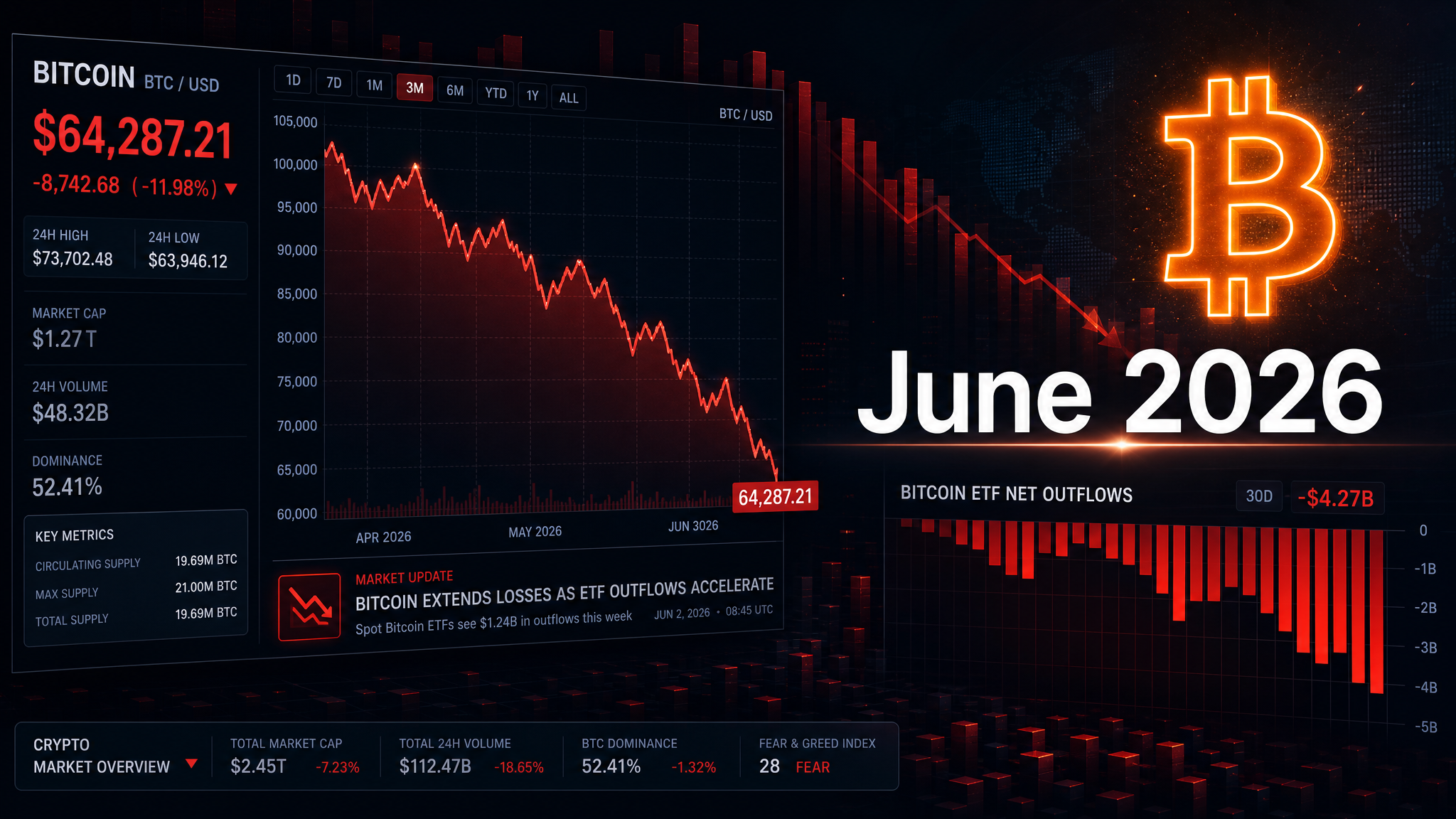
Bitcoin entered this week trading around $63,000–$65,000, having clawed back from a 21-month low of roughly $57,800 hit in late June. That low came after a brutal stretch: record ETF outflows of $4.5 billion in June, a hawkish Fed pivot under Warsh, and a broader risk-off rotation out of speculative assets.
The partial recovery since then has been real but fragile. Analysts at Nansen describe it as a "positioning bounce" rather than a conviction-driven rally. ETF inflows returned modestly — about $197 million for the week ending July 10 — but stablecoin supply on-chain hasn't expanded meaningfully, which limits the dry powder available for a sustained push higher.
On July 28 itself, Bitcoin dipped to an Asian session low of $63,065 before recovering to the $63,400–$63,500 range. The broader market was under pressure: Nasdaq futures hit three-month lows, South Korea's Kospi dropped 10.8%, and the global risk-off mood weighed on everything from tech stocks to altcoins. Ethereum fell 3.52% to $1,872, Solana dropped 4.08%, and XRP shed 4.44%.
The Transmission Chain: How Fed Policy Actually Hits Crypto
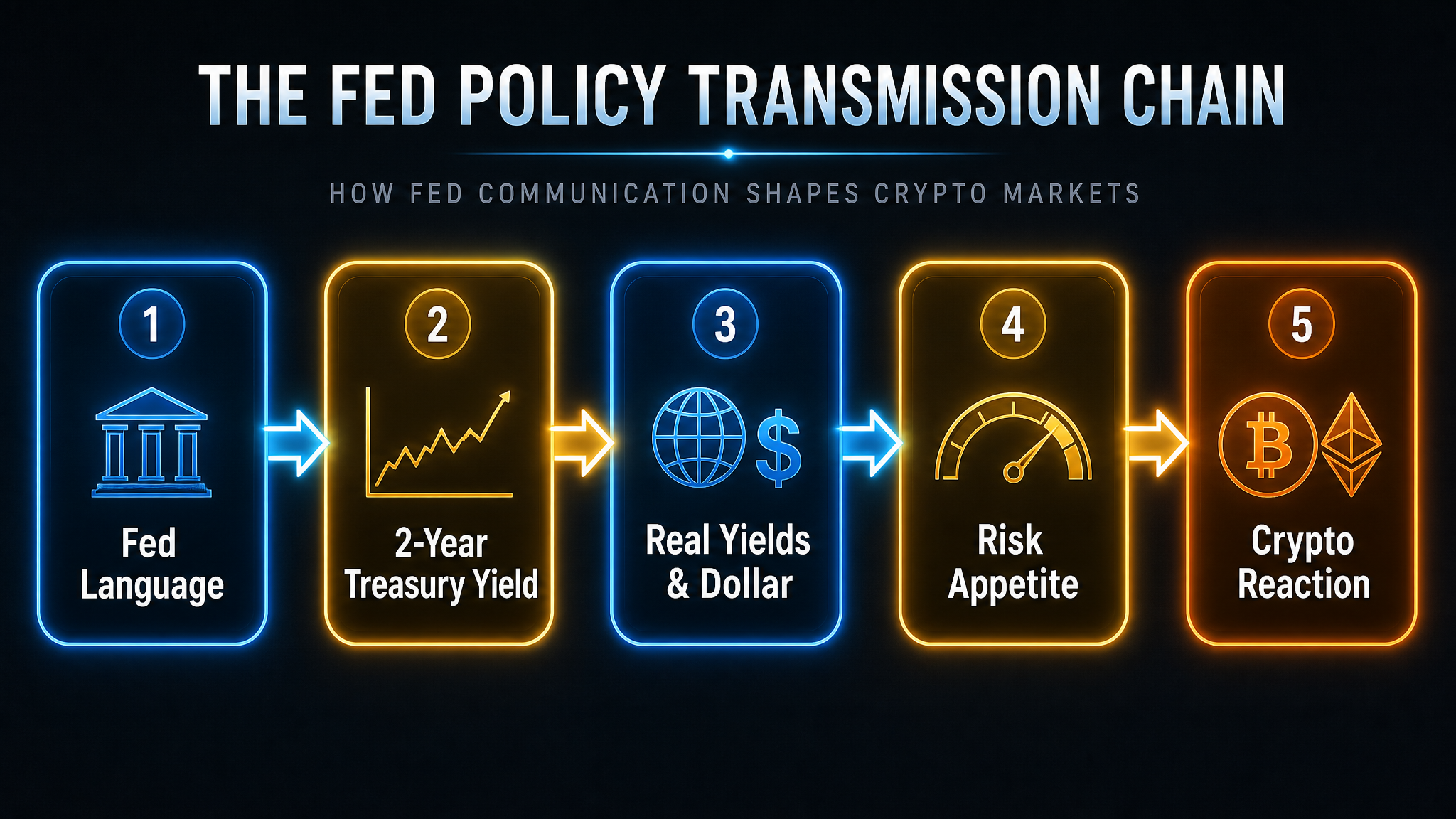
A lot of crypto investors think the Fed rate decision affects Bitcoin directly. It doesn't — at least not in a straight line. The actual transmission chain looks like this:
- Fed language sets the expected policy path for future meetings
- 2-year Treasury yields immediately reprice to reflect that path
- Real yields and the U.S. Dollar Index (DXY) adjust based on yield moves
- Risk appetite in equities and credit markets shifts accordingly
- Crypto reacts through ETF flows, derivative positioning, and spot demand
This is why the 2-year Treasury yield is the cleanest real-time proxy for how the Fed meeting is landing. If yields spike after the announcement, that's a hawkish read — and it's bad for Bitcoin. If yields fall or stay flat, the market is interpreting the statement as neutral-to-dovish, which gives crypto room to breathe.
The DXY matters too. A stronger dollar historically creates headwinds for Bitcoin, particularly for leveraged altcoin positions. Watch both the 2-year yield and DXY in the minutes after the 2:00 PM ET announcement — they'll tell you more than the headline rate number.
Three Scenarios and What They Mean for Your Portfolio
Analysts at Toobit have laid out the probability-weighted scenarios for Wednesday's decision. Here's how each one plays out for crypto:
Scenario 1: Hold with Hawkish Communication (~50% probability)
This is the most likely outcome. The Fed holds rates but signals that a September hike remains on the table. Warsh emphasizes that inflation hasn't cooled enough to justify easing. The 2-year yield ticks up, the dollar strengthens, and Bitcoin tests the $63,000–$64,000 support zone. Altcoins with high leverage exposure get hit harder. This isn't a catastrophe, but it keeps the market in a defensive crouch through August.
Scenario 2: Hold with Neutral Communication (~32% probability)
The Fed holds and the statement is balanced — acknowledging inflation progress without committing to a specific path. Bitcoin grinds sideways in the $63,000–$66,000 range. No major catalyst in either direction. The market waits for September's meeting and the next round of CPI data. This is actually the most comfortable outcome for long-term holders who don't want volatility.
Scenario 3: Hawkish Surprise — Rate Hike (~15% probability)
An unexpected 25-basis-point hike would be the worst-case scenario. Analysts warn this could trigger "liquidation cascades" in leveraged crypto markets. Bitcoin could retest the $58,000 support level or lower. This scenario is unlikely but not impossible — and it's why keeping leverage low heading into the announcement is prudent risk management.
Scenario 4: Dovish Surprise (~2–3% probability)
Warsh signals that rate cuts could come sooner than expected. Yields fall, the dollar weakens, and Bitcoin attempts a breakout above $66,000. This is the bull case, but it's a long shot given current inflation dynamics.
Ready to master crypto trading? Check out Icoinpro's comprehensive trading course.
The $68,500 Level: Bitcoin's Critical Threshold
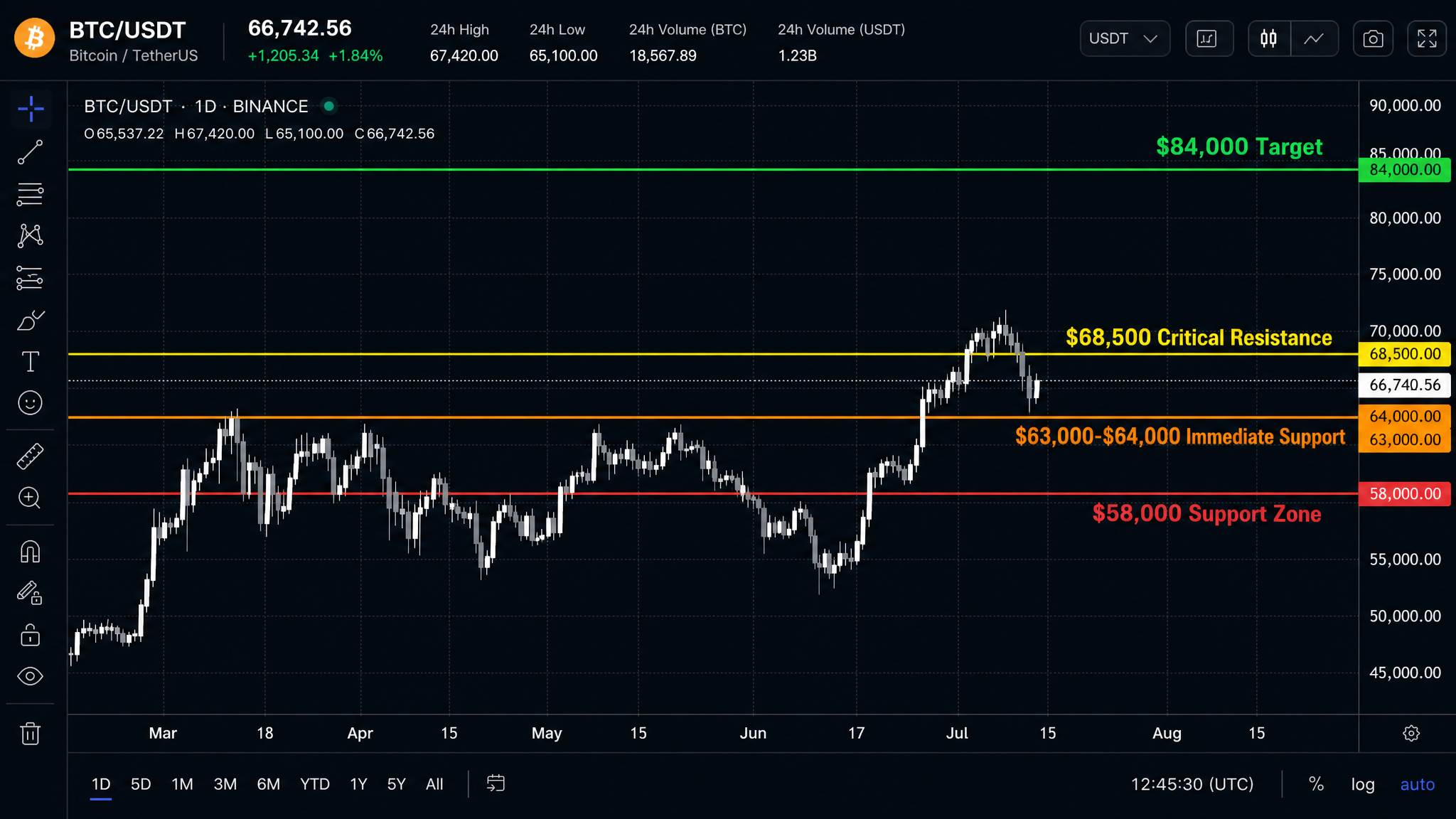
Regardless of Wednesday's outcome, analysts at Bitfinex have identified $68,500 as the most important technical level for Bitcoin in the near term. Here's why it matters.
That price represents the aggregate cost basis for short-term holders — investors who have held Bitcoin for less than 155 days. At $68,500, a large cohort of holders breaks even. That creates structural resistance: as Bitcoin approaches that level, many of those holders are expected to sell, capping upside momentum.
But here's the interesting part. If Bitcoin can push through $68,500 with conviction, volume analysis suggests there's an "air pocket" above — a zone with relatively little technical resistance — that could allow a rapid expansion toward $84,000. That's the bull case scenario that would require a dovish Fed surprise plus renewed institutional buying.
On the downside, $58,000 remains the critical floor. A break below that level would open the path toward $50,000–$53,000, which is where some analysts see the next major support cluster.
What About Altcoins?
Altcoins are more sensitive to macro conditions than Bitcoin, and the FOMC meeting amplifies that sensitivity. When the dollar strengthens and real yields rise, leveraged altcoin positions get unwound first. We saw this play out on July 28 itself: while Bitcoin fell 2.82%, Solana dropped 4.08% and XRP shed 4.44%.
A few altcoins have shown relative strength despite the macro headwinds. Audiera (BEAT) rallied 50% in the final week of July. Ondo (ONDO) gained 17% on a breakout from an accumulation zone. Ethena (ENA) absorbed a 40-million-token unlock and still managed a 14.4% weekly gain. These moves suggest that project-specific catalysts can override macro pressure — but they're the exception, not the rule.
For most altcoin holders, the practical advice is simple: reduce leverage before the announcement, watch the 2-year yield as your real-time signal, and don't chase the initial price reaction. Historical data from 2025 and early 2026 shows that Bitcoin's first move after FOMC announcements is often reversed within hours.
Protect your crypto assets with a Ledger hardware wallet — the gold standard in cold storage security.
The Bigger Picture: What 2026 Has Taught Us
Bitcoin entered 2026 above $93,000. By late June, it had fallen to $57,800 — a 38% drawdown driven almost entirely by macro factors rather than crypto-specific events. No exchange collapse, no protocol failure, no regulatory shock. Just the Fed holding rates higher for longer than the market expected.
That's a meaningful shift from previous cycles. Bitcoin is increasingly correlated with risk assets during periods of macro stress. The 2026 drawdown has been a masterclass in how monetary policy can override crypto fundamentals, at least in the short term.
The good news: macro-driven drawdowns tend to be more predictable and more recoverable than crypto-specific crashes. When the Fed eventually pivots — whether in September 2026, early 2027, or later — the liquidity that flows back into risk assets will likely benefit Bitcoin disproportionately. The question is timing, and that's what Wednesday's meeting is really about.
Want to understand the economics behind Bitcoin? The Bitcoin Standard is essential reading for every crypto enthusiast.
Key Takeaways: What to Watch on Wednesday
- 2:00 PM ET: The FOMC statement drops. Watch the 2-year Treasury yield and DXY immediately — these are your real-time signals.
- 2:30 PM ET: Chair Warsh's press conference begins. Listen for any mention of September, inflation progress, or "data-dependent" language.
- Bitcoin support: $63,000–$64,000 is the immediate floor. A hold above this level after the announcement is constructive.
- Bitcoin resistance: $65,700–$66,000 is the first hurdle. $68,500 is the critical structural level for a sustained recovery.
- Leverage: Keep it low. Initial reactions are often reversed. Don't get caught in a liquidation cascade on a knee-jerk move.
- ETF flows: Watch Thursday's ETF flow data — it will confirm whether institutional money is buying the dip or continuing to exit.
Final Thoughts
The July 2026 FOMC meeting won't resolve the macro uncertainty hanging over crypto markets — but it will clarify the path forward. A neutral-to-dovish outcome gives Bitcoin room to consolidate and potentially build toward a recovery. A hawkish surprise puts the $58,000 support level back in play.
Either way, the fundamentals of Bitcoin haven't changed. The halving cycle is intact, institutional infrastructure continues to mature, and the long-term case for digital assets remains compelling. What changes with each FOMC meeting is the timeline — and right now, the market is waiting for the Fed to give it permission to move higher.
Stay patient, manage your risk, and watch those Treasury yields.