Coinbase vs Binance 2026: Which Crypto Exchange Should You Use?
Affiliate Disclosure: This article may contain affiliate links. We may earn a commission at no extra cost to you. All opinions are our own.
Marcus Chen
Senior Crypto Analyst & Educator
Certified Blockchain Professional | Former Wall Street Analyst
Marcus Chen is a cryptocurrency analyst and educator with over 8 years of experience in digital asset trading. He has helped thousands of beginners navigate the crypto markets through practical, actionable education.
Coinbase vs Binance 2026: Which Crypto Exchange Should You Use?
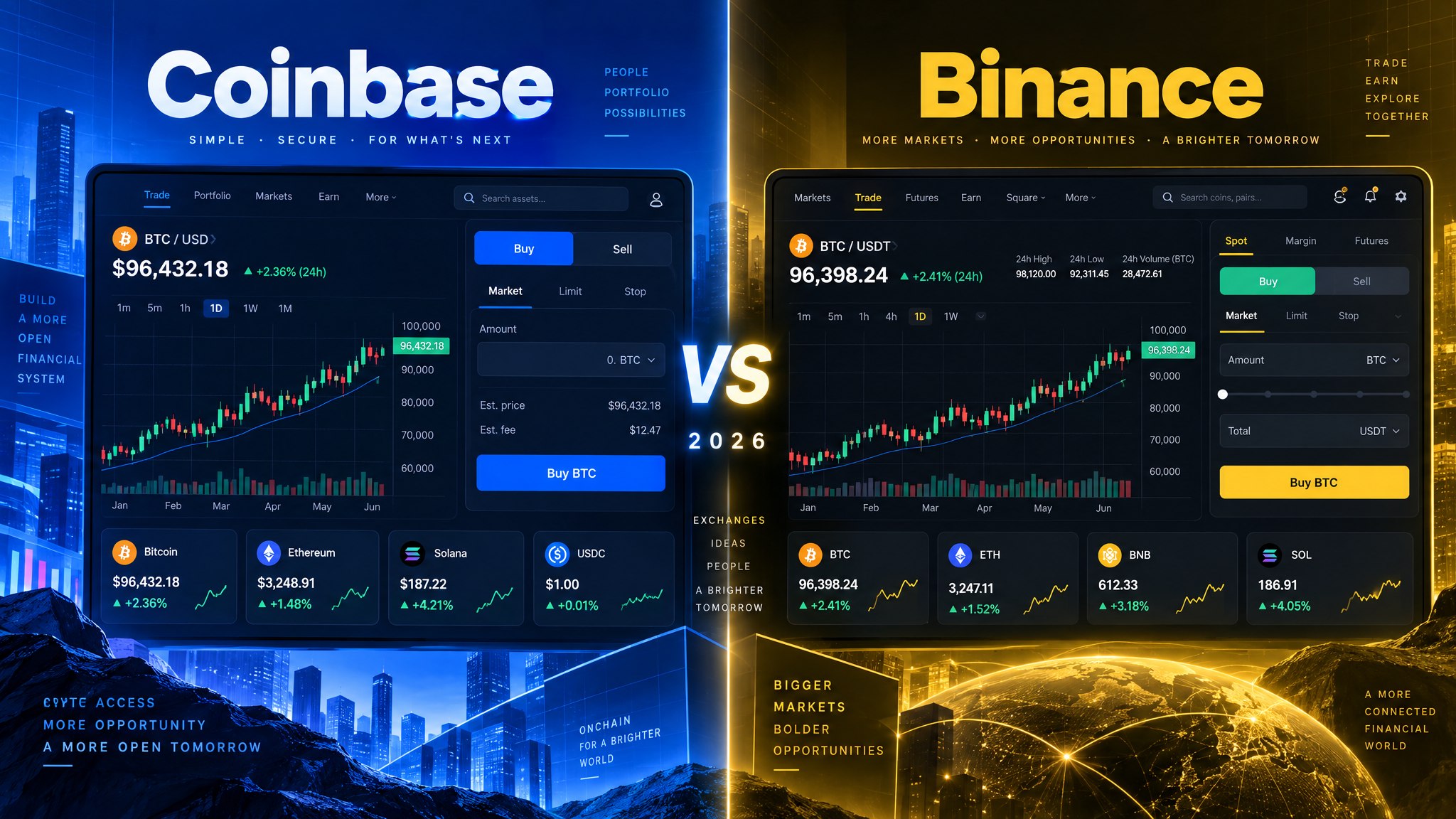
The Coinbase vs Binance 2026 debate is one of the most common questions new and experienced crypto investors face. Both platforms dominate the industry — Coinbase as the go-to regulated exchange for US users, Binance as the world's largest exchange by trading volume. But they serve very different audiences, and picking the wrong one can cost you real money in fees, limit your access to assets, or expose you to regulatory headaches. This guide cuts through the noise and tells you exactly which exchange fits your situation.
The Short Answer: It Depends on Where You Live
If you're in the United States, Coinbase is almost certainly your primary option. Binance's global platform is blocked for US residents, and Binance.US — the American version — is a stripped-down product that lacks most of the features that make Binance compelling. If you're outside the US, the calculus flips: Binance's lower fees, deeper liquidity, and broader asset selection make it hard to beat for active traders.
That said, geography isn't the only factor. Let's break down every dimension that matters.
Fees — Where the Real Difference Lies
Fees are where Coinbase and Binance diverge most sharply, and where many users quietly lose hundreds of dollars a year without realizing it.
Coinbase Fees
Coinbase runs two interfaces: the standard "Simple Trade" mode and "Advanced Trade" (formerly Coinbase Pro). The difference is enormous.
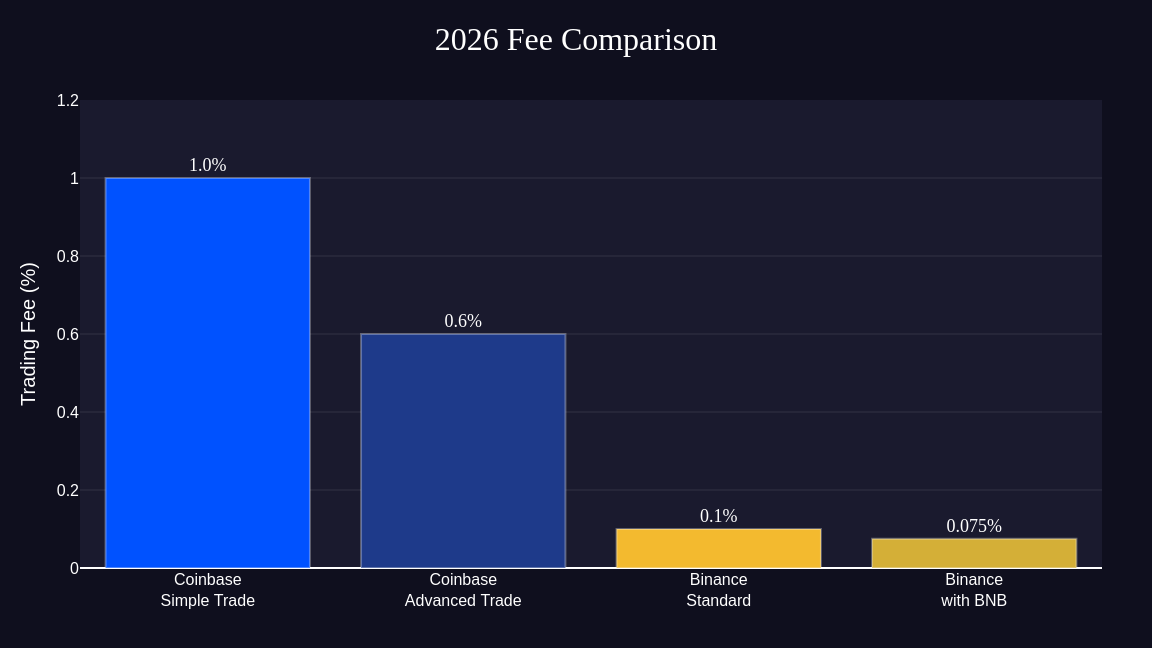
- Simple Trade: Coinbase charges a spread of roughly 0.5–2% on top of the market price, plus a flat transaction fee. A $500 Bitcoin purchase can cost $10–15 in fees alone.
- Advanced Trade: Maker fees start at 0% and taker fees at 0.60%, dropping as your 30-day volume increases. At $10,000+ monthly volume, taker fees fall to 0.40%.
The lesson: if you're using Coinbase, always use Advanced Trade. The simple interface is a fee trap for casual users who don't know better.
Binance Fees
Binance's standard spot trading fee is 0.10% for both makers and takers — already far below Coinbase's retail rate. Pay with BNB (Binance's native token) and you get a 25% discount, bringing fees to 0.075%. High-volume traders can negotiate even lower rates through VIP tiers.
For a trader doing $50,000 in monthly volume, the annual fee difference between Coinbase Advanced Trade and Binance can easily exceed $1,000. That's real money.
Asset Selection and Trading Features
Binance lists over 500 cryptocurrencies globally, including many small-cap altcoins and new token launches that Coinbase won't touch. Coinbase supports roughly 250–260 assets — a solid selection for most investors, but limiting if you want exposure to emerging projects.
On the features front, Binance is in a different league for active traders:
- Derivatives: Binance offers futures, options, and perpetual contracts with up to 125x leverage. Coinbase has no derivatives trading for US users.
- Staking: Binance supports staking for 200+ assets globally. Coinbase offers staking for ETH, SOL, ADA, and a handful of others, with availability varying by state.
- Trading bots: Binance has native grid trading and DCA bots built into the platform. Coinbase requires third-party integrations.
- Earn products: Binance's "Simple Earn" and "Dual Investment" products offer yield on idle assets. Coinbase's equivalent is more limited.
For buy-and-hold investors who just want to accumulate Bitcoin and Ethereum, Coinbase's feature set is more than adequate. For active traders who want to run strategies, Binance wins decisively.
Ready to sharpen your trading skills regardless of which exchange you use? Icoinpro's comprehensive trading course covers exchange mechanics, order types, and strategy execution from beginner to advanced level.
Security Track Record
Both exchanges have strong security reputations, but their histories differ.
Coinbase has never suffered a customer-funds breach in its 13-year history — a remarkable record in an industry plagued by hacks. It stores approximately 98% of customer assets in cold storage and carries crime insurance on its hot wallets. As a publicly traded company (NASDAQ: COIN), it publishes quarterly financial reports and undergoes regular audits.
Binance was hacked in 2019, losing $40 million in Bitcoin. The exchange covered all losses from its Secure Asset Fund for Users (SAFU) — a self-insurance reserve — and no customer lost money. Since then, Binance has significantly hardened its infrastructure and publishes monthly Proof-of-Reserves using Merkle tree verification.
Both exchanges are considered safe for active trading. For long-term storage of significant holdings, neither exchange is the right answer — that's what hardware wallets are for. Protect your crypto assets with a Ledger hardware wallet — the gold standard in cold storage security.

Regulatory Standing in 2026
This is where the two exchanges diverge most fundamentally.
Coinbase is a US-regulated, publicly traded company. It holds money-transmitter licenses in all 50 states, complies with SEC reporting requirements, and has been a vocal advocate for clear crypto regulation in Washington. Following the CLARITY Act's passage in late 2026, Coinbase is positioned as the institutional-grade exchange of choice for US investors and financial advisors.
Binance operates globally but has faced significant regulatory pressure. After a $4.3 billion settlement with US authorities in 2023, the global platform is inaccessible to US residents. Binance.US operates as a separate, more limited entity. Outside the US, Binance holds licenses in multiple jurisdictions including France, Dubai, and Japan, but its regulatory footprint remains more complex than Coinbase's.
For US investors, Coinbase's regulatory clarity is a genuine advantage — especially as institutional adoption grows and compliance requirements tighten.
Who Should Use Coinbase?
- US residents who need a fully licensed, compliant exchange
- Beginners who want a clean, intuitive interface and strong customer support
- Long-term holders accumulating Bitcoin and Ethereum without active trading
- Institutional investors and financial advisors who need regulatory certainty
- Tax-conscious investors — Coinbase's tax reporting tools integrate directly with TurboTax and CoinTracker
One practical tip: always use Coinbase Advanced Trade (accessible at advanced.coinbase.com) instead of the standard app. The fee savings are substantial.
Who Should Use Binance?
- Non-US traders who want the lowest fees and deepest liquidity
- Active traders running futures, options, or high-frequency strategies
- Altcoin hunters who need access to 500+ assets including new listings
- Yield seekers who want to maximize returns through staking and earn products
- BNB holders who can reduce fees further through the native token discount
The Verdict: Coinbase vs Binance 2026
There's no universal winner — the right exchange depends entirely on your situation. For US investors, Coinbase is the clear choice: regulated, secure, and increasingly feature-rich after the CLARITY Act. For international traders who prioritize low fees and advanced tools, Binance remains the industry benchmark.
Many sophisticated investors use both: Coinbase for fiat on-ramps, long-term holding, and tax reporting; Binance for active trading, altcoin exposure, and yield strategies. That "split-brain" approach captures the best of both platforms.
Whatever exchange you choose, understanding how to trade effectively matters more than the platform itself. For a structured approach to learning crypto trading, Icoinpro offers step-by-step training that has helped thousands of beginners build real trading skills.
Actionable Takeaways
- US residents: use Coinbase, but always through Advanced Trade to minimize fees
- International traders: Binance's 0.075% fees (with BNB) beat Coinbase's retail rates by 5–10x
- Neither exchange is safe for long-term storage of large holdings — use a hardware wallet
- Binance.US is not a substitute for global Binance — it lacks derivatives, most altcoins, and advanced features
- Both exchanges publish Proof-of-Reserves; verify your balance is included before depositing large sums
- Consider using both exchanges for different purposes rather than committing to one
Want to understand the deeper economics of Bitcoin and why exchange choice matters for long-term wealth building? The Bitcoin Standard is essential reading for every serious crypto investor.
Tools are only as good as the trader using them.
The best platform in the world won't help if your analysis is off. Before investing in more tools, consider investing in your trading education — it's the one thing that compounds everything else.
The program I recommend to people who ask me is this crypto trading course — it\'s the one I point friends and family to when they\'re serious about learning. Daily lessons, live analysis, and a community that actually helps.
Affiliate link — I may earn a commission at no extra cost to you. I only recommend what I genuinely use.
Disclaimer: The information provided on this website is for educational and informational purposes only. It should not be considered financial or investment advice. Cryptocurrency investments carry significant risk. Always do your own research and consult with a qualified financial advisor before making investment decisions.
Free Crypto Insights
Get weekly trading tips, market analysis, and exclusive strategies delivered to your inbox.