Phantom vs MetaMask: Which Crypto Wallet Should You Use in 2026?
Affiliate Disclosure: This article may contain affiliate links. We may earn a commission at no extra cost to you. All opinions are our own.
Marcus Chen
Senior Crypto Analyst & Educator
Certified Blockchain Professional | Former Wall Street Analyst
Marcus Chen is a cryptocurrency analyst and educator with over 8 years of experience in digital asset trading. He has helped thousands of beginners navigate the crypto markets through practical, actionable education.
August 2026 Update: MetaMask MASK Airdrop & New Security Features
Both wallets have shipped meaningful updates since this article was first published. MetaMask has integrated a Linea-based reward system that tracks user activity for potential eligibility in the upcoming MASK token airdrop — a significant development that's driving renewed interest in the wallet. Meanwhile, Phantom has continued expanding its multi-chain support, now covering Solana, Ethereum, Polygon, and Bitcoin (including Ordinals and BRC-20 tokens) from a single unified dashboard.
On the security front, both wallets now feature transaction simulation — Phantom's is noted for clearly flagging malicious outcomes, while MetaMask uses Blockaid integration to warn users before signing dangerous transactions. MetaMask also introduced "Smart Transactions" on Ethereum, routing trades through private mempools for MEV protection. Swap fees remain close: Phantom charges ~0.85% while MetaMask charges ~0.875%.
For related reading, see our guide on Best Crypto Hardware Wallets in 2026 and our review of MetaMask vs Coinbase Wallet.
Frequently Asked Questions
Does Phantom support Ethereum in 2026?
Yes. Phantom has evolved well beyond its Solana roots. It now supports Solana, Ethereum, Polygon, and Bitcoin (including Ordinals and BRC-20 tokens) from a single unified interface — no manual network configuration required.
What is MetaMask's MASK token airdrop?
MetaMask has integrated a Linea-based reward system that tracks user activity for potential eligibility in an upcoming MASK token airdrop. Users who actively use MetaMask for swaps, bridging, and dApp interactions may qualify. Details on eligibility criteria are still being finalized.
Which wallet has better MEV protection?
MetaMask's "Smart Transactions" feature routes Ethereum trades through private mempools, providing meaningful MEV (sandwich attack) protection. Phantom offers native cross-chain swaps optimized for Solana's speed. For Ethereum DeFi users, MetaMask's Smart Transactions is the stronger MEV protection option.
Is Phantom open source?
Phantom is not fully open source, but it publishes third-party audit reports. MetaMask maintains a significant transparency advantage as a fully open-source project, allowing continuous community and independent security audits.
Which wallet is better for NFTs?
Phantom is generally considered superior for NFT collectors, offering native support for compressed NFTs (cNFTs) on Solana and in-wallet marketplace integration. MetaMask manages NFTs across EVM chains but typically relies on external platforms like OpenSea for advanced management.
Phantom vs MetaMask: Which Crypto Wallet Should You Use in 2026?
The Phantom vs MetaMask debate has never been more relevant. Both wallets have evolved dramatically in 2026 — MetaMask now supports native Bitcoin and Solana, while Phantom has expanded deep into Ethereum and launched a Visa spending card. So which one actually belongs in your browser? The answer depends on where you spend most of your on-chain time, and this guide breaks it down without the fluff.
I've used both wallets extensively across DeFi protocols, NFT platforms, and cross-chain bridges. Here's what I found.
Quick Verdict: Who Should Use Which Wallet
Before diving into the details, here's the short version:
- Choose Phantom if you're primarily on Solana, love NFTs, or want the cleanest mobile experience available.
- Choose MetaMask if you live in Ethereum's DeFi ecosystem, need access to hundreds of EVM chains, or rely on developer tools.
- Use both if you're active across multiple ecosystems — many serious crypto users do exactly this.
Neither wallet is objectively "better." They're built for different ecosystems, and understanding that distinction saves a lot of frustration.
What Is Phantom Wallet?
Phantom launched in 2021 as the go-to Solana wallet, and it quickly became the default for anyone interacting with Solana DeFi, NFTs, and dApps. Fast forward to 2026, and Phantom has grown into a genuine multi-chain wallet with native support for Solana, Ethereum, Polygon, and Bitcoin — including Ordinals and BRC-20 tokens.
The wallet now serves over 15 million monthly active users and holds more than $25 billion in self-custodied assets. That's not a niche tool anymore.
Key Features and Supported Chains
- Chains: Solana, Ethereum, Polygon, Bitcoin (L1, Ordinals, BRC-20)
- Built-in swap aggregator routing through Jupiter, Raydium, Uniswap, and 0x
- Native SOL staking with Marinade and Jito liquid staking support
- NFT gallery with direct listing on Magic Eden and Tensor
- Phantom Cash — a Visa card launched late 2025 for real-world spending
- Transaction simulation showing token movements before you sign
- Spam NFT filtering and phishing blocklist built in
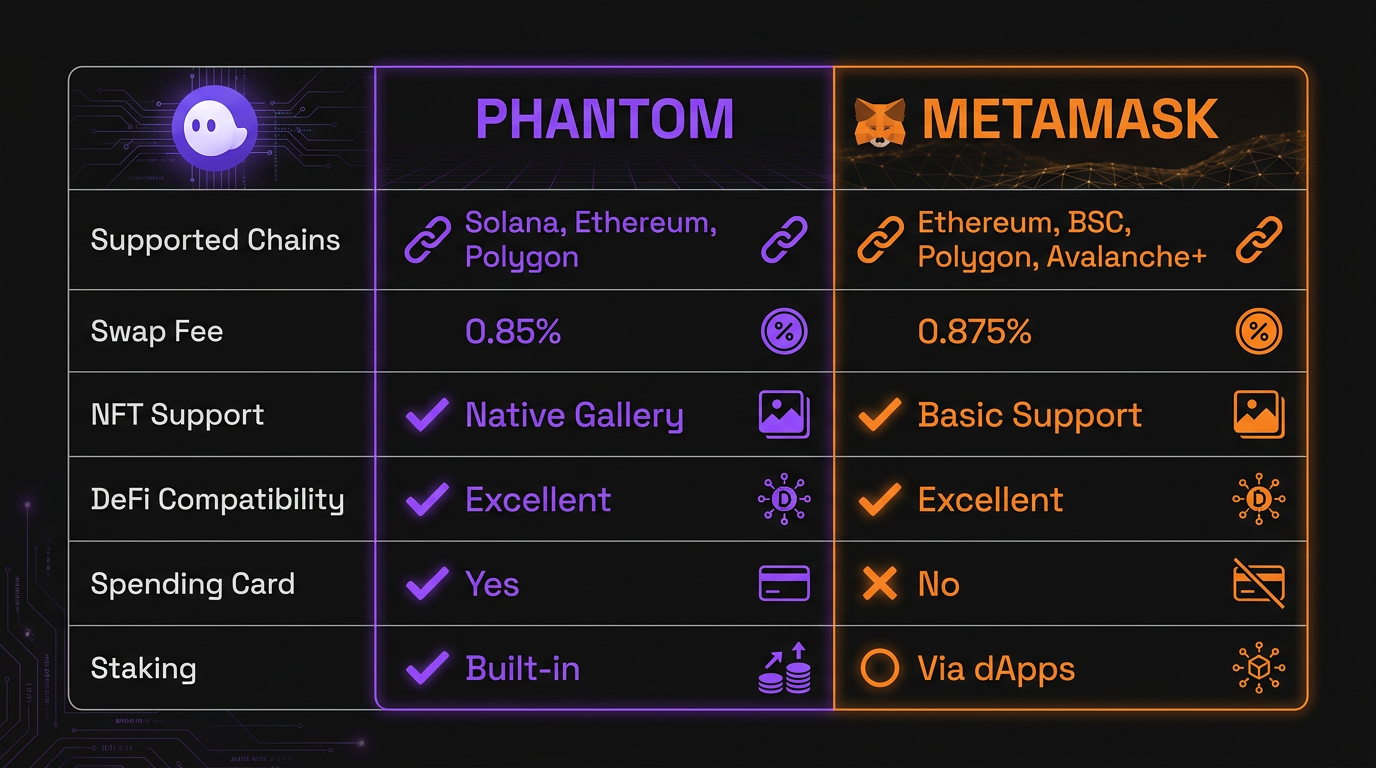
Swap fees sit at 0.85% — slightly lower than MetaMask's 0.875%. Not a huge difference, but it adds up if you're trading frequently on Solana.
What Is MetaMask?
MetaMask has been the Ethereum wallet since 2016. With 30 million monthly active users and over 143 million total accounts created, it's the most widely used crypto wallet in the world. In 2026, it's no longer just an Ethereum tool — MetaMask added native Bitcoin and Solana support to its core UI, and launched the MetaMask Card (Mastercard) in February 2026.
The wallet's real strength is breadth. If a DeFi protocol exists on an EVM chain, MetaMask almost certainly works with it. That universal compatibility is hard to beat.
Key Features and Supported Chains
- Chains: All EVM chains (Ethereum, Arbitrum, Optimism, Base, BNB Chain, Avalanche, zkSync, and hundreds more), plus native Bitcoin and Solana
- MetaMask Snaps — plugin system extending support to Cosmos, Stacks, and other non-EVM chains
- Smart Transactions for MEV protection on Ethereum swaps
- MetaMask Bridge for cross-chain EVM asset movement
- MetaMask Card (Mastercard via Baanx) — spend USDC, USDT, WETH at any Mastercard terminal
- Advanced Permissions (April 2026) — scoped, time-bound dApp access without per-action signatures
- ERC-4337 smart accounts for multi-sig and social recovery
Swap fees are 0.875% — marginally higher than Phantom, but the Smart Transactions feature can save you money on Ethereum by avoiding MEV sandwich attacks.
Phantom vs MetaMask: Head-to-Head Comparison
Supported Blockchains
This is where the gap is most obvious. MetaMask natively supports hundreds of EVM chains — Arbitrum, Optimism, Base, zkSync, Linea, Scroll, Mantle, Blast, and more. Add Snaps and you can extend it to Cosmos, Stacks, and other ecosystems. Phantom, by contrast, supports four chains natively: Solana, Ethereum, Polygon, and Bitcoin.
If you're active on Layer 2s like Base or Arbitrum, MetaMask is the clear choice. Phantom doesn't support those chains natively, which is a real limitation for DeFi users chasing yield across rollups.
User Interface and Experience
Phantom wins here, and it's not particularly close. The interface is clean, modern, and shows your total portfolio value across all chains on a single dashboard. Switching between Solana, Ethereum, and Bitcoin takes one click. The mobile app mirrors the desktop experience almost perfectly.
MetaMask has improved significantly with its 2024 redesign, but adding new networks still requires manual RPC configuration. Transaction history is per-network rather than unified. It's functional, but it feels like a tool built by engineers rather than designers.
Security Features
Both wallets are non-custodial — your keys, your crypto. But their security implementations differ in meaningful ways.
Phantom's transaction simulation is genuinely useful. Before you sign anything, you see exactly which tokens are leaving your wallet and which are arriving. Combined with automatic spam filtering and phishing blocklists, it's a solid defense layer for everyday users.
MetaMask is fully open-source, which means the security community can audit every line of code. Its Blockaid integration flags malicious transactions, and it supports Ledger, Trezor, and other hardware wallets across all EVM chains. The ERC-4337 smart account support adds multi-sig and social recovery options that Phantom doesn't offer yet.
For maximum security on large holdings, pair either wallet with a hardware wallet. Protect your crypto assets with a Ledger hardware wallet — the gold standard in cold storage security.
DeFi Compatibility
MetaMask is the default wallet for the entire EVM DeFi ecosystem. Uniswap, Aave, Compound, Curve, Yearn — they all work with MetaMask out of the box. If a protocol is on an EVM chain, you can connect MetaMask to it.
Phantom excels in Solana DeFi. Jupiter, Raydium, Orca, Kamino — all optimized for Phantom's connection flow. It also connects to major Ethereum protocols like Uniswap and Aave, but the experience isn't as seamless as MetaMask on those platforms.
NFT Support
Phantom is the clear winner for NFT users, especially on Solana. The visual gallery displays collections with metadata and rarity information. You can list NFTs directly on Magic Eden or Tensor without leaving the wallet. Compressed NFTs, programmable NFTs, and Bitcoin Ordinals are all supported natively.
MetaMask displays NFTs through its Portfolio dApp, but the experience is less polished. Listing or trading requires connecting to external marketplaces. For serious NFT collectors, Phantom's integrated approach is noticeably better.
Built-in Swap Fees
Phantom charges 0.85% on swaps. MetaMask charges 0.875%. The difference is negligible for most users, but Phantom's aggregator on Solana often finds better routes through Jupiter's deep liquidity pools, which can offset the fee difference through better execution prices.
Staking Options
Phantom has a built-in staking interface for Solana — delegate SOL to validators directly from the wallet, with no minimum. Liquid staking through Marinade and Jito is integrated natively. Current SOL staking yields run around 6-8% APY.
MetaMask's staking is more limited. ETH staking happens through MetaMask Portfolio via Lido or Rocket Pool, not natively in the extension. For other chains, you need to connect to external dApps. If staking is a priority, Phantom's native integration is more convenient.
Spending Cards (2026 Update)
Both wallets now offer spending cards. Phantom Cash (Visa, late 2025) draws from a Solana-secured balance — spending other assets requires a conversion step first. MetaMask Card (Mastercard, February 2026) lets you spend USDC, USDT, or WETH at any Mastercard terminal in 49 US states, with a Metal Card tier offering up to 3% cashback. MetaMask's card has a slight edge — broader stablecoin support and the cashback tier make it more practical for everyday use.
Which Wallet Is Better for Beginners?
Phantom. The cleaner interface, automatic spam filtering, and transaction simulation make it more forgiving for new users. The mobile app is excellent. If you're just getting started and plan to explore Solana or buy some NFTs, Phantom's learning curve is gentler.
That said, if you're starting with Ethereum specifically — buying ETH on Coinbase and moving it to DeFi — MetaMask is what every tutorial will reference. The ecosystem documentation assumes MetaMask. For a structured approach to learning crypto trading, Icoinpro offers step-by-step training that has helped thousands of beginners navigate both wallets and DeFi protocols.
Which Wallet Is Better for DeFi Power Users?
It depends on your chains. For Ethereum and L2 DeFi — Arbitrum, Optimism, Base, zkSync — MetaMask is the better tool. The breadth of EVM support, Smart Transactions for MEV protection, and universal dApp compatibility make it the professional's choice for EVM-native strategies.
For Solana DeFi — Jupiter aggregator, Kamino lending, Drift perpetuals — Phantom is the native choice. Solana dApps are optimized for Phantom's connection flow, and the experience shows. Many serious DeFi users run both wallets with separate seed phrases to isolate risk across ecosystems.
Can You Use Both Wallets?
Absolutely — and many experienced crypto users do. The typical setup: Phantom for Solana, NFTs, and Bitcoin Ordinals; MetaMask for Ethereum mainnet and L2 DeFi. Keep separate seed phrases for each, stored securely offline. The Trezor Model T offers top-tier security with an intuitive touchscreen interface and works with both wallets for hardware-backed protection.
Final Verdict
The Phantom vs MetaMask question doesn't have a universal answer — it has a personal one.
If your crypto life revolves around Solana, NFTs, or you want the most polished wallet experience available, Phantom is the better choice. Its interface is genuinely excellent, the Solana DeFi integration is seamless, and the transaction simulation adds real security value.
If you're deep in Ethereum DeFi, need access to dozens of L2 chains, or rely on developer tools and Snaps, MetaMask's breadth is unmatched. The open-source codebase and universal EVM compatibility make it the professional standard for a reason.
For most users in 2026, the real answer is: start with Phantom for its better UX, add MetaMask when you need EVM chain access. Both are free, both are non-custodial, and both have earned their place in the crypto toolkit.
Frequently Asked Questions
Is Phantom safer than MetaMask?
Both are non-custodial wallets with strong security features. Phantom's transaction simulation and spam filtering are user-friendly safety tools. MetaMask's open-source code allows public auditing. Neither is inherently "safer" — your security practices (hardware wallet, seed phrase storage) matter more than the wallet choice.
Can Phantom be used for Ethereum?
Yes. Phantom natively supports Ethereum, including ERC-20 tokens and major DeFi protocols like Uniswap and Aave. However, it doesn't support all EVM chains — Arbitrum, Optimism, and Base are not natively supported.
Does MetaMask support Solana?
Yes, as of 2025-2026, MetaMask added native Solana support to its core UI. However, the Solana experience in MetaMask is not as polished as Phantom's, which was built specifically for the Solana ecosystem.
Which wallet has lower swap fees?
Phantom charges 0.85% on swaps; MetaMask charges 0.875%. The difference is minimal — execution quality matters more. Phantom's Jupiter aggregator on Solana often finds better prices, while MetaMask's Smart Transactions can save money on Ethereum by avoiding MEV attacks.
Tools are only as good as the trader using them.
The best platform in the world won't help if your analysis is off. Before investing in more tools, consider investing in your trading education — it's the one thing that compounds everything else.
The program I recommend to people who ask me is this crypto trading course — it\'s the one I point friends and family to when they\'re serious about learning. Daily lessons, live analysis, and a community that actually helps.
Affiliate link — I may earn a commission at no extra cost to you. I only recommend what I genuinely use.
Disclaimer: The information provided on this website is for educational and informational purposes only. It should not be considered financial or investment advice. Cryptocurrency investments carry significant risk. Always do your own research and consult with a qualified financial advisor before making investment decisions.
Free Crypto Insights
Get weekly trading tips, market analysis, and exclusive strategies delivered to your inbox.