Bitcoin Covered Call ETF Strategy: Earn 15-25% Yield in 2026
Affiliate Disclosure: This article may contain affiliate links. We may earn a commission at no extra cost to you. All opinions are our own.
Marcus Chen
Senior Crypto Analyst & Educator
Certified Blockchain Professional | Former Wall Street Analyst
Marcus Chen is a cryptocurrency analyst and educator with over 8 years of experience in digital asset trading. He has helped thousands of beginners navigate the crypto markets through practical, actionable education.

Bitcoin Covered Call ETF Strategy: Earn 15–25% Yield in 2026
The Bitcoin covered call ETF strategy has quietly become one of the most talked-about income plays in crypto this year — and for good reason. When BlackRock launched its iShares Bitcoin Premium Income ETF (ticker: BITA) on June 16, 2026, it wasn't just another product launch. It was a signal that Wall Street has figured out how to turn Bitcoin's notorious volatility into a monthly paycheck. If you've been sitting on BTC exposure and wondering how to squeeze yield out of it without selling, this guide breaks down exactly how covered call strategies work, what BITA offers, and how to evaluate whether this approach fits your portfolio.
Affiliate Disclosure: This article contains affiliate links. We may earn a commission at no extra cost to you if you make a purchase through these links. See our affiliate disclosure for details.
Disclaimer: This content is for informational purposes only and should not be considered financial advice. Cryptocurrency investments carry significant risk. Always do your own research (DYOR) before making any investment decisions.
What Is a Covered Call Strategy — and Why Does It Work for Bitcoin?
A covered call is one of the oldest income strategies in traditional finance. You hold an asset, then sell someone else the right to buy it from you at a set price (the "strike") by a certain date. In exchange, you collect a premium upfront. If the asset stays below the strike, you keep the premium and the asset. If it blows past the strike, you sell at that price — capping your upside but still pocketing the premium.
Now apply that to Bitcoin. BTC's implied volatility regularly runs 60–80% annualized, compared to roughly 15–20% for the S&P 500. Higher volatility means fatter option premiums. That's the core insight behind BITA and similar products: Bitcoin's wild price swings, which terrify most investors, are actually a feature when you're selling options. You're essentially getting paid to tolerate the choppiness.
The math is straightforward. If you hold $100,000 in Bitcoin and sell a 30-day call option at a 10% out-of-the-money strike, you might collect $2,000–$3,500 in premium depending on current volatility. Do that every month and you're looking at 24–42% annualized — before accounting for any price movement in BTC itself. BITA targets a more conservative 15–25% annualized yield by only overwriting 25–35% of its holdings, which preserves meaningful upside participation.
BlackRock BITA: How the Fund Actually Works
BITA holds a combination of spot Bitcoin and shares of BlackRock's own iShares Bitcoin Trust (IBIT). The fund then systematically sells call options on 25–35% of its IBIT holdings — typically laddered across four weekly expiries to smooth out the income stream. Premiums collected are distributed to shareholders monthly.
A few structural details worth knowing:
- Expense ratio: 0.65% annually — notably cheaper than competing covered-call crypto products, which often charge 0.95–0.99%.
- Upside capture: Because only 25–35% of the portfolio is "overwritten," BITA captures roughly 70% of Bitcoin's price appreciation in a bull market. You're not completely locked out of gains.
- Tax structure: BITA is registered under the Securities Act of 1933 as a partnership, not a traditional 1940 Act ETF. This means you'll receive a Schedule K-1 at tax time. The options portion qualifies as Section 1256 contracts — taxed at a blended 60/40 long-term/short-term rate, which is favorable for active traders.
- Custodians: Coinbase Custody Trust Company and Anchorage Digital Bank hold the Bitcoin. Goldman Sachs acts as clearing agent for the options. This is institutional-grade infrastructure.
The fund launched on Nasdaq on June 16, 2026, just one day after receiving SEC effectiveness. It's competing with Roundhill's YBTC (which uses a synthetic covered call approach for weekly income) and a pending Goldman Sachs Bitcoin Premium Income ETF that may use a more aggressive 40–100% overwrite range.
Running the Numbers: Three Market Scenarios
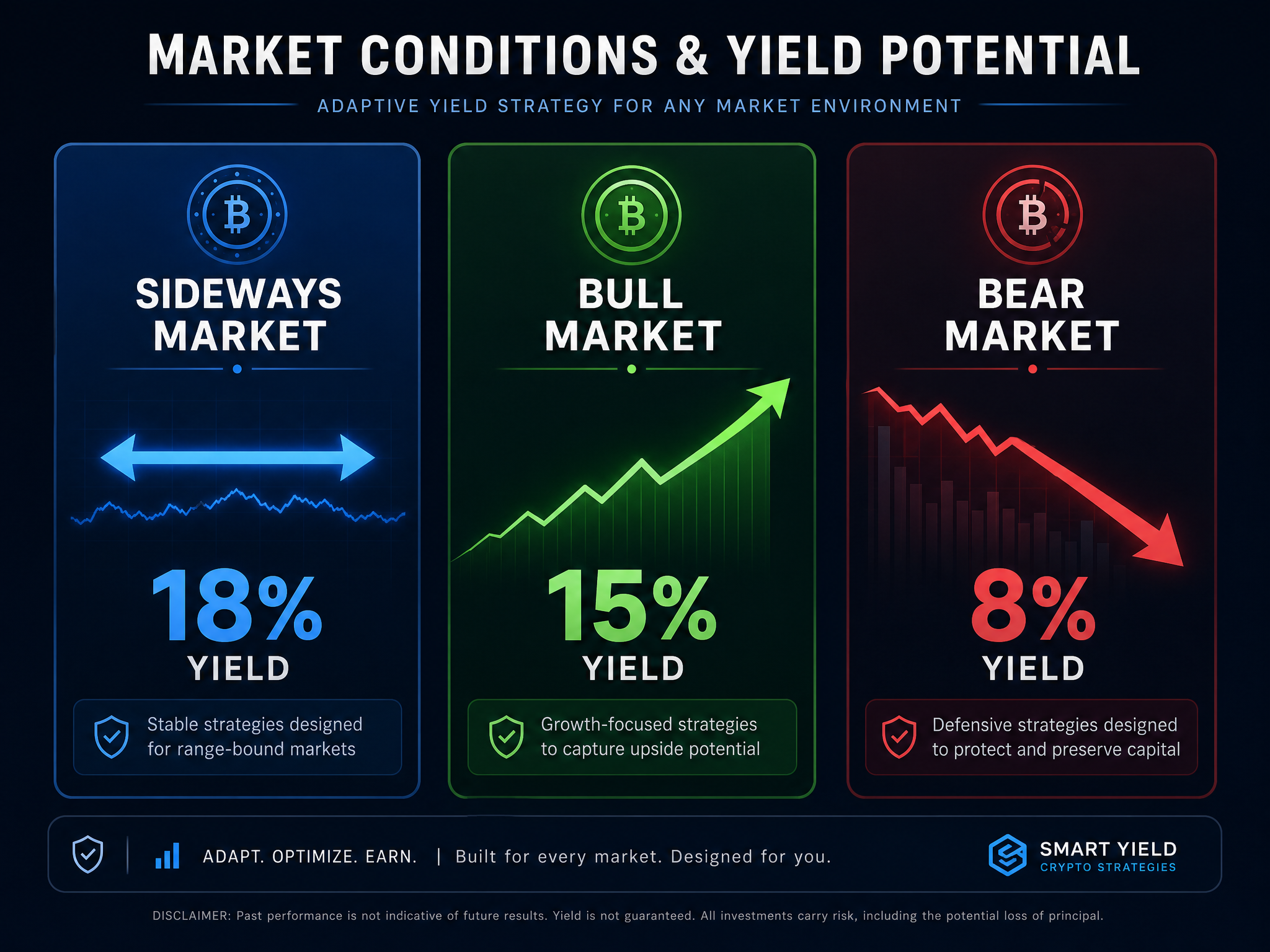
Let's say you invest $50,000 in BITA. Here's how the strategy plays out across three realistic scenarios over 12 months:
Scenario 1: Bitcoin Trades Sideways (±15%)
This is where covered calls shine. With BTC grinding between $90,000 and $110,000, the options you've sold expire worthless most months. You collect roughly $7,500–$12,500 in annual premium income (15–25% yield). Your NAV stays roughly flat. Net result: you've earned meaningful income on an asset that went nowhere. A pure spot holder earned zero.
Scenario 2: Bitcoin Rallies 60%
BTC rips from $100,000 to $160,000. Your overwritten 30% of holdings gets called away at the strike prices — you miss some of that upside. But the other 70% participates fully. BITA might return 45–50% total (price appreciation + premiums) versus 60% for a pure spot ETF. You underperform, but you still made serious money and collected income along the way.
Scenario 3: Bitcoin Drops 30%
BTC falls from $100,000 to $70,000. Your NAV drops accordingly — covered calls provide no downside protection. However, the premiums you collected (say, $10,000–$12,500 on a $50,000 position) cushion the blow. You're down roughly 17–20% instead of 30%. Still painful, but meaningfully better than holding spot.
The takeaway: covered call strategies outperform in flat or mildly volatile markets, roughly match in moderate bull markets, and provide a partial buffer in bear markets. They're not a hedge — they're an income overlay.
DIY Covered Calls vs. BITA: Which Makes More Sense?
Sophisticated traders sometimes ask: why pay BITA's 0.65% fee when I can sell calls myself on Deribit or CME? Fair question. Here's the honest breakdown:
DIY advantages: You control strike selection, expiry timing, and overwrite percentage. You can be tactical — selling more aggressively when implied volatility spikes (like during a macro event) and pulling back when vol is compressed. You keep 100% of the premium without any management fee.
BITA advantages: No options account required. No margin management. No rolling positions manually. The fund handles execution across four weekly expiries, which is genuinely time-consuming to replicate. And for tax-advantaged accounts (IRAs, 401ks), BITA can be held directly — you can't trade Deribit options in a Roth IRA.
For most investors managing under $500,000 in Bitcoin exposure, BITA's convenience and institutional execution quality likely justify the fee. Above that threshold, the math starts favoring a DIY approach — especially if you have options trading experience.
Ready to master crypto trading? Check out Icoinpro's comprehensive trading course — it covers options strategies, risk management, and advanced crypto trading techniques that complement income strategies like covered calls.
Key Risks You Need to Understand Before Allocating
No strategy is free money. Here are the risks that matter most:
Capped Upside in a Bull Market
If Bitcoin goes on a 2020-style parabolic run — say, tripling in six months — BITA will significantly underperform a pure spot ETF. The premiums you collected won't come close to compensating for the missed gains on the overwritten portion. This is the strategy's biggest structural weakness, and it's why most advisors suggest limiting covered-call exposure to a portion of your Bitcoin allocation rather than replacing it entirely.
Volatility Crush
If implied volatility collapses (which can happen after a major uncertainty event resolves), option premiums shrink dramatically. A fund targeting 15–25% yield might deliver 8–10% in a low-vol environment. The income isn't guaranteed — it's a function of market conditions.
Counterparty and Structural Risk
BITA's partnership structure and K-1 reporting add complexity. The fund relies on Goldman Sachs for options clearing — institutional-grade, but not zero-risk. And as with any ETF, there's tracking error and the possibility of the fund trading at a premium or discount to NAV.
Tax Complexity
Monthly distributions from covered-call ETFs can create significant tax drag in taxable accounts. The Section 1256 treatment helps, but you're still generating taxable income every month. Run the numbers with a tax advisor before allocating heavily in a taxable brokerage account.
How to Position BITA in a Crypto Portfolio
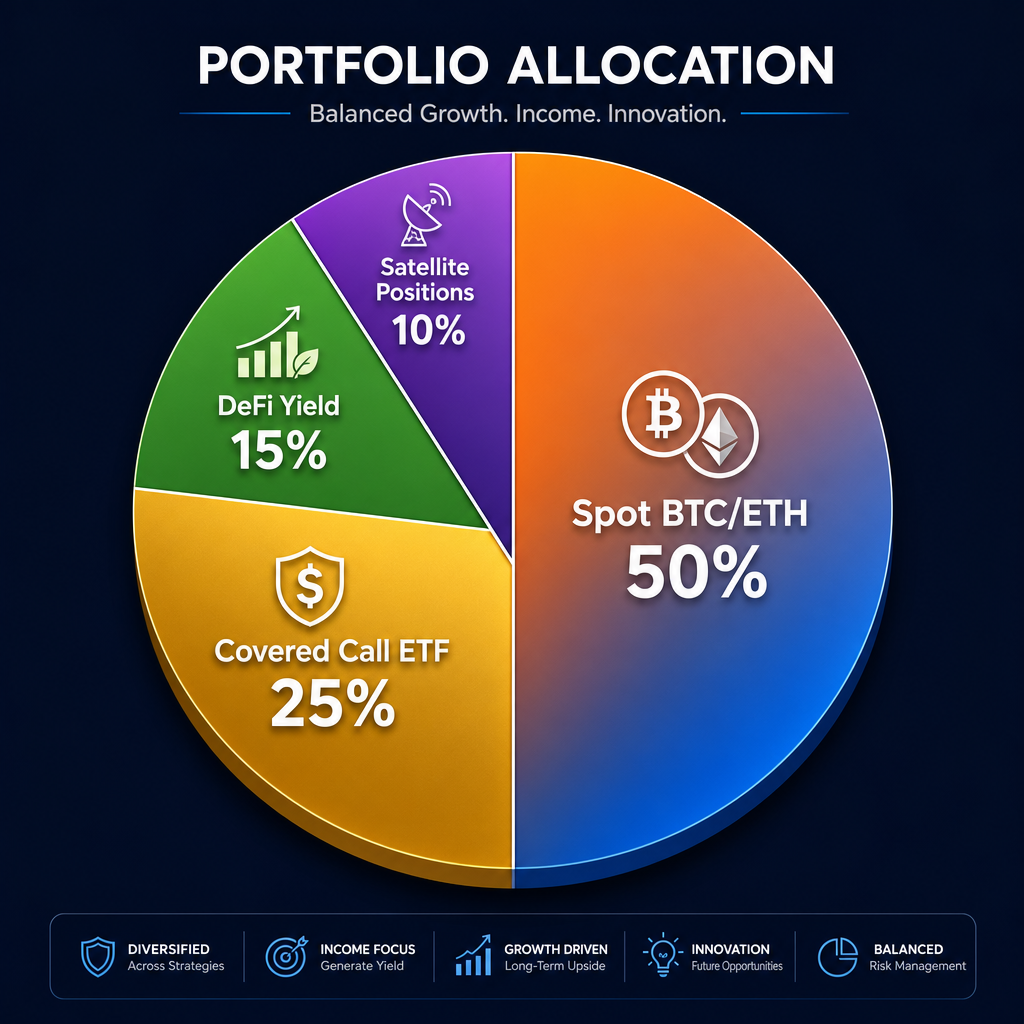
Think of BITA as the "income sleeve" of a crypto allocation. A practical framework for a $100,000 crypto portfolio might look like this:
- 50% pure spot BTC/ETH — for full upside participation and long-term appreciation
- 25% BITA or similar covered-call ETF — for monthly income and volatility dampening
- 15% DeFi yield strategies — stablecoin lending, liquid staking, etc.
- 10% satellite positions — higher-risk, higher-reward altcoin or DeFi plays
This structure gives you meaningful income generation without sacrificing all your upside. The covered-call sleeve essentially pays you to hold Bitcoin through choppy periods — which, historically, is most of the time.
Protect your underlying Bitcoin holdings with a Ledger hardware wallet — the gold standard in cold storage security. If you're holding significant BTC alongside your ETF positions, keeping your self-custodied coins in cold storage is non-negotiable.
Competing Products: YBTC, EHCC, and What's Coming
BITA isn't alone. The Bitcoin income ETF space is getting crowded fast:
- Roundhill YBTC: Uses a synthetic covered call approach targeting weekly distributions. More aggressive overwrite, potentially higher yield but less upside participation.
- Global X EHCC: Launched April 2026, focuses on Ethereum rather than Bitcoin. Writes weekly call options on ether-related ETPs. Good for ETH holders seeking income.
- Goldman Sachs Bitcoin Premium Income ETF (pending): Filed with the SEC, targeting a 40–100% overwrite range. If approved, this would be the most aggressive income product in the space — potentially 30%+ yield but with severely capped upside.
Competition is good for investors. Fees will likely compress further as more issuers enter the space, and product innovation (partial hedges, dynamic overwrite percentages) will give investors more nuanced options.
Want to understand the deeper economics of Bitcoin as a monetary asset? The Bitcoin Standard is essential reading for every crypto enthusiast — it provides the foundational context for why institutional products like BITA are being built on top of Bitcoin in the first place.
Actionable Takeaways
- BITA is a legitimate income tool — not a gimmick. BlackRock's institutional infrastructure, 0.65% expense ratio, and 15–25% yield target make it one of the most credible Bitcoin income products available.
- Best suited for sideways or moderately volatile markets. If you're convinced Bitcoin is about to 3x, stick with pure spot exposure. If you think we're in a consolidation phase, BITA earns you income while you wait.
- Don't replace your entire BTC position. Use covered-call ETFs as an income overlay on a portion of your allocation — not as a substitute for spot exposure.
- Understand the tax implications before allocating in a taxable account. The K-1 structure and monthly distributions add complexity. Consider holding BITA in a tax-advantaged account if possible.
- Watch the volatility environment. BITA's yield is directly tied to implied volatility. In low-vol periods, temper your income expectations. In high-vol periods, the strategy becomes even more attractive.
- Compare products. YBTC, EHCC, and upcoming Goldman Sachs offerings each have different risk/reward profiles. Match the overwrite percentage and distribution frequency to your specific income needs.
The Bitcoin covered call ETF strategy represents a genuine maturation of the crypto market — Wall Street's financial engineering applied to digital assets in a way that creates real utility for income-focused investors. Whether you use BITA directly or build your own covered call overlay on Deribit, the core insight is the same: Bitcoin's volatility is an asset, not just a liability. In 2026, you can finally get paid for it.
Ready to put these strategies into practice?
The trading concepts in this article work — but only if you have the right foundation. I learned most of what I know through structured training that connected the dots between theory and live markets.
The program I recommend to people who ask me is this crypto trading course — it\'s the one I point friends and family to when they\'re serious about learning. Daily lessons, live analysis, and a community that actually helps.
Affiliate link — I may earn a commission at no extra cost to you. I only recommend what I genuinely use.
Disclaimer: The information provided on this website is for educational and informational purposes only. It should not be considered financial or investment advice. Cryptocurrency investments carry significant risk. Always do your own research and consult with a qualified financial advisor before making investment decisions.
Free Crypto Insights
Get weekly trading tips, market analysis, and exclusive strategies delivered to your inbox.