Crypto Options Trading Strategies for 2026: Hedge, Earn, and Profit
Affiliate Disclosure: This article may contain affiliate links. We may earn a commission at no extra cost to you. All opinions are our own.
Marcus Chen
Senior Crypto Analyst & Educator
Certified Blockchain Professional | Former Wall Street Analyst
Marcus Chen is a cryptocurrency analyst and educator with over 8 years of experience in digital asset trading. He has helped thousands of beginners navigate the crypto markets through practical, actionable education.
Crypto Options Trading Strategies for 2026: Hedge, Earn, and Profit
If you've been trading crypto for a while, you already know that crypto options trading strategies are among the most powerful — and underused — tools available to serious market participants. Options let you profit from volatility, generate income on holdings you're not selling, and protect your portfolio from sudden crashes. In 2026, with Bitcoin ETF options hitting record open interest and institutional players flooding into regulated derivatives, the landscape has never been more accessible.
This guide breaks down six proven strategies, explains the mechanics you need to know, and tells you which platforms are worth your time. No fluff — just actionable frameworks you can apply this week.
Why Crypto Options Are Having a Moment in 2026
The numbers tell the story. Crypto derivatives volume hit $61.7 trillion in 2025, surpassing spot trading for the first time. In April 2026, options on BlackRock's Bitcoin ETF (IBIT) overtook Deribit's BTC options in open interest — a milestone that would have seemed absurd three years ago. Institutions aren't just buying Bitcoin anymore; they're writing covered calls, buying protective puts, and running iron condors to collect premium in sideways markets.
For retail traders, this institutional flood is good news: deeper liquidity, tighter spreads, more regulated venues. Three macro factors are driving adoption:
- Volatility without direction. Bitcoin oscillated between $78K and $88K for much of early 2026 — perfect conditions for premium-selling strategies.
- Institutional hedging demand. Corporate treasuries holding BTC need downside protection, creating a structural bid for puts and opportunities for sellers.
- Diversified ETF options. Hashdex's NCIQ ETF launched options in March 2026, covering BTC, ETH, XRP, SOL, ADA, Chainlink, and Stellar in one instrument.
The Basics You Need Before Trading Crypto Options
Skip this section if you already know your Greeks. If not, five minutes here will save you from expensive mistakes.
Calls vs. Puts: The Foundation
A call option gives you the right — not the obligation — to buy an asset at a set price (the strike) before a set date (expiry). Buy calls when you expect the price to rise. A put option gives you the right to sell at the strike. Buy puts when you expect the price to fall.
The premium is what you pay upfront. If you're the seller (writer), you collect the premium but take on the obligation to fulfill the contract if exercised. Most retail traders start as buyers; sophisticated traders often become sellers, because time decay works in the seller's favor.
Key Greeks: Delta, Theta, Vega
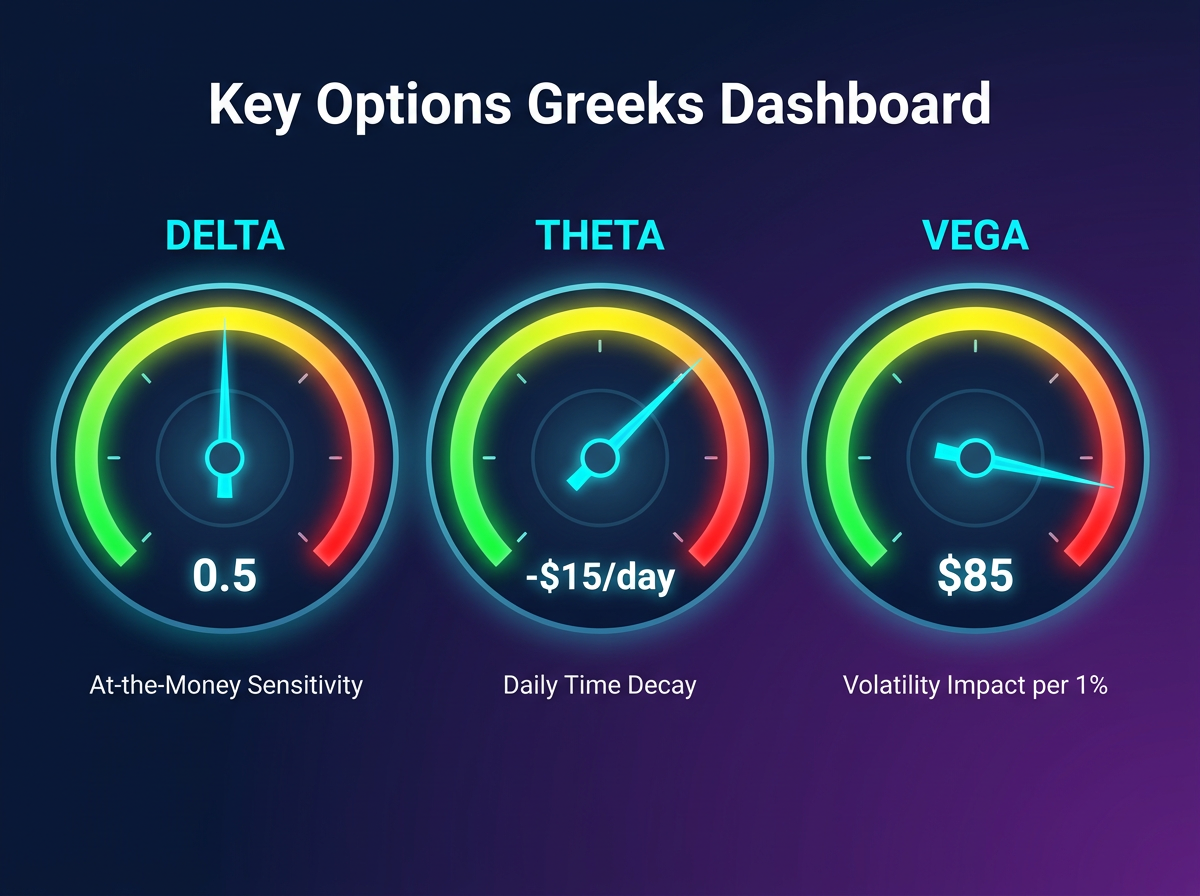
You don't need a PhD in quantitative finance, but you do need to understand three Greeks:
- Delta (Δ): How much the option's price moves for every $1 move in the underlying. A delta of 0.5 means the option gains $0.50 for every $1 BTC rises. At-the-money options typically have a delta near 0.5.
- Theta (Θ): Time decay. Every day that passes, an option loses a little value — all else equal. Theta is the enemy of option buyers and the friend of sellers. A theta of -$15 means you lose $15 per day just from time passing.
- Vega (V): Sensitivity to implied volatility (IV). High IV inflates premiums; low IV deflates them. Buying options when IV is high is expensive. Selling options when IV is high is lucrative — if you're right about direction staying contained.
Practical rule: if IV is in the top 30% of its historical range, lean toward selling premium. Bottom 30%, lean toward buying.
6 Crypto Options Strategies That Actually Work
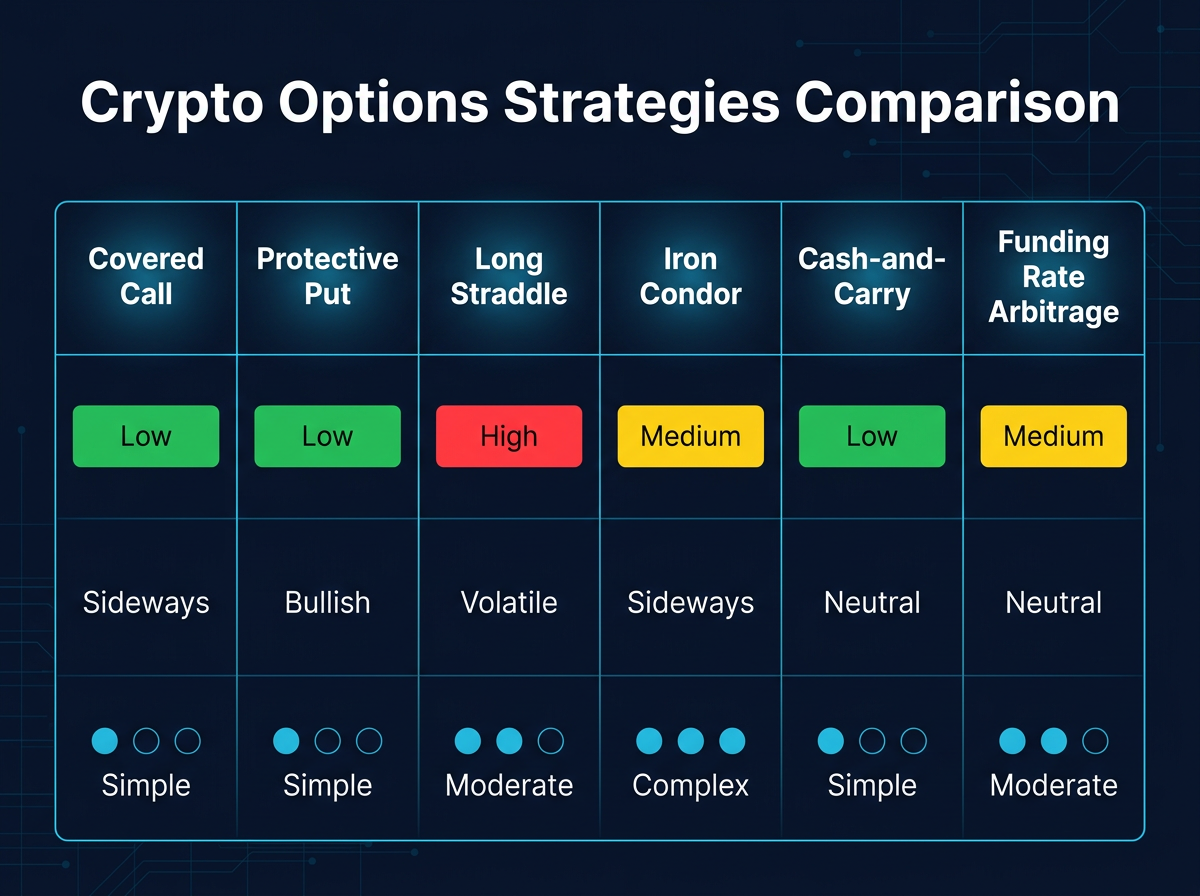
1. Covered Call — Earn Income on Your Holdings
Best for: Long-term BTC or ETH holders who want to generate yield without selling.
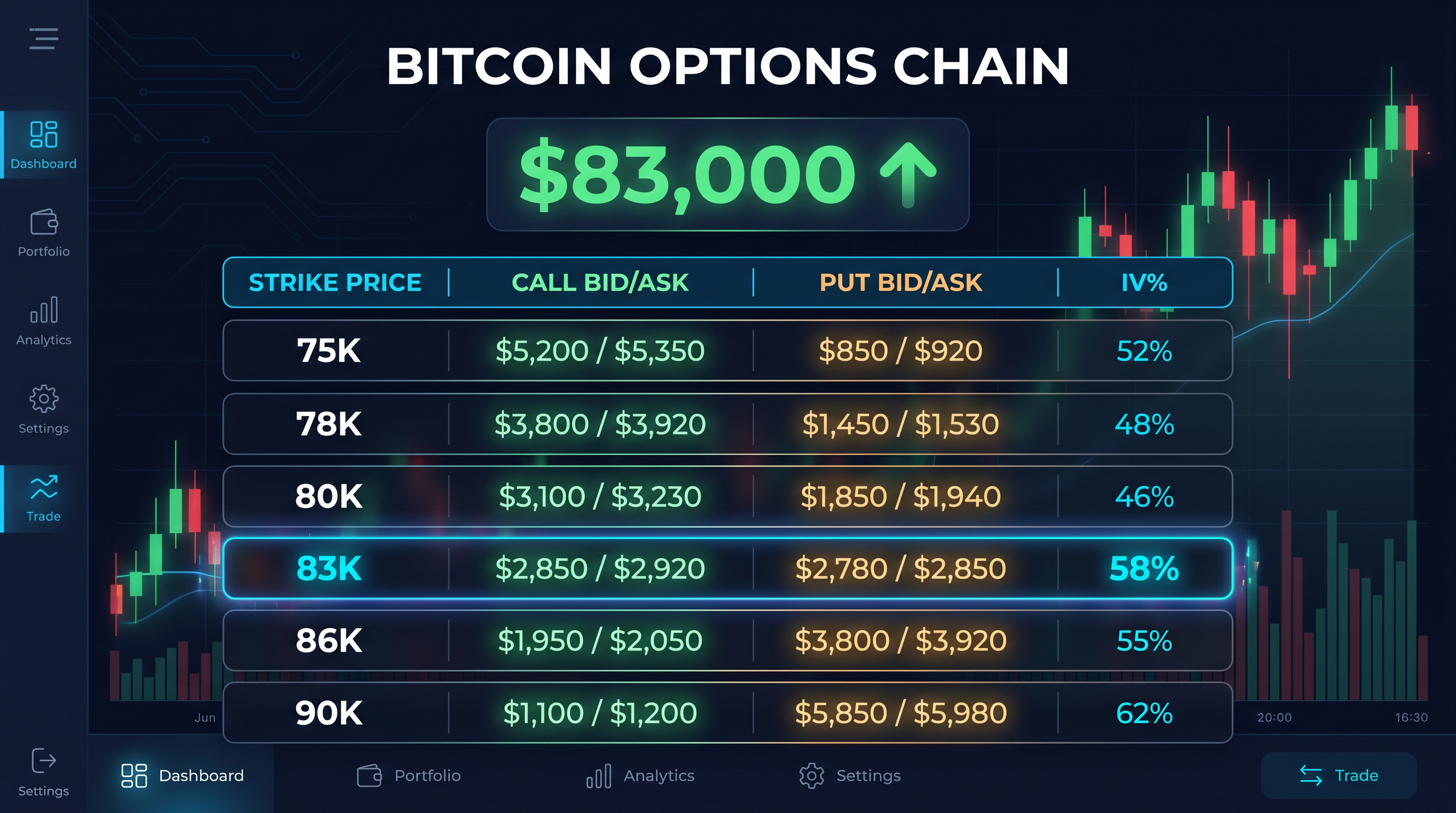
You hold 1 BTC (~$83,000) and sell a $90,000 call expiring in 30 days, collecting $1,200 in premium. If BTC stays below $90K, the option expires worthless — a 1.4% return in 30 days. If BTC blows past $90K, your upside is capped at $90K plus premium, but you still profit. The risk: if BTC crashes to $60K, you still own the BTC at a loss. Many institutional BTC holders run covered calls monthly, turning their holdings into a yield-generating asset.
Ready to master crypto trading? Check out Icoinpro's comprehensive trading course — it covers options strategies alongside spot and futures trading in a structured curriculum.
2. Protective Put — Insurance for Your Portfolio
You hold 1 ETH (~$3,200) and buy a $3,000 put expiring in 14 days, paying $80 in premium. If ETH drops to $2,500, your put is worth $500 — offsetting most of the loss. If ETH rises, you lose only the $80 premium. Think of it like car insurance: use it tactically around high-uncertainty events (Fed meetings, regulatory decisions), not as a permanent hedge.
3. Long Straddle — Profit From Big Moves Either Way
Buy both a call and a put at the same strike and expiry. If BTC is at $83,000, you buy the $83K call and $83K put, paying $2,500 total. For the trade to profit, BTC needs to move more than $2,500 in either direction — a move to $87,000 or $78,500 puts you in the money.
Straddles are expensive — you're buying two options. They work best when IV is low and you're anticipating a catalyst: a protocol upgrade, regulatory ruling, or macro shock. The danger is buying right before IV collapses, which crushes both legs simultaneously.
4. Iron Condor — Collect Premium in Sideways Markets
This is a four-leg strategy: sell an OTM call, buy a further OTM call (to cap risk), sell an OTM put, buy a further OTM put. You collect net premium upfront. As long as the underlying stays within your defined range at expiry, all four options expire worthless and you keep everything.
Example: BTC at $83,000. Sell the $90K call, buy the $93K call, sell the $76K put, buy the $73K put. Net premium: $800. Max loss: $2,200. As long as BTC stays between $76K and $90K, you keep everything — a $14,000 range, roughly 17% on either side.
Iron condors are the bread-and-butter of professional premium sellers. They require active management if price approaches either wing, but in range-bound conditions, they're remarkably consistent.
5. Cash-and-Carry (Spot-Futures Basis Trade)
Buy BTC in the spot market and simultaneously sell a BTC futures contract at a premium. During bull markets, futures trade above spot (contango). You lock in the spread — say, 8% annualized — and collect it as futures converge to spot at expiry.
In April 2026, the BTC basis ran at 6-10% annualized — one of the most attractive risk-adjusted trades available. The main risks are exchange counterparty risk and cost of capital. Protect your crypto assets with a Ledger hardware wallet — the gold standard in cold storage security — when holding spot BTC for basis trades.
6. Funding Rate Arbitrage
Best for: Traders with capital on multiple exchanges who want market-neutral yield.
Perpetual futures use funding rates to stay anchored to spot. When longs dominate, funding goes positive — longs pay shorts every 8 hours. Hold spot BTC and short an equivalent amount in perpetuals, and you collect those payments while staying delta-neutral.
During the May 2026 rally, BTC funding rates hit 0.05-0.08% per 8-hour period — roughly 55-88% annualized if sustained. Rates fluctuate and can go negative, so this isn't set-and-forget. But for traders with capital to deploy, it's a legitimate income stream that doesn't depend on price direction.
Best Platforms for Crypto Options in 2026
Platform choice matters enormously. Liquidity, margin models, and fee structures can make or break a strategy.
- Deribit: Deepest global liquidity for BTC and ETH options. Weekly, monthly, and quarterly expiries, portfolio margin. Restricted for US, Canada, and UK retail users.
- Coinbase (IBIT Options): Best regulated venue for US traders. IBIT options surpassed Deribit in open interest in April 2026. Strong compliance, familiar interface.
- Bybit: Cash-settled options on BTC, ETH, SOL, and altcoins. Unified Trading Account enables portfolio margin across spot, futures, and options.
- OKX: Full derivatives suite with portfolio margin ($10K minimum). Options settled in the underlying coin.
- Derive.xyz: On-chain, self-custodial alternative with cross-margin and multi-asset collateral. The leading DeFi options venue in 2026.
For a deep dive into Bitcoin's monetary philosophy and why institutional adoption is accelerating, grab a copy of The Bitcoin Standard — essential reading for every serious crypto trader.
Risk Management: What Most Guides Skip
Options can amplify losses just as easily as gains. A few principles that separate traders who last from those who blow up:
- Risk no more than 2-5% per trade. Options can go to zero. Size accordingly.
- Know your max loss before entering. Defined-risk strategies (iron condors, spreads) make this easy. Avoid naked short options until you have real experience.
- Watch IV percentile, not just IV level. An IV of 80% sounds high, but if the historical range is 60-120%, it's actually in the lower half. Context matters.
- Have a mechanical exit plan. Many traders take profit at 50% of max gain and cut losses at 2x the premium collected. Rules beat emotions every time.
- Prioritize liquidity. Wide bid-ask spreads erode edge on every trade. Stick to the most active strikes and expiries.
Final Thoughts: Is Options Trading Right for You?
Crypto options trading strategies aren't for everyone. They require active management, a solid grasp of mechanics, and the discipline to stick to defined risk parameters. But for traders who put in the work, options open up a different dimension of the market — one where you profit from volatility itself, generate income on idle holdings, and hedge against tail risks that would otherwise wipe out a portfolio.
Start with covered calls if you're already holding BTC or ETH. They're the most intuitive entry point and immediately put premium in your pocket. Graduate to protective puts for event-driven hedging. Once you're comfortable with both, multi-leg strategies become accessible.
The institutional money is already here. The infrastructure is better than ever. The question is whether you're going to use these tools or keep leaving them on the table.
Key Takeaways
- Six core crypto options trading strategies: covered calls, protective puts, straddles, iron condors, cash-and-carry, and funding rate arbitrage.
- Master delta, theta, and vega before placing your first trade.
- High IV percentile → sell premium. Low IV percentile → buy options.
- Top 2026 platforms: Deribit (global), IBIT options on Coinbase (US), Bybit, OKX, Derive.xyz (DeFi).
- Risk no more than 2-5% of your portfolio per options trade.
- Institutional ETF options adoption is deepening liquidity — retail traders benefit from tighter spreads.
About the Author
Marcus Chen — Senior Crypto Analyst & Educator, Certified Blockchain Professional, Former Wall Street Analyst. With 8+ years in digital asset markets, Marcus has guided thousands of traders from spot fundamentals to advanced derivatives strategies, bringing institutional-grade rigor to retail-accessible education.
Updated July 2026: Added July 2026 market sentiment data from Deribit showing elevated put-call skew, updated platform landscape with OKX and Bybit leading for advanced traders, and expanded FAQ section with current market context.
For more context on the broader market environment affecting options pricing, see our analysis of how the CLARITY Act stall is impacting crypto markets. If you're new to derivatives, our beginner's guide to reading crypto charts is a solid foundation before diving into options.
Frequently Asked Questions: Crypto Options Trading 2026
What is the best crypto options strategy for beginners in 2026?
For beginners, covered calls and protective puts are the safest starting points. Covered calls let you earn premium income on Bitcoin or ETH you already hold, while protective puts act like insurance against price drops. Both strategies have defined, limited risk — unlike selling naked options, which can result in unlimited losses.
Are crypto options markets showing bullish or bearish sentiment in July 2026?
As of July 2026, options markets are showing cautious sentiment. Data from Deribit indicates put options are trading at a premium relative to calls — meaning traders are paying more for downside protection than upside speculation. The put-call skew remains elevated, suggesting defensive positioning despite Bitcoin's recent price recovery.
Which platforms offer the best crypto options trading in 2026?
OKX and Bybit lead for advanced traders who want full options chains with precise control over strikes and expiries. Binance's "Easy Options" and Crypto.com offer simplified flows for retail users. For institutional-grade products, CME Group's Bitcoin options remain the regulated benchmark.
What is a long call condor strategy in crypto?
A long call condor is a range-bound strategy where you buy a call at a low strike, sell two calls at intermediate strikes, and buy a call at a high strike. It profits when the underlying asset stays within a defined price range. In July 2026, institutional traders have been using this structure to capitalize on Bitcoin's relatively stable price corridor.
How do I manage risk when trading crypto options?
Position sizing is everything. Never risk more than 2-5% of your portfolio on a single options trade. Use defined-risk strategies (long calls/puts, spreads) rather than naked selling. Set alerts for key price levels and always know your maximum loss before entering a trade. Consider pairing options strategies with cold storage for your core holdings.
Ready to put these strategies into practice?
The trading concepts in this article work — but only if you have the right foundation. I learned most of what I know through structured training that connected the dots between theory and live markets.
The program I recommend to people who ask me is this crypto trading course — it\'s the one I point friends and family to when they\'re serious about learning. Daily lessons, live analysis, and a community that actually helps.
Affiliate link — I may earn a commission at no extra cost to you. I only recommend what I genuinely use.
Disclaimer: The information provided on this website is for educational and informational purposes only. It should not be considered financial or investment advice. Cryptocurrency investments carry significant risk. Always do your own research and consult with a qualified financial advisor before making investment decisions.
Free Crypto Insights
Get weekly trading tips, market analysis, and exclusive strategies delivered to your inbox.