The Crypto Revenue-to-Buyback Strategy: How Hyperliquid Is Redefining Altcoin Value in 2026
Affiliate Disclosure: This article may contain affiliate links. We may earn a commission at no extra cost to you. All opinions are our own.
Marcus Chen
Senior Crypto Analyst & Educator
Certified Blockchain Professional | Former Wall Street Analyst
Marcus Chen is a cryptocurrency analyst and educator with over 8 years of experience in digital asset trading. He has helped thousands of beginners navigate the crypto markets through practical, actionable education.
The Crypto Revenue-to-Buyback Strategy: How Hyperliquid Is Redefining Altcoin Value in 2026
The crypto revenue-to-buyback strategy is quietly becoming one of the most powerful frameworks for identifying high-conviction altcoin positions in 2026. While most traders are still chasing narrative-driven pumps, a smaller group of institutional-grade investors is doing something different — they're reading protocol income statements and following the buyback money. If you want to understand why Hyperliquid's HYPE token is up over 68% year-to-date while most altcoins are bleeding against Bitcoin, this is the framework you need.
Why Most Altcoins Are Failing in 2026 — And What's Different
Bitcoin's dominance has been sitting in the 58–60% range for most of 2026. The Altcoin Season Index? Hovering around 30–40, firmly in "Bitcoin Season" territory. That means the vast majority of altcoins are underperforming BTC on a risk-adjusted basis. Retail capital is cautious. Meme coins have cooled. And the "everything pumps" dynamic of 2021 feels like a different era.
But here's what's interesting: a handful of altcoins are absolutely crushing it. Not because of hype or influencer shilling — because they have real revenue, real users, and tokenomics that create genuine buy pressure. The market has matured. Institutional capital, unlocked by regulatory clarity from the CLARITY Act and a growing suite of crypto ETF products, is now the kingmaker. And institutions don't buy vibes. They buy cash flows.
This is the environment where the revenue-to-buyback strategy thrives. In Q1 2026, crypto derivatives trading volume hit 8.63 trillion — representing 91% of total crypto market volume. The protocols capturing that volume and returning it to token holders are the ones worth owning.
What Is the Revenue-to-Buyback Strategy?
The concept is straightforward, even if the execution requires discipline. You identify protocols that generate significant, verifiable on-chain revenue from real user activity, allocate a meaningful percentage of that revenue to systematically buying back their native token from the open market, and hold a defensible market position within their sector.
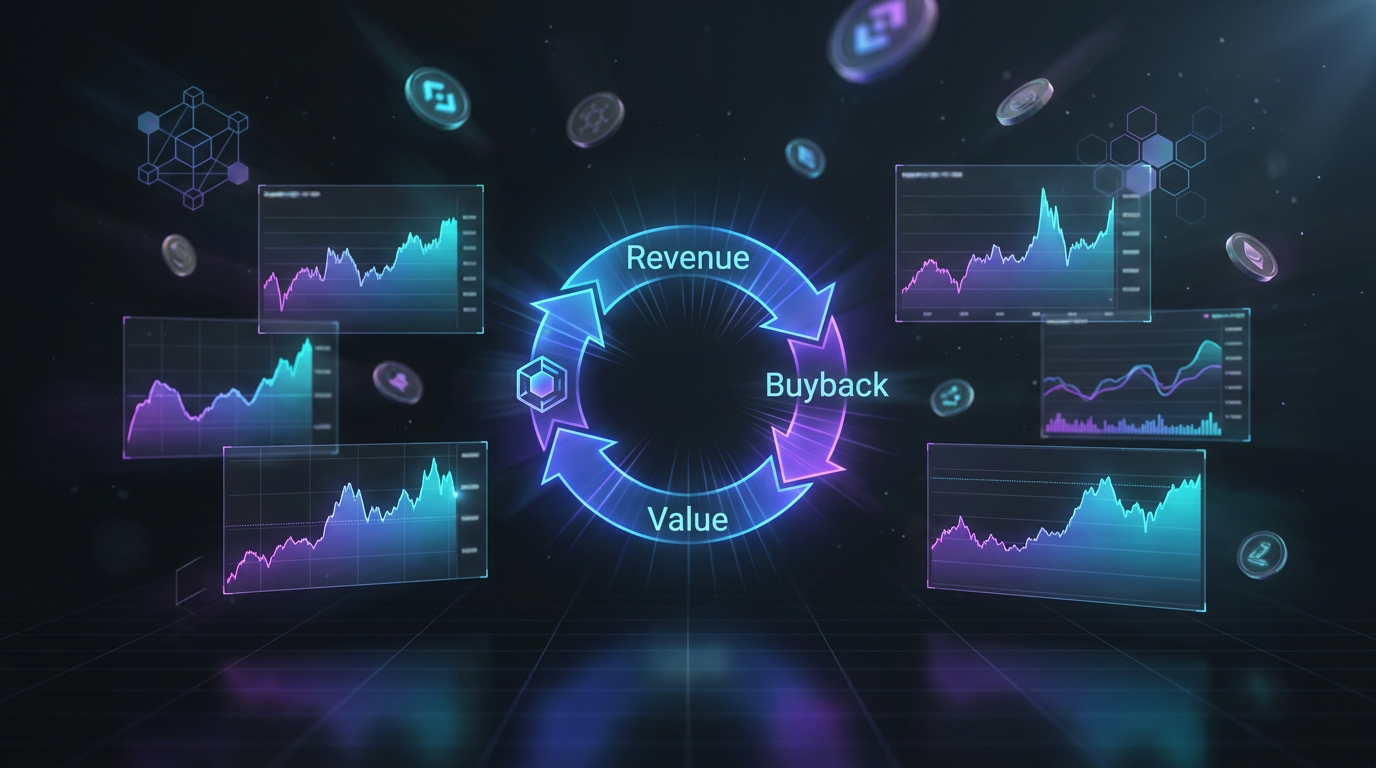
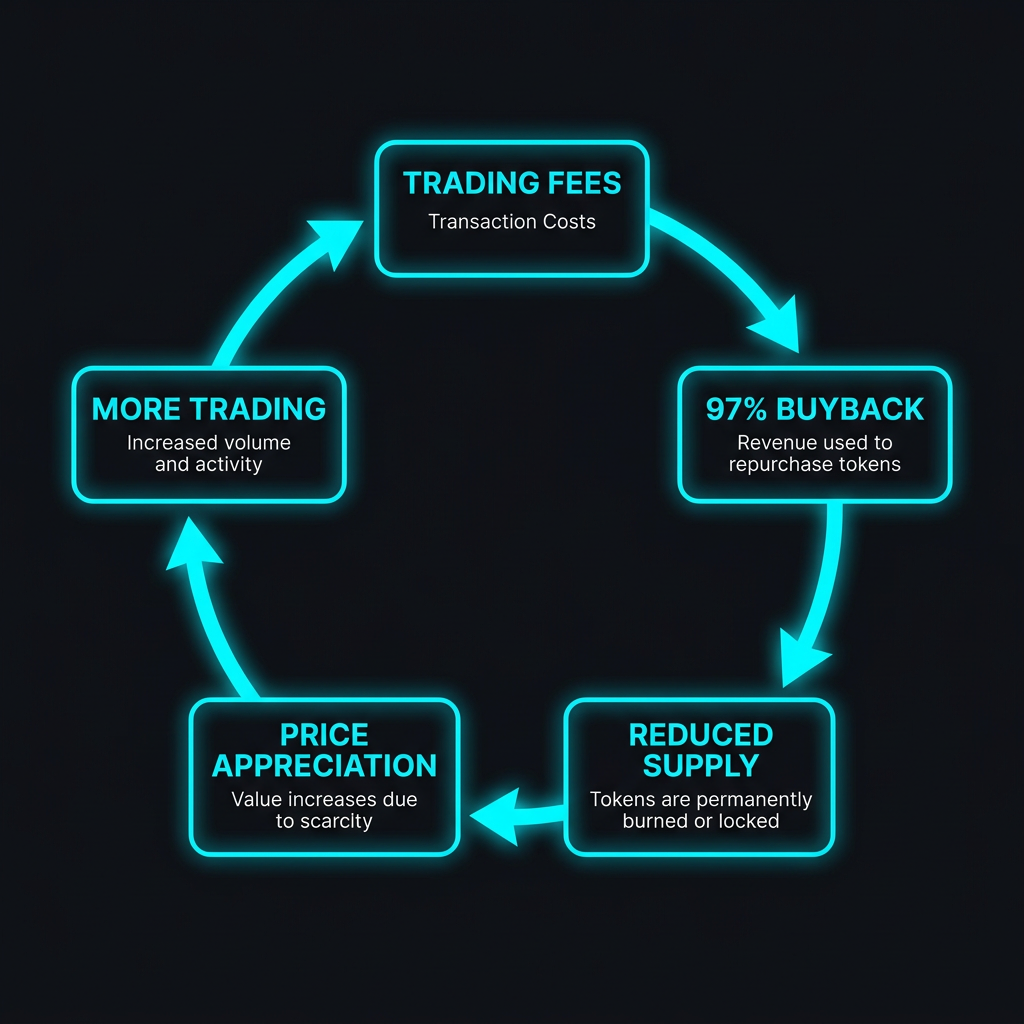
When a protocol buys back its own token, it creates non-speculative demand. Unlike a whale accumulating or a market maker positioning, buybacks are mechanical and predictable. Revenue goes up → more tokens get bought → supply shrinks → price has structural support. It's a flywheel, and once it's spinning, it's hard to stop.
Compare this to the two dominant altcoin token models that have largely failed investors. Pure governance tokens like early UNI gave holders voting rights but zero economic claim on protocol revenue — the token had no reason to appreciate even as Uniswap processed billions in volume. Inflationary reward tokens paid liquidity providers in freshly minted tokens, creating constant sell pressure that overwhelmed any organic demand. The APY looked great until the token price collapsed 90%.
The buyback model solves both problems. It creates a direct link between protocol success and token value — the kind of link that institutional analysts can model and underwrite.
Case Study: Hyperliquid (HYPE) — The Buyback Machine
No protocol illustrates this strategy better than Hyperliquid. If you haven't been paying attention to HYPE, the numbers will surprise you.
Hyperliquid's Market Dominance
Hyperliquid commands approximately 70% of the market share in decentralized perpetual futures. That's not a niche position — that's category dominance. In a derivatives market where Q1 2026 crypto derivatives trading volume hit 8.63 trillion, being the dominant decentralized venue for perpetual contracts is an extraordinarily valuable position.
The platform processes billions in daily volume with near-zero latency, a fully on-chain order book, and a user experience that rivals centralized exchanges. Traders who've migrated from centralized perp platforms often don't go back. That stickiness is a moat, and moats protect revenue.
The 97% Revenue Buyback Model
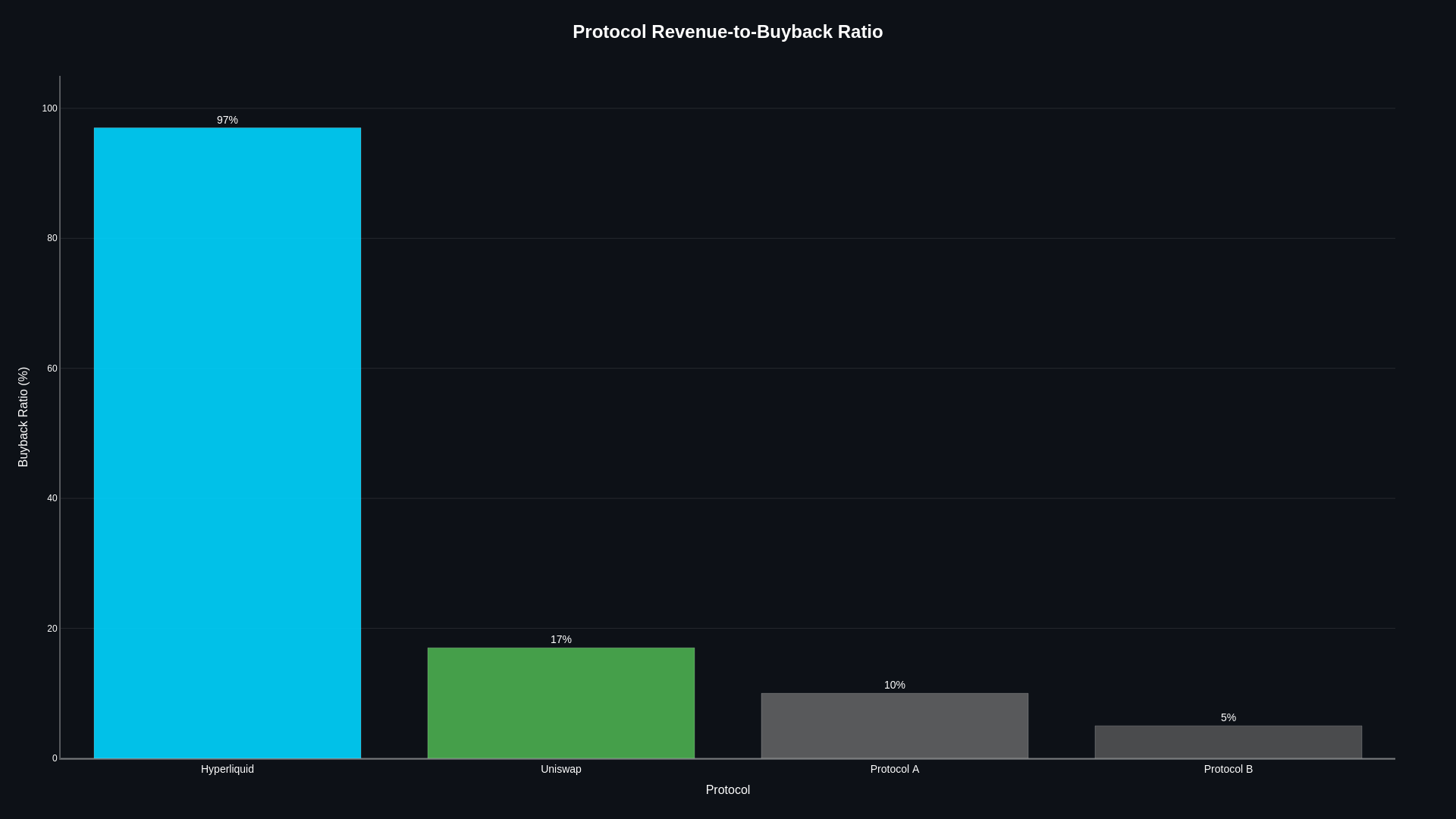
Here's the number that stops most people cold: Hyperliquid directs 97% of its protocol revenue to systematically buy back HYPE tokens from the open market. Not 10%. Not 30%. Ninety-seven percent.
This is an almost unprecedented commitment to token value accrual. Every time a trader pays a fee on Hyperliquid, 97 cents of every dollar goes toward buying HYPE. The protocol essentially operates at cost, treating token appreciation as its primary business model. For token holders, this creates a compounding effect: as the platform grows, buyback volume grows, supply shrinks, and the remaining tokens become more valuable.
With daily volumes regularly exceeding –8 billion, even modest fee rates generate substantial buyback pressure. This isn't theoretical — it's visible on-chain, auditable in real time. That transparency is exactly what institutional investors need to build a position thesis.
HYPE Performance and Institutional Validation
The market has noticed. HYPE is trading around 0–43 with a market cap near 0.4 billion as of May 2026, representing a +68.62% year-to-date gain — in a market where most altcoins are flat or negative against Bitcoin.
More telling than the price action is the institutional interest. Grayscale, Bitwise, and 21Shares have all filed for spot ETF products tied to HYPE. When three major asset managers independently decide a token is worth building a regulated product around, that's not speculation — that's due diligence. They've looked at the revenue model, the market share, and the tokenomics, and concluded this is a fundable thesis.
Want to accelerate your trading journey? Explore Icoinpro's daily trading signals and education platform — particularly useful for learning how to time entries on fundamentals-driven positions like HYPE.
How to Find the Next Hyperliquid: A Screening Framework
HYPE is the clearest current example, but the strategy is replicable. Here's the framework for identifying similar opportunities before institutional capital fully prices them in.
Step 1: Verify Real Protocol Revenue
Start with DeFiLlama's "Fees & Revenue" dashboard. You want protocols generating consistent, growing revenue from actual user activity — not token emissions or one-time events. Look for 90-day revenue trends, not just 24-hour spikes. Sustainable revenue is the foundation of everything else. A protocol doing 0M in monthly fees is a very different animal from one doing 00K.
Step 2: Quantify the Buyback Commitment
Read the protocol's tokenomics documentation and governance proposals carefully. What percentage of revenue is committed to buybacks? Is it hardcoded in the smart contract (like Hyperliquid) or subject to governance votes? Hardcoded buybacks are more reliable. Governance-dependent buybacks carry execution risk — a single contentious vote can change the economics overnight.
Uniswap's December 2025 fee switch activation is a useful secondary example. UNI governance voted to route 17% of swap fees to buybacks and burns — a meaningful step, though far less aggressive than Hyperliquid's model. UNI's response was positive but muted compared to HYPE's trajectory, illustrating how the percentage matters enormously.
Step 3: Assess Sector Market Share
A protocol with 5% market share in a competitive sector is vulnerable. A protocol with 70% share has pricing power, network effects, and the ability to sustain revenue even through market downturns. Look for protocols that are either dominant in their niche or growing share rapidly in a sector with high barriers to entry. The combination of high market share and high buyback percentage is the sweet spot.
Step 4: Watch for Institutional Signals
ETF filings, large wallet accumulation patterns, and inclusion in institutional research reports are leading indicators that smart money has done the work. You don't need to be first — you need to be early enough that the institutional inflow hasn't fully priced in yet. Track SEC filings, Grayscale trust additions, and on-chain wallet clustering tools to spot these signals early.
Risk Management for Buyback-Driven Altcoin Positions
Strong fundamentals don't eliminate risk — they just give you a better foundation for managing it. A few principles worth internalizing before you put capital to work.
Position sizing matters more than entry price. Even the best fundamental thesis can see 40–60% drawdowns in a crypto bear market. Size positions so that a 50% drop doesn't force you to sell. If you can't hold through volatility, the strategy won't work for you regardless of how good the fundamentals are.
Monitor revenue sustainability. Buybacks are only as good as the revenue funding them. Set alerts for significant drops in protocol volume or fee revenue. If Hyperliquid's daily volume dropped from B to 00M, the buyback math changes dramatically. Check DeFiLlama weekly — it takes five minutes and keeps you honest about whether the thesis is still intact.
Know your exit signals. The thesis breaks if the protocol loses significant market share to a competitor, governance votes to reduce the buyback percentage, or a security exploit damages user trust. These are your stop-loss conditions — not price levels, but fundamental changes to the thesis. Price drops without fundamental deterioration are buying opportunities. Fundamental deterioration without price drops is a warning to exit.
Protect your crypto assets with a Ledger hardware wallet — the gold standard in cold storage security. When you're holding high-conviction positions for months, keeping assets off exchanges is non-negotiable.
Actionable Takeaways
The revenue-to-buyback strategy isn't a shortcut — it's a framework for doing the work that most retail traders skip. In a market where Bitcoin dominance is high and narrative-driven altcoins are struggling, protocols with real revenue and systematic buybacks are the ones generating alpha. Hyperliquid has proven the model works at scale. The question is which protocol does it next.
- ✅ Screen for real revenue: Use DeFiLlama Fees & Revenue. Filter for 90-day consistency, not 24-hour spikes.
- ✅ Verify buyback mechanics: Is it hardcoded or governance-dependent? What percentage? Higher is better.
- ✅ Check market share: Is the protocol dominant or growing in a defensible niche with high barriers to entry?
- ✅ Look for institutional signals: ETF filings, large wallet activity, research coverage from major asset managers.
- ✅ Size positions for volatility: Even great fundamentals don't prevent 40–50% drawdowns in crypto bear markets.
- ✅ Monitor weekly: Revenue trends, competitive landscape, governance proposals. The thesis can change fast.
For a structured approach to learning crypto trading, Icoinpro offers step-by-step training that has helped thousands of traders build systematic, fundamentals-driven approaches to the market.
August 2026 Update: Assistance Fund Reaches 46M HYPE
Since this article was first published, Hyperliquid's buyback program has continued to execute at scale. The Assistance Fund now holds approximately 46.18 million HYPE tokens — representing 4.62% of the total 1 billion supply. During the July 2026 contributor token unlock, the fund held 4.6 times more HYPE than the amount being released, effectively acting as a structural floor against sell pressure.
Analysts have noted that the buyback mechanism successfully absorbed the July 2026 unlock without a significant price drop — validating the model's effectiveness as a counterweight to vesting schedules. The protocol is also expanding into real-world asset (RWA) tokenization, which could open new fee revenue streams to sustain the buyback pace.
For related reading, see our guide on Best Crypto Hardware Wallets in 2026 and our analysis of how macro conditions affect DeFi protocols.
Frequently Asked Questions
How much HYPE has Hyperliquid's Assistance Fund accumulated?
As of early August 2026, the Assistance Fund holds approximately 46.18 million HYPE tokens — about 4.62% of the 1 billion maximum supply. This accumulation reduces circulating supply and creates ongoing deflationary pressure.
Does the buyback program protect against token unlocks?
Yes. During the July 2026 contributor unlock, the Assistance Fund held approximately 4.6 times more HYPE than the amount being released. This "standing bid" is designed to absorb sell-side pressure from vesting schedules without significant price impact.
What percentage of Hyperliquid's fees go to buybacks?
The protocol routes 97–99% of trading fees into the Assistance Fund for open-market HYPE purchases. This is one of the highest fee-to-buyback ratios of any major DeFi protocol.
Is the Hyperliquid buyback sustainable long-term?
Analysts are watching closely as Hyperliquid expands into new verticals like real-world assets (RWAs). The sustainability depends on maintaining trading volume — if fee revenue drops significantly, the buyback pace would slow. So far, the protocol has maintained strong volume through 2026.
How does Hyperliquid's model compare to traditional stock buybacks?
Unlike corporate buybacks that use retained earnings, Hyperliquid's buybacks are funded entirely by real protocol revenue — trading fees paid by users. This makes it more analogous to a company buying back shares with operating cash flow rather than debt, which is generally considered a healthier model.
Ready to put these strategies into practice?
The trading concepts in this article work — but only if you have the right foundation. I learned most of what I know through structured training that connected the dots between theory and live markets.
The program I recommend to people who ask me is this crypto trading course — it\'s the one I point friends and family to when they\'re serious about learning. Daily lessons, live analysis, and a community that actually helps.
Affiliate link — I may earn a commission at no extra cost to you. I only recommend what I genuinely use.
Disclaimer: The information provided on this website is for educational and informational purposes only. It should not be considered financial or investment advice. Cryptocurrency investments carry significant risk. Always do your own research and consult with a qualified financial advisor before making investment decisions.
Free Crypto Insights
Get weekly trading tips, market analysis, and exclusive strategies delivered to your inbox.