How to Use Crypto Copy Trading in 2026 (Step-by-Step Guide)
Affiliate Disclosure: This article may contain affiliate links. We may earn a commission at no extra cost to you. All opinions are our own.
Marcus Chen
Senior Crypto Analyst & Educator
Certified Blockchain Professional | Former Wall Street Analyst
Marcus Chen is a cryptocurrency analyst and educator with over 8 years of experience in digital asset trading. He has helped thousands of beginners navigate the crypto markets through practical, actionable education.
How to Use Crypto Copy Trading in 2026 (Step-by-Step Guide)
Crypto copy trading has quietly become one of the most practical ways to participate in the market without spending hours glued to charts. The idea is simple: you pick an experienced trader, allocate some capital, and the platform automatically mirrors their moves in your account. In 2026, crypto copy trading has matured significantly — platforms like Bybit and Bitget now offer sophisticated tools, transparent performance metrics, and real risk controls that didn't exist a few years ago. This guide walks you through exactly how it works, how to pick the right trader, and how to avoid the traps that catch most beginners.
Disclaimer: This content is for informational purposes only and should not be considered financial advice. Cryptocurrency investments carry significant risk. Always do your own research (DYOR) before making any investment decisions.
This article contains affiliate links. We may earn a commission at no extra cost to you if you make a purchase through these links. See our affiliate disclosure for details.
What Is Crypto Copy Trading?
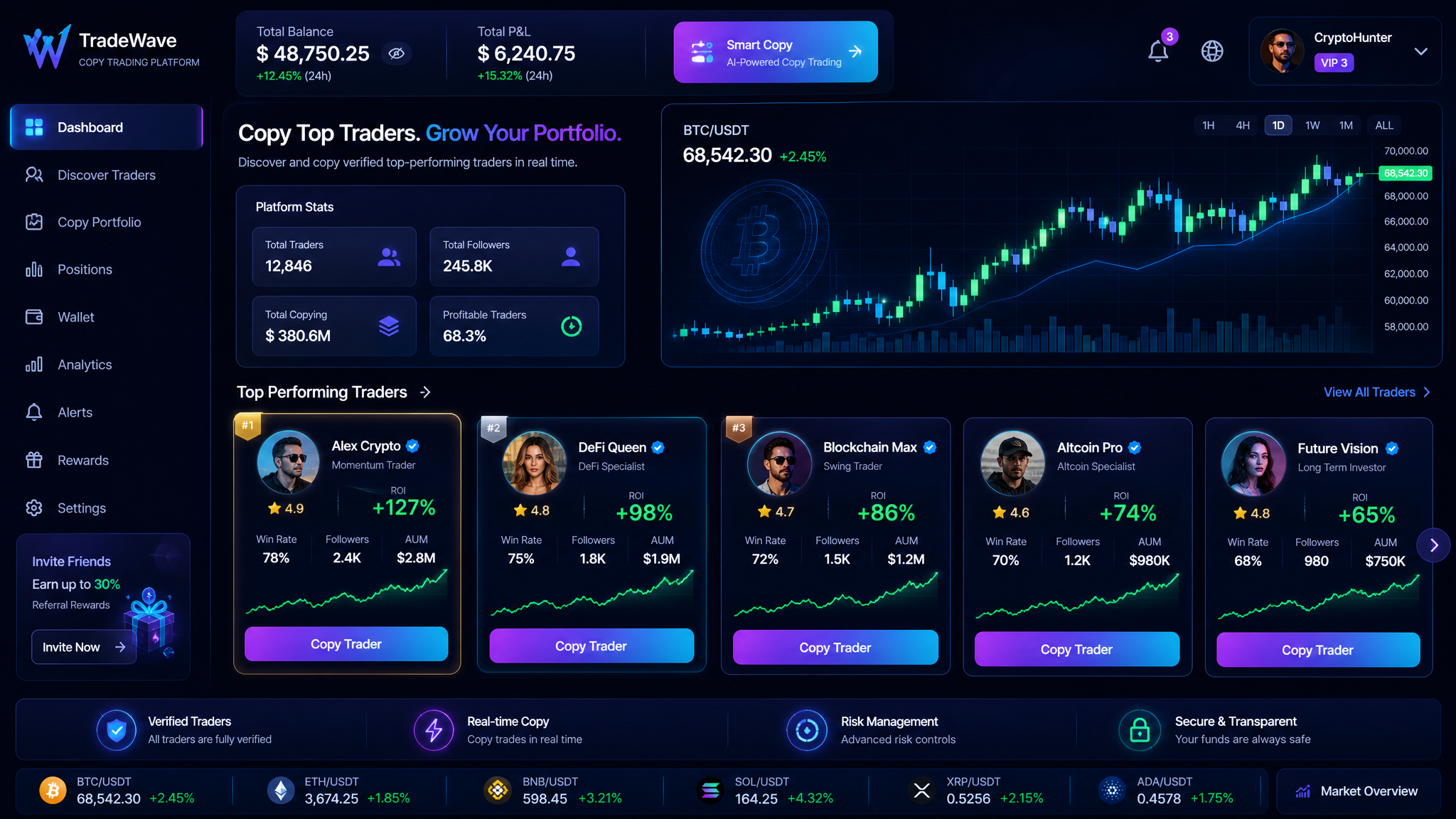
Copy trading is a form of social investing where your account automatically replicates the trades of a lead trader in real time. When they buy ETH, you buy ETH. When they close a position, yours closes too — proportionally, based on how much capital you've allocated.
It's not a new concept. Stock traders have used similar tools for years. But crypto copy trading in 2026 has evolved well beyond basic mirroring. You can now choose between spot copying, futures copying, and even on-chain wallet mirroring. The best platforms give you detailed performance data — drawdown history, win rates, strategy type — so you're not flying blind.
Think of it as hiring a trader to manage a slice of your portfolio, except you stay in control of your funds and can stop at any time.
How Crypto Copy Trading Works
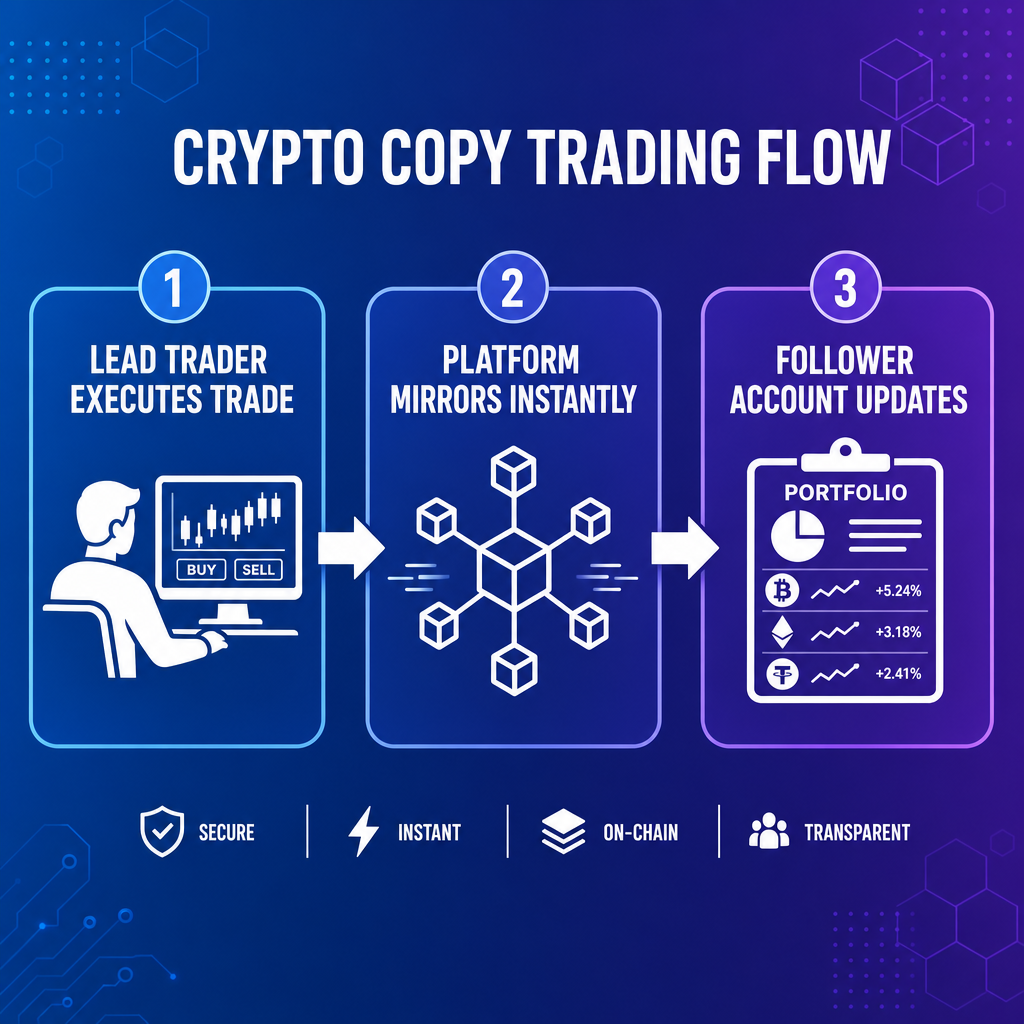
The mechanics vary slightly by platform, but the core flow is consistent: a lead trader executes a trade on their account, the platform's infrastructure detects it, and within milliseconds, a proportional version of that trade is placed in your account.
CEX-Based Copy Trading
Centralized exchanges like Bybit, Bitget, and OKX have built copy trading directly into their platforms. You browse a leaderboard of verified traders, review their stats, and click "Copy." Your funds stay on the exchange, and the platform handles execution automatically.
The advantage here is simplicity and liquidity. The downside? You're trusting the exchange with custody of your assets, and execution can lag by a few seconds during high-volatility moments — which matters more in futures than spot.
On-Chain Copy Trading
A newer approach involves mirroring on-chain wallets directly. Tools like Hyperliquid Vaults and dHEDGE let you follow specific smart-money wallets or automated DeFi strategies without giving up custody. You can see exactly what the wallet holds and what it's doing in real time.
This is more transparent but also more complex. You'll need a self-custody wallet, some familiarity with DeFi, and a higher tolerance for gas fees and smart contract risk. For most beginners, CEX-based copy trading is the better starting point.
Best Platforms for Copy Trading in 2026
Not all platforms are equal. Here's a breakdown of the top options worth considering this year.
Bybit Copy Trading
Bybit offers three distinct copy trading models. The Classic model mirrors USDT perpetual contracts in real time — this is what most people use. The Pro model works more like a managed fund, where you buy shares of a strategy rather than copying individual trades. The TradFi model extends into forex and commodities via MT5.
Bybit's profit-sharing structure uses a weekly settlement cycle, and the High Water Mark system ensures you only pay performance fees when the trader exceeds their previous peak equity. That's a meaningful protection against paying fees on recovered losses.
Bitget Copy Trading
Bitget is arguably the most beginner-friendly option. Their leaderboard is clean, the metrics are easy to read, and they offer both spot and futures copying. Bitget also maintains a $300M+ Protection Fund — not a guarantee against losses, but a meaningful signal of platform stability.
Key features: stop-loss percentages per copied trader, maximum concurrent position limits, and the ability to set a total loss cap across your entire copy portfolio. These controls matter more than most beginners realize.
OKX Copy Trading
OKX takes a marketplace approach. Their discovery interface lets you filter traders by PnL, AUM, win rate, and strategy type. It's particularly useful if you want to compare multiple traders side by side before committing capital. OKX also supports both spot and derivatives copying, with solid liquidity across major pairs.
Ready to master crypto trading? Check out Icoinpro's comprehensive trading course.
How to Choose the Right Trader to Copy
This is where most people go wrong. They sort by highest ROI and pick whoever's at the top. That's a mistake. A 300% return over 30 days often means someone got lucky with high leverage — and the next 30 days could wipe out everything.
Here's what actually matters when evaluating a lead trader:
- Maximum Drawdown: This is the single most important metric. It tells you the worst peak-to-trough loss the trader has experienced. Anything above 40% should raise a red flag. Under 20% is solid.
- Track Record Length: Look for at least 90 days of verified history. Short streaks — even impressive ones — don't tell you much about how a trader handles adversity.
- Win Rate vs. Risk-to-Reward: A 45% win rate can still be profitable if the average win is 3x the average loss. Don't dismiss traders with lower win rates if their RRR is strong.
- Strategy Type: Scalpers take dozens of trades per day with tight margins. Swing traders hold positions for days or weeks. Make sure the strategy matches your risk tolerance and the amount of attention you want to pay.
- Leverage Used: Avoid traders consistently using 20x+ leverage. One bad trade at that level can liquidate a position before your stop-loss even triggers.
- Consistency: Look at monthly PnL, not just total ROI. Steady, moderate gains beat volatile spikes every time for long-term copy trading.
Step-by-Step: Setting Up Copy Trading on Bybit
Here's a practical walkthrough for getting started on Bybit — the process is similar on other platforms.
- Create and verify your account. Register on Bybit, complete KYC (government ID + selfie), and enable 2FA. This takes 10–30 minutes depending on verification speed.
- Fund your account. Deposit USDT or convert existing crypto. For copy trading, most experts recommend starting with no more than 10–20% of your total crypto holdings — treat it as one strategy among several.
- Navigate to Copy Trading. Find the Copy Trading section in the main menu. Select "Classic" mode for standard futures mirroring.
- Browse the leaderboard. Filter by 90-day ROI, max drawdown, and number of followers. Read the trader's profile — many include notes on their strategy and risk approach.
- Set your copy parameters. Choose your allocation amount, set a stop-loss threshold (e.g., stop copying if you lose 15% of allocated capital), and decide whether to copy open positions or only new ones going forward.
- Activate and monitor. Once live, check in every few days. Review the trader's recent trades, not just your balance. If their behavior changes — more leverage, more frequent trades, unusual position sizes — that's a signal to reassess.
Serious about security? The Ledger Nano X keeps your private keys offline and safe.
Risk Management for Copy Traders
Copy trading doesn't eliminate risk — it redistributes it. You're still exposed to market volatility, platform risk, and the possibility that your chosen trader has a bad run. Here's how to manage that intelligently.
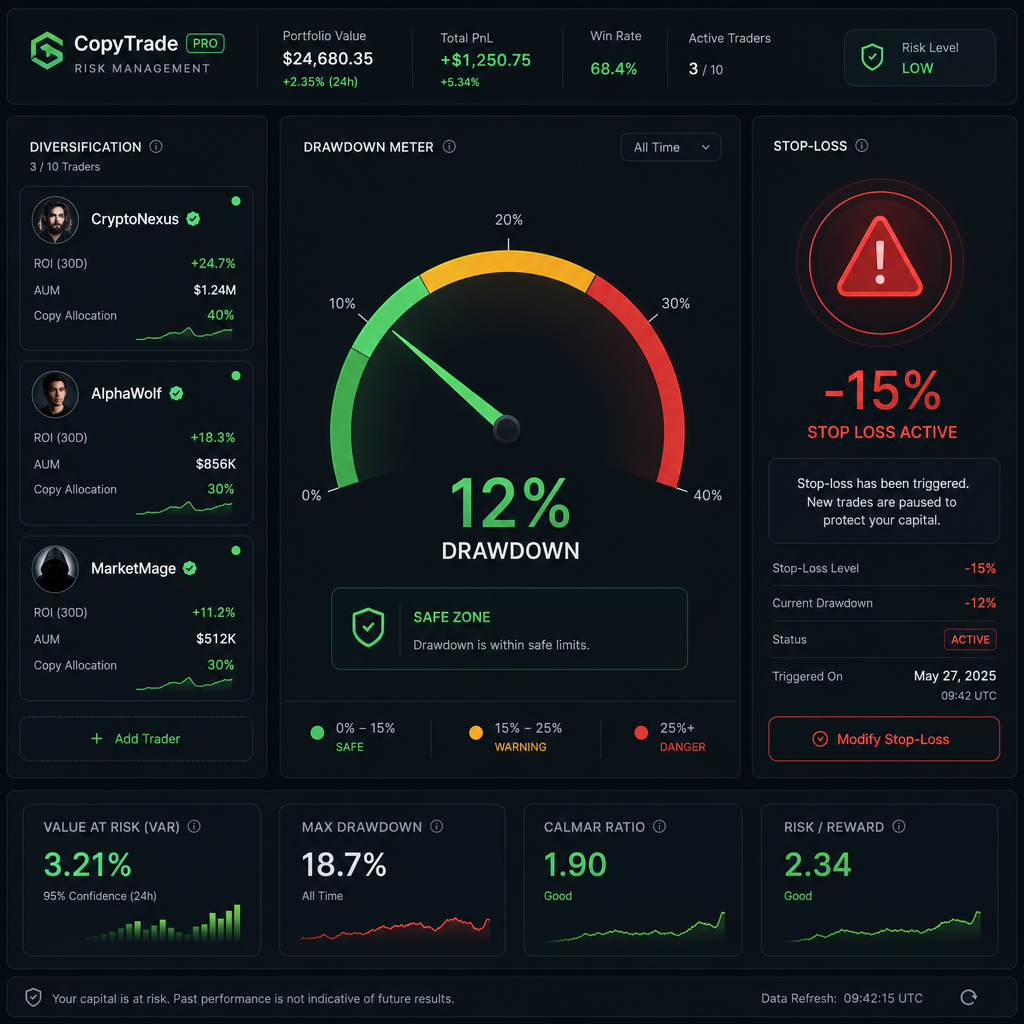
Diversify across traders. Spread capital across 3–5 traders with different strategies — a swing trader, a scalper, a trend-follower. Platforms like Phemex support up to 20 simultaneous traders with independent account structures, preventing one bad performer from contaminating the rest.
Set hard stop-loss limits. Every platform lets you define a maximum loss threshold per trader. A 15–20% stop on your allocated capital is a reasonable starting point — if they hit it, copying stops automatically.
Size your allocation correctly. Allocate only what you can afford to lose entirely. That mindset keeps you from making emotional decisions when things get rough.
Watch for execution slippage. Followers enter trades seconds after the lead trader. In fast-moving markets, that lag can mean worse entry prices — more pronounced in futures than spot. Factor it into your return expectations.
Review monthly, not daily. Checking your balance every hour breeds anxiety and bad decisions. Set a monthly review cadence and evaluate whether each trader's behavior still matches what you signed up for.
Common Mistakes to Avoid
A few patterns show up repeatedly among copy traders who lose money:
Chasing recent performance. The trader who made 200% last month is the one everyone piles into — right before they give it all back. Past performance in crypto is a weak predictor of future results over short windows.
Ignoring fees. Performance fees typically run 10–25% of net profits. Add trading fees and funding rates on futures, and your actual net return can be significantly lower than the headline number. Always calculate net-of-fees returns before committing.
Allocating too much capital. Start small, learn how the platform works, and scale up only after you've seen how your chosen traders perform through a volatile period.
Not reading the strategy notes. Most lead traders on Bybit and Bitget include descriptions of their approach. Read them. A trader using 50x leverage on meme coins is not the same as one running a disciplined swing strategy on BTC and ETH.
Stopping during drawdowns. If you've chosen a solid trader, a 10% drawdown isn't necessarily a reason to panic. Every strategy has losing periods — the question is whether it's within the historical range you accepted when you started copying.
Is Crypto Copy Trading Worth It in 2026?
For the right person, yes. Copy trading makes the most sense if you believe in crypto's long-term trajectory but don't have the time or inclination to actively trade. It's also a legitimate way to learn — watching how experienced traders manage positions, size their risk, and react to market conditions is genuinely educational.
It's not a shortcut to guaranteed profits. Losses are real, and they come out of your account just as fast as gains go in. The traders who do well with copy trading treat it as one component of a broader strategy — not their entire plan. For a structured approach to learning crypto trading, Icoinpro offers step-by-step training that has helped thousands of beginners.
Final Thoughts
Crypto copy trading in 2026 is more accessible and better-regulated than it's ever been. Pick traders based on drawdown and consistency, not headline ROI. Diversify across strategies. Set hard stop-losses. And never allocate more than you can afford to lose.
Key Takeaways
- Crypto copy trading automatically mirrors experienced traders' positions in your account
- Top platforms in 2026: Bybit (Classic/Pro models), Bitget (beginner-friendly), OKX (marketplace discovery)
- Evaluate traders by max drawdown, track record length, and strategy type — not just ROI
- Always set stop-loss thresholds and diversify across 3–5 traders
- Execution slippage and performance fees reduce real returns — factor them in
- Copy trading works best as one component of a broader crypto strategy
Ready to put these strategies into practice?
The trading concepts in this article work — but only if you have the right foundation. I learned most of what I know through structured training that connected the dots between theory and live markets.
The program I recommend to people who ask me is this crypto trading course — it\'s the one I point friends and family to when they\'re serious about learning. Daily lessons, live analysis, and a community that actually helps.
Affiliate link — I may earn a commission at no extra cost to you. I only recommend what I genuinely use.
Disclaimer: The information provided on this website is for educational and informational purposes only. It should not be considered financial or investment advice. Cryptocurrency investments carry significant risk. Always do your own research and consult with a qualified financial advisor before making investment decisions.
Free Crypto Insights
Get weekly trading tips, market analysis, and exclusive strategies delivered to your inbox.