MEV Protection: How to Stop Bots from Stealing Your Crypto Trades in 2026
Affiliate Disclosure: This article may contain affiliate links. We may earn a commission at no extra cost to you. All opinions are our own.
Marcus Chen
Senior Crypto Analyst & Educator
Certified Blockchain Professional | Former Wall Street Analyst
Marcus Chen is a cryptocurrency analyst and educator with over 8 years of experience in digital asset trading. He has helped thousands of beginners navigate the crypto markets through practical, actionable education.

MEV Protection: How to Stop Bots from Stealing Your Crypto Trades in 2026
MEV protection has become one of the most critical skills for any serious DeFi trader in 2026. Every time you swap tokens on a decentralized exchange, invisible bots are scanning the mempool — the waiting room for unconfirmed transactions — looking for a chance to sandwich your trade, front-run your order, or extract value before your transaction even lands. Ethereum alone sees roughly $180 million in MEV extracted from ordinary traders every month. That's not a rounding error. That's a structural tax on every retail participant who doesn't know how to defend themselves.
This guide breaks down how MEV works, which attack vectors hit traders hardest in 2026, and the concrete tools you can deploy right now to stop bots from eating your profits.
What Is MEV and Why Should Advanced Traders Care?
MEV stands for Maximal Extractable Value — profit that validators, block builders, and bots extract by controlling transaction order within a block. Originally called "Miner Extractable Value," the term evolved as Ethereum moved to proof-of-stake and the extraction machinery became far more sophisticated.
The public mempool is a dark forest. When you submit a swap on any standard AMM without protection, your transaction sits in a public queue where MEV bots — running on colocated servers with sub-200ms reaction times — scan constantly for profitable opportunities.
The three main attack types you need to understand:
Sandwich Attacks
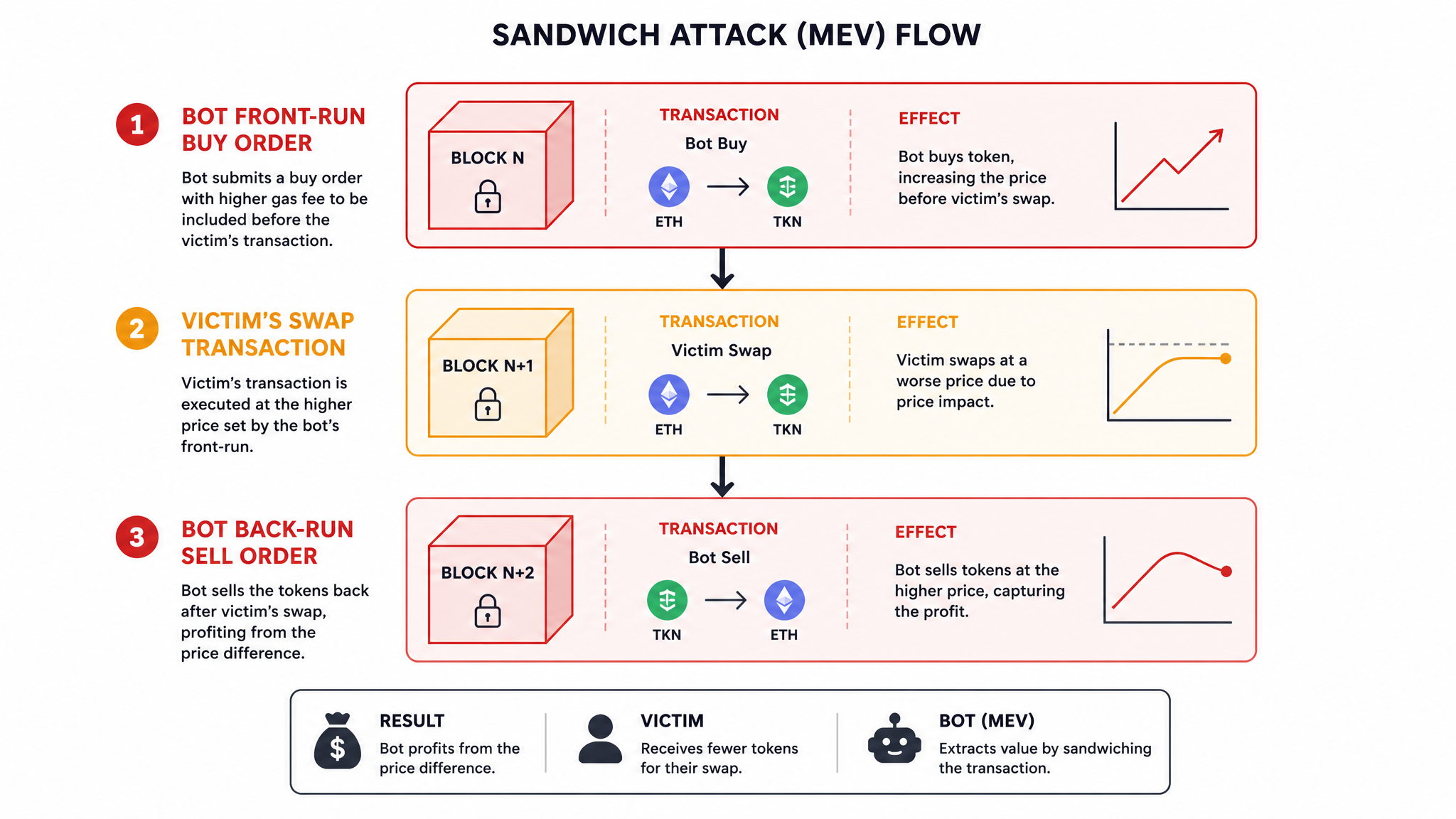
The most costly MEV form for retail traders. A bot sees your pending swap, buys before yours (front-run) to push the price up, then sells after your trade executes (back-run) to pocket the difference. You get filled at a worse price — often without realizing it. Individual attacks average ~$3 in extracted value, but thousands occur daily across Ethereum and Solana.
Front-Running
A bot spots your transaction and submits an identical order with a higher gas fee, executing first. By the time your trade lands, the price has moved against you — especially brutal for large swaps in lower-liquidity pools.
Just-in-Time (JIT) Liquidity
Bots inject concentrated liquidity into an AMM pool milliseconds before your large swap, capture the trading fees, then withdraw immediately after. You don't lose money directly, but existing LPs get diluted — value extraction that's harder to see but very real.
The 2026 MEV Landscape: What's Changed
The MEV ecosystem has professionalized dramatically. On Ethereum, most blocks are now assembled by specialized builders through MEV-Boost — Proposer-Builder Separation (PBS) that formalizes the auction for transaction ordering. This has moved the "dark forest" into a more structured market, but it hasn't eliminated extraction — it's just made it more efficient for the extractors.
Solana operates differently. There's no public mempool in the traditional sense; instead, Jito's block engine runs a tip-based auction where searchers submit transaction bundles with tips to validators. Monthly MEV on Solana has reached approximately $45 million and is growing as the ecosystem's DeFi TVL expands.
Notably, ESMA formally classified sandwich attacks as potential market manipulation under MiCA in 2026. Ethereum's upcoming "Glamsterdam" upgrade (Q3 2026) aims to enshrine PBS directly into the protocol, reducing reliance on third-party relays.
The infrastructure is evolving, but the threat is live. You need active defenses.
MEV Protection Strategy 1: Private RPC Endpoints
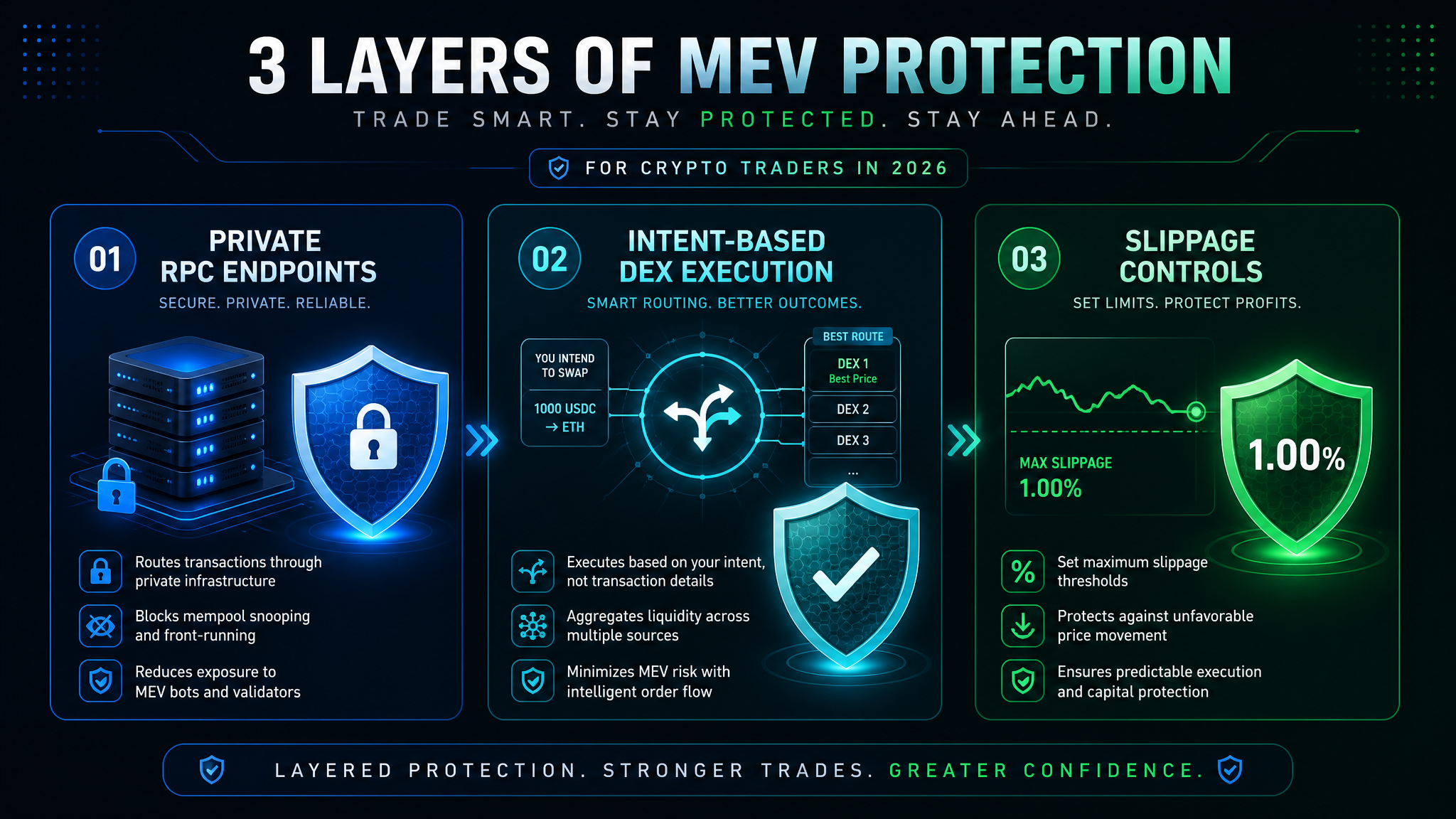
The single most impactful change you can make is switching from a public RPC endpoint to a private one. Public RPCs broadcast your transaction to the entire mempool. Private RPCs route your transaction directly to block builders, bypassing the public queue entirely — which means bots never see it before it's confirmed.
Flashbots Protect
Free, widely used, and battle-tested. Flashbots Protect routes your transactions directly to Flashbots' builder network. It prevents front-running and sandwich attacks by keeping your transaction out of the public mempool. It also offers gas fee refunds and MEV rebates in some cases. Setup is simple: add the Flashbots Protect RPC to MetaMask or your wallet of choice.
- RPC URL: https://rpc.flashbots.net
- Chain ID: 1 (Ethereum mainnet)
- Best for: Most Ethereum DeFi trades
MEV Blocker
Developed by CoW DAO and acquired by Consensys' Special Mechanisms Group in early 2026, MEV Blocker takes a different approach. Rather than simply hiding your transaction, it runs an auction among searchers. Bots can back-run your transaction (which is relatively harmless) but cannot sandwich it. Better yet, you receive up to 90% of the captured back-run value as a rebate. You're not just protected — you're getting paid a share of the MEV that would have been extracted from you.
MEV Blocker offers multiple endpoints: /fast (speed-prioritized), /noreverts (filters likely-to-revert transactions), and /fullprivacy (maximum protection). Rotate between Flashbots Protect and MEV Blocker depending on trade size; keep a public RPC as a backup for emergencies.
MEV Protection Strategy 2: Intent-Based DEXs
Private RPCs protect you at the transaction submission layer. Intent-based DEXs go further — they change the execution model entirely, making sandwich attacks structurally impossible.
CoW Swap
CoW Protocol uses batch auctions. Instead of executing your swap immediately against an AMM, it collects orders over a short window and settles them in batches at a uniform clearing price. Professional "solvers" compete off-chain to find the best execution path. Because all trades in a batch settle at the same price, there's no opportunity for a bot to sandwich individual orders. CoW Swap also routes through multiple liquidity sources, often achieving better prices than direct AMM swaps.
UniswapX
Uniswap's intent-based layer uses a Dutch auction mechanism. You sign an order expressing your intent, and off-chain fillers compete to execute it — competitive execution without mempool exposure.
1inch Fusion
Similar solver-based architecture. Resolvers compete for best execution, pay gas on your behalf, and there's no mempool exposure. Particularly effective for larger trades where AMM slippage would be significant.
Use CoW Swap or UniswapX for most DeFi swaps. Reserve direct AMM interaction (with private RPC protection) for situations where intent-based platforms don't support your token pair.
MEV Protection Strategy 3: Slippage Management
Slippage tolerance is your last line of defense — and most traders set it wrong. Here's the logic: a sandwich bot can only profit if your trade executes at a price worse than your slippage tolerance allows. Tighten the tolerance, and you reduce the bot's profit window. If the window is too small to be worth attacking, the bot moves on.
Practical slippage settings for 2026:
- Major pairs (ETH/USDC, BTC/USDT): 0.1%–0.3% — these pools have deep liquidity, tight spreads
- Mid-cap tokens: 0.5%–1.0% — balance between protection and transaction success rate
- Low-cap / new tokens: 1.0%–3.0% — higher volatility requires more tolerance, but be aware this increases MEV exposure
The trade-off: tighter slippage means more failed transactions in volatile markets. Combine tight slippage with a private RPC — the private RPC reduces revert risk while tight slippage limits MEV exposure.
MEV Protection Strategy 4: OTC for Large Trades
For five-figure and above transactions, OTC (over-the-counter) trading is the most effective MEV protection available — because there's no mempool exposure at all. OTC trades are negotiated bilaterally between counterparties and settled off-chain or through private channels. No public queue, no bots, no sandwich risk.
Major exchanges including Coinbase Prime, Kraken OTC, and Binance OTC offer institutional-grade OTC desks. For DeFi-native large trades, protocols like Hashflow and Paraswap's OTC module provide on-chain settlement with off-chain price discovery. Rule of thumb: if your swap would move a pool's price by more than 0.5%, you're a sandwich target — OTC or intent-based execution is worth the extra friction.
Solana-Specific MEV Protection
Solana's MEV landscape differs from Ethereum's. Without a traditional public mempool, validators can observe incoming transactions and reorder them within a slot. Sandwich attacks on Solana have resulted in significant losses, with some reports citing tens of thousands of SOL extracted monthly.
Solana-specific defenses:
- Jito-aware RPCs: Use RPCs that integrate with Jito's block engine. Some services allow you to flag transactions with
jitodontfrontparameters to reduce front-running risk. - MEV-aware RPCs: Services that only release your transaction when a trusted validator is the active leader, reducing the window for reordering attacks.
- Jupiter's MEV protection: Jupiter DEX (the dominant Solana aggregator) has integrated MEV protection features that route trades through protected channels. Enable this in Jupiter's settings before executing large swaps.
- Application-Controlled Execution (ACE): Allows dApps to define execution constraints, making sandwiching structurally harder at the application layer.
What NOT to Do: MEV Bot Scams
A quick but important warning: if you see Telegram channels, YouTube ads, or Twitter accounts promoting "MEV bots" that promise passive income by running your own extraction operation, treat them as scams until proven otherwise. The overwhelming majority are designed to steal your funds — either by asking you to deposit ETH into a "bot contract" that drains your wallet, or by selling fake software that exfiltrates your private keys.
Legitimate MEV operations require colocated infrastructure, Rust-based bot development, and significant capital. They are not accessible to retail participants through a Telegram link. The only "MEV bots" worth your attention are the protection tools described above.
Building Your MEV Defense Stack: A Practical Checklist
Here's the actionable framework for 2026:
- Add Flashbots Protect RPC to your wallet — takes 2 minutes, protects every Ethereum transaction you make
- Add MEV Blocker as a secondary RPC — rotate to this for larger trades to capture rebates
- Default to CoW Swap or UniswapX for DeFi swaps — intent-based execution eliminates sandwich risk structurally
- Set slippage to 0.1%–0.5% for major pairs — tighter tolerance, smaller attack surface
- Use Jupiter's MEV protection on Solana — enable it in settings before any significant swap
- Route trades above $50K through OTC — no mempool exposure, no sandwich risk
- Never interact with "MEV bot" promotions — they are scams
Key Takeaways
- MEV extraction costs Ethereum traders approximately $180 million per month — it's a real, quantifiable tax on unprotected DeFi activity
- Sandwich attacks are the most costly attack type for retail traders; front-running and JIT liquidity are also significant
- Private RPCs (Flashbots Protect, MEV Blocker) are the fastest, easiest protection to implement — add them to your wallet today
- Intent-based DEXs (CoW Swap, UniswapX, 1inch Fusion) eliminate sandwich risk at the architectural level
- Tight slippage tolerance (0.1%–0.5% for major pairs) reduces the profit window for bots
- OTC trading is the gold standard for large transactions — no mempool, no bots
- Solana has its own MEV dynamics; use Jupiter's built-in protection and Jito-aware RPCs
Ready to put these strategies into practice?
The trading concepts in this article work — but only if you have the right foundation. I learned most of what I know through structured training that connected the dots between theory and live markets.
The program I recommend to people who ask me is this crypto trading course — it\'s the one I point friends and family to when they\'re serious about learning. Daily lessons, live analysis, and a community that actually helps.
Affiliate link — I may earn a commission at no extra cost to you. I only recommend what I genuinely use.
Disclaimer: The information provided on this website is for educational and informational purposes only. It should not be considered financial or investment advice. Cryptocurrency investments carry significant risk. Always do your own research and consult with a qualified financial advisor before making investment decisions.
Free Crypto Insights
Get weekly trading tips, market analysis, and exclusive strategies delivered to your inbox.