Bitcoin Iron Condor Strategy: How to Earn Consistent Options Income in 2026
Affiliate Disclosure: This article may contain affiliate links. We may earn a commission at no extra cost to you. All opinions are our own.
Marcus Chen
Senior Crypto Analyst & Educator
Certified Blockchain Professional | Former Wall Street Analyst
Marcus Chen is a cryptocurrency analyst and educator with over 8 years of experience in digital asset trading. He has helped thousands of beginners navigate the crypto markets through practical, actionable education.

Disclaimer: This content is for informational purposes only and should not be considered financial advice. Cryptocurrency investments carry significant risk. Always do your own research (DYOR) before making any investment decisions.
This article contains affiliate links. We may earn a commission at no extra cost to you if you make a purchase through these links. See our affiliate disclosure for details.
Bitcoin Iron Condor Strategy: How to Earn Consistent Options Income in 2026
The Bitcoin iron condor strategy is one of the most underused income tools in a crypto trader's arsenal. While most retail traders are busy chasing breakouts or trying to predict Bitcoin's next big move, a growing number of sophisticated investors are quietly collecting premium every week — regardless of which direction BTC goes. That's the core appeal of the iron condor: you don't need to be right about direction. You just need Bitcoin to stay within a range.
In 2026, with Bitcoin trading in the $80,000–$95,000 corridor and implied volatility remaining elevated after the February correction, the conditions for running iron condors have actually improved. Options premiums are rich. Weekly expirations on Deribit and OKX give you frequent opportunities to reset positions. And the strategy's defined-risk structure means you always know your maximum loss before you enter.
This guide walks you through exactly how to set up, manage, and exit a Bitcoin iron condor — with a real 2026 trade example and the risk management rules that separate profitable traders from those who blow up on the wings.
What Is an Iron Condor? The Core Mechanics
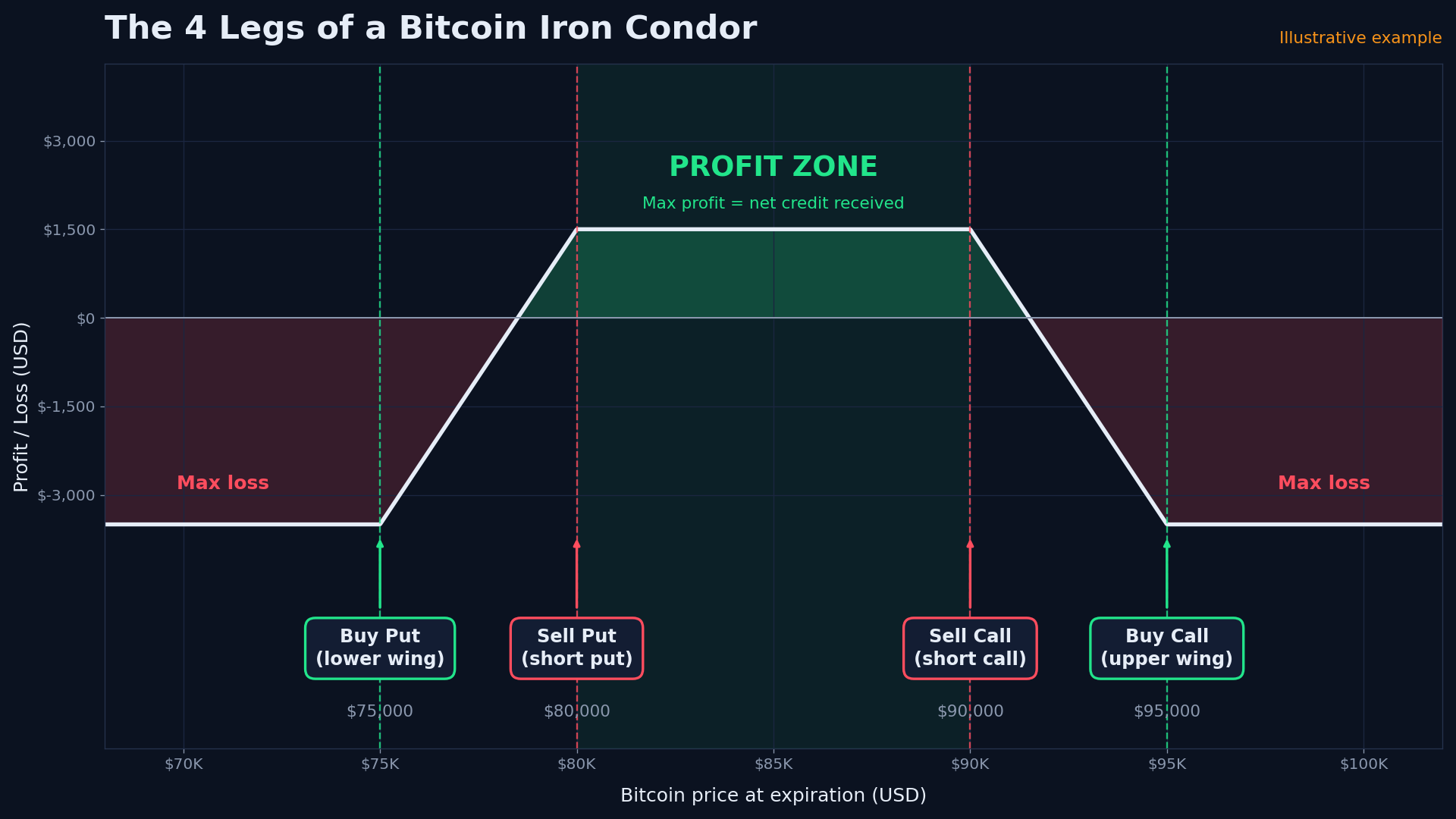
An iron condor is a four-legged options strategy that profits when the underlying asset — in this case, Bitcoin — stays within a defined price range through expiration. You're simultaneously selling a bear call spread above the current price and a bull put spread below it. The net result is a credit in your account upfront, and you keep that credit if BTC doesn't breach either of your short strikes.
Here's the structure broken down:
- Sell an OTM call (upper short strike) — collects premium
- Buy a further OTM call (upper long strike) — caps your upside risk
- Sell an OTM put (lower short strike) — collects premium
- Buy a further OTM put (lower long strike) — caps your downside risk
All four legs share the same expiration date. The net credit you receive at entry is your maximum profit. Your maximum loss is the width of one spread minus the credit received — and it's capped, which is what makes this a defined-risk trade.
The profit zone sits between your two short strikes. As long as Bitcoin closes inside that range at expiration, every option expires worthless and you pocket the full premium. Simple in theory. The execution and management is where it gets interesting.
Why Bitcoin Is Actually Good for Iron Condors
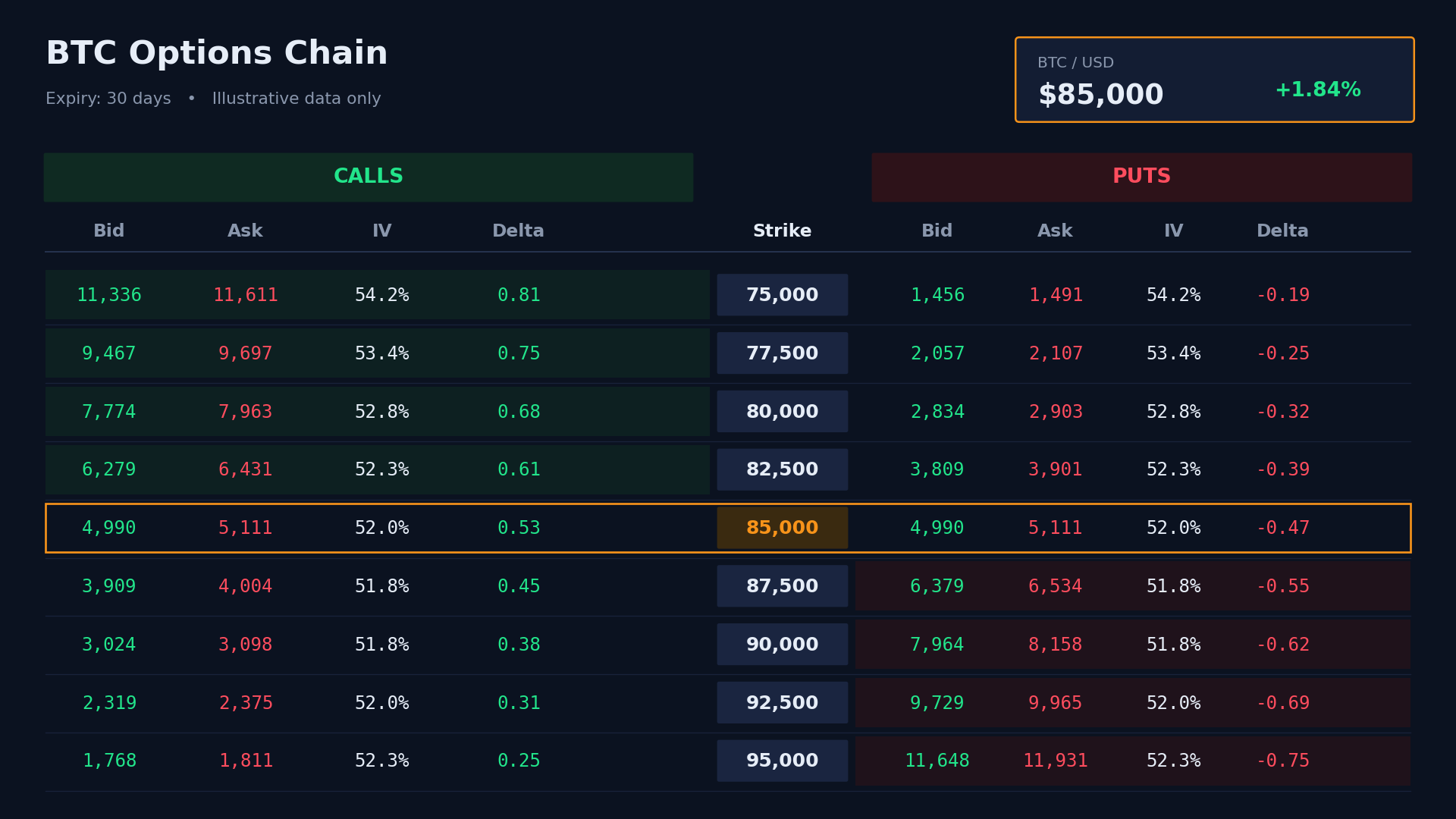
Here's a counterintuitive truth: Bitcoin's high implied volatility makes iron condors more attractive, not less. When IV is elevated, options premiums are fat. That means you can sell strikes further out of the money — giving yourself a wider profit zone — while still collecting a meaningful credit.
In February 2026, Bitcoin's 25-delta implied volatility hit 75% for calls and 95% for puts — levels not seen since 2022. By October 2026, IV has moderated but remains historically elevated compared to traditional assets. That's a favorable environment for premium sellers.
There's also a structural edge: Bitcoin tends to consolidate after major moves. After the $81K short squeeze in August and the subsequent range-bound action through September and October, BTC has been grinding sideways — exactly the environment where iron condors thrive. You're not fighting the market; you're getting paid to wait.
One more factor: the volatility skew. In crypto, put options are typically more expensive than calls. A skilled iron condor trader can exploit this by placing the put spread slightly closer to the money, collecting more premium on the downside while keeping the call spread further out.
How to Set Up a Bitcoin Iron Condor Step by Step
Let's walk through the setup process using current market conditions as a reference point.
Step 1: Choose your expiration. Weekly expirations (7 days) give faster theta decay but require more active management. For most traders, the 14–21 day expiration window is the sweet spot — enough time decay to work in your favor without excessive macro exposure.
Step 2: Select your short strikes. Sell strikes at the 20–25 delta level. At 20 delta, each short strike has roughly an 80% probability of expiring out of the money. In an $87,000 BTC environment with elevated IV, that might put your short call around $95,000 and your short put around $79,000 — a $16,000 profit zone.
Step 3: Buy your long strikes for protection. Place long strikes $3,000–$5,000 further out from your short strikes. If you sold the $95K call, buy the $98K call. If you sold the $79K put, buy the $76K put. This caps your maximum loss precisely.
Step 4: Check your credit-to-width ratio. A healthy iron condor collects at least 25–33% of the spread width as a net credit. On a $3,000-wide spread, collect at least $750–$1,000 in premium. If the credit is too thin, the risk/reward doesn't justify the trade.
Step 5: Size your position appropriately. Never risk more than 2–3% of your account on a single iron condor. Most experienced traders run multiple smaller condors across different expirations rather than one large position.
Managing Your Iron Condor: Adjustments and Exits
Entry is the easy part. Management is where most traders either make or lose money on iron condors.
The 50% profit rule: Close the position when you've captured 50–70% of the maximum profit. If you collected $1,000 in premium, close the trade when it's worth $300–$500 to buy back. This frees up capital and improves your overall win rate. Don't get greedy chasing the last $200.
Rolling a threatened wing: If Bitcoin moves aggressively toward one of your short strikes, roll the threatened spread to a later expiration (collecting additional credit) or further out of the money. Act early — when the short strike is tested, not after it's breached.
The 200% loss rule: If it would cost 200% of the original credit to close the position, close it. Take the defined loss and move on. Holding through a breach hoping for a reversal is how small losses become catastrophic ones.
Gamma risk near expiration: In the final 3–5 days before expiration, gamma accelerates dramatically. A $2,000 move in Bitcoin can swing your position from profitable to maximum loss in hours. Many experienced traders close iron condors 5 days before expiration regardless of profit level.
Real Example: A Bitcoin Iron Condor Trade in 2026
Here's a concrete example using realistic October 2026 market conditions.
Setup (October 20, 2026):
- BTC spot price: $87,200
- Expiration: November 7, 2026 (18 days out)
- Sell $95,000 call / Buy $98,000 call → collect $420 credit
- Sell $79,000 put / Buy $76,000 put → collect $580 credit
- Total net credit: $1,000
- Maximum loss per spread: $3,000 − $1,000 = $2,000
- Profit zone: $79,000 to $95,000 (a $16,000 range)
- Break-even points: $78,000 (lower) and $96,000 (upper)
Notice the skew: the put spread collected more premium ($580 vs. $420) because put implied volatility is higher. This is typical in crypto markets where downside fear is priced in.
Scenario A (BTC stays in range): Bitcoin closes at $88,500 on November 7. All four options expire worthless. You keep the full $1,000 credit — a 50% return on risk in 18 days.
Scenario B (early exit at 50% profit): By October 30, BTC is at $86,000 and the position has decayed to a $500 debit to close. You lock in $500 profit in 10 days and free up capital for the next trade.
Scenario C (BTC spikes to $97,000): The call spread is breached. You close the entire position for a $1,500 loss. Painful, but defined. You didn't blow up your account.
Ready to master crypto options trading? Icoinpro's comprehensive trading course covers options strategies, risk management, and systematic trading frameworks used by professional traders.
Risk Management: What Can Go Wrong
Iron condors are not a "set and forget" strategy. Several things can go wrong, and knowing them in advance is half the battle.
Volatility spikes: A sudden surge in implied volatility — triggered by a regulatory announcement, a major hack, or a macro shock — can cause your options to reprice dramatically even if Bitcoin's spot price hasn't moved much. This is vega risk. Some traders prefer to run iron condors after a volatility spike (when IV is high and likely to mean-revert) rather than into one.
Gap risk: Crypto trades 24/7. A weekend flash crash or a Sunday night liquidation cascade can gap Bitcoin through your short strike before you can react. This is why position sizing matters so much — your maximum loss is defined, but it can happen fast.
Correlation risk: If you're running iron condors on BTC while also holding spot Bitcoin, a sharp move against your condor will likely also hurt your other holdings. Your total portfolio risk is higher than the condor's defined risk in isolation.
Liquidity risk: Bitcoin options on Deribit and OKX have reasonable liquidity for major strikes, but bid-ask spreads on further OTM options can be wide. Always use limit orders and check the mid-price before entering.
Protect your trading capital with a Ledger hardware wallet — keeping your crypto in cold storage while you trade options on exchange is a smart security practice that separates your long-term holdings from your active trading capital.
Tools and Platforms for Bitcoin Options Trading
Not every exchange offers the options infrastructure you need for iron condors. Here's what's worth knowing in 2026:
Deribit: Still the dominant venue for Bitcoin and Ethereum options by open interest. Deep liquidity on major strikes, weekly and monthly expirations, and a clean options chain interface. The go-to platform for serious options traders.
OKX: Strong options liquidity, particularly for shorter-dated contracts. The portfolio margin system allows experienced traders to run more capital-efficient positions.
CME Group: For US-based traders who prefer regulated venues, CME Bitcoin options offer weekly expirations and cash settlement. Liquidity has improved significantly since the ETF approval wave in 2024–2025.
Analytics tools: Laevitas and Amberdata provide options flow data, IV surface visualization, and Greeks tracking. Glassnode's options dashboard shows open interest concentration by strike — useful for identifying where the market is positioned.
Want to understand Bitcoin's long-term value proposition? The Bitcoin Standard is essential reading for any serious crypto investor running income strategies on top of their BTC holdings.
Key Takeaways
- The Bitcoin iron condor strategy earns income when BTC stays within a defined price range — no directional prediction required.
- High implied volatility in 2026 means richer premiums and wider profit zones — favorable for premium sellers.
- Use the 20–25 delta level for short strikes, collect at least 25–33% of spread width as credit, and size positions at 2–3% of account risk maximum.
- Close at 50–70% of maximum profit; use 200% of credit received as a hard stop-loss rule.
- Close positions 5 days before expiration to avoid gamma risk; always use limit orders.
- Deribit and OKX are the primary venues; CME is the regulated alternative for US traders.
- Iron condors work best as part of a broader portfolio strategy — combine with spot holdings for a balanced approach.
The iron condor isn't a magic income machine. It requires discipline, active management, and a clear understanding of your risk parameters. For traders who've mastered the basics and want a systematic way to generate returns in sideways markets, it's one of the most powerful tools in 2026's crypto options landscape.
Ready to put these strategies into practice?
The trading concepts in this article work — but only if you have the right foundation. I learned most of what I know through structured training that connected the dots between theory and live markets.
The program I recommend to people who ask me is this crypto trading course — it\'s the one I point friends and family to when they\'re serious about learning. Daily lessons, live analysis, and a community that actually helps.
Affiliate link — I may earn a commission at no extra cost to you. I only recommend what I genuinely use.
Disclaimer: The information provided on this website is for educational and informational purposes only. It should not be considered financial or investment advice. Cryptocurrency investments carry significant risk. Always do your own research and consult with a qualified financial advisor before making investment decisions.
Free Crypto Insights
Get weekly trading tips, market analysis, and exclusive strategies delivered to your inbox.