Crypto Statistical Arbitrage: How to Trade Correlated Pairs for Market-Neutral Returns in 2026
Affiliate Disclosure: This article may contain affiliate links. We may earn a commission at no extra cost to you. All opinions are our own.
Marcus Chen
Senior Crypto Analyst & Educator
Certified Blockchain Professional | Former Wall Street Analyst
Marcus Chen is a cryptocurrency analyst and educator with over 8 years of experience in digital asset trading. He has helped thousands of beginners navigate the crypto markets through practical, actionable education.
Crypto Statistical Arbitrage: How to Trade Correlated Pairs for Market-Neutral Returns in 2026
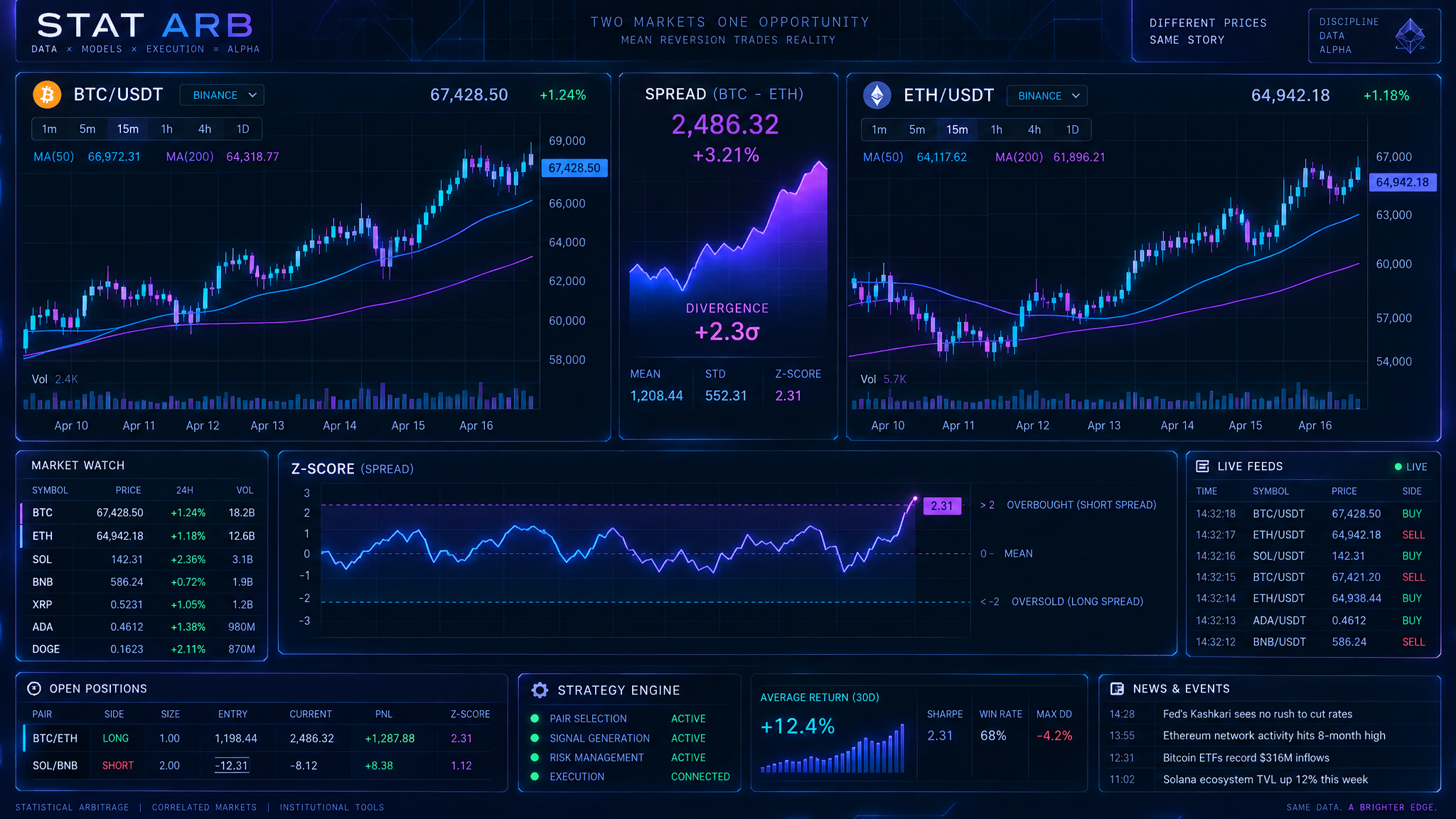
Crypto statistical arbitrage — stat arb, for short — is one of the few advanced strategies that doesn't require you to predict whether Bitcoin goes up or down. Instead, you trade the relationship between two correlated assets. When that relationship stretches too far, you bet on it snapping back. It sounds simple. The execution is anything but. Done right, though, stat arb can generate consistent, market-neutral returns whether the broader market is ripping or crashing.
In 2026, with institutional players flooding crypto markets and spreads compressing across major exchanges, the edge in statistical arbitrage has shifted. Naive correlation models no longer cut it. What works now is cointegration-based pairs trading, sector basket strategies, and disciplined Z-score execution — the same toolkit that quant funds on Wall Street have used for decades, now adapted for 24/7 crypto markets.
This guide breaks down exactly how stat arb works in crypto, which pairs and baskets are worth trading, how to size positions, and where the real risks hide.
What Is Statistical Arbitrage in Crypto?
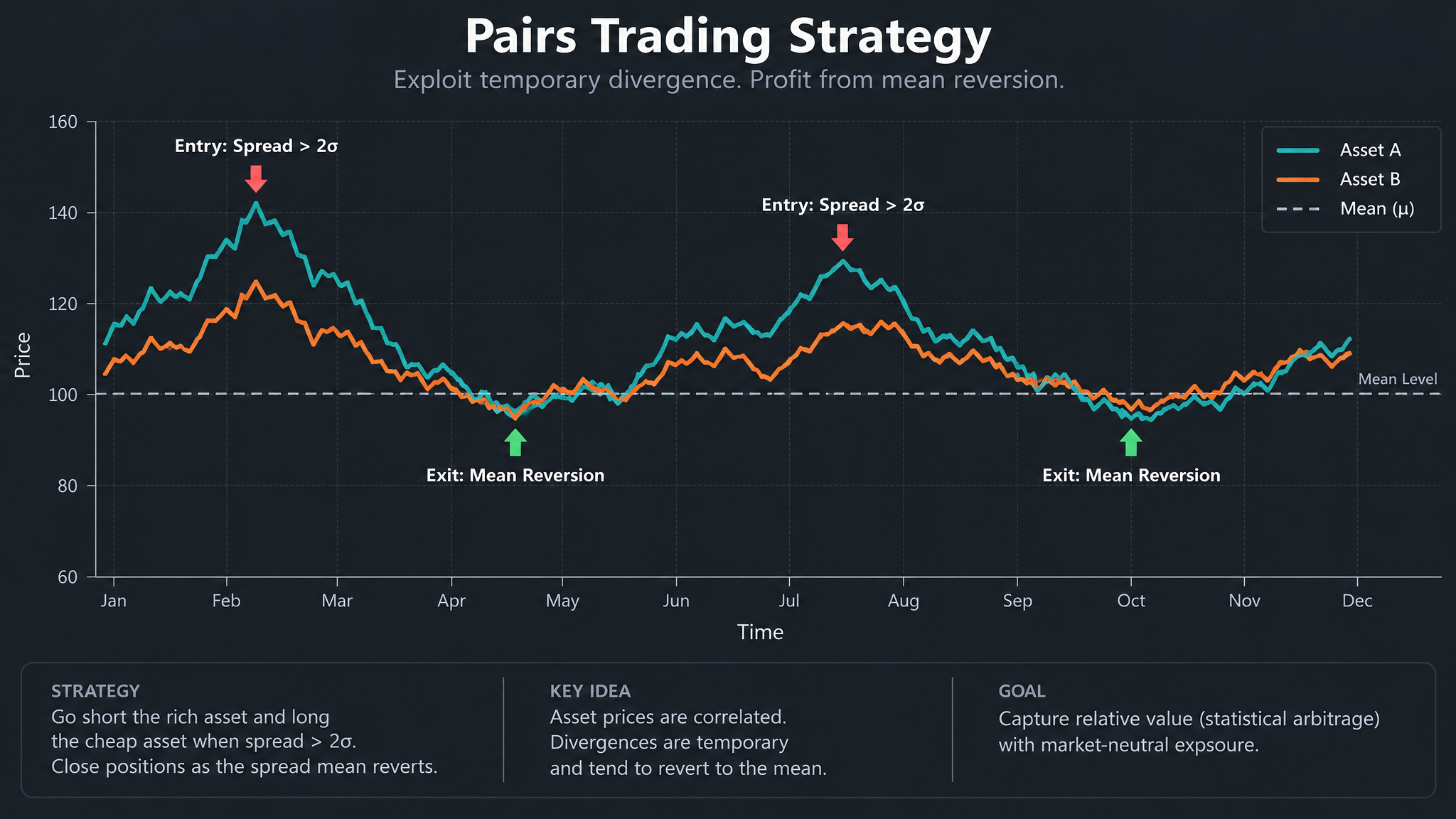
Statistical arbitrage exploits temporary price dislocations between assets that share a long-term economic relationship. The core idea: if ETH and SOL tend to move together over time, and suddenly ETH surges while SOL lags, that gap is likely to close. You short the outperformer, go long the underperformer, and wait for mean reversion.
The key word is cointegration — not just correlation. Two assets can be highly correlated (both go up in bull markets) without being cointegrated (their spread doesn't mean-revert). Cointegration means there's a stable long-run equilibrium between the two price series. When the spread deviates, it tends to return. That's your edge.
Practitioners use the Engle-Granger or Johansen cointegration tests to validate pairs before trading them. A Z-score normalizes the spread: when it hits +2.0 standard deviations, you short the spread; when it hits -2.0, you go long. You exit when the Z-score returns to zero.
Why Stat Arb Works in Crypto (and Why It's Getting Harder)
Crypto markets have some structural features that make stat arb attractive. First, they run 24/7 — no overnight gaps, no market-open volatility spikes that reset your positions. Second, perpetual futures let you short any asset without borrowing, and funding rates add an extra return component when you're on the right side. Third, crypto assets within the same sector (L1s, DeFi protocols, Layer 2s) share genuine economic linkages — they compete for the same users, liquidity, and developer attention.
That said, the strategy has gotten harder since 2020-2021. Back then, retail-driven markets created wide, persistent mispricings. Today, institutional market makers and algorithmic funds have compressed spreads significantly. The pairs that worked in 2021 often don't work now. Regime shifts — a regulatory shock, a protocol hack, a major token unlock — can permanently decouple historically correlated assets overnight.
The traders succeeding in 2026 are those who combine rigorous statistical validation with fast execution and strict risk controls. This isn't a set-it-and-forget-it strategy.
The Best Crypto Pairs for Statistical Arbitrage in 2026
Not every correlated pair is worth trading. Here are the categories that have shown the most consistent cointegration in 2026:
ETH/BTC — The Classic Pair
The ETH/BTC ratio is the most liquid and most-studied pair in crypto. Both assets are deeply liquid, have active futures markets on every major exchange, and share macro drivers (risk-on/risk-off sentiment, institutional flows). The spread tends to mean-revert on 3-14 day horizons. The catch: this pair is heavily traded by institutions, so the edge is thin. You need tight execution and low fees to make it work.
L1 vs. L2 Baskets
One of the more interesting developments in 2026 is basket-level stat arb. Instead of trading two individual assets, you trade a basket of L1 tokens (ETH, SOL, AVAX) against a basket of L2 tokens (ARB, OP, MATIC). The thesis: L1s and L2s compete for the same blockspace demand, so their relative valuations should mean-revert over time.
Basket strategies reduce idiosyncratic risk — if one token in the basket gets hit by bad news, the others cushion the blow. The tradeoff is execution complexity: you're managing 6+ positions simultaneously, each with its own funding rate and liquidity profile.
DeFi Protocol Pairs
Within the DeFi sector, governance tokens like UNI, AAVE, and CRV share similar revenue models and user bases. When one protocol's token outperforms on no fundamental news, it often reverts. These pairs tend to have wider spreads than ETH/BTC, which means more potential profit per trade — but also more idiosyncratic risk from protocol-specific events (governance votes, exploits, fee changes).
CEX Token Pairs
Exchange tokens — BNB, OKB, CRO — are another viable category. They're all driven by exchange volume, fee revenue, and buyback programs. When one exchange token diverges from the others without a clear fundamental reason, the spread often closes within days.
How to Execute a Stat Arb Trade: Step by Step
Here's a practical walkthrough of how a stat arb trade actually works, using ETH/SOL as an example.
Step 1: Validate the Pair
Run a cointegration test on 90-180 days of daily price data. If the p-value from the Engle-Granger test is below 0.05, the pair is cointegrated. Revalidate monthly — cointegration can break down as market structure changes.
Step 2: Calculate the Spread and Z-Score
The spread is typically calculated as: Spread = log(Price_A) - β × log(Price_B), where β is the hedge ratio from the cointegration regression. Normalize the spread into a Z-score using a rolling 30-day mean and standard deviation.
Step 3: Set Entry and Exit Thresholds
Standard thresholds: enter when Z-score hits ±2.0, exit when it returns to 0. Some traders use ±1.5 for entry to catch more trades, accepting lower per-trade profit. Stop-loss at ±3.0 — if the spread keeps widening, something fundamental may have changed.
Step 4: Execute via Perpetual Futures
Use perpetual futures on both legs. This lets you short without borrowing and gives you leverage control. Keep leverage low — 2-3x maximum. Higher leverage amplifies both the return and the risk of a correlation breakdown blowing up your position.
Step 5: Monitor Funding Rates
Funding rates can work for or against you. If you're short the outperformer and funding is positive (longs pay shorts), you collect funding while waiting for mean reversion. If funding is negative, it eats into your return. Factor this into your expected P&L before entering.
Crypto Basket Strategies: Scaling Stat Arb
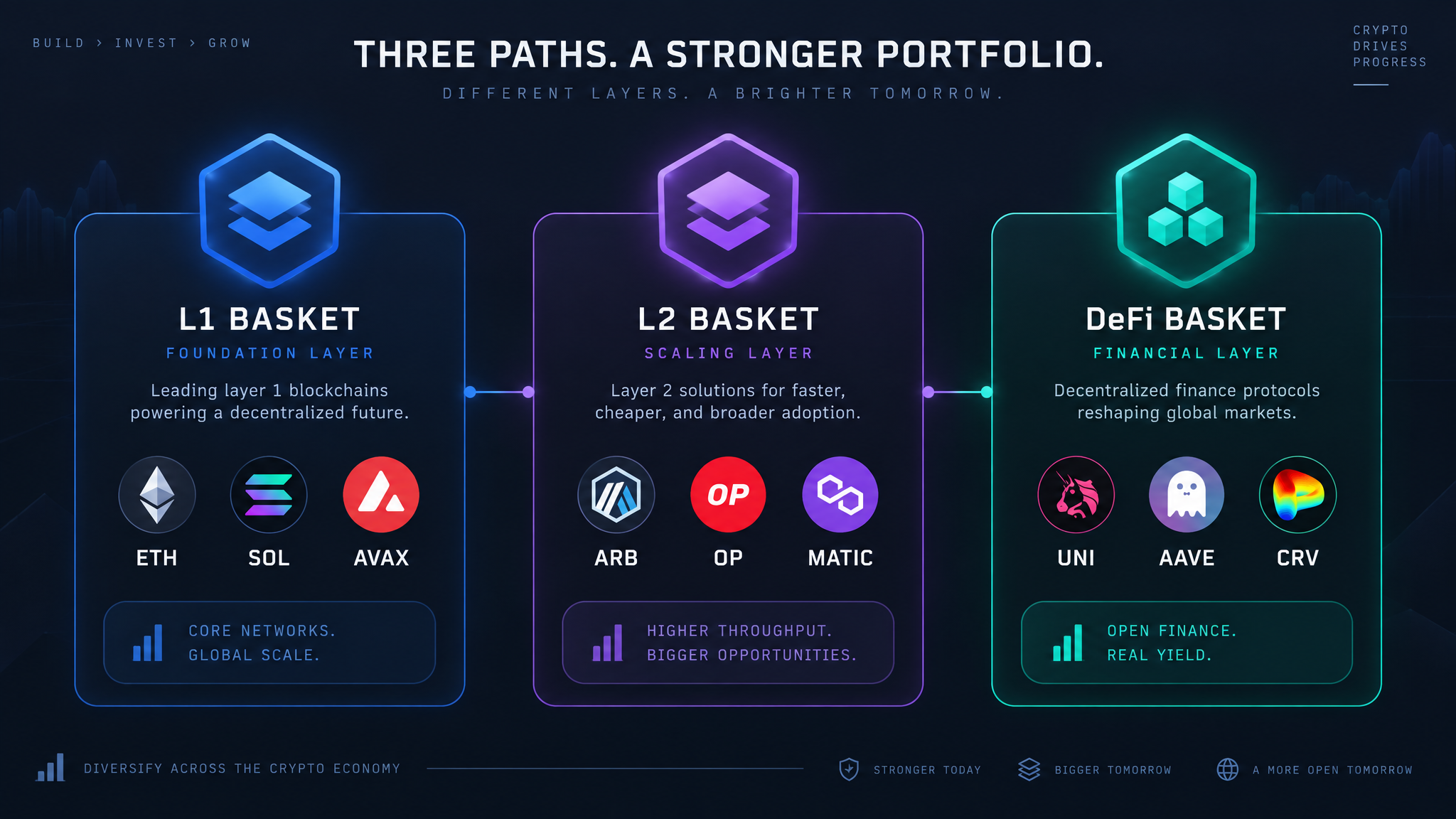
Individual pairs are fine for getting started. But institutional stat arb funds diversify across 50-200 pairs to smooth out variance. For retail traders, a practical middle ground is sector basket trading.
The mechanics: equal-weight (or volatility-weight) a basket of 3-5 assets in one sector, and trade it against a basket in a correlated sector. Rebalance the baskets weekly to maintain target weights. This forces a systematic "buy low, sell high" dynamic within each basket as assets drift from their target weights.
The key advantage over single-pair trading: one bad token in a basket doesn't blow up the whole trade. If AVAX gets hit by a protocol issue, ETH and SOL in the same basket cushion the impact. Your exposure is to the sector, not the individual asset.
Want to accelerate your trading journey? Explore Icoinpro's daily trading signals and education platform — they cover systematic strategies including pairs trading and sector rotation in their advanced modules.
Risk Management: Where Stat Arb Goes Wrong
Stat arb looks low-risk on paper — you're market-neutral, right? In practice, several things can go badly wrong.
Correlation Breakdown
The biggest risk. A regulatory action, a major hack, or a token unlock can permanently decouple two historically correlated assets. Your "temporary" spread divergence becomes a permanent loss. This is why stop-losses at ±3.0 Z-score are non-negotiable. If the spread keeps widening past your stop, exit and reassess — don't average into a broken trade.
Execution Costs
Stat arb margins are thin. On a typical ETH/BTC trade, you might be targeting 1-3% profit. If you're paying 0.05% per leg on entry and exit, that's 0.2% in fees alone — plus slippage, plus funding rate drag. Use limit orders where possible. Trade on exchanges with maker rebates. Keep position sizes large enough that fees don't eat your entire edge.
Leverage Risk
Even with low leverage, a correlation breakdown can move against you fast. A 3x leveraged position in a pair that diverges 10% before mean-reverting means a 30% drawdown on that position. Size positions so that a full stop-loss hit costs no more than 1-2% of your total portfolio.
Liquidity Risk
Smaller tokens in DeFi or CEX baskets can have thin order books. In a fast-moving market, your exit order might move the price against you. Stick to assets with at least $50M in daily futures volume on your chosen exchange.
Protect your trading capital with a Ledger hardware wallet — the gold standard in cold storage security. Keep your long-term holdings offline while you trade with a separate hot wallet allocation.
Tools and Infrastructure for Crypto Stat Arb
You don't need a Bloomberg terminal to run stat arb, but you do need the right tools.
Data: Coinglass for funding rates and open interest. Glassnode or Nansen for on-chain flows. TradingView for charting and spread visualization. For cointegration testing, Python with statsmodels is the standard — the Engle-Granger test is three lines of code.
Execution: Bybit, OKX, and Binance all offer low-fee perpetual futures with good liquidity on major pairs. For basket strategies, you'll need to manage multiple positions simultaneously — a simple spreadsheet tracker or a basic Python script connected to exchange APIs works fine at the retail level.
Backtesting: Always backtest on out-of-sample data. A strategy that looks great on 2022-2024 data may have already been arbitraged away. Use at least 6 months of out-of-sample data to validate before going live.
For a structured approach to learning systematic crypto trading, Icoinpro offers step-by-step training that covers quantitative methods, risk management, and live market application.
Is Stat Arb Right for You?
Statistical arbitrage isn't for everyone. It requires comfort with quantitative concepts (Z-scores, cointegration, hedge ratios), discipline to follow rules mechanically rather than emotionally, and enough capital to absorb drawdowns without panic-selling. It's also genuinely time-intensive to set up properly — validating pairs, building execution workflows, monitoring positions.
That said, for traders who've mastered the basics and want a strategy that doesn't depend on predicting market direction, stat arb is one of the most intellectually rigorous and potentially rewarding approaches in crypto. The market-neutral structure means you can generate returns in sideways or bear markets — a significant edge over pure directional trading.
Key Takeaways
- Stat arb trades relationships, not direction — you profit from spread mean reversion between correlated assets, regardless of overall market trend.
- Cointegration, not correlation — validate pairs with statistical tests before trading; correlation alone isn't enough.
- Z-score thresholds — enter at ±2.0, exit at 0, stop-loss at ±3.0. Stick to these mechanically.
- Basket strategies reduce idiosyncratic risk — L1 vs. L2 baskets and DeFi protocol baskets offer more diversified exposure than single pairs.
- Execution costs matter — thin margins mean fees, slippage, and funding rates can make or break profitability.
- Correlation breakdown is the main risk — always use stop-losses and revalidate pairs monthly.
Ready to put these strategies into practice?
The trading concepts in this article work — but only if you have the right foundation. I learned most of what I know through structured training that connected the dots between theory and live markets.
The program I recommend to people who ask me is this crypto trading course — it\'s the one I point friends and family to when they\'re serious about learning. Daily lessons, live analysis, and a community that actually helps.
Affiliate link — I may earn a commission at no extra cost to you. I only recommend what I genuinely use.
Disclaimer: The information provided on this website is for educational and informational purposes only. It should not be considered financial or investment advice. Cryptocurrency investments carry significant risk. Always do your own research and consult with a qualified financial advisor before making investment decisions.
Free Crypto Insights
Get weekly trading tips, market analysis, and exclusive strategies delivered to your inbox.