BTCFi Yield Strategies: How to Earn on Your Bitcoin in 2026
Affiliate Disclosure: This article may contain affiliate links. We may earn a commission at no extra cost to you. All opinions are our own.
Marcus Chen
Senior Crypto Analyst & Educator
Certified Blockchain Professional | Former Wall Street Analyst
Marcus Chen is a cryptocurrency analyst and educator with over 8 years of experience in digital asset trading. He has helped thousands of beginners navigate the crypto markets through practical, actionable education.

BTCFi Yield Strategies: How to Earn on Your Bitcoin in 2026
For years, holding Bitcoin meant one thing: sit tight and wait. But BTCFi yield strategies have changed that calculus entirely. In 2026, Bitcoin is no longer just a store of value — it's a productive asset generating 4–12% APY through non-custodial staking, liquidity pools, and automated yield vaults. If you're still letting your BTC collect dust in a cold wallet, you're leaving real money on the table.
This guide breaks down four advanced BTCFi strategies, the protocols powering them, realistic return expectations, and the risks you need to understand before committing capital. No hype, no hand-waving — just the mechanics.
What Is BTCFi and Why It Matters Now
BTCFi — short for Bitcoin Decentralized Finance — refers to the ecosystem of protocols that allow Bitcoin holders to deploy their BTC into yield-generating activities without selling or surrendering custody. Think of it as DeFi, but built around Bitcoin's liquidity rather than Ethereum's.
The shift happened gradually. Bitcoin Layer-2 networks like Stacks, Babylon, and Core matured enough to support complex smart contract logic. Liquid staking tokens (LSTs) emerged to represent staked BTC on-chain. By Q1 2026, over $14 billion in BTC was deployed across BTCFi protocols — up from roughly $2 billion at the start of 2025. That's not a niche experiment. That's a structural shift.
Three forces are driving this:
- Institutional demand for yield: ETF holders want more than price appreciation. Treasury companies holding BTC are exploring yield strategies to offset custody costs.
- Layer-2 maturity: Networks like Babylon and Stacks now offer the throughput and security guarantees needed for serious capital deployment.
- LST composability: Liquid staking tokens let you stake BTC and still use the receipt token as collateral elsewhere — stacking yield sources.
Now let's get into the actual strategies.
Strategy 1: Non-Custodial Bitcoin Staking via Babylon Protocol
Babylon is the most talked-about BTCFi protocol in 2026, and for good reason. It lets you lock BTC directly on the Bitcoin network — no bridging, no wrapping — to help secure Proof-of-Stake chains. You retain custody of your keys throughout.
Here's how it works in practice. You lock BTC into a Babylon staking contract using a Bitcoin-native script. That locked BTC acts as economic security for a PoS chain (called a "Consumer Chain"). If the validators on that chain misbehave, your BTC can be slashed — but only under specific, verifiable conditions. In return, you earn staking rewards denominated in the Consumer Chain's native token.
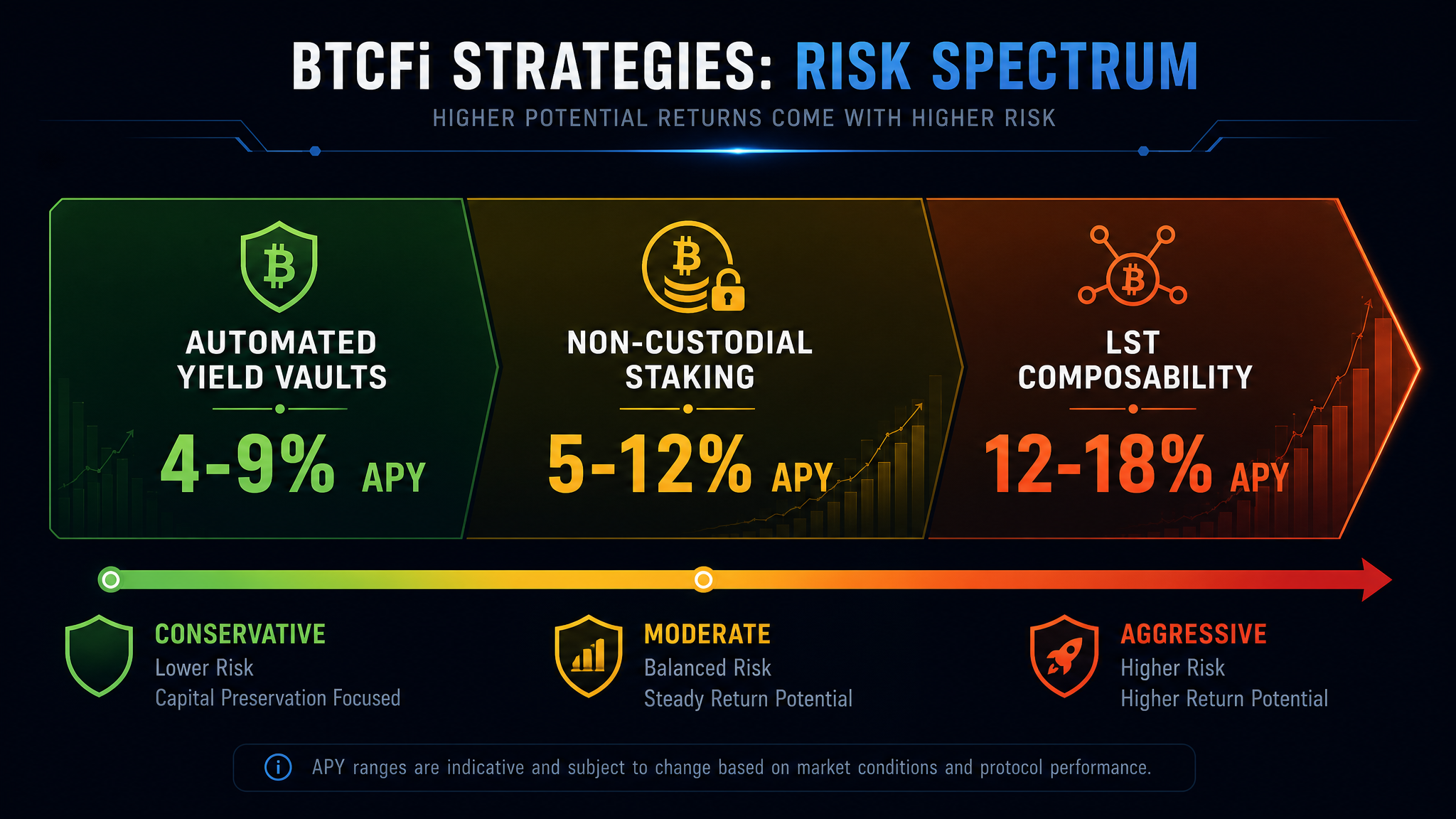
Realistic returns: Early Babylon stakers in 2025 saw annualized yields of 5–8% in token rewards. By mid-2026, as more chains compete for BTC security, some pools are offering 8–12% APY — though these higher rates come with more slashing exposure.
What you need: A compatible Bitcoin wallet (Unisat or Xverse), a minimum stake (typically 0.01 BTC), and patience — lock-up periods range from 7 to 30 days depending on the Consumer Chain.
Key risk: Slashing. If the validator set you're backing acts maliciously, a portion of your BTC can be destroyed. Babylon's slashing conditions are narrow and cryptographically verifiable, but the risk is real. Stick to established Consumer Chains with long track records.
Ready to master crypto trading? Check out Icoinpro's comprehensive trading course.
Strategy 2: Liquidity Provision on Bitcoin-Native DEXs
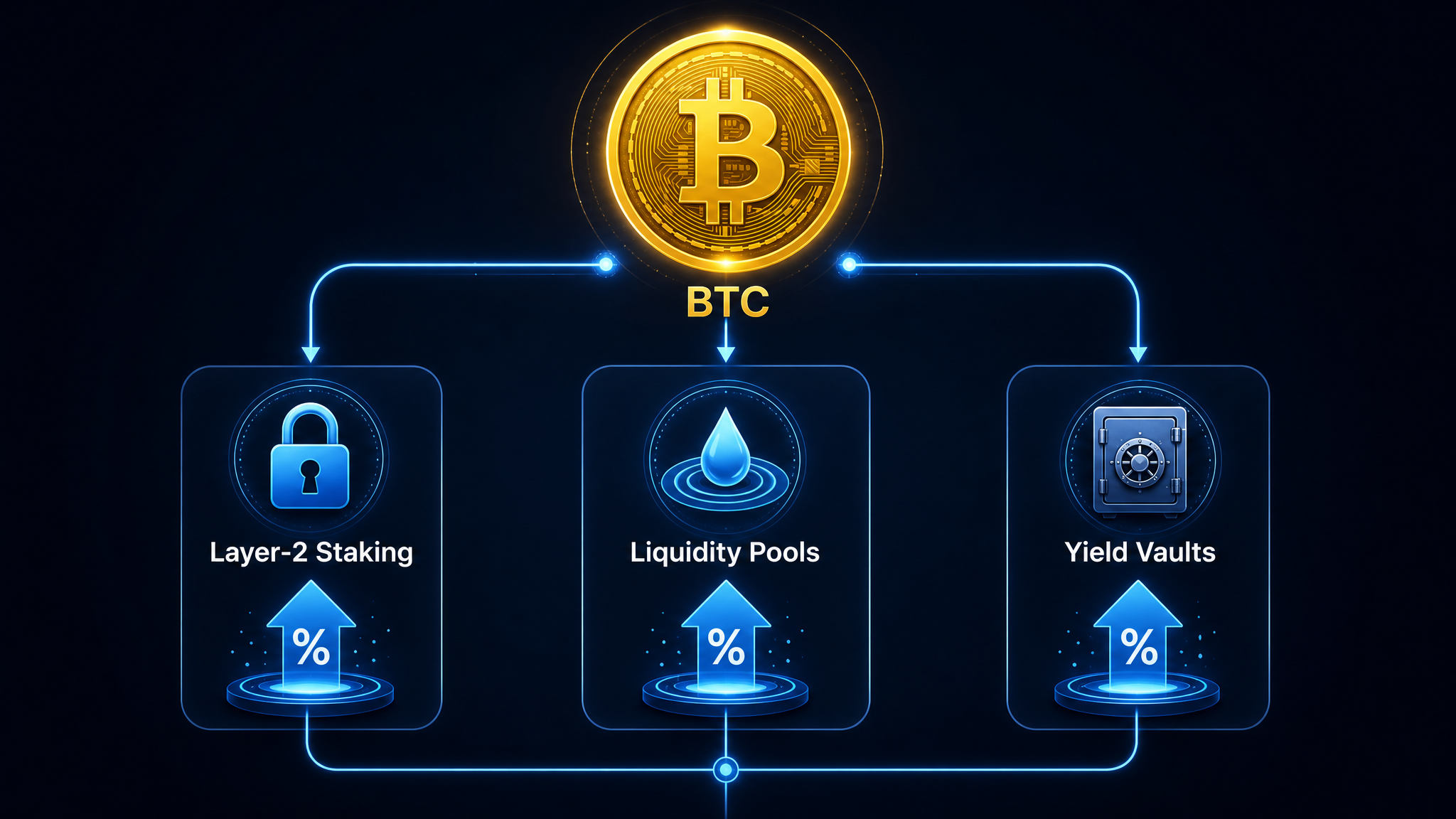
Providing liquidity on decentralized exchanges is one of the oldest DeFi strategies — but doing it with BTC on Bitcoin-native infrastructure is a 2026 development. Protocols like Hermetica, Alex Lab (on Stacks), and Sui's BTCFi integrations now let you deposit BTC (or wrapped BTC equivalents) into AMM pools and earn trading fees.
The mechanics mirror Uniswap's concentrated liquidity model. You deposit BTC paired with a stablecoin or another asset into a pool. Every time a trader swaps through that pool, you earn a percentage of the fee. The tighter your price range, the more fees you capture — but the more frequently you'll need to rebalance as prices move.
Realistic returns: BTC/USDC pools on active L2 DEXs are generating 6–15% APY in trading fees, depending on volume and your range width. Stablecoin-paired pools with tight ranges (±2%) tend to be more consistent but require active management.
The impermanent loss problem: If BTC's price moves significantly outside your range, you stop earning fees and your position drifts toward the underperforming asset. A 30% BTC price move can wipe out months of fee income. Mitigate this by using wider ranges (±15–20%), laddering positions across multiple ranges, or pairing BTC with yield-bearing stablecoins like USDe to add a native yield floor.
For most advanced traders, BTC/stablecoin LP positions work best as a complement to a core BTC holding — not a replacement.
Protect your crypto assets with a Ledger hardware wallet — the gold standard in cold storage security.
Strategy 3: Automated Yield Vaults — Set, Forget, Compound
Not everyone wants to actively manage liquidity ranges or monitor staking dashboards. Automated yield vaults solve this. Protocols like Hermetica's USDh vaults, Stacks-based yield aggregators, and cross-chain vault managers accept BTC deposits and algorithmically rotate capital across the highest-yielding BTCFi opportunities.
The vault handles everything: rebalancing LP positions, compounding rewards, switching between staking and lending based on rate differentials. You deposit BTC, receive a vault receipt token, and watch your balance grow.
Realistic returns: Automated vaults typically yield 4–9% APY — lower than manually optimized positions, but with dramatically less time investment. The best vaults in 2026 are also incorporating off-chain derivatives hedging to reduce impermanent loss, which improves risk-adjusted returns significantly.
What to look for in a vault: Multiple independent audits (Trail of Bits, Certik, Halborn), verifiable Proof of Reserves, clear withdrawal conditions (some have lock-up periods), and reasonable fees — 1–2% management annually is fair; performance fees above 20% of profits start eating into returns.
Automated vaults are the most accessible BTCFi entry point. Start here if you're new to the ecosystem.
Strategy 4: Liquid Staking Tokens (LSTs) for Capital Efficiency
Liquid staking tokens are where BTCFi gets genuinely sophisticated. When you stake BTC through a protocol like Babylon or Stacks, you receive an LST — a tokenized receipt representing your staked position. Tokens like LBTC (Lombard Finance), tBTC (Threshold Network), and sBTC (Stacks) are the most liquid examples in 2026.
The power of LSTs is composability. Your staked BTC earns staking rewards. But the LST itself can be deployed elsewhere simultaneously — as collateral in a lending protocol, in a liquidity pool, or as margin for derivatives. You're stacking yield sources on the same underlying capital.
A concrete example: Deposit 1 BTC into Babylon → receive 1 LBTC → deposit LBTC into an Aave-compatible lending market as collateral → borrow stablecoins against it → deploy stablecoins into a high-yield stablecoin pool. Your 1 BTC is now earning: (a) Babylon staking rewards, (b) lending collateral incentives, and (c) stablecoin pool fees. Combined yields of 12–18% APY are achievable — but so is a cascade of liquidations if BTC drops sharply.
The leverage risk: LST stacking is leveraged yield farming. Each layer adds liquidation risk. A 20% BTC price drop can trigger margin calls on borrowed stablecoins. Advanced traders keep LTV ratios below 50%, set automated health factor alerts, and maintain a cash reserve to top up collateral without selling BTC.
LST strategies are high-ceiling, high-risk. Get the risk management right and they're among the most capital-efficient plays in crypto. Get it wrong and liquidation cascades will teach you an expensive lesson.
Risk Management: What Can Go Wrong in BTCFi
BTCFi is not passive income in the traditional sense. Every strategy above carries specific risks that deserve honest treatment.
Smart contract risk: Every BTCFi protocol is code. Code has bugs. Even audited protocols have been exploited — Ronin, Euler, and Radiant all had audits before their hacks. Never put more than 20–25% of your BTC into any single protocol.
Bridge and wrapping risk: Many BTCFi strategies require bridging BTC to a Layer-2 or wrapping it (WBTC, tBTC, LBTC). Bridges are historically the most exploited infrastructure in crypto. Use only battle-tested bridges with significant TVL.
Slashing risk: Babylon staking carries slashing conditions. While narrow, they're real. Understand exactly what triggers slashing before committing capital.
Liquidity and regulatory risk: LSTs may trade at a discount to spot BTC during market panics — plan your exit before you need it. The Clarity Act of 2026 improved US regulatory clarity, but non-US BTCFi protocols may still face access restrictions for American users.
How to Get Started: A Practical Checklist
If you're ready to put your BTC to work, here's a sensible starting framework:
- Allocate conservatively at first. Start with 5–10% of your BTC stack in BTCFi. Understand the mechanics before scaling up.
- Start with automated vaults. Lower complexity, audited protocols, reasonable yields. Build familiarity before moving to active LP or LST strategies.
- Use a dedicated wallet. Keep your BTCFi activity separate from your core cold storage. This limits blast radius if something goes wrong.
- Track everything. Use a portfolio tracker that supports BTCFi positions — you need real-time health factors, yield rates, and impermanent loss data.
- Set alerts and keep tax records. Price alerts, health factor thresholds, and TVL monitoring are non-negotiable. Staking rewards and LP fees are taxable income in most jurisdictions — track from day one.
Want to understand the economics behind Bitcoin? The Bitcoin Standard is essential reading for every crypto enthusiast.
September 2026 Update: BTCFi's Maturation Continues
Since this guide was first published, the BTCFi landscape has shifted meaningfully. The "yield theater" era of 2025 — where protocols competed on unsustainable token-emission subsidies — has largely ended. What's replaced it is a more durable ecosystem built on real revenue and native Bitcoin security primitives.
Here's what's changed as of September 2026:
- Babylon dominates native staking: Babylon's security-as-a-service model has become the go-to for conservative Bitcoin holders who want yield without bridging risk. You stake native BTC to secure proof-of-stake chains — no wrapping, no custodians.
- Lombard captures 60% of liquid staking: LBTC has emerged as the dominant liquid staking token, giving holders a composable ERC-20 representation of staked BTC that works across major DeFi protocols like Aave and Morpho.
- Circle launches cirBTC: Joining Coinbase's cbBTC, Circle's cirBTC gives institutional treasuries another verifiable-reserve wrapped BTC option, intensifying competition in the institutional custody space.
- Solv Protocol exploit (March 2026): A significant security incident reinforced why cloning Ethereum DeFi primitives onto Bitcoin chains carries real risk. Always verify audits before committing capital.
- Yield compression is real: As more capital enters liquid staking and native security protocols, yields are compressing. The 8–15% APY ranges from 2025 have narrowed. Expect 4–9% on most established strategies in late 2026.
The penetration gap remains striking: less than 1% of circulating Bitcoin supply participates in BTCFi. That's both a risk signal (low adoption = less battle-tested) and an opportunity signal (early-mover advantage for those who do their homework).
Frequently Asked Questions: BTCFi in 2026
- Is BTCFi safe for regular Bitcoin holders?
- It depends on the strategy. Native staking via Babylon carries the lowest additional risk since you're not bridging or wrapping your BTC. Liquid staking and DeFi vaults introduce smart contract risk. Start small, verify audits, and never commit more than you can afford to lose.
- What's the difference between Babylon staking and liquid staking?
- Babylon lets you stake native BTC to secure PoS chains — you keep custody of your Bitcoin. Liquid staking (e.g., Lombard's LBTC) wraps your BTC into a tradeable token you can use in DeFi, but introduces bridge and smart contract risk in exchange for composability.
- What happened to the high BTCFi yields from 2025?
- Most of those yields were subsidized by token emissions — essentially protocols paying you in their own tokens to attract TVL. As those incentives dried up and airdrop farmers exited, yields compressed to more sustainable levels. Real revenue-based yields (4–9% APY) are what you should expect in 2026.
- Which BTCFi protocols are considered most trustworthy in 2026?
- Babylon (native staking), Lombard (liquid staking), and Stacks (Bitcoin L2 with Clarity language) are widely regarded as the most established. Coinbase's cbBTC and Circle's cirBTC are the institutional-grade wrapped BTC options with verifiable reserves.
- How do I get started with BTCFi if I'm new to DeFi?
- Start with the lowest-complexity option: Babylon's native staking. It requires no bridging and keeps your BTC in your control. Once comfortable, explore Lombard for liquid staking. Avoid complex multi-protocol yield stacking until you understand the risks involved.
Final Thoughts
BTCFi is the most significant evolution in Bitcoin's utility since the Lightning Network — and it's happening right now, not in some theoretical future. The strategies outlined here — non-custodial staking, liquidity provision, automated vaults, and LST composability — represent a genuine shift in what's possible with BTC as a productive asset.
That said, none of this is risk-free. The yields are real, but so are the smart contract bugs, slashing conditions, and liquidation cascades. Approach BTCFi the way a professional approaches any new asset class: start small, understand the mechanics deeply, and scale only after you've stress-tested your risk management.
The traders who master BTCFi in 2026 won't just be holding Bitcoin. They'll be earning on it — and that's a meaningful edge in a market where most retail participants are still sitting on their hands.
Key Takeaways
- BTCFi lets you earn 4–18% APY on Bitcoin without selling — through staking, LP, vaults, and LSTs.
- Babylon Protocol offers non-custodial BTC staking with 5–12% APY; slashing risk is real but narrow.
- Automated yield vaults are the best starting point — lower complexity, audited, 4–9% APY.
- LST composability can stack multiple yield sources on the same BTC, but adds liquidation risk.
- Never allocate more than 20–25% of your BTC to any single protocol. Diversify across strategies.
- Track health factors, set alerts, and keep records for tax purposes from day one.
Ready to put these strategies into practice?
The trading concepts in this article work — but only if you have the right foundation. I learned most of what I know through structured training that connected the dots between theory and live markets.
The program I recommend to people who ask me is this crypto trading course — it\'s the one I point friends and family to when they\'re serious about learning. Daily lessons, live analysis, and a community that actually helps.
Affiliate link — I may earn a commission at no extra cost to you. I only recommend what I genuinely use.
Disclaimer: The information provided on this website is for educational and informational purposes only. It should not be considered financial or investment advice. Cryptocurrency investments carry significant risk. Always do your own research and consult with a qualified financial advisor before making investment decisions.
Free Crypto Insights
Get weekly trading tips, market analysis, and exclusive strategies delivered to your inbox.