Uniswap v4 Concentrated Liquidity Strategy: How to Earn More as an LP in 2026
Affiliate Disclosure: This article may contain affiliate links. We may earn a commission at no extra cost to you. All opinions are our own.
Marcus Chen
Senior Crypto Analyst & Educator
Certified Blockchain Professional | Former Wall Street Analyst
Marcus Chen is a cryptocurrency analyst and educator with over 8 years of experience in digital asset trading. He has helped thousands of beginners navigate the crypto markets through practical, actionable education.
Uniswap v4 Concentrated Liquidity Strategy: How to Earn More as an LP in 2026
The Uniswap v4 concentrated liquidity model has fundamentally changed what it means to be a liquidity provider in DeFi. If you've been depositing into v2-style pools and watching impermanent loss quietly eat your returns, this is your wake-up call. With v4's hook architecture and precision capital deployment, sophisticated LPs are now capturing yields that passive depositors simply can't touch — but the strategy requires real understanding, not just clicking "add liquidity."
What Makes Uniswap v4 Different From v3 (And Why It Matters for LPs)
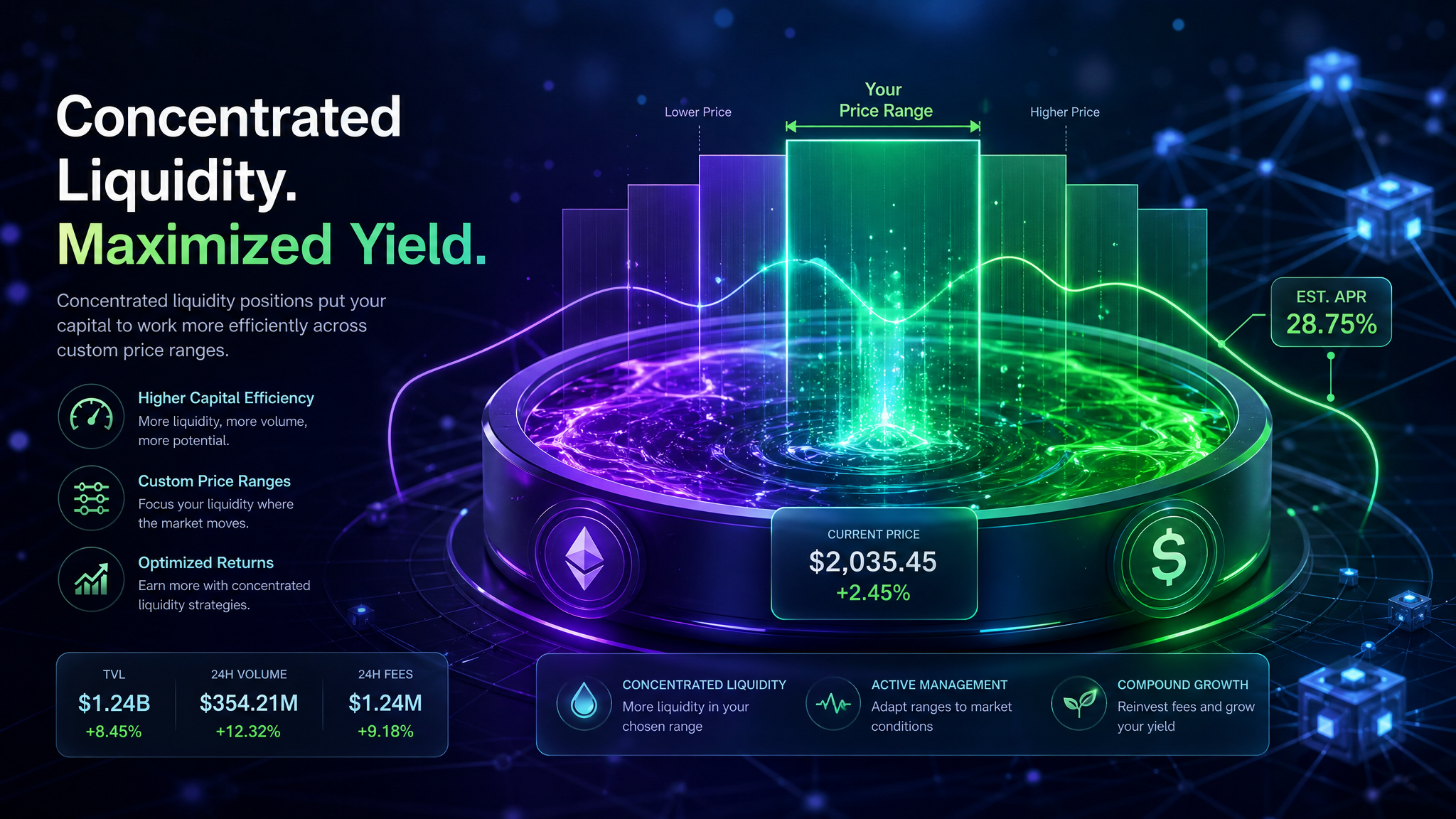
Uniswap v3 introduced concentrated liquidity in 2021 — instead of spreading capital across every possible price, you pick a range. If ETH trades between $2,800 and $3,200, you only provide liquidity there. Capital works harder, fees compound faster, and you earn more per dollar deployed.
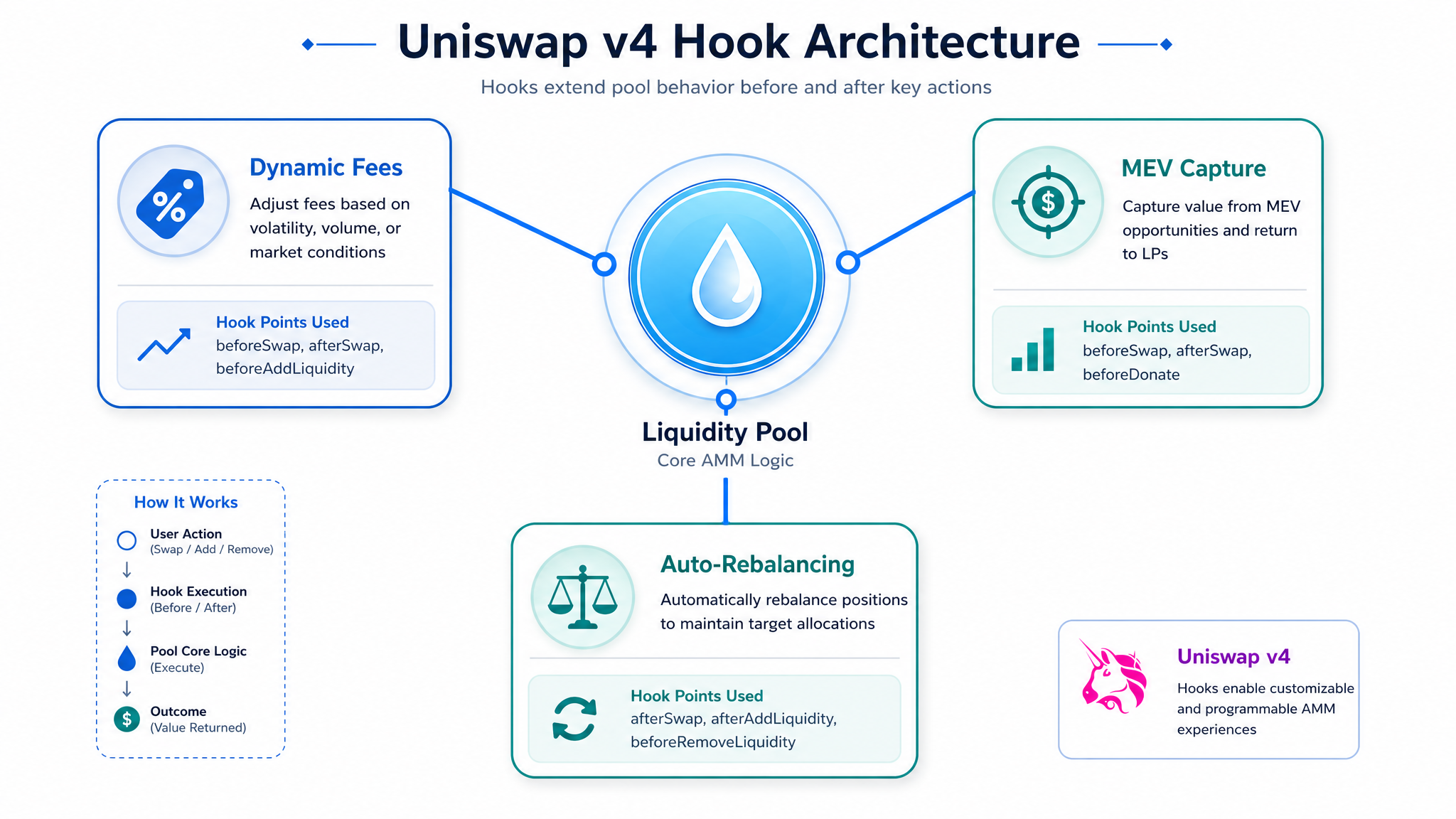
Uniswap v4 keeps that core mechanic but adds hooks — programmable logic that attaches to a pool. Hooks can fire before or after swaps, adjust fees dynamically, rebalance your range automatically, or route MEV value back to LPs instead of letting bots capture it. By mid-2026, v4 has processed hundreds of billions in cumulative volume, with sophisticated hook-enabled pools outperforming static v3 positions by 20–40% on a risk-adjusted basis.
The Core Mechanics: Ticks, Ranges, and Capital Efficiency
Before deploying capital, understand ticks. In Uniswap v4, prices are discrete "ticks" — logarithmically spaced price points. You choose a lower and upper tick; your capital only earns fees when the current price sits between them.
Here's a concrete example. Say ETH is trading at $3,000. You have $10,000 to deploy:
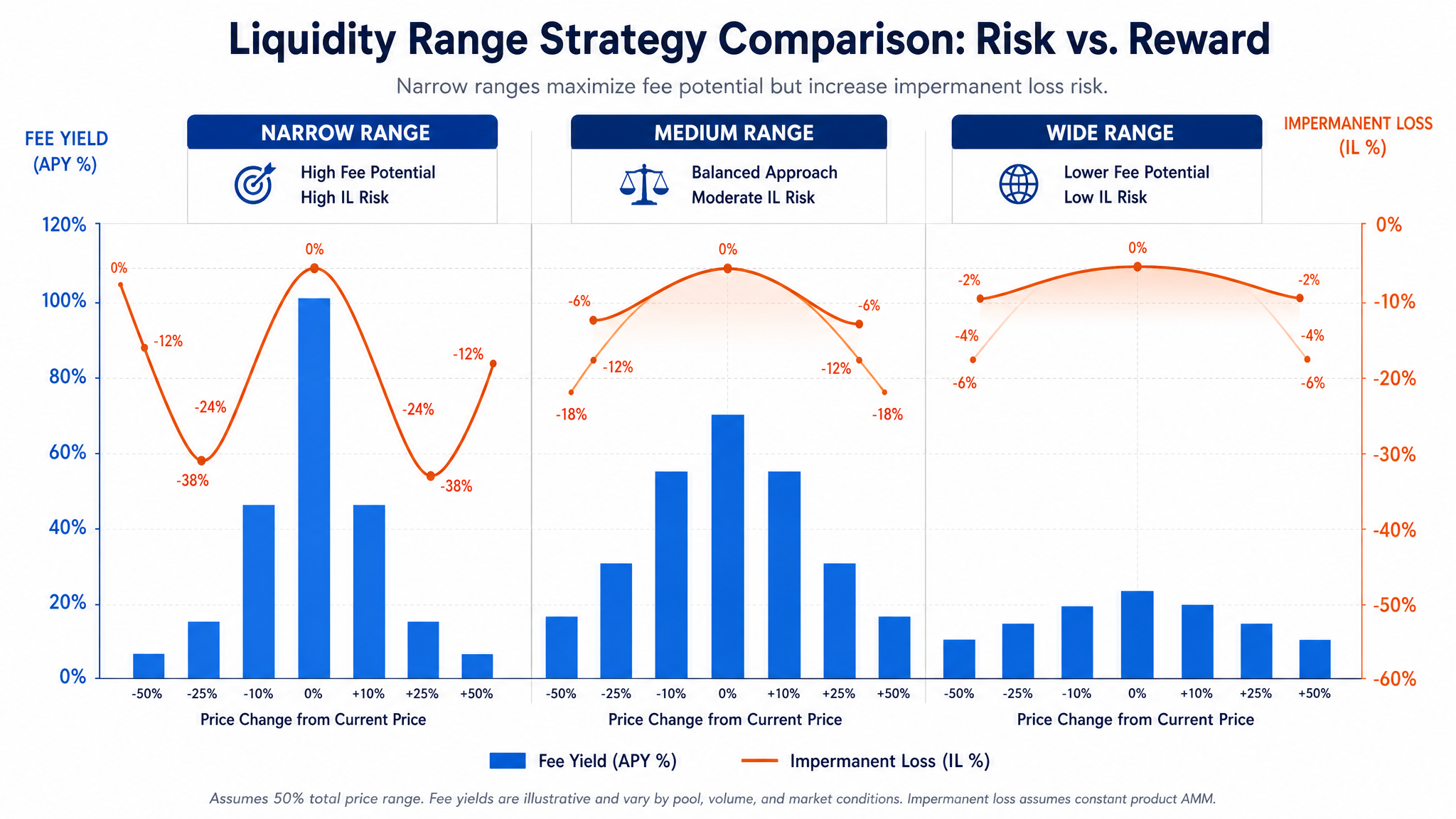
- Wide range ($1,000–$6,000): Your capital is spread thin. You earn fees, but your effective capital utilization might be 15–20%. Low impermanent loss risk, but modest returns.
- Tight range ($2,800–$3,200): Nearly all your capital is active. Fee earnings can be 5–8x higher per dollar. But if ETH moves outside that range, you earn nothing — and you're fully exposed to impermanent loss.
- Asymmetric range ($2,700–$3,500): A common professional approach. Slightly wider on the upside to capture bull momentum, tighter on the downside to limit loss exposure.
The math is unforgiving. A tight range generates spectacular fees during calm periods and devastating impermanent loss during sharp moves — range selection is the single most important decision an LP makes.
Uniswap v4 Hooks: The Advanced LP's Secret Weapon
Hooks are where v4 separates casual LPs from professionals. Here are the three hook categories that matter most in 2026:
1. Dynamic Fee Hooks
Standard Uniswap pools charge a fixed fee — 0.05%, 0.3%, or 1% depending on the pool tier. Dynamic fee hooks change that. They read real-time volatility data (often via Chainlink or on-chain oracle feeds) and adjust the swap fee accordingly.
During a low-volatility period, fees might drop to 0.05% to attract more volume. When volatility spikes — say, during a major macro event — fees automatically jump to 0.5% or higher. This directly compensates LPs for the increased impermanent loss risk they're absorbing. Early data from pools using dynamic fee hooks shows a 15–25% improvement in LP net returns compared to fixed-fee equivalents.
2. MEV-Capture Hooks
Here's something that should make every LP angry: in traditional AMMs, arbitrage bots extract value from your pool every time the price moves. They buy cheap, sell high, and pocket the difference — value that should belong to LPs. Projects like Angstrom and similar MEV-aware hook implementations are changing this.
MEV-capture hooks run a mini-auction for the right to arbitrage the pool. The winning bot pays a fee that flows directly to LPs rather than being extracted as pure profit. In active pools, this can add 0.5–2% annualized yield on top of standard swap fees. Not life-changing on its own, but compounded over a year, it's meaningful alpha.
3. Auto-Rebalancing Hooks
The biggest operational headache for concentrated liquidity LPs is range management. When price moves out of your range, you stop earning fees. You have to manually withdraw, reset your range, and redeposit — paying gas each time. Auto-rebalancing hooks handle this automatically.
When price approaches the edge of your range, the hook triggers a rebalance: it withdraws your liquidity, adjusts the range to center around the new price, and redeposits. This keeps your capital active without constant manual intervention. The tradeoff is gas costs for each rebalance and the hook's own fee structure — typically 0.1–0.3% of managed assets annually.
A word of caution: after the Bunni protocol exploit in 2025, the DeFi community learned hard lessons about hook security. Only use hooks that have undergone formal verification and multiple independent audits. Check the audit history before depositing significant capital.
Building a Real LP Strategy: Step-by-Step
Theory is one thing. Here's how to actually build a Uniswap v4 LP position that makes sense in the current market environment.
Step 1: Choose Your Pool and Pair
Not all pairs are equal for LP profitability. The best pools for concentrated liquidity strategies share a few characteristics:
- High volume relative to TVL: This is your fee yield driver. A pool with $50M TVL and $200M daily volume generates 4x more fees per dollar than one with $200M TVL and $50M volume.
- Predictable price behavior: Correlated pairs (ETH/stETH, USDC/USDT) have tight, predictable ranges. Volatile pairs (ETH/MEME tokens) require much wider ranges or constant management.
- Sustainable fee tier: The 0.05% tier works for stablecoin pairs. ETH/USDC typically performs best in the 0.3% tier. Exotic pairs often need 1%.
In mid-2026, the ETH/USDC 0.3% pool and WBTC/ETH 0.3% pool remain the highest-volume venues for retail LPs. Stablecoin pairs like USDC/USDT in the 0.05% tier offer lower yields but dramatically reduced impermanent loss risk.
Step 2: Set Your Range Using ATR
Professional LPs use the Average True Range (ATR) — a volatility indicator from traditional finance — to set data-driven boundaries. Pull ETH's 14-day ATR: if ETH moves an average of $150/day, a 7-day range is roughly ±$1,050 from current price. Set your lower tick at current price minus 1.5x ATR and upper tick at current price plus 2x ATR (slightly asymmetric to the upside in a bull market). Recheck weekly, or use an auto-rebalancing hook.
Step 3: Size Your Position Correctly
Never put more than 20–30% of your DeFi capital into a single concentrated liquidity position. Treat LP positions like any other risk asset. A practical allocation for a $50,000 DeFi portfolio: $15,000 in a tight ETH/USDC range (high yield, active management), $10,000 in a USDC/USDT stablecoin pool (low yield, minimal risk), and the remainder in lending protocols or staked assets.
Step 4: Track Your Real Returns
Raw APY numbers from pool interfaces don't account for impermanent loss. Your actual return is: fees earned minus impermanent loss minus gas costs. Use tools like Revert Finance or APY.vision to track real P&L. If impermanent loss consistently exceeds fee income, your range is too tight — widen it or switch to a less volatile pair.
Risk Management: What Can Go Wrong
Concentrated liquidity is not a passive income strategy. These are the risks you need to actively manage:
Impermanent Loss at Scale
In a tight range, impermanent loss can be severe. If you provide ETH/USDC liquidity in a $2,900–$3,100 range and ETH drops to $2,500, you're fully converted to ETH at the worst possible time — and you've stopped earning fees. The loss isn't "impermanent" if you withdraw at that point; it becomes permanent.
Hook Risk
As mentioned, hooks are smart contracts. Smart contracts can have bugs. The 2025 Bunni exploit drained millions from pools using an unaudited hook. Stick to hooks from established protocols with clean audit histories and significant TVL — the market has already stress-tested them.
Gas Cost Erosion
Frequent rebalancing on Ethereum mainnet can eat into returns. If you're managing a $5,000 position and paying $50 in gas every week to rebalance, that's 52% annualized drag. Either use Layer 2 deployments of Uniswap v4 (Arbitrum, Base, Optimism all have active v4 deployments), or use auto-rebalancing hooks that batch operations efficiently.
Layer 2 vs. Mainnet: Where to Deploy
For most retail LPs, Ethereum mainnet Uniswap v4 only makes sense for positions above $50,000 — gas costs destroy returns below that threshold. The better options in 2026: Arbitrum (deepest L2 liquidity, best for ETH/USDC and WBTC/ETH), Base (explosive growth in 2026, strong stablecoin pools), and Optimism (solid hook support, active developer community). Gas on these networks runs $0.10–$0.50 per transaction versus $5–$30 on mainnet — for a $10,000 position, that's the margin between profitable and break-even.
Stacking Yield: Beyond Basic LP Fees
Advanced practitioners don't stop at LP fees. Some protocols accept Uniswap v4 LP positions as collateral for borrowing — you earn LP fees while simultaneously borrowing stablecoins to deploy elsewhere. This amplifies returns but also amplifies liquidation risk, so use it conservatively. Many protocols also offer token incentives on top of swap fees; always model the scenario where incentives end and only swap fees remain.
Ready to master crypto trading? Check out Icoinpro's comprehensive trading course — it covers DeFi strategies, LP mechanics, and risk management in a structured format that's helped thousands of traders build real skills.
Protecting Your Assets
Before deploying capital into any DeFi protocol, your security setup matters. Serious about security? The Ledger Nano X keeps your private keys offline and safe — essential when interacting with smart contracts regularly. Always verify contract addresses from official documentation, use a dedicated DeFi wallet separate from long-term holdings, and never approve unlimited token allowances.
Key Takeaways: Uniswap v4 LP Strategy in 2026
- Concentrated liquidity multiplies fee earnings but requires active range management — passive depositing doesn't cut it.
- Hooks are the real innovation in v4: dynamic fees, MEV capture, and auto-rebalancing can add 15–40% to LP returns versus static positions.
- Use ATR to set data-driven ranges rather than guessing. Rebalance weekly or use a hook to automate it.
- Deploy on Layer 2 (Arbitrum, Base, Optimism) unless your position exceeds $50,000 — gas costs kill returns on mainnet for smaller positions.
- Track real returns including impermanent loss, not just fee APY. Tools like Revert Finance give you the honest picture.
- Only use audited hooks with significant TVL and a clean security history. Hook risk is real and has cost LPs millions.
- Size positions appropriately — no more than 20–30% of DeFi capital in any single concentrated liquidity position.
Want to understand the deeper economics behind DeFi and crypto markets? The Bitcoin Standard is essential reading for every crypto enthusiast — it builds the monetary foundation that makes DeFi strategies make sense.
Ready to put these strategies into practice?
The trading concepts in this article work — but only if you have the right foundation. I learned most of what I know through structured training that connected the dots between theory and live markets.
The program I recommend to people who ask me is this crypto trading course — it\'s the one I point friends and family to when they\'re serious about learning. Daily lessons, live analysis, and a community that actually helps.
Affiliate link — I may earn a commission at no extra cost to you. I only recommend what I genuinely use.
Disclaimer: The information provided on this website is for educational and informational purposes only. It should not be considered financial or investment advice. Cryptocurrency investments carry significant risk. Always do your own research and consult with a qualified financial advisor before making investment decisions.
Free Crypto Insights
Get weekly trading tips, market analysis, and exclusive strategies delivered to your inbox.