Cross-Chain Yield Optimization: How to Stack DeFi Returns Across Multiple Blockchains in 2026
Affiliate Disclosure: This article may contain affiliate links. We may earn a commission at no extra cost to you. All opinions are our own.
Marcus Chen
Senior Crypto Analyst & Educator
Certified Blockchain Professional | Former Wall Street Analyst
Marcus Chen is a cryptocurrency analyst and educator with over 8 years of experience in digital asset trading. He has helped thousands of beginners navigate the crypto markets through practical, actionable education.
Disclaimer: This content is for informational purposes only and should not be considered financial advice. Cryptocurrency investments carry significant risk. Always do your own research (DYOR) before making any investment decisions.
This article contains affiliate links. We may earn a commission at no extra cost to you if you make a purchase through these links. See our affiliate disclosure for details.
Cross-Chain Yield Optimization: How to Stack DeFi Returns Across Multiple Blockchains in 2026
Cross-chain yield optimization has quietly become one of the most powerful — and underused — strategies in advanced DeFi. While most retail investors park assets on a single chain and hope for the best, sophisticated operators are routing capital across Ethereum, Base, Arbitrum, and beyond, capturing yield spreads that can add 100 to 300 basis points of additional return annually. The mechanics are more accessible than ever in 2026, thanks to intent-based routing infrastructure that handles the complexity behind the scenes.
This guide breaks down how to build a multi-chain yield stack — from the conservative lending layer to delta-neutral strategies and concentrated liquidity — and how to manage the risks that come with operating across multiple protocols.
Why Cross-Chain Yield Optimization Matters in 2026
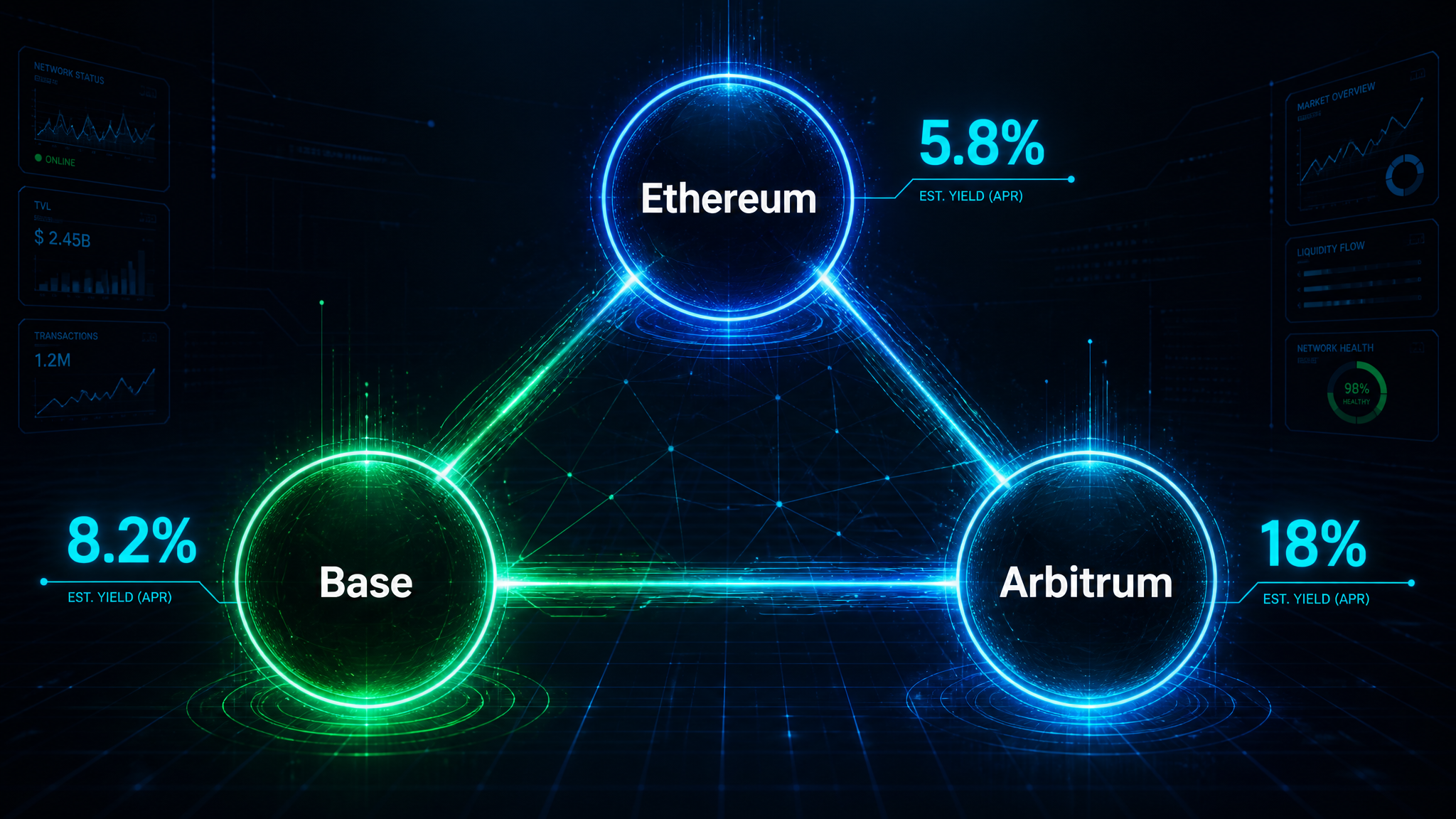
DeFi yields are not uniform. At any given moment, USDC lending rates on Morpho's Base deployment might be running 6.2% while the same asset on Ethereum mainnet earns 4.8%. ETH/USDC liquidity pools on Arbitrum's Uniswap v4 might generate 18% in trading fees during a volatile week, while a comparable Ethereum mainnet pool earns 11%.
These spreads exist because liquidity is fragmented. Each chain has its own supply and demand dynamics, its own user base, and its own set of protocols competing for capital. The investor who can efficiently move capital to wherever rates are highest — without getting eaten alive by gas fees and bridge delays — has a structural edge.
Intent-based routing protocols, ERC-4337 smart accounts, and cross-chain messaging standards like ERC-7683 have collapsed what used to be a multi-step, multi-hour process into a single signed transaction. That changes the calculus entirely. Want to accelerate your trading journey? Explore Icoinpro's daily trading signals and education platform — a solid foundation before deploying capital across complex multi-chain strategies.
The Barbell Framework: Balancing Safety and Upside
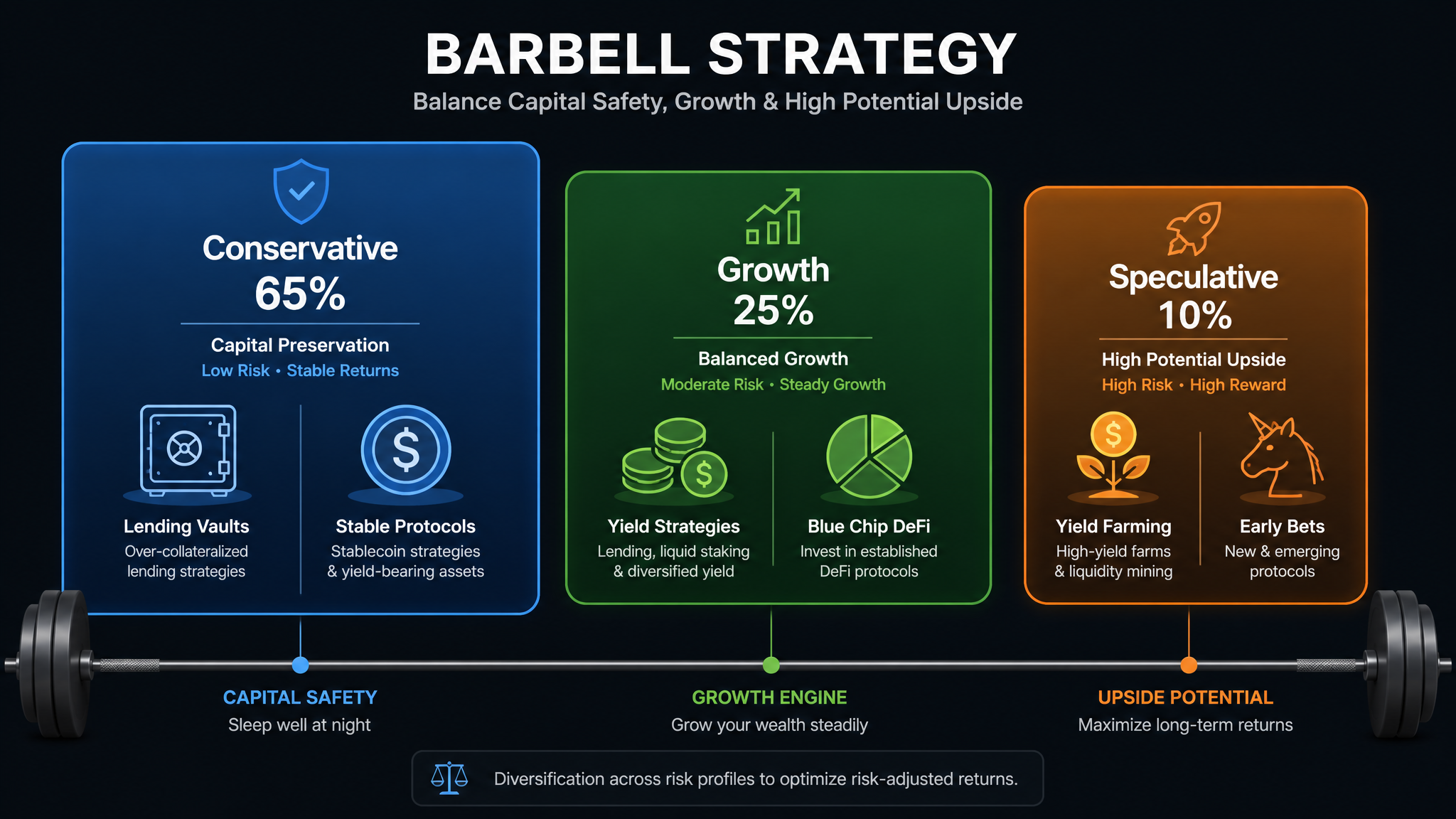
Before touching a single protocol, you need a framework. The most battle-tested approach among professional DeFi operators in 2026 is the barbell strategy — a concept borrowed from Nassim Taleb's risk philosophy and adapted for on-chain capital allocation.
The idea is simple: keep the majority of your capital in ultra-safe, low-volatility positions, and allocate a smaller slice to higher-risk, higher-reward opportunities. You avoid the dangerous middle ground of medium-risk positions that offer neither safety nor meaningful upside.
Conservative Tier (60–70%): Blue-Chip Lending
This is your foundation. Stablecoin lending on Aave V4, Morpho Blue, and Compound V3 across Ethereum and its L2s. Target 4–7% APY on USDC, USDT, or DAI. These positions are liquid, audited, and battle-tested. The goal here is not to maximize yield — it's to preserve capital while earning a meaningful return above T-bills.
Morpho's curated vaults are particularly compelling in this tier. Curators like Steakhouse Financial and Gauntlet manage allocation across isolated markets, adjusting risk parameters dynamically. You deposit once and the vault does the rebalancing. Typical yields: 4.5–6.5% APY on conservative vaults, up to 8.5% on Gauntlet's Frontier vaults for those willing to accept slightly higher collateral risk.
Growth Tier (20–30%): Delta-Neutral and Rate Strategies
This is where things get interesting. Delta-neutral strategies generate yield without taking directional price exposure — meaning you're not betting on whether ETH goes up or down. Two approaches dominate here in 2026:
Ethena sUSDe: Ethena's synthetic dollar earns yield from perpetual funding rates and ETH staking rewards. The protocol holds long spot ETH (via stETH) and simultaneously shorts ETH perpetuals, capturing the funding rate paid by long-biased traders. In bull markets, this has historically yielded 15–35% APY. In the current mid-2026 environment with compressed funding rates, sUSDe is running 4–7% — still competitive for a delta-neutral position. The key risk: sustained negative funding during bear markets can temporarily compress yields toward zero.
Pendle PT tokens: Pendle lets you buy Principal Tokens at a discount, locking in a fixed yield to maturity. A PT-sUSDe maturing in December 2026 might offer a fixed 8.2% APY regardless of what funding rates do between now and then. This is essentially a DeFi bond — predictable, fixed, and useful for the portion of your growth tier where you want rate certainty.
Speculative Tier (10–15%): High-Yield Asymmetric Bets
Keep this small. This is where you deploy into newer protocols, higher-risk LP positions, or leveraged yield strategies. The goal is asymmetric upside — positions where a good outcome returns 3–5x your allocation, but a bad outcome only costs you the 10–15% you allocated. Never let a speculative position bleed into your conservative tier.
Tier 1 — Morpho Vaults: The Institutional-Grade Lending Layer
Morpho Blue launched as a permissionless lending primitive — an immutable base layer where anyone can create isolated lending markets. The magic happens at the vault layer, where professional risk managers (curators) aggregate capital and allocate it across multiple Morpho markets to optimize yield while managing risk.
Here's what makes Morpho compelling for cross-chain yield optimization specifically:
- Isolation architecture: Each market is isolated. A bad debt event in one market doesn't contaminate others. This is a significant improvement over monolithic protocols like early Aave versions.
- Multi-chain deployment: Morpho is live on Ethereum mainnet, Base, and Optimism. Yield spreads between chains are real and persistent — Base USDC vaults have consistently run 50–150 bps higher than mainnet equivalents due to higher borrowing demand from Base's growing DeFi ecosystem.
- Institutional validation: Coinbase routes retail USDC deposits through a Steakhouse-curated Morpho vault. Apollo Global launched on-chain credit vaults on Morpho in Q4 2025. When institutions this size are using a protocol as infrastructure, it's a meaningful signal about security and reliability.
Practical note: curator fees typically run 5–15% of earned yield. A vault advertising 7% APY might net you 6% after fees. Always check the net APY, not the gross figure.
Tier 2 — Ethena sUSDe: Delta-Neutral Yield Without Directional Risk
Ethena's USDe is a synthetic dollar backed by a delta-neutral hedge: long stETH (earning staking yield) plus short ETH perpetuals (capturing funding rates). When you stake USDe to receive sUSDe, you earn the protocol's yield — a blend of staking rewards and funding rate income.
The 2026 version of Ethena is more mature than its 2024 launch. Ethena has integrated BlackRock's BUIDL fund as a reserve asset, providing a yield floor during negative funding periods. The insurance fund has grown to over $70 million, buffering short-term yield compression. Ethena also wound down certain EU operations to comply with MiCA, reducing regulatory tail risk.
The primary risk remains funding-rate dependency. During the 2025 bear market correction, sUSDe yields briefly compressed to 1.2% for six weeks. Size it appropriately — it's a structured yield product, not a stablecoin substitute. Pendle markets for sUSDe exist on multiple chains, letting you lock in fixed yields or speculate on future funding rate movements.
Tier 3 — Concentrated Liquidity on Uniswap v4 and Curve
Concentrated liquidity positions are the highest-maintenance component of a cross-chain yield stack, but they can generate the highest fee income when managed correctly.
Uniswap v4's hook architecture allows pools to implement dynamic fee tiers that adjust based on real-time volatility and automated position rebalancing. Deploy into a hook-enabled pool and the protocol automatically widens your range during high-volatility periods (reducing IL risk) and tightens it during calm periods (maximizing fee capture).
Practical yield benchmarks: ETH/USDC on Uniswap v4 (Arbitrum, tight range) runs 12–25% APY in fees during normal volatility weeks; USDC/USDT on Curve (Base) yields 4–8% APY from fees plus CRV/CVX rewards via Convex; wstETH/ETH on Curve (Ethereum) earns 3–6% APY with minimal impermanent loss due to correlated assets.
The critical discipline: set a maximum impermanent loss threshold before entering any concentrated position. If IL exceeds 3–5% of your principal, close and redeploy. An out-of-range position earns zero fees while IL compounds.
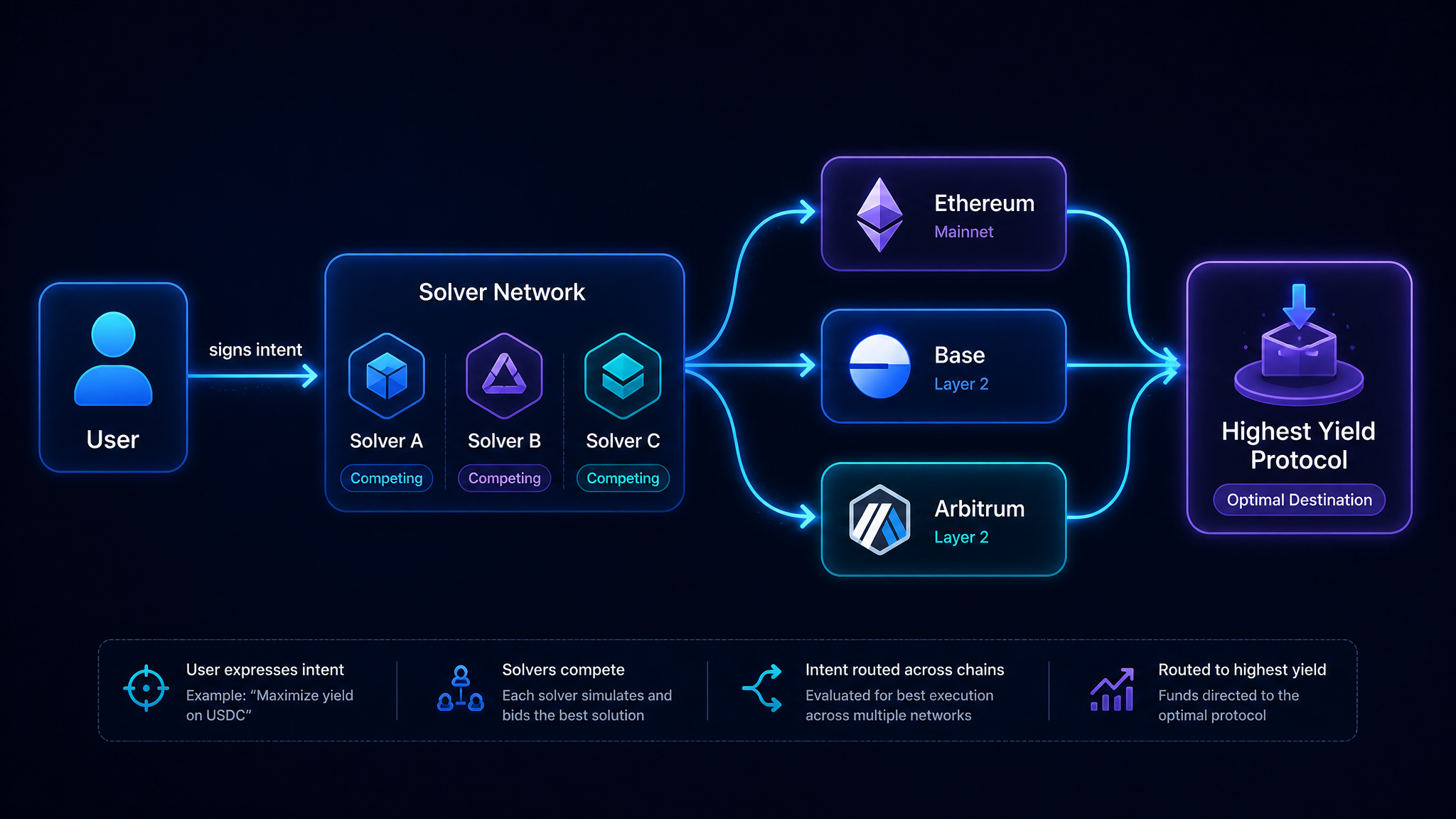
Intent-Based Routing: The Infrastructure That Makes It All Work
Intent-based routing flips the traditional model. Instead of specifying how to move your assets, you specify what you want: "Move 10,000 USDC from Ethereum to Base and deposit into the highest-yielding Morpho vault." A network of solvers — specialized actors who compete to fulfill your request — handles the routing, bridging, and deployment. You sign one transaction.
Key protocols: Eco Routes specializes in stablecoin routing across 15+ chains using Circle's CCTP, compressing fees 30–70% vs. traditional bridges. Across Protocol (co-author of ERC-7683) uses an optimistic oracle for fast, secure transfers. LI.FI handles multi-step DeFi workflows in a single transaction. UniswapX uses Dutch-auction solver competition for optimal pricing with MEV protection.
The practical implication: rebalancing your cross-chain yield stack no longer requires a full afternoon. A weekly 20-minute review — checking yield spreads and routing capital to better opportunities — is now operationally feasible for individual investors.
A Real-World Cross-Chain Yield Stack (Example Portfolio)
Here's how a $50,000 cross-chain yield portfolio might look in August 2026, applying the barbell framework:
Conservative Tier — $32,500 (65%): $15,000 USDC in Morpho Steakhouse vault (Base) at ~5.8% APY; $10,000 USDC in Aave V4 (Ethereum) at ~4.9% APY; $7,500 USDT in Morpho Gauntlet Prime vault (Ethereum) at ~6.1% APY.
Growth Tier — $12,500 (25%): $7,500 in Ethena sUSDe (staked) at ~5.5% APY delta-neutral; $5,000 in Pendle PT-sUSDe December 2026 at ~8.2% fixed APY.
Speculative Tier — $5,000 (10%): $3,000 in ETH/USDC concentrated LP on Uniswap v4 (Arbitrum) targeting ~18% APY; $2,000 in wstETH/ETH Curve pool (Base) + Convex staking at ~7.5% APY.
Blended portfolio yield estimate: ~7.2% APY — meaningfully above what any single-chain, single-protocol approach would deliver, with risk distributed across multiple independent systems.
Risk Management: What Can Go Wrong
Multi-chain yield strategies introduce risks single-chain investors don't face:
Smart contract risk multiplies. Each protocol adds an independent attack surface. Stick to audited, battle-tested protocols with significant TVL and a track record of surviving market stress events.
Bridge and routing risk. The April 2026 KelpDAO exploit caused contagion across DeFi — protocols that were themselves unexploited still experienced liquidity stress. Keep bridge exposure time-limited: route capital, deploy it, don't leave assets sitting in bridge contracts.
Curator risk on Morpho vaults. You're delegating risk management to the curator. Stick to established curators with transparent track records: Steakhouse Financial, Gauntlet, Re7 Labs.
Funding rate compression on Ethena. sUSDe yields can compress to near-zero during bear markets. Size your position so a 6-week period of 1% yield doesn't materially damage your overall return.
Impermanent loss on concentrated LP positions. Set hard stop-loss thresholds on IL before entering any concentrated position. Protect your crypto assets with a Ledger hardware wallet — the gold standard in cold storage security — to ensure your private keys stay offline while you manage active DeFi positions.
Key Takeaways
- Cross-chain yield optimization captures 100–300 bps of additional return by exploiting yield spreads between chains.
- The barbell framework: 60–70% conservative lending (Morpho, Aave), 20–30% delta-neutral (Ethena sUSDe, Pendle PTs), 10–15% speculative (concentrated LP).
- Morpho vaults offer institutional-grade lending with isolated risk architecture across Ethereum, Base, and Optimism.
- Ethena sUSDe provides delta-neutral yield stabilized by RWA reserves and a $70M+ insurance fund.
- Intent-based routing (Eco Routes, Across, LI.FI) makes cross-chain rebalancing feasible for individual investors — one signed transaction replaces hours of manual bridging.
- Risk management: set IL thresholds on LP positions, stick to audited Morpho curators, and size Ethena exposure to survive funding rate compression.
Want to understand the economics behind Bitcoin? The Bitcoin Standard is essential reading for every crypto enthusiast.
Ready to put these strategies into practice?
The trading concepts in this article work — but only if you have the right foundation. I learned most of what I know through structured training that connected the dots between theory and live markets.
The program I recommend to people who ask me is this crypto trading course — it\'s the one I point friends and family to when they\'re serious about learning. Daily lessons, live analysis, and a community that actually helps.
Affiliate link — I may earn a commission at no extra cost to you. I only recommend what I genuinely use.
Disclaimer: The information provided on this website is for educational and informational purposes only. It should not be considered financial or investment advice. Cryptocurrency investments carry significant risk. Always do your own research and consult with a qualified financial advisor before making investment decisions.
Free Crypto Insights
Get weekly trading tips, market analysis, and exclusive strategies delivered to your inbox.