Risk-Adjusted Momentum (RAM) Crypto Strategy: How to Run a Market-Neutral Long-Short Portfolio in 2026
Affiliate Disclosure: This article may contain affiliate links. We may earn a commission at no extra cost to you. All opinions are our own.
Marcus Chen
Senior Crypto Analyst & Educator
Certified Blockchain Professional | Former Wall Street Analyst
Marcus Chen is a cryptocurrency analyst and educator with over 8 years of experience in digital asset trading. He has helped thousands of beginners navigate the crypto markets through practical, actionable education.
Disclaimer: This content is for informational purposes only and should not be considered financial advice. Cryptocurrency investments carry significant risk. Always do your own research (DYOR) before making any investment decisions.
This article contains affiliate links. We may earn a commission at no extra cost to you if you make a purchase through these links. See our affiliate disclosure for details.
Risk-Adjusted Momentum (RAM) Crypto Strategy: How to Run a Market-Neutral Long-Short Portfolio in 2026
The risk-adjusted momentum (RAM) crypto strategy is one of the most compelling market-neutral approaches available to sophisticated traders in 2026. Instead of betting on whether Bitcoin goes up or down, RAM isolates the spread between the strongest and weakest assets in the market — letting you earn whether the broader market rallies, crashes, or grinds sideways. If you've been frustrated by directional trading's coin-flip nature, this framework offers a genuinely different edge.
What Is Risk-Adjusted Momentum — and Why Does It Work?
Standard momentum strategies rank assets by raw price return over a lookback window and buy the winners while shorting the losers. The problem? A coin that jumped 80% in a week on a single tweet carries far more risk than one that climbed 30% steadily over a month. Raw return treats both the same.
Risk-adjusted momentum fixes this by dividing each asset's return by its volatility over the same period. The formula is simple:
RAM Score = Return(n days) ÷ StdDev(daily returns, n days)
This is essentially a Sharpe ratio without the risk-free rate subtracted. Assets that climb steadily score high. Assets that spike violently on low-conviction volume score low — even if their raw return looks impressive. The result is a ranking system that favors quality momentum over noisy momentum.
Why does it work in crypto specifically? Three reasons. First, crypto markets are still inefficient enough that momentum persists across 7–28 day windows. Second, the long-short construction removes the market beta that makes most crypto strategies just leveraged Bitcoin exposure in disguise. Third, volatility-adjusted sizing prevents a single volatile altcoin from blowing up the whole book.
Building the Signal: Multi-Horizon Blending
Using a single lookback window is fragile. A 7-day signal is fast and responsive but noisy. A 28-day signal is stable but slow to react to regime changes. The solution most practitioners use in 2026 is to blend multiple horizons.
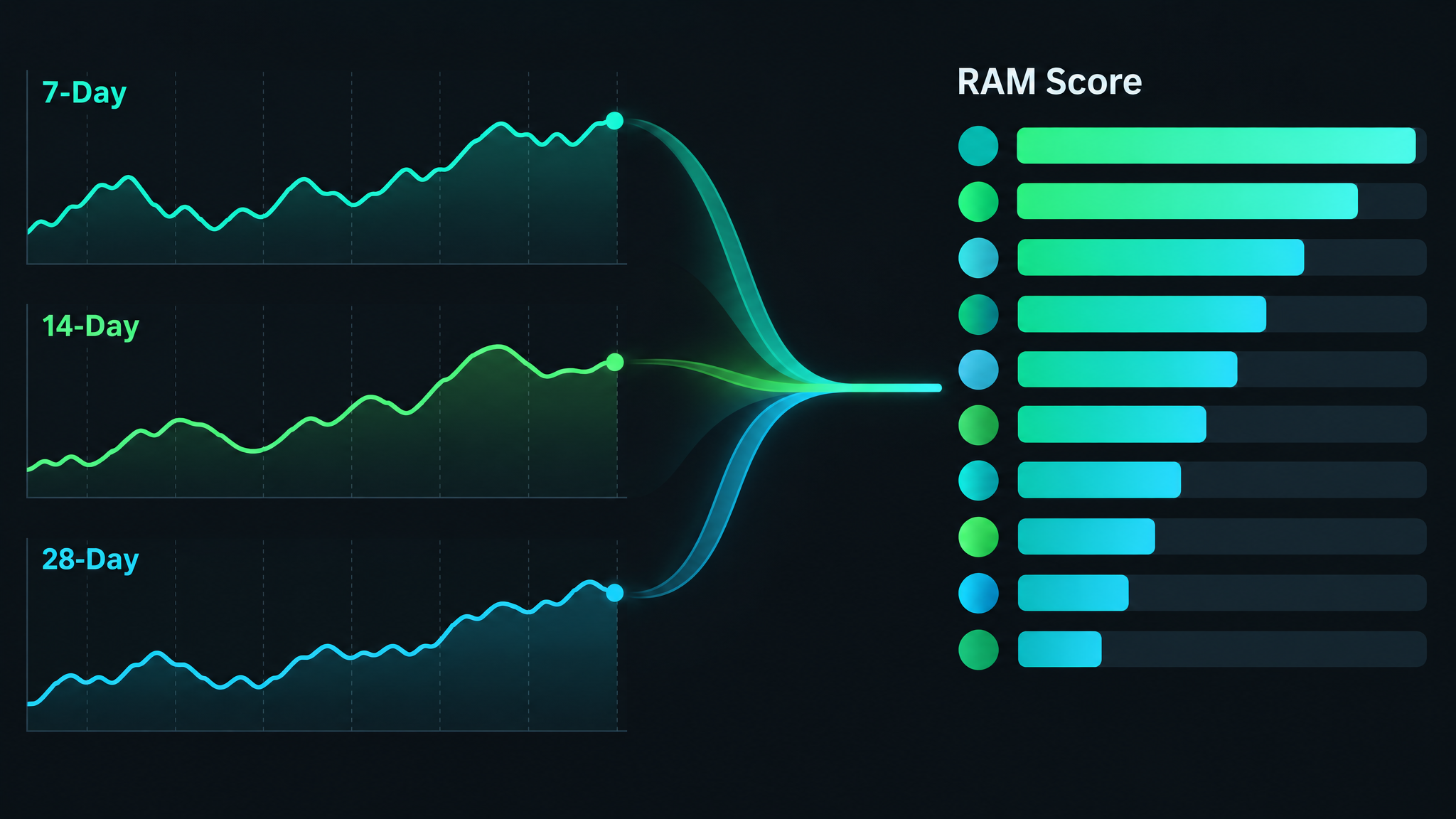
Calculate RAM scores at 7, 14, and 28 days. Standardize each into z-scores (subtract the mean, divide by standard deviation across your asset universe). Then average the three z-scores into a composite signal. This blended score captures both short-term momentum and medium-term trend persistence without being dominated by either.
A practical example: Suppose you're running this on the top 50 liquid crypto assets by market cap. On a given day, Solana might score +1.8 on the 7-day, +1.4 on the 14-day, and +1.1 on the 28-day — composite of +1.43. Meanwhile, a mid-cap altcoin might score -1.2, -0.9, and -1.5 — composite of -1.2. Solana goes in the long book; the altcoin goes in the short book.
Portfolio Construction: The Long-Short Book
Once you have composite RAM scores, you need to translate them into actual positions. Here's how the mechanics work in practice.
Asset Universe and Liquidity Filters
Start with the top 50–100 crypto assets by 30-day average daily volume. Exclude anything with less than $5M in daily volume — the slippage on illiquid tokens will eat your edge alive. Also exclude stablecoins, wrapped tokens, and assets with less than 90 days of price history. You want a clean, liquid universe where your signals actually mean something.
Position Sizing
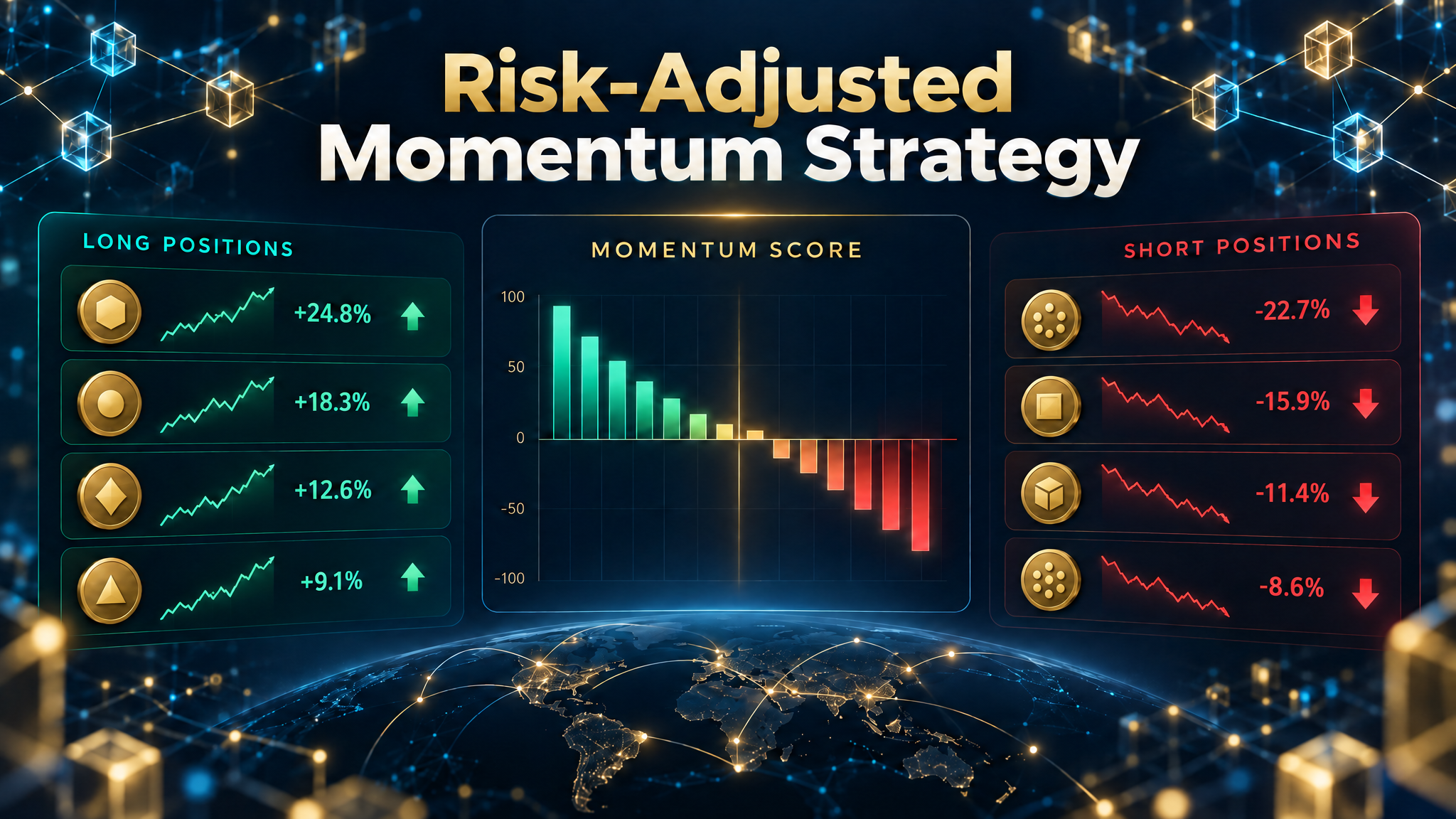
Take the top 10 assets by composite RAM score for the long leg. Take the bottom 10 for the short leg. Size each position inversely proportional to its 28-day volatility — so a coin with 4% daily volatility gets half the notional of one with 2% daily volatility. This is volatility targeting, and it's what keeps a single wild altcoin from dominating your risk.
Allocate equal dollar amounts to the long and short legs. If you're running $100,000, put $50,000 long and $50,000 short. Some practitioners use a 60/40 or 70/30 split to account for crypto's structural positive drift — the market tends to go up over time, so a slight long bias can improve risk-adjusted returns. Test both on your specific universe.
Rebalancing Frequency
Daily rebalancing captures momentum signals most precisely but generates significant transaction costs. Weekly rebalancing is the sweet spot for most retail-scale implementations — you capture most of the alpha while keeping fees manageable. Monthly rebalancing works for larger positions where the percentage cost of rebalancing is lower relative to position size.
One practical trick: implement a "buffer zone" where you only replace a position if the new candidate's score exceeds the current holding's score by at least 0.3 standard deviations. This reduces unnecessary turnover without meaningfully degrading signal quality.
Execution: Where to Run This Strategy
You need an exchange that supports both spot and perpetual futures, has deep liquidity across a broad asset universe, and offers reasonable fees. Binance, OKX, and Bybit are the most common choices for running this at scale. For the short leg, you'll typically use perpetual futures rather than spot shorting — it's more capital-efficient and avoids the complexity of borrowing assets.
Keep your long positions in spot (or spot-equivalent staking positions where available). Keep your short positions in perpetuals. This way, your long leg can earn staking yield while your short leg earns or pays funding rates depending on market conditions.
Speaking of funding rates — this is a critical variable. When the market is in a strong bull phase, perpetual funding rates can run 0.05–0.1% per 8 hours on the short side, which annualizes to 55–110%. That's a massive drag on your short book. Monitor funding rates daily and factor them into your net return calculations. During periods of extreme positive funding, you may want to reduce short exposure or shift to options-based hedges instead.
Want to accelerate your trading journey? Explore Icoinpro's daily trading signals and education platform — they cover systematic strategies like RAM in their advanced modules.
Risk Management: The Non-Negotiables
Market-neutral doesn't mean risk-free. Here are the specific risks that can blow up a RAM strategy and how to manage them.
Basis Blowout Risk
During extreme market stress — think a sudden 20% Bitcoin crash — correlations across all crypto assets spike toward 1.0. Your long book drops. Your short book also drops (which is good for your shorts), but the spread between them can compress violently as everything moves together. This is called basis blowout, and it's the primary tail risk in any long-short crypto strategy.
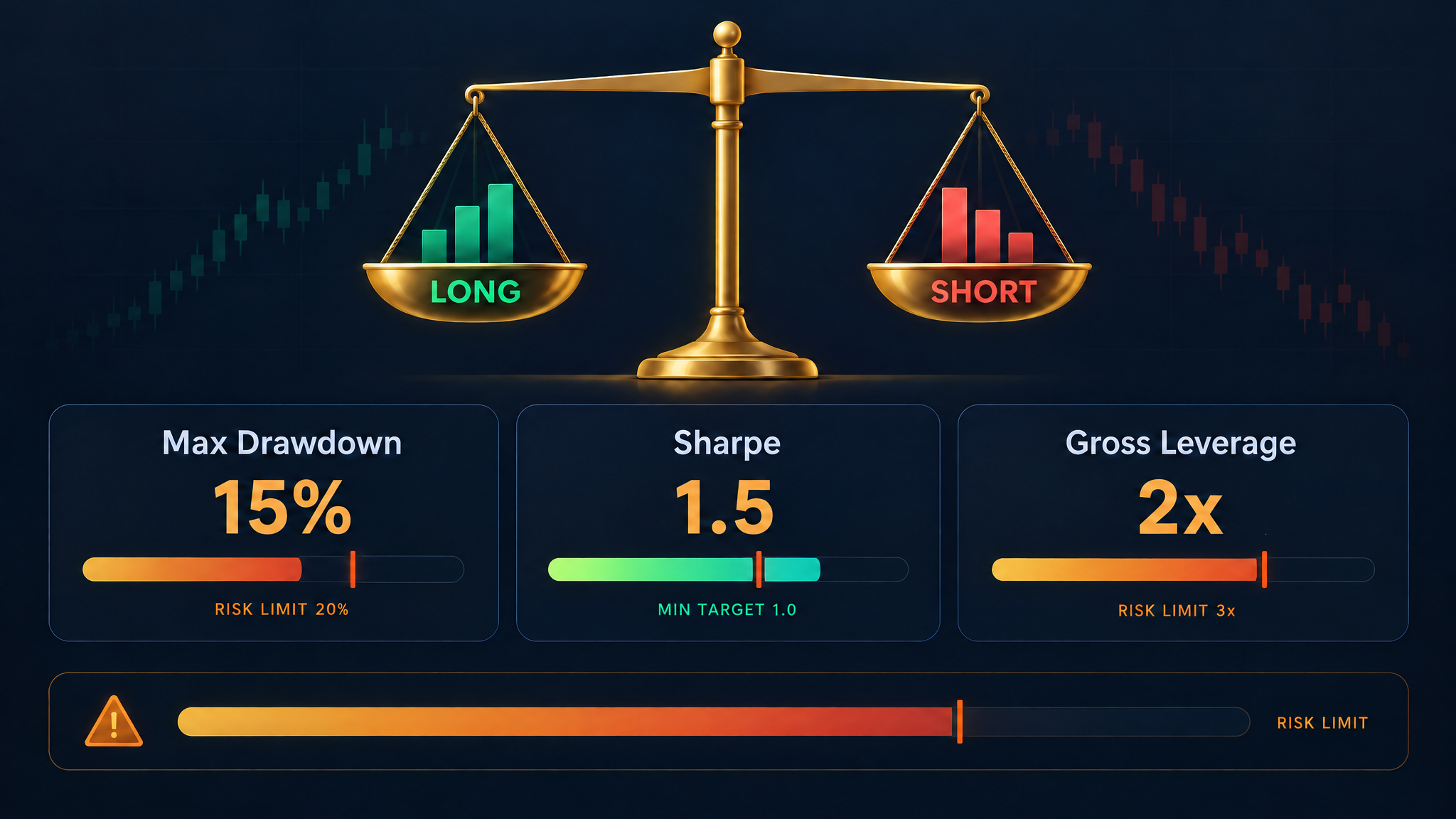
Mitigation: Keep gross leverage below 2x. Maintain a cash buffer of 20–30% of portfolio value for margin calls. Set hard stop-losses at the portfolio level — if your net asset value drops 15% from peak, reduce all positions by 50% and reassess.
Regime Shifts
Momentum strategies underperform during sharp reversals and choppy, sideways markets. A simple regime filter helps: only run the full strategy when Bitcoin is above its 200-day moving average. When Bitcoin is below the 200-day, reduce gross exposure by 50% or shift to a pure cash-and-carry strategy instead.
Liquidity Risk
Your exit liquidity matters as much as your entry liquidity. If you're running $500,000+ in this strategy, you need to model your market impact on exit. A position that represents more than 2% of an asset's daily volume will move the market against you when you try to close it. Size accordingly.
Real Performance Numbers: What to Expect
Backtests through September 2026 on the top 50 liquid crypto assets show that a well-constructed RAM long-short strategy has delivered 15–25% annualized returns with a Sharpe ratio of 1.2–1.8 — significantly better than buy-and-hold Bitcoin on a risk-adjusted basis. Maximum drawdowns have typically been in the 12–18% range versus 60–80% for Bitcoin alone.
That said, past performance in crypto backtests is notoriously unreliable. Survivorship bias (you're only seeing assets that survived), look-ahead bias (using data that wasn't available at the time), and transaction cost underestimation are all common pitfalls. When you run your own backtests, use realistic fee assumptions (0.05–0.1% per trade), include slippage estimates, and test on out-of-sample data from at least two different market regimes.
Live performance tends to run 30–50% below backtest performance once real-world friction is accounted for. If your backtest shows 40% annualized, expect 20–28% in live trading. That's still excellent — but calibrate your expectations accordingly.
Tools and Infrastructure You'll Need
Running this strategy manually is possible but painful. At minimum, you need:
- Data feed: CoinGecko Pro or Messari for daily OHLCV data across your asset universe
- Calculation engine: Python with pandas and numpy for signal calculation and portfolio construction
- Execution: Exchange APIs (Binance, OKX, or Bybit) for automated order placement
- Monitoring: A dashboard tracking net exposure, funding rate costs, and portfolio-level P&L
For those who want a more structured learning path before building their own system, Ready to master crypto trading? Check out Icoinpro's comprehensive trading course — it covers systematic trading frameworks that complement quantitative strategies like RAM.
Protect your crypto assets with a Ledger hardware wallet — the gold standard in cold storage security. Even if you're running an active trading strategy, keeping your reserve capital in cold storage is non-negotiable.
Is RAM Right for You?
This strategy suits traders who are comfortable with quantitative frameworks, have at least $20,000–$50,000 in capital (smaller amounts get eaten by fees), and can commit to systematic execution without emotional overrides. It's not a set-and-forget system — you need to monitor funding rates, rebalance weekly, and adjust for regime changes.
If you're still building your foundational crypto knowledge, start there first. But if you've been trading for a year or more and want to move beyond directional bets, RAM is one of the most intellectually honest strategies available. It doesn't require you to predict market direction. It just requires you to identify which assets are trending better than others — and that's a much more tractable problem.
Key Takeaways
- RAM scores assets by return divided by volatility, favoring steady climbers over volatile spikes
- Blend 7, 14, and 28-day signals into a composite z-score for more robust rankings
- Run 10 longs and 10 shorts, sized inversely to volatility, with equal dollar allocation to each leg
- Rebalance weekly; use a buffer zone to reduce unnecessary turnover
- Monitor funding rates daily — they can turn a profitable short book into a losing one during bull markets
- Apply a Bitcoin 200-day MA regime filter to reduce exposure during bear markets
- Expect live performance to run 30–50% below backtest results once real friction is accounted for
Ready to put these strategies into practice?
The trading concepts in this article work — but only if you have the right foundation. I learned most of what I know through structured training that connected the dots between theory and live markets.
The program I recommend to people who ask me is this crypto trading course — it\'s the one I point friends and family to when they\'re serious about learning. Daily lessons, live analysis, and a community that actually helps.
Affiliate link — I may earn a commission at no extra cost to you. I only recommend what I genuinely use.
Disclaimer: The information provided on this website is for educational and informational purposes only. It should not be considered financial or investment advice. Cryptocurrency investments carry significant risk. Always do your own research and consult with a qualified financial advisor before making investment decisions.
Free Crypto Insights
Get weekly trading tips, market analysis, and exclusive strategies delivered to your inbox.