Best Bitcoin ETFs 2026: Top 6 Ranked for Every Investor Type
Affiliate Disclosure: This article may contain affiliate links. We may earn a commission at no extra cost to you. All opinions are our own.
Marcus Chen
Senior Crypto Analyst & Educator
Certified Blockchain Professional | Former Wall Street Analyst
Marcus Chen is a cryptocurrency analyst and educator with over 8 years of experience in digital asset trading. He has helped thousands of beginners navigate the crypto markets through practical, actionable education.
Disclaimer: This content is for informational purposes only and should not be considered financial advice. Cryptocurrency investments carry significant risk. Always do your own research (DYOR) before making any investment decisions.
This article contains affiliate links. We may earn a commission at no extra cost to you if you make a purchase through these links. See our affiliate disclosure for details.
Best Bitcoin ETFs 2026: Top 6 Ranked for Every Investor Type
The best Bitcoin ETFs in 2026 aren't all created equal — and picking the wrong one could quietly cost you thousands in fees or leave you stuck with poor liquidity when you need to exit fast. Since the landmark January 2024 approvals, the spot Bitcoin ETF market has matured dramatically. Fee wars have settled, AUM has ballooned past $100 billion collectively, and now we have a clear picture of which funds actually deliver. Whether you're a buy-and-hold investor, an active trader, or someone already inside a specific brokerage ecosystem, there's a right answer here — and it's probably not the one you'd guess.
Why Bitcoin ETF Choice Actually Matters in 2026
Here's the thing most people miss: all spot Bitcoin ETFs track the same asset. Bitcoin is Bitcoin. So why does fund selection matter? Three reasons: fees compound silently over years, liquidity determines your real execution cost, and custody arrangements carry counterparty risk you might not have considered.
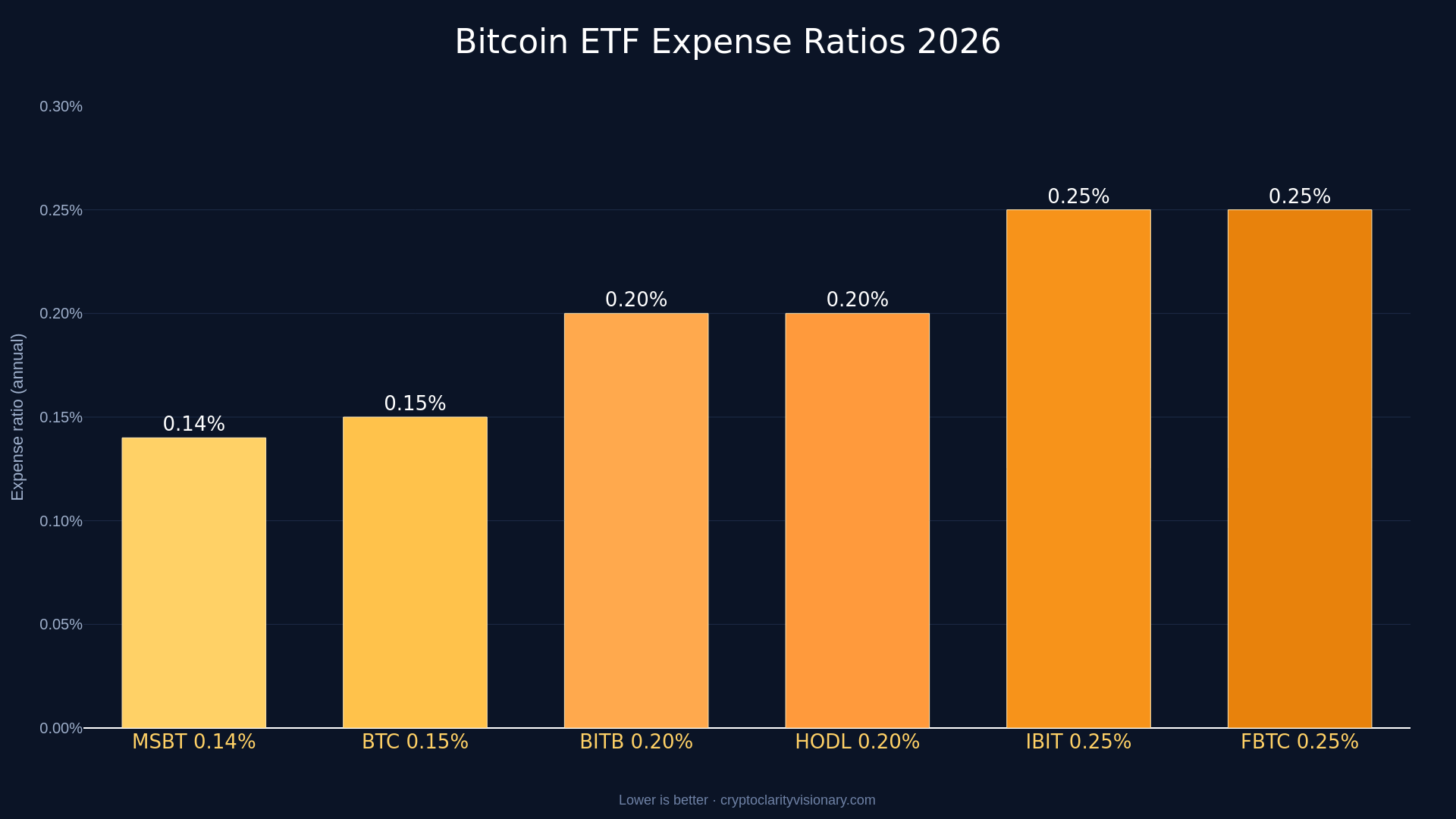
A 0.25% expense ratio versus 0.14% sounds trivial. On a $50,000 position held for 10 years, that gap compounds to roughly $700 in extra fees — before accounting for Bitcoin's potential appreciation. And if you're an active trader, the bid-ask spread on a thinly traded fund can eat more than a full year's expense ratio in a single trade.
The fee war that dominated 2024 and 2025 has largely settled. The last introductory waivers expired in July 2026, so the numbers you see now are the real, permanent costs. Here's what the landscape looks like.
The 6 Best Bitcoin ETFs in 2026, Ranked
1. iShares Bitcoin Trust (IBIT) — Best for Active Traders
IBIT is the undisputed king of liquidity. With roughly $47 billion in AUM, it dwarfs every competitor and maintains the tightest bid-ask spreads in the category. The options chain is deep — critical if you're running covered calls or protective puts on your Bitcoin position. BlackRock's institutional distribution network means this fund sees consistent daily volume that smaller funds simply can't match.
The expense ratio sits at 0.25%, which is mid-pack. For a buy-and-hold investor, that's a meaningful cost over a decade. But for anyone trading in and out, the execution savings from tight spreads more than compensate. Custody is through Coinbase, which is the industry standard — not a differentiator, but not a concern either.
Best for: Active traders, options strategies, institutional-scale positions
Expense ratio: 0.25%
AUM: ~$47 billion
Custody: Coinbase
2. Fidelity Wise Origin Bitcoin Fund (FBTC) — Best for Fidelity Users & Custody Independence
FBTC stands out for one reason that matters more than most people realize: Fidelity Digital Assets handles custody in-house. Every other major Bitcoin ETF routes through Coinbase. That's not necessarily dangerous, but it does mean the entire industry has a single point of custody concentration. FBTC breaks that pattern.
Performance has been essentially identical to IBIT — both track Bitcoin with minimal tracking error. The 0.25% expense ratio matches IBIT. Where FBTC wins is for investors already in the Fidelity ecosystem who want seamless integration with their existing brokerage accounts, IRAs, or 401(k)s. Fidelity's retirement account support for FBTC is particularly strong.
Best for: Fidelity account holders, IRA/retirement investors, custody diversification
Expense ratio: 0.25%
Custody: Fidelity Digital Assets (proprietary)
3. Grayscale Bitcoin Mini Trust (BTC) — Best Low-Cost Default
At 0.15%, the Grayscale Bitcoin Mini Trust hits the sweet spot between cost efficiency and operational track record. It's been running long enough to have proven its tracking accuracy through significant volatility — including the February 2026 drawdown that tested every fund's mechanics. MSBT is cheaper, but it only launched in April 2026. BTC has the history.
This is the fund I'd recommend to most long-term investors who don't have a strong brokerage preference. It's not flashy. It doesn't have IBIT's liquidity or FBTC's custody story. But it quietly does its job at a cost that compounds favorably over time. Think of it as the index fund equivalent in the Bitcoin ETF space.
Best for: Long-term buy-and-hold investors, cost-conscious allocators
Expense ratio: 0.15%
Custody: Coinbase
4. Morgan Stanley Bitcoin Trust (MSBT) — Best Expense Ratio
MSBT launched in April 2026 and immediately grabbed headlines with its 0.14% expense ratio — the lowest in the category. If you're purely optimizing for cost and you're comfortable with a newer fund, this is your pick. The dual-custody structure (Coinbase plus Fidelity) is a thoughtful design choice that reduces single-custodian concentration risk.
The catch? AUM is still modest at around $300 million, which means liquidity is thin compared to IBIT or FBTC. For large positions or active trading, the spread costs could easily exceed the fee savings. For a patient, long-term investor making regular contributions, though, MSBT's cost advantage is real and will compound meaningfully over a decade.
Best for: Cost-minimizing long-term investors, Morgan Stanley clients
Expense ratio: 0.14% (lowest in category)
Custody: Coinbase + Fidelity (dual)
5. Bitwise Bitcoin ETF (BITB) — Best for Crypto-Native Investors
Bitwise is the only pure-play crypto asset manager in this list. Unlike BlackRock, Fidelity, or Morgan Stanley, crypto is Bitwise's entire business — not a product line. That focus shows in their research quality, their transparency reports, and their community engagement. They publish monthly proof-of-reserves attestations and donate 10% of profits to Bitcoin open-source development.
The 0.20% expense ratio is competitive, and AUM has grown steadily. For investors who want their ETF provider to be deeply aligned with the Bitcoin ecosystem rather than a traditional finance giant adding crypto as an afterthought, BITB is the principled choice.
Best for: Bitcoin-aligned investors, those valuing crypto-native management
Expense ratio: 0.20%
Custody: Coinbase
6. VanEck Bitcoin ETF (HODL) — Best for Gemini Custody Diversification
HODL rounds out the list with a 0.20% expense ratio and Gemini as custodian — the only major fund outside the Coinbase/Fidelity duopoly. VanEck also donates 5% of profits to Bitcoin core developers, similar to Bitwise's community commitment. AUM is smaller than the top three, but liquidity is adequate for most retail investors.
The Gemini custody angle is genuinely useful for investors who want maximum diversification across custodians. If you hold IBIT in one account and HODL in another, you've spread custody risk across three entities (Coinbase, Fidelity, Gemini) — a reasonable institutional-style approach.
Best for: Custody diversification, Bitcoin-aligned investors
Expense ratio: 0.20%
Custody: Gemini
How to Choose the Right Bitcoin ETF for You
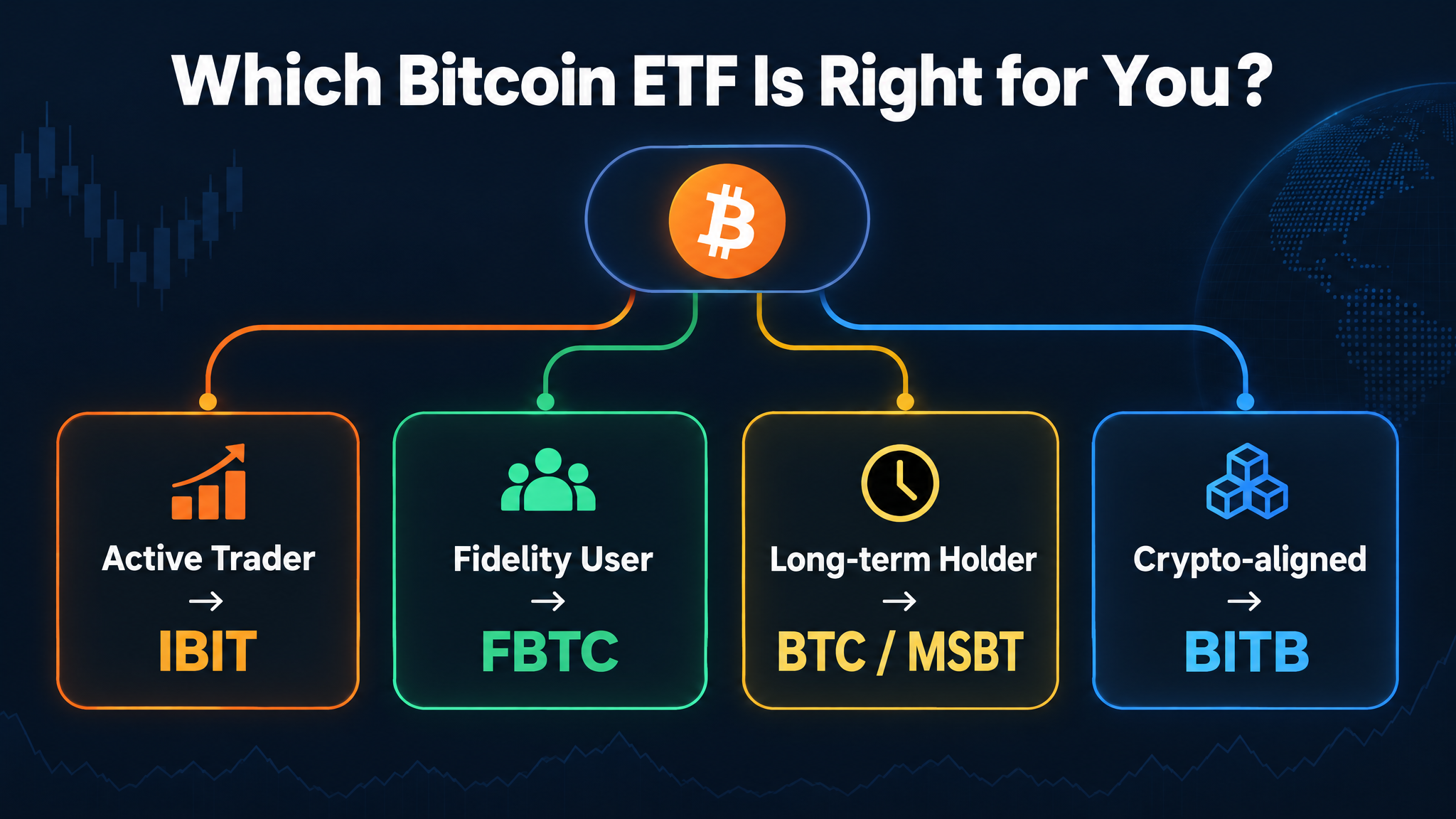
The decision tree is simpler than it looks:
Are you an active trader? Go with IBIT. The liquidity advantage is decisive — nothing else comes close for execution quality.
Are you a Fidelity customer? FBTC integrates seamlessly with your existing accounts and offers the custody independence bonus. Easy choice.
Are you a long-term, cost-focused investor? BTC (Grayscale Mini) or MSBT. If you want the proven track record, BTC. If you're comfortable with a newer fund and want the absolute lowest fee, MSBT.
Do you care about Bitcoin ecosystem alignment? BITB or HODL. Both donate to Bitcoin development and are managed by teams whose entire identity is crypto.
What About Ethereum ETFs and Multi-Asset Crypto ETFs?
Spot Ethereum ETFs launched in mid-2024 and have grown steadily, though AUM remains a fraction of Bitcoin ETF totals. The same framework applies: ETHA (BlackRock) leads on liquidity, FETH (Fidelity) offers custody independence, and smaller funds compete on fees. If you want diversified crypto exposure in a single wrapper, a handful of multi-asset crypto ETFs now exist — but they typically carry higher fees and less transparency than single-asset funds.
For most investors, the cleaner approach is to hold separate Bitcoin and Ethereum ETFs in your preferred ratio rather than relying on a bundled product where the manager controls the allocation.
Tax Considerations for Bitcoin ETF Investors
One underappreciated advantage of Bitcoin ETFs over direct Bitcoin ownership: simplified tax reporting. Your brokerage generates standard 1099 forms, and you don't need to track individual wallet transactions or use specialized crypto tax software. Capital gains treatment is identical to any other ETF — short-term if held under a year, long-term if held longer.
For retirement accounts, Bitcoin ETFs are particularly powerful. Holding FBTC or IBIT inside a Roth IRA means any appreciation is tax-free. That's a structural advantage that direct Bitcoin ownership in a personal wallet can't replicate without complex self-directed IRA arrangements.
Ready to accelerate your understanding of crypto markets and trading strategies? Explore Icoinpro's daily trading signals and education platform — built for investors who want to go beyond passive ETF holding.
Security: What Happens If a Custodian Fails?
This is the question that keeps institutional risk managers up at night. The short answer: Bitcoin ETF investors are protected by the fund structure itself. The Bitcoin held by custodians is segregated from the custodian's own assets — it's not on their balance sheet. If Coinbase went bankrupt tomorrow, IBIT's Bitcoin would be recoverable through bankruptcy proceedings as a segregated client asset.
That said, the process could take months and create significant disruption. This is why custody diversification across IBIT, FBTC, and HODL makes sense for very large allocations. For most retail investors with positions under $100,000, the practical risk is minimal — but it's worth understanding.
Serious about protecting your broader crypto holdings beyond ETFs? Protect your crypto assets with a Ledger hardware wallet — the gold standard in cold storage security for any Bitcoin you hold directly.
The Bottom Line: Best Bitcoin ETFs 2026
The spot Bitcoin ETF market has matured into a genuinely competitive, well-regulated space. The fee war is over, the winners are clear, and the choice now comes down to your specific situation rather than any dramatic quality differences between funds.
- IBIT — Best liquidity, best for active traders
- FBTC — Best for Fidelity users, unique custody independence
- BTC — Best proven low-cost option for long-term holders
- MSBT — Lowest expense ratio, newer but promising
- BITB — Best for crypto-native, mission-aligned investors
- HODL — Best for Gemini custody diversification
None of these are bad choices. The worst outcome is paralysis — spending months researching while Bitcoin moves. Pick the fund that fits your brokerage, your time horizon, and your cost sensitivity, then focus your energy on the bigger question: how much Bitcoin exposure makes sense in your overall portfolio.
Want to understand the deeper economics behind Bitcoin's value proposition? The Bitcoin Standard is essential reading for every serious crypto investor.
Frequently Asked Questions
Which Bitcoin ETF has the lowest fees in 2026?
The Morgan Stanley Bitcoin Trust (MSBT) has the lowest expense ratio at 0.14%, followed by the Grayscale Bitcoin Mini Trust (BTC) at 0.15%.
Is IBIT or FBTC better?
For active traders, IBIT wins on liquidity. For Fidelity account holders or investors who want custody independence from Coinbase, FBTC is the better choice. For pure cost efficiency, neither — look at BTC or MSBT instead.
Can I hold a Bitcoin ETF in an IRA?
Yes. Most major Bitcoin ETFs, including IBIT and FBTC, are available in traditional and Roth IRAs through standard brokerage accounts. Fidelity has particularly strong retirement account integration for FBTC.
Are Bitcoin ETFs safe?
Bitcoin ETFs are regulated investment products with segregated custody. They carry Bitcoin's price volatility risk, but the fund structure itself provides investor protections that direct Bitcoin ownership doesn't. The main risks are Bitcoin price risk and, to a lesser degree, custodian operational risk.
Building wealth in crypto requires more than holding and hoping.
The difference between investors who compound and those who stagnate usually comes down to active skill development — understanding market cycles, position sizing, and when to take profits.
The program I recommend to people who ask me is this crypto trading course — it\'s the one I point friends and family to when they\'re serious about learning. Daily lessons, live analysis, and a community that actually helps.
Affiliate link — I may earn a commission at no extra cost to you. I only recommend what I genuinely use.
Disclaimer: The information provided on this website is for educational and informational purposes only. It should not be considered financial or investment advice. Cryptocurrency investments carry significant risk. Always do your own research and consult with a qualified financial advisor before making investment decisions.
Free Crypto Insights
Get weekly trading tips, market analysis, and exclusive strategies delivered to your inbox.