Best Crypto Passive Income Strategies in 2026: 7 Ways to Make Your Crypto Work for You
Affiliate Disclosure: This article may contain affiliate links. We may earn a commission at no extra cost to you. All opinions are our own.
Marcus Chen
Senior Crypto Analyst & Educator
Certified Blockchain Professional | Former Wall Street Analyst
Marcus Chen is a cryptocurrency analyst and educator with over 8 years of experience in digital asset trading. He has helped thousands of beginners navigate the crypto markets through practical, actionable education.

Disclaimer: This content is for informational purposes only and should not be considered financial advice. Cryptocurrency investments carry significant risk. Always do your own research (DYOR) before making any investment decisions.
This article contains affiliate links. We may earn a commission at no extra cost to you if you make a purchase through these links. See our affiliate disclosure for details.
Best Crypto Passive Income Strategies in 2026: 7 Ways to Make Your Crypto Work for You
The best crypto passive income strategies in 2026 have matured well beyond the wild-west yield farming days of 2021. Today, you can earn 3% to 20%+ annually on your crypto holdings — without staring at charts all day — using battle-tested protocols that have processed billions in transactions. Whether you're holding ETH, SOL, stablecoins, or BTC, there's a strategy here that fits your risk tolerance and time commitment.
I've spent eight years watching this space evolve, and the shift toward sustainable, protocol-revenue-backed yields is the most important development for long-term crypto investors. Let's break down exactly what's working right now.
Why Passive Income from Crypto Makes Sense in 2026
Holding crypto without putting it to work is increasingly a missed opportunity. The infrastructure has improved dramatically — audited smart contracts, institutional-grade custody integrations, and liquid staking tokens that let you earn yield while staying flexible. The risks are real, but so are the rewards when you approach this methodically.
A few ground rules before we start: never put more into yield strategies than you can afford to lose, diversify across at least 2-3 protocols, and always verify you're using official contract addresses. With that said, here are the seven strategies worth your attention.
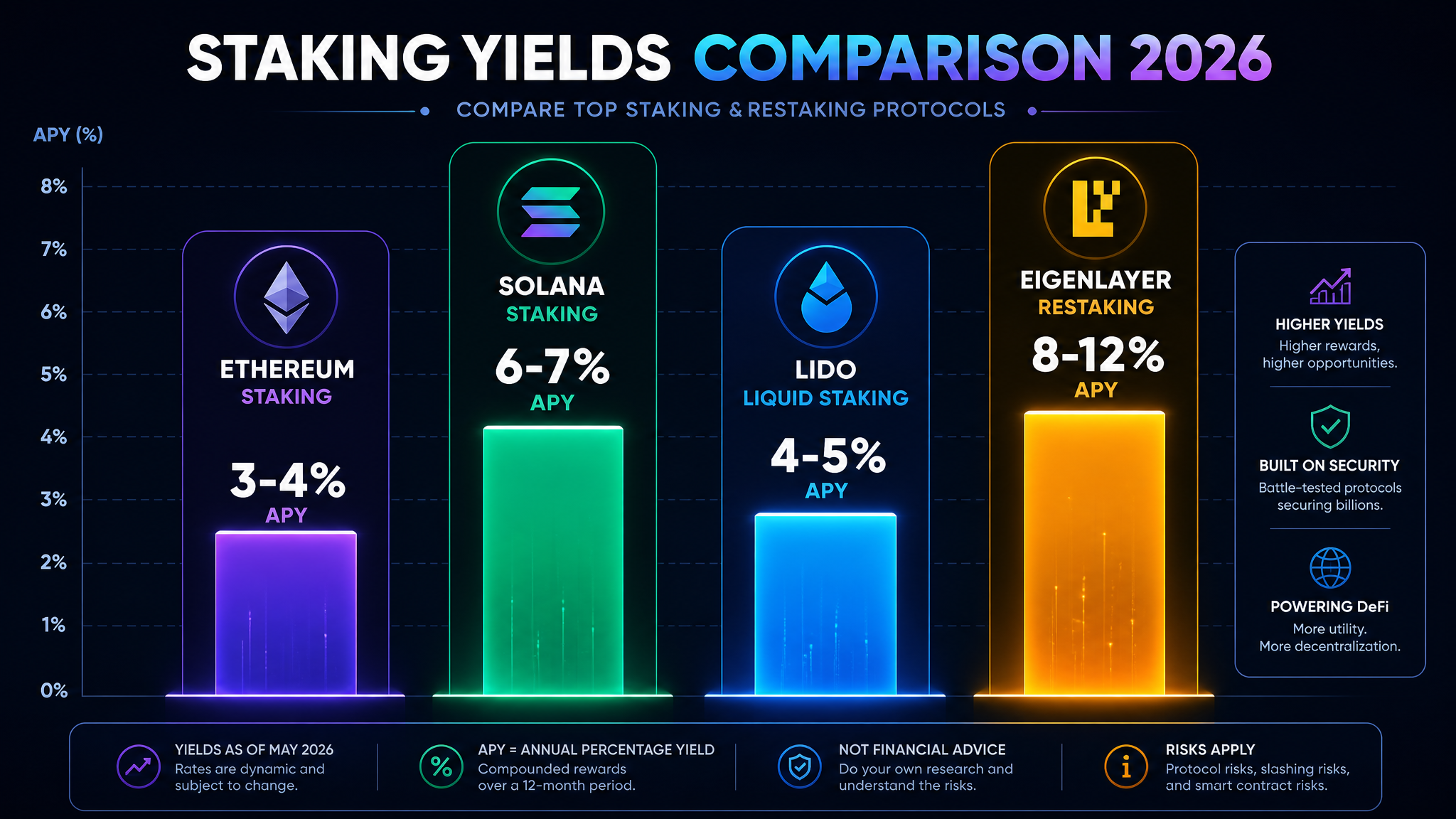
1. Ethereum Liquid Staking (3–4% APY)
Staking ETH directly requires 32 ETH and technical know-how. Liquid staking solves both problems. Platforms like Lido let you deposit any amount of ETH and receive stETH in return — a token that earns staking rewards automatically while remaining usable across DeFi.
Current yields sit around 3–4% annually, which sounds modest until you realize it's denominated in ETH. If ETH appreciates, your staking rewards compound on top of price gains. Lido holds over $30 billion in TVL and has been audited extensively. Rocket Pool is a solid decentralized alternative if you prefer a more distributed validator set.
The key advantage here: you're not locked up. Sell your stETH anytime on secondary markets. This flexibility is why liquid staking has become the default choice for ETH holders who want yield without sacrificing optionality.
2. Solana Staking (6–7% APY)
Solana's proof-of-stake network currently offers 6–7% annual staking rewards — nearly double Ethereum's rate. You can stake directly through wallets like Phantom or Backpack by delegating to a validator, or use liquid staking via Jito (which adds MEV tips on top of base rewards) or Marinade Finance.
Jito's liquid staking token, JitoSOL, has consistently outperformed basic SOL staking by capturing MEV (maximal extractable value) from Solana's block production. In practice, that's pushed effective yields closer to 7.5–8% for some periods in 2026.
Minimum stake: as little as 0.01 SOL. Unstaking takes 2–3 days for native staking, or you can sell JitoSOL instantly on DEXs. For SOL holders, this is the lowest-effort, highest-yield option available.
3. Stablecoin Lending on Aave (4–8% APY)
If you want yield without crypto price exposure, stablecoin lending is your answer. Aave — the blue-chip DeFi lending protocol — lets you deposit USDC, USDT, or DAI and earn interest from borrowers. Rates fluctuate with demand but have ranged from 4% to 8% on major stablecoins throughout 2026.
Aave operates on Ethereum mainnet plus Arbitrum, Base, Polygon, and Avalanche. For smaller positions, using Aave on Arbitrum or Base dramatically reduces gas costs. The protocol has processed over $50 billion in loans without a major exploit — a track record that matters when you're evaluating smart contract risk.
Morpho is worth mentioning here too. It sits on top of Aave and Compound, routing your deposits to whichever protocol offers better rates at any given moment. Morpho users have consistently earned 10–20% more yield than depositing directly, with the same underlying risk profile.
Ready to master crypto trading alongside your passive income strategy? Icoinpro offers step-by-step training that has helped thousands of beginners understand both active and passive crypto strategies.
4. Restaking with EigenLayer (Variable, 5–12% APY)
Restaking is the most innovative yield strategy to emerge in the past two years. EigenLayer lets you take your already-staked ETH (or liquid staking tokens like stETH) and "restake" it to provide security for additional protocols called Actively Validated Services (AVS).
In plain English: you earn your base ETH staking yield plus additional rewards from the AVS protocols you're securing. Combined yields have ranged from 5% to 12% depending on which AVS operators you choose and market conditions.
The risk is higher than basic staking — you're taking on slashing risk from multiple sources. But EigenLayer has attracted serious institutional attention, with over $15 billion in restaked assets. For sophisticated ETH holders comfortable with the mechanics, it's a compelling yield enhancement.
5. Yield Farming on Uniswap v4 (Variable, 10–30% APY)
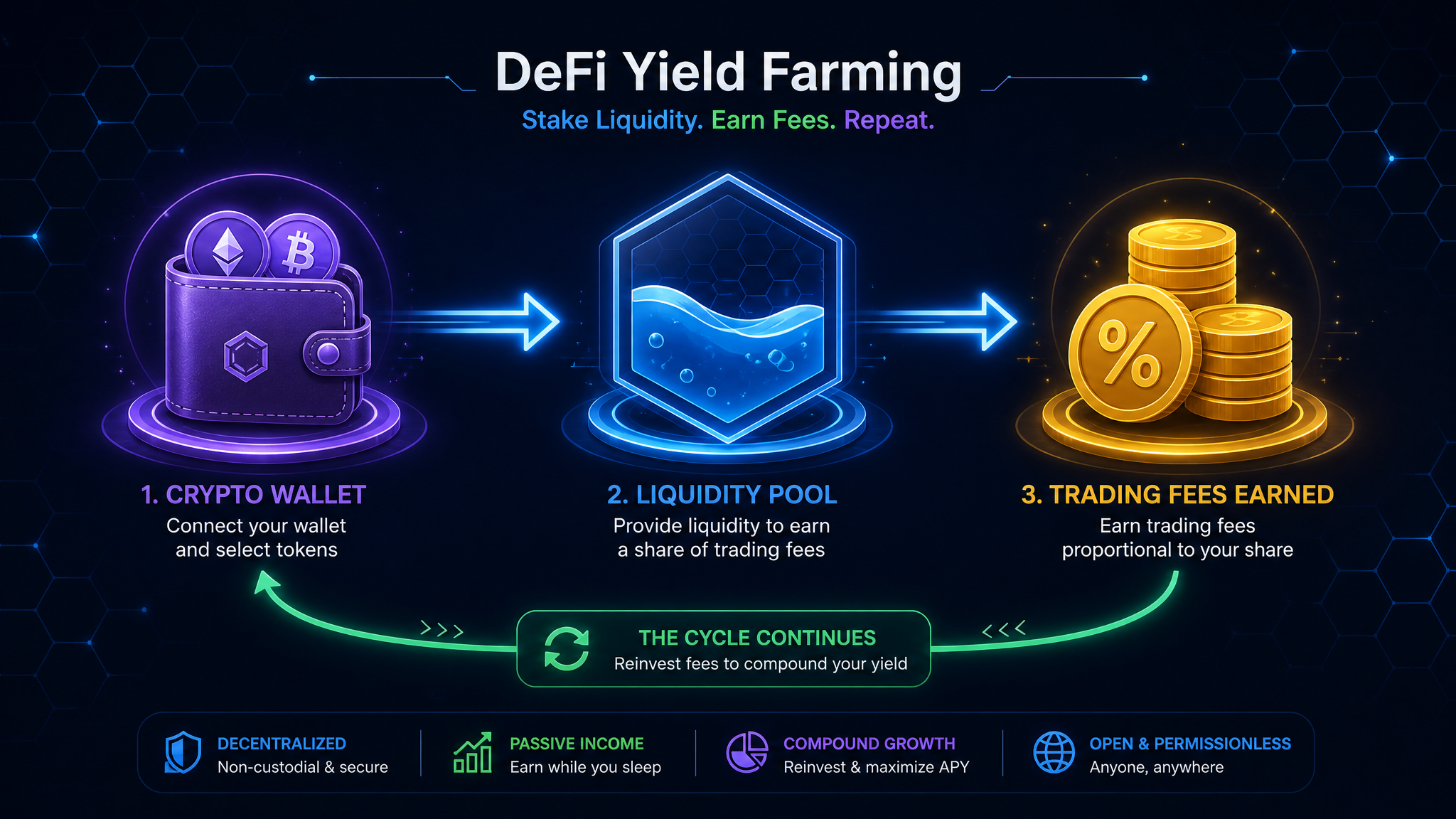
Providing liquidity to decentralized exchanges earns you a share of trading fees. Uniswap v4, launched in late 2025, introduced concentrated liquidity and hooks that have made LP positions significantly more capital-efficient than earlier versions.
The mechanics: you deposit two tokens (say, ETH and USDC) into a liquidity pool within a specific price range. Every trade that passes through your range earns you fees. On high-volume pairs, this can generate 10–30% APY — but it comes with impermanent loss risk if prices move sharply outside your range.
Best pairs for beginners: ETH/USDC or ETH/WBTC on narrow ranges. Use tools like Revert Finance or Gamma Strategies to monitor your positions and rebalance automatically. This strategy rewards active management — it's not truly "set and forget."
6. Pendle Finance: Fixed-Yield Strategies (5–15% APY)
Pendle Finance has become one of the most interesting yield tools in DeFi. It splits yield-bearing assets into two components: Principal Tokens (PT) and Yield Tokens (YT). This lets you lock in a fixed yield rate — regardless of what happens to variable rates — by buying PT at a discount.
Example: You buy PT-stETH expiring in 6 months at a 7% discount to face value. At expiry, you redeem for full stETH value. That 7% discount is your fixed yield, annualized. No variable rate risk, no impermanent loss — just a predictable return on your ETH.
Pendle has expanded to support dozens of yield-bearing assets across Ethereum, Arbitrum, and BNB Chain. TVL has grown past $5 billion in 2026. For investors who want DeFi yields with more predictability, Pendle is genuinely worth learning.
Protect your crypto assets while you earn yield — a Ledger hardware wallet keeps your private keys offline and safe, even as you interact with DeFi protocols through connected wallets.
7. Bitcoin Yield via BTCFi (3–8% APY)
Bitcoin holders have historically had limited yield options — HODL or nothing. That's changed. The BTCFi ecosystem now offers several ways to earn on BTC without selling or wrapping it on Ethereum.
Babylon Protocol enables native Bitcoin staking, where BTC holders can stake their coins to provide security for proof-of-stake chains and earn rewards. Stacks lets you "stack" STX tokens to earn BTC rewards directly. And wrapped BTC (WBTC or cbBTC) on Aave or Compound earns lending yields of 1–3% with minimal complexity.
For BTC holders who refuse to touch DeFi, some centralized platforms like Nexo offer 3–5% on BTC deposits — though this reintroduces custodial risk. The native BTCFi options are more complex but keep your BTC under your control.
Risk Management: The Framework That Matters
Every strategy above carries distinct risks. Here's how to think about them:
- Smart contract risk: Stick to protocols with 2+ years of live operation and multiple audits. Aave, Lido, Uniswap, and Pendle all qualify.
- Concentration risk: Don't put 100% of your yield-seeking capital into one protocol. Spread across 3–5 strategies.
- Liquidity risk: Know your exit. Liquid staking tokens can be sold instantly; native staking has unbonding periods.
- Tax implications: Staking rewards and yield farming income are generally taxable as ordinary income in most jurisdictions. Track everything with a tool like Koinly or CoinTracker.
Want to understand the deeper economics behind Bitcoin and crypto as a monetary system? The Bitcoin Standard is essential reading for every serious crypto investor.
Actionable Takeaways
- Start simple: ETH liquid staking (Lido) or SOL staking (Jito) are the lowest-friction entry points with solid yields.
- Add stablecoin yield: Aave or Morpho for USDC/USDT gives you yield without price exposure — great for capital you might need.
- Level up with Pendle: Lock in fixed yields on your stETH or other yield-bearing assets for predictable returns.
- Explore BTCFi: If you're a Bitcoin maximalist, Babylon and Stacks now offer native BTC yield without wrapping.
- Never chase APY alone: A 200% APY on an unknown protocol is a red flag, not an opportunity. Sustainable yield comes from real protocol revenue.
The passive income landscape in crypto has never been more mature or more accessible. The protocols are battle-tested, the yields are real, and the tools to manage risk have improved dramatically. Start with one strategy, understand it deeply, then expand from there.
Building wealth in crypto requires more than holding and hoping.
The difference between investors who compound and those who stagnate usually comes down to active skill development — understanding market cycles, position sizing, and when to take profits.
The program I recommend to people who ask me is this crypto trading course — it\'s the one I point friends and family to when they\'re serious about learning. Daily lessons, live analysis, and a community that actually helps.
Affiliate link — I may earn a commission at no extra cost to you. I only recommend what I genuinely use.
Disclaimer: The information provided on this website is for educational and informational purposes only. It should not be considered financial or investment advice. Cryptocurrency investments carry significant risk. Always do your own research and consult with a qualified financial advisor before making investment decisions.
Free Crypto Insights
Get weekly trading tips, market analysis, and exclusive strategies delivered to your inbox.