Crypto DCA Strategy for Beginners: How to Build Wealth Without Timing the Market in 2026
Affiliate Disclosure: This article may contain affiliate links. We may earn a commission at no extra cost to you. All opinions are our own.
Marcus Chen
Senior Crypto Analyst & Educator
Certified Blockchain Professional | Former Wall Street Analyst
Marcus Chen is a cryptocurrency analyst and educator with over 8 years of experience in digital asset trading. He has helped thousands of beginners navigate the crypto markets through practical, actionable education.
Crypto DCA Strategy for Beginners: How to Build Wealth Without Timing the Market in 2026
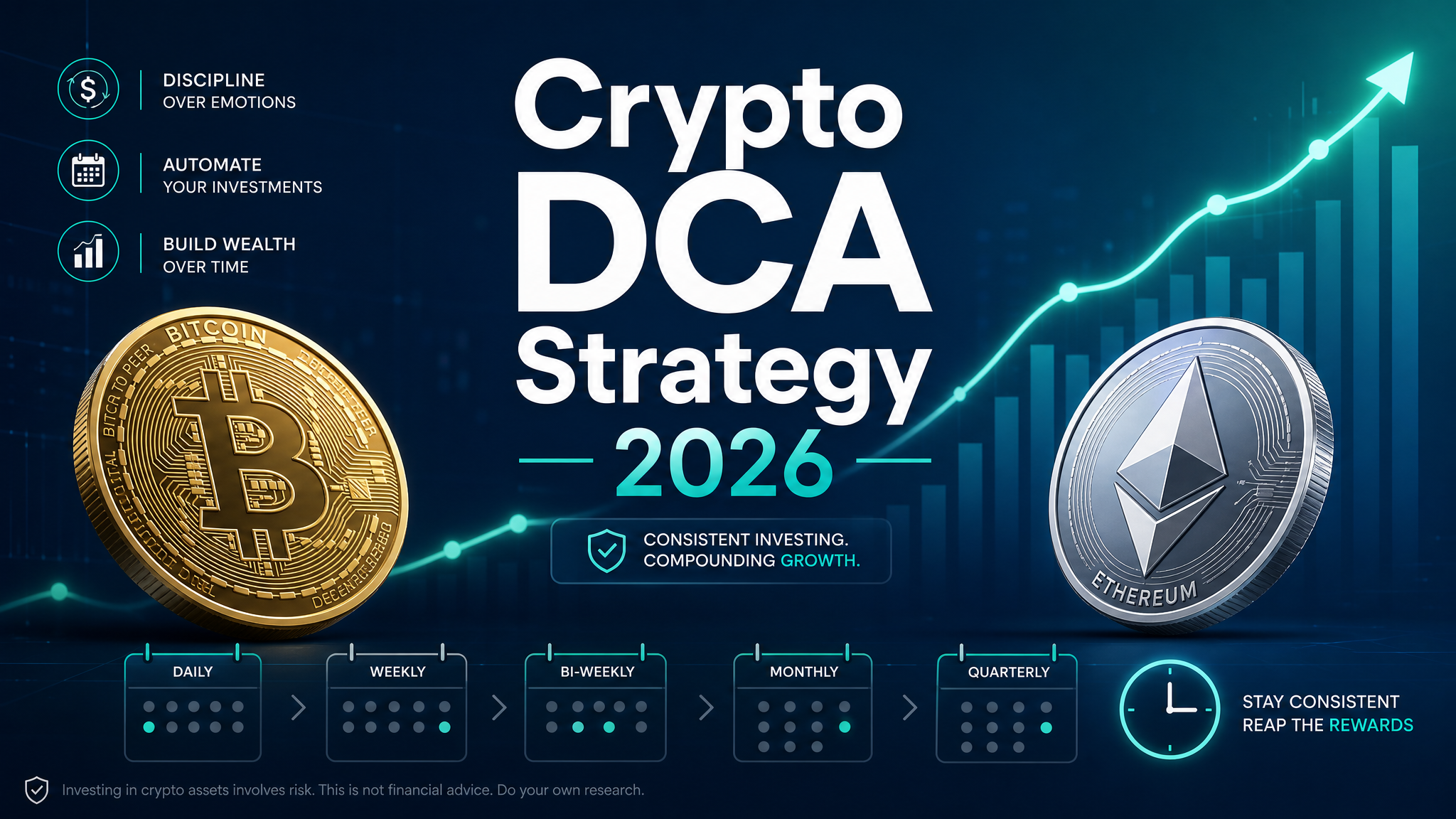
The crypto DCA strategy — dollar-cost averaging — is the single most beginner-friendly way to build a cryptocurrency position in 2026 without losing sleep over price swings. Instead of trying to buy the perfect dip (spoiler: nobody consistently does), you invest a fixed amount on a regular schedule. Bitcoin at $95,000? You buy. Bitcoin drops to $78,000? You buy more. Over time, your average entry price smooths out, and you accumulate more coins during downturns automatically.
This guide walks you through exactly how to set up a DCA plan, which assets to target, how to store what you buy, and what the IRS expects from you come tax season. No jargon overload. Just a practical roadmap.
What Is Dollar-Cost Averaging in Crypto?
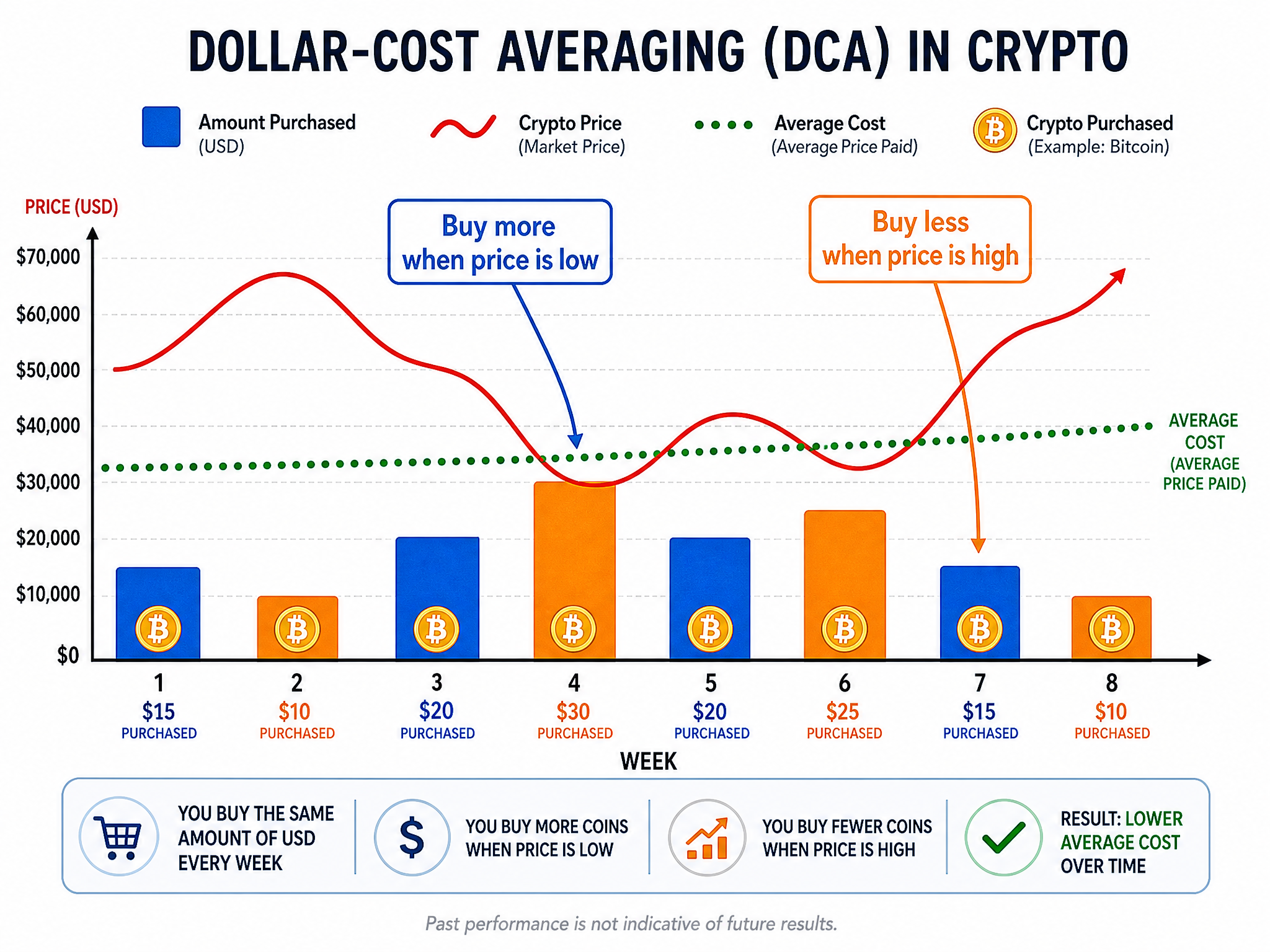
Dollar-cost averaging means buying a fixed dollar amount of an asset at regular intervals — weekly, bi-weekly, or monthly — regardless of the current price. It's the opposite of trying to time the market.
Here's a simple example. Say you invest $100 in Bitcoin every week for four weeks:
- Week 1: BTC at $90,000 → you get 0.00111 BTC
- Week 2: BTC at $80,000 → you get 0.00125 BTC
- Week 3: BTC at $85,000 → you get 0.00118 BTC
- Week 4: BTC at $95,000 → you get 0.00105 BTC
Total spent: $400. Total BTC: 0.00459. Average cost per BTC: ~$87,145. If you'd tried to time it and bought all $400 in Week 1, your average would be $90,000. DCA saved you nearly $3,000 per BTC in this scenario — without any market prediction required.
The math works because you automatically buy more units when prices are low and fewer when prices are high. It's not magic. It's just discipline applied consistently.
Why DCA Works Especially Well for Crypto Beginners
Crypto is volatile. Bitcoin has dropped 30% in a single week and recovered 50% the following month. For someone new to the space, that kind of movement is emotionally brutal. DCA removes the decision-making from the equation.
Three reasons DCA fits beginners perfectly:
1. It Eliminates Emotional Trading
The biggest mistake new investors make is panic-selling during dips. When you're on a DCA schedule, a price crash isn't a disaster — it's a discount. Your automated purchase goes through regardless, and you end up with more coins for the same dollar amount. That mental reframe alone is worth the strategy.
2. It Builds the Habit of Investing
Consistency beats perfection. Investing $50 every week for a year beats waiting for the "right moment" that never comes. DCA turns investing into a routine, like a gym membership you actually use.
3. It Works With Small Budgets
You don't need $10,000 to start. Most major exchanges let you buy as little as $10 worth of Bitcoin or Ethereum. A $25/week DCA plan adds up to $1,300 per year — a meaningful position built without ever feeling the pinch of a large lump-sum purchase.
Which Crypto Assets Should Beginners DCA Into?
Not all cryptocurrencies are DCA-worthy. The strategy works best with assets that have strong fundamentals, deep liquidity, and a reasonable expectation of long-term survival. Here's how to think about it:
Bitcoin (BTC) — The Core Position
Bitcoin is the foundation of any beginner DCA portfolio. It has the longest track record, the deepest institutional adoption (spot ETFs now hold over $120 billion in assets as of mid-2026), and the clearest regulatory status in the US. Most DCA-focused advisors suggest putting 50–70% of your crypto allocation into BTC.
Ethereum (ETH) — The Smart Contract Layer
Ethereum powers the majority of DeFi, NFTs, and Layer 2 networks. It's the second-most liquid crypto asset and has a deflationary supply mechanism post-Merge. A 20–30% allocation alongside Bitcoin gives you exposure to the broader crypto ecosystem without chasing speculative altcoins.
Solana (SOL) — Optional Growth Allocation
If you want a small growth kicker, Solana has proven itself as a high-throughput blockchain with real developer activity and user adoption. Keep this to 10% or less of your crypto allocation. It's more volatile than BTC or ETH, so size accordingly.
What to avoid: Meme coins, newly launched tokens with no track record, and anything promising guaranteed returns. DCA is a long-term wealth-building tool — not a vehicle for speculation.
For a structured approach to learning how to evaluate crypto assets and build trading skills, Icoinpro offers step-by-step training that has helped thousands of beginners move from confused to confident.
How to Set Up Your Crypto DCA Plan: Step by Step
Setting up a DCA plan takes about 20 minutes. Here's the exact process:
Step 1: Choose a Regulated Exchange
For US-based beginners, Coinbase, Kraken, and Gemini are the most regulated and user-friendly options. All three offer recurring buy features that automate your DCA purchases. Create an account, complete KYC verification (government ID required), and enable two-factor authentication using an authenticator app — not SMS, which is vulnerable to SIM-swap attacks.
Step 2: Fund Your Account
Link a bank account via ACH transfer. This is the cheapest funding method — typically free or under 0.5% in fees. Avoid credit card purchases, which can carry fees up to 4% and may be treated as cash advances by your bank.
Step 3: Set Up Recurring Buys
On Coinbase: go to "Buy" → select your asset → choose "Recurring" → set your amount and frequency. Weekly purchases work well for smoothing volatility. Monthly purchases are more fee-efficient if you're on a tight budget. Set it and forget it.
Step 4: Move to Self-Custody Once You Hit $1,000
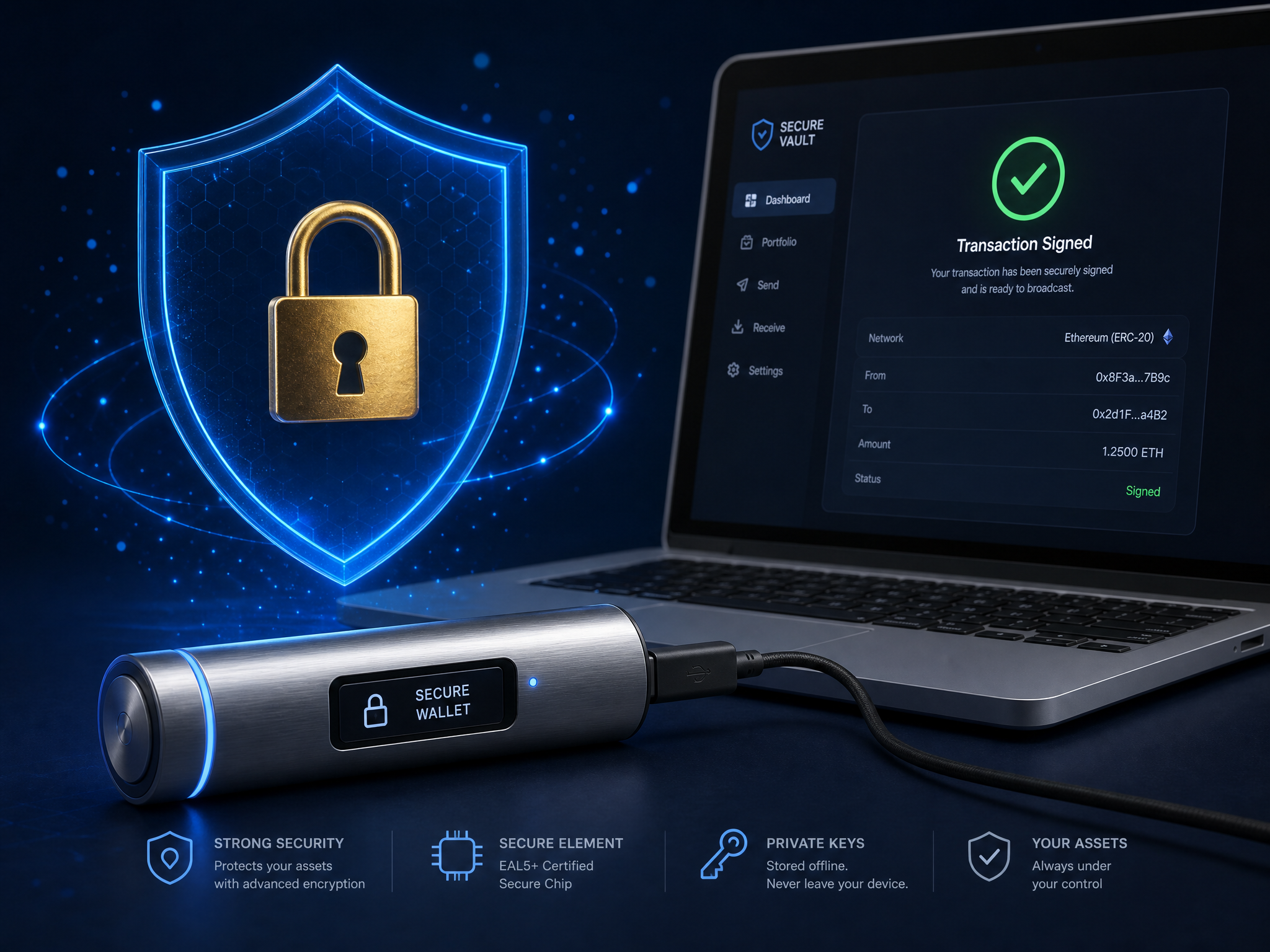
Leaving crypto on an exchange means trusting that exchange with your assets. Exchanges can be hacked, go bankrupt, or freeze withdrawals. Once your holdings exceed roughly $1,000, move them to a hardware wallet. Protect your crypto assets with a Ledger hardware wallet — the gold standard in cold storage security. Your private keys stay offline, completely out of reach of remote attackers.
Step 5: Store Your Seed Phrase Offline
When you set up a hardware wallet, you'll receive a 12–24 word seed phrase. Write it on paper (or metal for fire/water resistance). Never photograph it, type it into any website, or store it digitally. This phrase is the master key to your funds — lose it and your crypto is gone forever.
DCA Frequency: Weekly vs. Monthly — Which Is Better?
Both work. The difference is marginal over long time horizons, but here's the practical breakdown:
Weekly DCA: Better volatility smoothing. More purchase events means your average cost tracks the market more closely. Slightly higher total fees if your exchange charges per transaction. Best for people who want maximum averaging effect.
Monthly DCA: Fewer transactions, lower total fees. Easier to align with a paycheck schedule. Slightly less smoothing, but the difference over 3–5 years is minimal. Best for people optimizing for simplicity and cost.
The honest answer: the frequency matters far less than the consistency. Pick one and stick to it. Stopping your DCA during a bear market is the single biggest mistake you can make — that's precisely when you're accumulating the most coins per dollar.
Crypto Taxes and DCA: What Beginners Need to Know
The IRS treats cryptocurrency as property. Every time you sell, trade, or spend crypto, it's a taxable event. Here's what that means for DCA investors:
Buying Is Not Taxable
Purchasing crypto with USD is not a taxable event. You're simply acquiring an asset. No tax owed at purchase.
Selling Creates Capital Gains or Losses
When you eventually sell, your gain or loss is calculated as: Sale Price − Cost Basis = Capital Gain/Loss. Your cost basis is what you paid for each lot of crypto. With DCA, you'll have dozens of purchase lots at different prices — this is where good record-keeping matters.
Short-Term vs. Long-Term Rates
Hold for under a year: gains taxed at ordinary income rates (10–37%). Hold for over a year: gains taxed at preferential long-term rates (0%, 15%, or 20%). This is a powerful incentive to hold your DCA positions for at least 12 months before selling.
Starting in 2026: Form 1099-DA
Centralized exchanges are now required to issue Form 1099-DA reporting your gross proceeds. Keep your own records too — exchange-issued forms sometimes have incomplete cost basis data, especially if you've moved assets between platforms.
For tracking all your DCA purchases and calculating taxes accurately, dedicated crypto tax software is worth the investment. Our Best Crypto Tax Software 2026 guide covers the top options.
Common DCA Mistakes to Avoid
A few pitfalls that trip up beginners:
- Stopping during bear markets. This is the most expensive mistake. Bear markets are when DCA accumulates the most value. Keep buying.
- Over-diversifying too early. Spreading $50/week across 10 different coins creates complexity without meaningful diversification. Start with BTC and ETH. Add others only after you understand what you own.
- Checking prices daily. DCA is a long-term strategy. Daily price checks lead to emotional decisions. A monthly portfolio review is plenty.
- Ignoring fees. Some exchanges charge 1.5–2.5% per transaction on recurring buys. Over years, that adds up. Compare fee structures before committing to a platform.
- Leaving everything on the exchange. As mentioned above — once your holdings are meaningful, move to self-custody.
How Much Should You DCA Into Crypto?
Financial advisors generally suggest keeping crypto exposure between 1% and 10% of your total investable assets. For most beginners, that means starting small — $25 to $100 per week — and increasing as your comfort and knowledge grow.
The key rule: only invest money you can afford to lose entirely. Crypto has made people wealthy and wiped out portfolios. DCA reduces risk but doesn't eliminate it. Never DCA with rent money, emergency funds, or money you'll need within 12 months.
Want to understand the deeper economics behind Bitcoin and why long-term holders have historically been rewarded? The Bitcoin Standard is essential reading for every crypto enthusiast building a long-term position.
Key Takeaways
- Crypto DCA means investing a fixed amount at regular intervals, regardless of price — removing emotion from the equation.
- Focus your DCA on Bitcoin and Ethereum as core positions; keep speculative altcoins to 10% or less.
- Set up recurring buys on a regulated exchange (Coinbase, Kraken, or Gemini) and automate the process.
- Move holdings to a hardware wallet once you exceed ~$1,000 in crypto assets.
- Never stop DCA during bear markets — that's when you accumulate the most value per dollar.
- Keep records of every purchase for tax purposes; hold positions over 12 months to qualify for lower long-term capital gains rates.
Building wealth in crypto requires more than holding and hoping.
The difference between investors who compound and those who stagnate usually comes down to active skill development — understanding market cycles, position sizing, and when to take profits.
The program I recommend to people who ask me is this crypto trading course — it\'s the one I point friends and family to when they\'re serious about learning. Daily lessons, live analysis, and a community that actually helps.
Affiliate link — I may earn a commission at no extra cost to you. I only recommend what I genuinely use.
Disclaimer: The information provided on this website is for educational and informational purposes only. It should not be considered financial or investment advice. Cryptocurrency investments carry significant risk. Always do your own research and consult with a qualified financial advisor before making investment decisions.
Free Crypto Insights
Get weekly trading tips, market analysis, and exclusive strategies delivered to your inbox.