Crypto Passive Income for Beginners: Staking vs. Yield Farming vs. Lending in 2026
Affiliate Disclosure: This article may contain affiliate links. We may earn a commission at no extra cost to you. All opinions are our own.
Marcus Chen
Senior Crypto Analyst & Educator
Certified Blockchain Professional | Former Wall Street Analyst
Marcus Chen is a cryptocurrency analyst and educator with over 8 years of experience in digital asset trading. He has helped thousands of beginners navigate the crypto markets through practical, actionable education.

Disclaimer: This content is for informational purposes only and should not be considered financial advice. Cryptocurrency investments carry significant risk. Always do your own research (DYOR) before making any investment decisions.
This article contains affiliate links. We may earn a commission at no extra cost to you if you make a purchase through these links. See our affiliate disclosure for details.
Crypto Passive Income for Beginners: Staking vs. Yield Farming vs. Lending in 2026
Crypto passive income is one of the most searched topics among new investors right now — and for good reason. In 2026, you can put your digital assets to work and earn real returns without actively trading. But here's the thing: not all passive income strategies are created equal. Staking, yield farming, and crypto lending each carry different risk levels, complexity, and expected returns. Pick the wrong one as a beginner and you could lose more than you earn.
This guide breaks down all three strategies in plain English, with real numbers, honest risk assessments, and a clear recommendation for where to start.
Why Crypto Passive Income Has Changed in 2026
The wild west days of 20,000% APY yield farms are mostly gone. After the 2022 DeFi collapses — Terra/Luna, Celsius, BlockFi — the market matured fast. What's left in 2026 is a more sustainable ecosystem where returns are driven by actual economic activity: transaction fees, lending demand, and network security rewards.
The GENIUS Act (signed into law in July 2025) also changed the stablecoin landscape. Yield-bearing stablecoins from centralized issuers are now restricted, which pushed more capital toward decentralized lending protocols. That's actually good news for DeFi yields — more borrowing demand means better rates for lenders.
Total crypto market cap sits around $2.7 trillion as of September 2026. Institutional money is in. Regulatory frameworks exist. This is a very different environment than 2021, and your passive income strategy should reflect that.
Strategy #1: Crypto Staking — The Beginner's Best Friend
Staking is the simplest way to earn passive income on crypto. You lock up your tokens to help secure a Proof-of-Stake (PoS) blockchain, and in return, the network pays you rewards. Think of it like earning interest at a bank — except the "bank" is a decentralized network, and you're helping validate transactions.
How Staking Works
When you stake ETH, SOL, or ATOM, you're essentially delegating your tokens to a validator node. That validator processes transactions and earns block rewards. You get a cut proportional to your stake. No trading required. No complex strategies. Just hold and earn.
Current staking yields in September 2026:
- Ethereum (ETH): 2.5–4.8% APY
- Solana (SOL): 6–8% APY
- Cosmos (ATOM): 12–18% APY (higher inflation, higher risk)
- Polkadot (DOT): 10–14% APY
ETH staking is the gold standard for beginners. The returns are modest but the network is battle-tested, and Ethereum's role in DeFi infrastructure makes it a long-term hold for most portfolios anyway.
Liquid Staking: Stake Without Getting Locked In
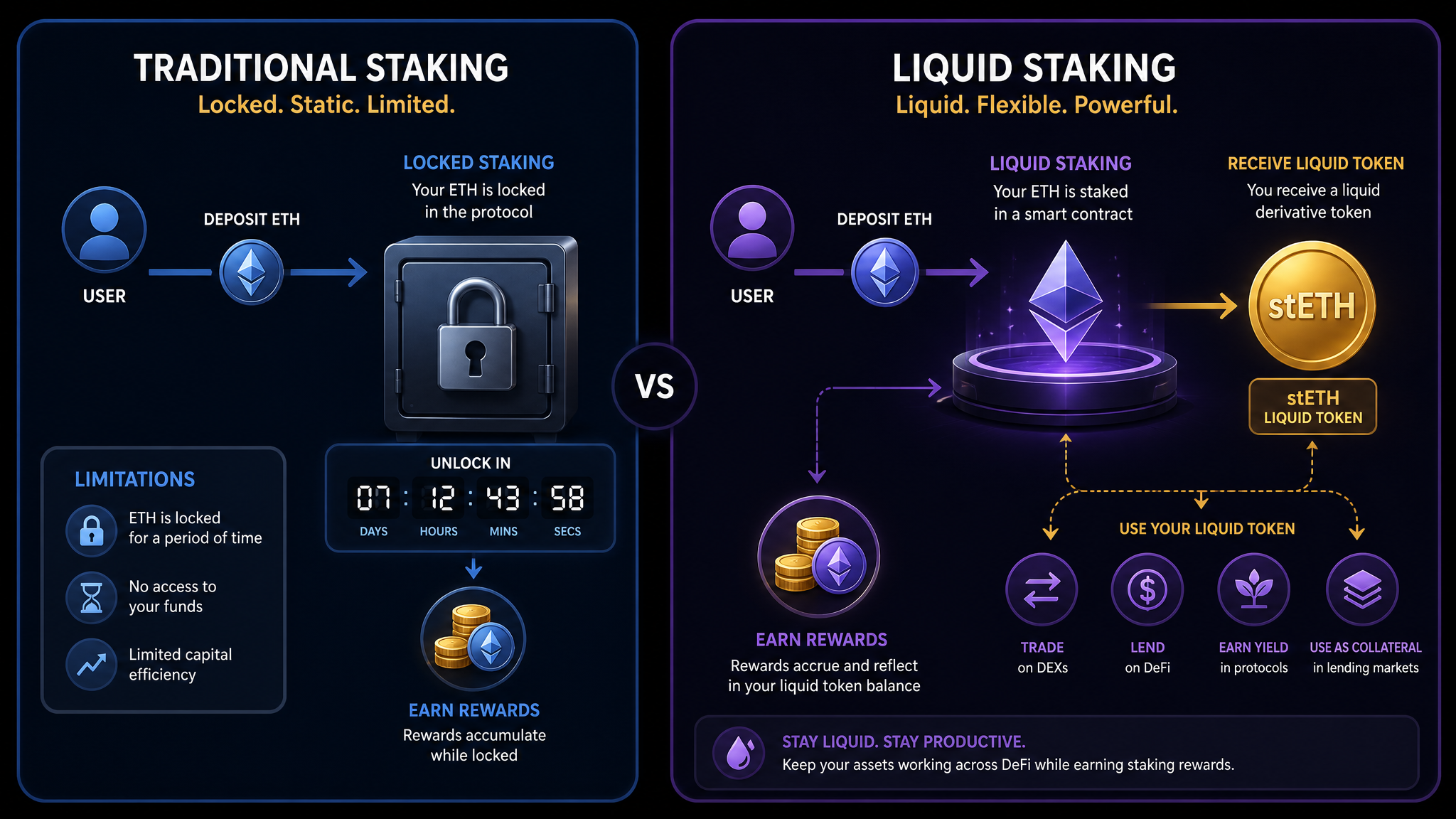
Traditional staking has one annoying drawback: lock-up periods. Ethereum's unbonding period can take days. That's where liquid staking comes in. Protocols like Lido (stETH), Rocket Pool (rETH), and Jito (jitoSOL on Solana) let you stake and receive a derivative token in return. That token represents your staked position and keeps accruing rewards — but you can trade it, use it as collateral, or move it anytime.
Liquid staking adds one layer of smart contract risk compared to native staking, but for most beginners, the flexibility is worth it.
Staking Risks to Know
- Slashing: If your validator misbehaves (rare), a portion of your stake can be penalized. Using reputable validators or liquid staking protocols mitigates this.
- Price volatility: You're earning more tokens, but if the token price drops 40%, your dollar-denominated returns suffer.
- Lock-up periods: Native staking can lock funds for days or weeks. Plan accordingly.
Bottom line on staking: Low complexity, low-to-medium risk, predictable returns. Perfect starting point for beginners.
For a structured approach to learning crypto trading alongside your staking strategy, Icoinpro offers step-by-step training that has helped thousands of beginners build confidence in the market.
Strategy #2: Crypto Lending — Predictable Yields, Manageable Risk
Crypto lending is exactly what it sounds like: you lend your assets to borrowers and earn interest. In DeFi, this happens through smart contracts on protocols like Aave, Compound, and Morpho. Borrowers must over-collateralize their loans (deposit more value than they borrow), which protects lenders from default.
Current Lending Rates (September 2026)
- USDC on Aave: 4–7% APY (varies with borrowing demand)
- ETH on Aave: 1.5–3% APY
- WBTC on Compound: 0.5–2% APY
- Stablecoins on Morpho: 5–9% APY (optimized lending)
Stablecoin lending is particularly attractive for risk-averse beginners. You're not exposed to crypto price volatility — you deposit USDC, earn 4–7%, and withdraw USDC. The only risks are smart contract bugs and protocol insolvency.
CeFi vs. DeFi Lending
Centralized lending platforms (CeFi) like Nexo or some exchange-based products offer simpler interfaces but carry counterparty risk. If the company goes under — as Celsius and BlockFi did in 2022 — your funds can be frozen or lost. DeFi lending protocols are transparent (all code is auditable) and non-custodial, meaning no company holds your keys.
For beginners, starting with a well-audited DeFi protocol like Aave is generally safer than trusting a centralized platform with your funds.
Lending Risks
- Smart contract exploits: Even audited protocols can have bugs. Diversify across protocols rather than putting everything in one.
- Variable rates: Lending APYs fluctuate with borrowing demand. The 7% you see today might be 3% next month.
- Liquidation cascades: In extreme market crashes, mass liquidations can temporarily destabilize protocols.
Bottom line on lending: Medium complexity, medium risk, solid returns especially on stablecoins. Good second step after you've got staking figured out.
Strategy #3: Yield Farming — High Reward, High Complexity
Yield farming is the most complex of the three strategies. You provide liquidity to a decentralized exchange (DEX) like Uniswap, Curve, or Aerodrome, and earn a share of trading fees plus bonus token rewards. The headline APYs can look incredible — sometimes 30%, 50%, even higher. But the reality is more nuanced.
How Yield Farming Works
To farm yield, you typically deposit two tokens into a liquidity pool in a 50/50 ratio. For example, you might deposit $500 of ETH and $500 of USDC into an ETH/USDC pool on Uniswap v4. Every time someone trades through that pool, you earn a fraction of the fee. Many protocols also pay bonus rewards in their governance tokens.
The Impermanent Loss Problem
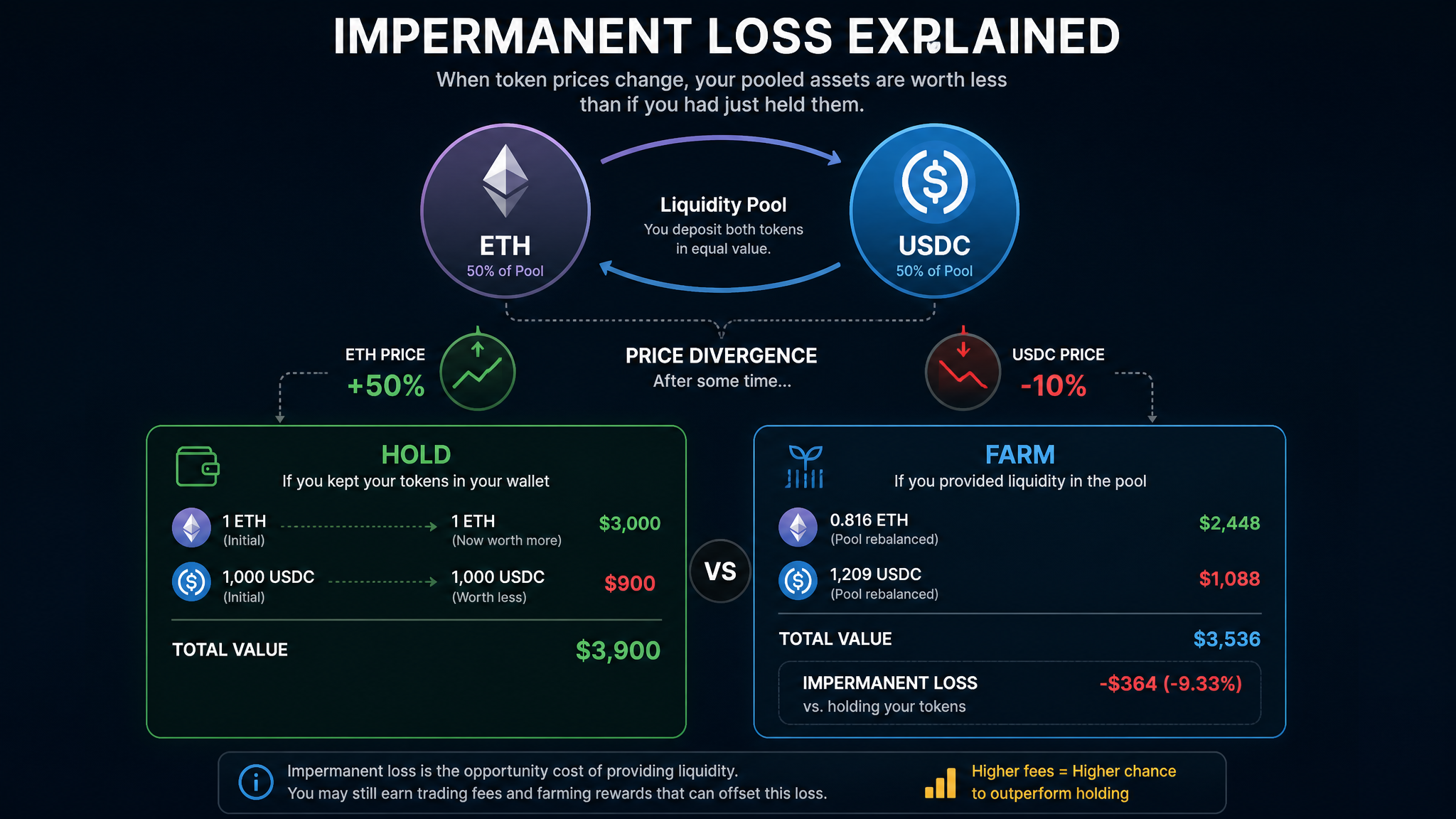
Here's what the high APY numbers don't tell you: impermanent loss. When the price ratio of your two deposited tokens changes significantly, you end up with less value than if you'd just held them. If ETH doubles in price while you're farming an ETH/USDC pool, you'd have been better off just holding ETH.
Real-world example: You deposit $1,000 into an ETH/USDC pool when ETH is at $3,000. ETH rises to $4,500. Your pool position is now worth roughly $1,225 — but if you'd just held the ETH and USDC separately, you'd have $1,375. That $150 gap is impermanent loss. The farming fees need to exceed that gap to make the strategy profitable.
When Yield Farming Makes Sense
Yield farming works best in specific scenarios:
- Stablecoin pairs: USDC/USDT pools have minimal impermanent loss since both tokens stay near $1. Curve Finance specializes in these.
- Correlated asset pairs: ETH/stETH or BTC/WBTC pools have low impermanent loss because the assets move together.
- Concentrated liquidity: Uniswap v4 lets you provide liquidity in a specific price range, boosting fee income — but requires active management.
Yield Farming Risks
- Impermanent loss: Can wipe out fee income in volatile markets.
- Smart contract risk: Higher than lending since you're interacting with more complex code.
- Reward token devaluation: If the protocol's governance token crashes, your "high APY" evaporates.
- Rug pulls: Newer, unaudited protocols can be fraudulent. Stick to established protocols.
Bottom line on yield farming: High complexity, high risk, potentially high reward. Not recommended for beginners until you've mastered staking and lending.
Side-by-Side Comparison: Which Strategy Is Right for You?
| Strategy | Complexity | Risk Level | Typical APY | Best For |
|---|---|---|---|---|
| Staking | Low | Low–Medium | 2–18% | Beginners, long-term holders |
| Lending | Medium | Medium | 3–9% | Risk-averse earners, stablecoin holders |
| Yield Farming | High | High | 5–50%+ | Experienced DeFi users |
Tax Implications You Can't Ignore
In the US, staking rewards, lending interest, and yield farming income are all treated as ordinary income at the time you receive them. That means if you earn $1,000 in staking rewards when ETH is at $3,000, you owe income tax on $1,000 — even if you never sell. When you eventually sell those reward tokens, you also owe capital gains tax on any appreciation.
Keep detailed records of every reward you receive, including the date and fair market value. Crypto tax software like Koinly or CoinTracker can automate most of this tracking.
How to Get Started: A Beginner's Roadmap
Here's a practical sequence for building your crypto passive income stack:
- Step 1 — Secure your assets first. Before earning yield, make sure your crypto is safe. Protect your crypto assets with a Ledger hardware wallet — the gold standard in cold storage security. You can still stake from a hardware wallet using compatible interfaces.
- Step 2 — Start with ETH or SOL staking. Use a liquid staking protocol (Lido for ETH, Jito for SOL) so you maintain flexibility. Earn 3–8% APY with minimal complexity.
- Step 3 — Add stablecoin lending. Once comfortable with staking, deposit some USDC into Aave or Morpho. Earn 4–7% with no price exposure.
- Step 4 — Explore yield farming only after mastering steps 2–3. Start with stablecoin pairs on Curve to minimize impermanent loss risk.
Want to understand the deeper economics behind crypto and build a solid investment foundation? The Bitcoin Standard is essential reading for every crypto enthusiast — it explains why Bitcoin exists and how to think about digital money long-term.
Key Takeaways
- Crypto passive income in 2026 is real and sustainable — but the 2021-era 10,000% APY farms are gone.
- Staking is the best starting point: low complexity, predictable returns, minimal active management required.
- Lending is ideal for stablecoin holders who want yield without price exposure.
- Yield farming can boost returns significantly but requires understanding impermanent loss and active position management.
- All three strategies generate taxable income — track everything from day one.
- Security first: use a hardware wallet and stick to audited, established protocols.
Want structured training instead of piecing it together yourself?
Self-education works, but it's slow. The course that accelerated my learning the most gave me a daily framework — real market analysis, real setups, real accountability.
The program I recommend to people who ask me is this crypto trading course — it\'s the one I point friends and family to when they\'re serious about learning. Daily lessons, live analysis, and a community that actually helps.
Affiliate link — I may earn a commission at no extra cost to you. I only recommend what I genuinely use.
Disclaimer: The information provided on this website is for educational and informational purposes only. It should not be considered financial or investment advice. Cryptocurrency investments carry significant risk. Always do your own research and consult with a qualified financial advisor before making investment decisions.
Free Crypto Insights
Get weekly trading tips, market analysis, and exclusive strategies delivered to your inbox.