Crypto Wallet Types Explained: Hot vs. Cold Wallets for Beginners in 2026
Affiliate Disclosure: This article may contain affiliate links. We may earn a commission at no extra cost to you. All opinions are our own.
Marcus Chen
Senior Crypto Analyst & Educator
Certified Blockchain Professional | Former Wall Street Analyst
Marcus Chen is a cryptocurrency analyst and educator with over 8 years of experience in digital asset trading. He has helped thousands of beginners navigate the crypto markets through practical, actionable education.
Crypto Wallet Types Explained: Hot vs. Cold Wallets for Beginners in 2026
If you've just bought your first Bitcoin or Ethereum, the next question hits fast: where do you actually keep it? Understanding crypto wallet types is the single most important security decision you'll make as a new investor. Get it wrong and you risk losing everything to a hack or a forgotten password. Get it right and your assets stay safe whether the market is up 300% or down 60%.
This guide breaks down every major wallet category — hot wallets, cold wallets, custodial vs. non-custodial — in plain English. No jargon overload, no assumptions about your technical background. By the end, you'll know exactly which wallet setup fits your situation.
What Is a Crypto Wallet, Really?
Here's the thing most beginners get wrong: a crypto wallet doesn't actually store your coins. Your Bitcoin and Ethereum live on the blockchain — a public ledger that nobody owns. What a wallet stores is your private key, which is the cryptographic proof that you control those assets.
Think of it like a safety deposit box key. The gold bars are in the vault (the blockchain). Your key is what lets you open the box and move them. Lose the key? The gold is still there — you just can't reach it. Ever. That's why wallet security isn't optional.
Every wallet also has a public key (your receiving address) that you can share freely, like an email address. The private key is what you guard with your life.
The Two Big Categories: Hot Wallets vs. Cold Wallets
All crypto wallets fall into one of two camps based on internet connectivity.
Hot Wallets: Convenient but Connected
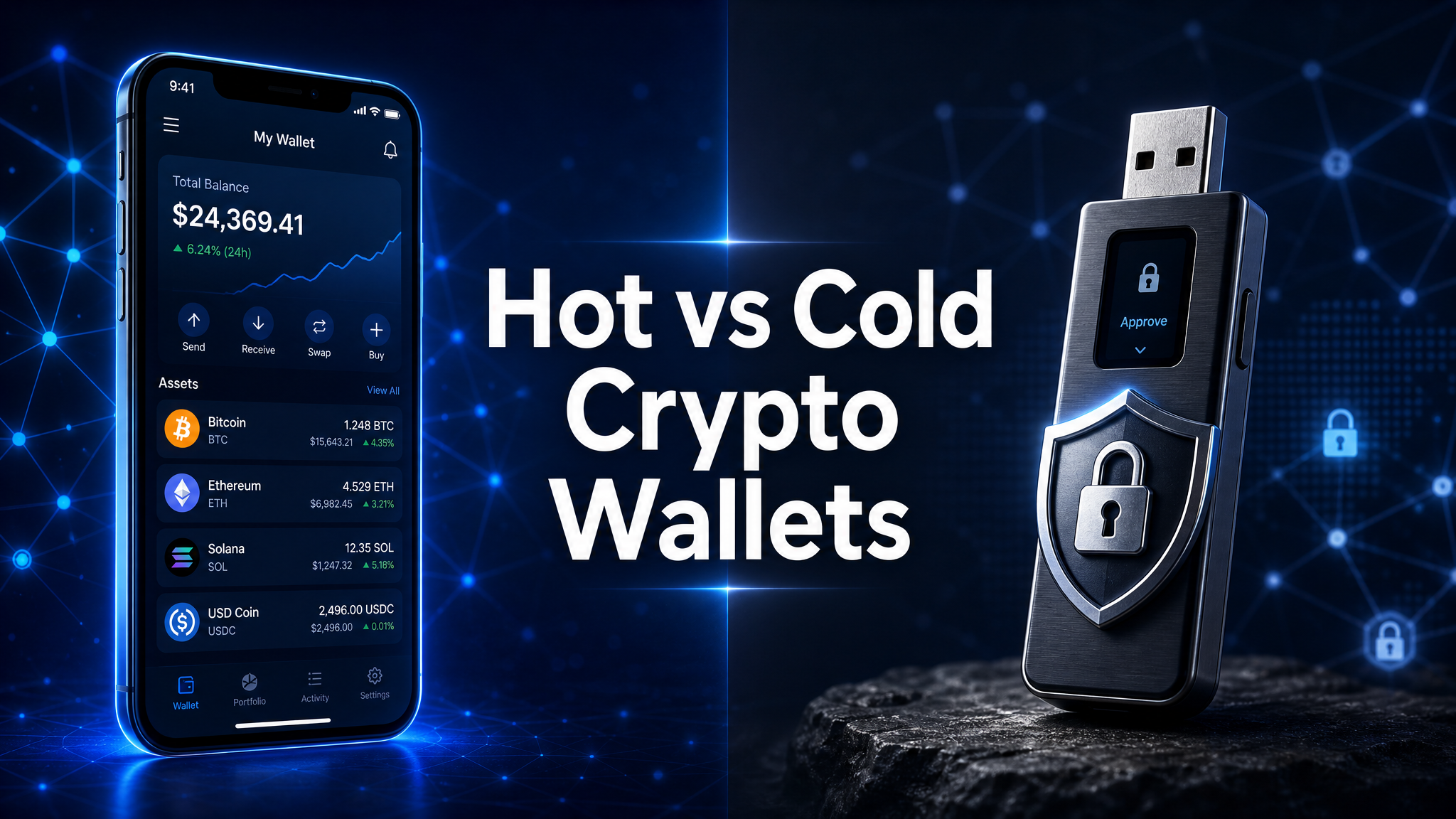
A hot wallet is any wallet that stays connected to the internet. This includes:
- Browser extensions — MetaMask, Rabby Wallet, Phantom
- Mobile apps — Trust Wallet, Coinbase Wallet, Exodus
- Desktop software — Electrum, Exodus desktop
- Exchange wallets — The built-in wallet on Coinbase, Binance, Kraken
Hot wallets are fast, free, and frictionless. You can swap tokens, interact with DeFi protocols, and send funds in seconds. For anyone actively trading or using crypto day-to-day, a hot wallet is essential.
The downside is real: because they're online, hot wallets are exposed to phishing attacks, malware, and malicious smart contract approvals. In 2025 alone, over $300 million was lost to phishing targeting hot wallet users. That's not a reason to avoid them — it's a reason to use them carefully and never store large amounts in them.
Cold Wallets: Secure but Offline
A cold wallet keeps your private keys completely offline. The most common form is a hardware wallet — a physical USB-like device that signs transactions without ever exposing your keys to an internet-connected computer.
Popular hardware wallets in 2026 include Ledger (Nano X, Nano S Plus) and Trezor (Model T, Safe 3). They cost between $49 and $200, which sounds like a lot until you consider you might be protecting $10,000 or $100,000 in assets.
Protect your crypto assets with a Ledger hardware wallet — the gold standard in cold storage security.
Cold wallets are immune to remote hacking. A hacker in another country cannot steal your private keys if those keys never touch the internet. The risks are physical: losing the device, losing your recovery phrase, or buying a counterfeit device from a sketchy third-party seller (always buy direct from the manufacturer).
Custodial vs. Non-Custodial: Who Holds the Keys?
The hot/cold distinction is about connectivity. The custodial/non-custodial distinction is about control.
Custodial Wallets
When you buy crypto on Coinbase or Kraken and leave it there, you're using a custodial wallet. The exchange holds your private keys. You log in with a username and password — the exchange handles the cryptographic heavy lifting.
Pros: Password recovery, customer support, easy fiat on/off ramps, no seed phrase to manage. Cons: You don't truly own your crypto. If the exchange gets hacked, goes bankrupt (remember FTX?), or freezes your account, your funds are at risk. "Not your keys, not your coins" isn't just a meme — it's a hard lesson millions of people learned the expensive way.
Custodial wallets are fine for small amounts you're actively trading. They're not appropriate for long-term storage of significant holdings.
Non-Custodial Wallets
Non-custodial wallets give you full control. You hold the private keys. Nobody can freeze your account, nobody can block your transactions, and nobody can bail you out if you lose your seed phrase.
MetaMask, Trust Wallet, and all hardware wallets are non-custodial. When you set one up, you get a 12 or 24-word seed phrase (also called a recovery phrase or mnemonic). This phrase IS your wallet. Anyone who has it can access your funds from any device, anywhere in the world.
Write it down on paper. Store it somewhere fireproof. Never photograph it, never type it into any website, never share it with anyone — including people claiming to be customer support.
The 90/10 Rule: A Practical Security Framework
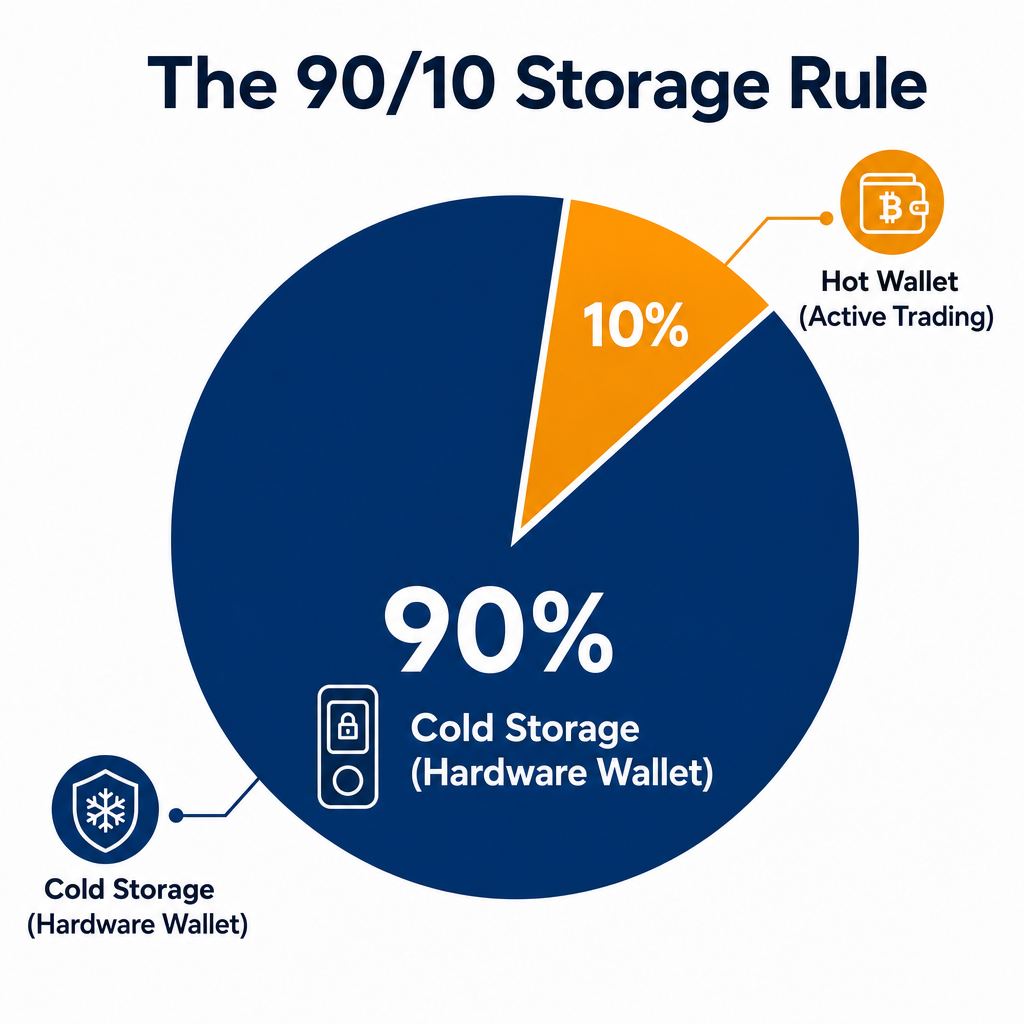
Most experienced crypto investors use a hybrid approach. The logic is simple:
- 90% in cold storage — your long-term holdings in a hardware wallet, untouched
- 10% in a hot wallet — your active trading funds, DeFi interactions, NFT purchases
If your hot wallet gets compromised, you lose 10% — painful but survivable. Your core holdings stay safe offline. This isn't a rigid rule; adjust the ratio based on how actively you trade. But the principle holds: don't keep more in a hot wallet than you can afford to lose.
Comparing Wallet Types at a Glance
| Feature | Hot Wallet | Cold Wallet | Exchange (Custodial) |
|---|---|---|---|
| Internet Connection | Always online | Offline | Always online |
| Key Control | You (non-custodial) | You (non-custodial) | Exchange (custodial) |
| Security Level | Moderate | High | Depends on exchange |
| Cost | Free | $49–$200+ | Free |
| Best For | Daily trading, DeFi | Long-term storage | Buying/selling crypto |
| Recovery Option | Seed phrase only | Seed phrase only | Email/password reset |
Which Wallet Should You Start With?
Here's a straightforward recommendation based on where you are in your crypto journey:
If You're Just Getting Started (Under $1,000)
Start with a reputable exchange like Coinbase or Kraken. Yes, it's custodial. But for small amounts while you're learning, the convenience and password recovery options outweigh the risks. Focus on understanding how crypto works before worrying about self-custody.
Once you're comfortable, download MetaMask or Trust Wallet as your first non-custodial hot wallet. Practice sending small amounts between wallets. Get comfortable with seed phrases before you're managing real money.
If You're Holding More Than $1,000
At this level, a hardware wallet becomes worth the investment. The Trezor Model T offers top-tier security with an intuitive touchscreen interface — a solid choice for beginners who want maximum protection without a steep learning curve.
Move the bulk of your holdings to cold storage. Keep only what you need for active trading in your hot wallet.
If You Want to Learn Crypto Trading Properly
Wallet security is just one piece of the puzzle. Understanding how to actually trade — reading charts, managing risk, timing entries — is what separates investors who grow their portfolios from those who watch them shrink. Ready to master crypto trading? Check out Icoinpro's comprehensive trading course.
Seed Phrase Security: The Non-Negotiables
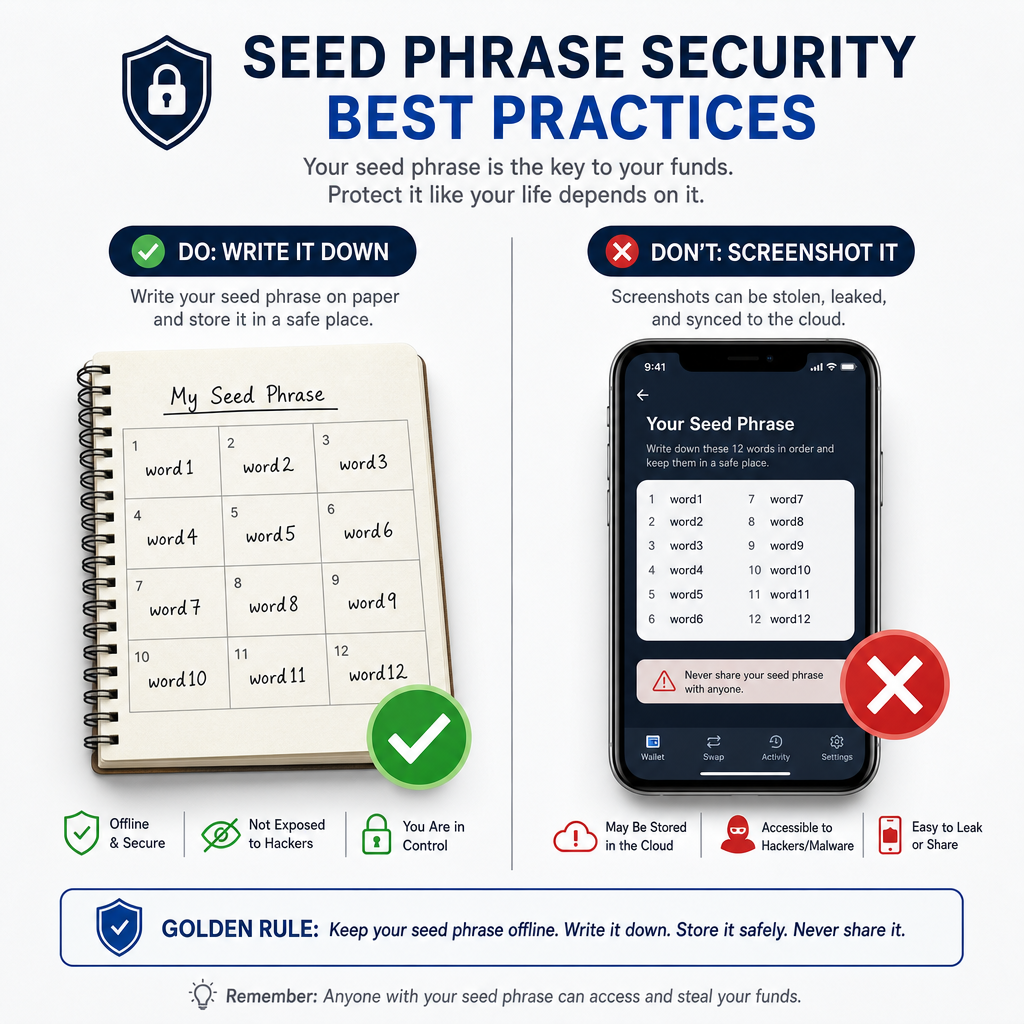
Your seed phrase deserves its own section because this is where most beginners make catastrophic mistakes.
Never do these things with your seed phrase:
- Screenshot it and save it to your phone's camera roll
- Type it into any website (legitimate wallets will never ask for it online)
- Store it in Google Drive, iCloud, or any cloud service
- Email it to yourself "for safekeeping"
- Share it with anyone claiming to be customer support
Do these things instead:
- Write it on paper with a pen — multiple copies
- Store copies in different physical locations (home safe, safety deposit box)
- Consider a metal backup plate for fire and water resistance
- Test your backup by restoring your wallet on a new device before you store significant funds
One more thing: when you set up a new wallet, do a test run. Send $5 to the wallet, then restore it from the seed phrase on a different device to confirm the backup works. This five-minute exercise has saved countless people from discovering their backup was wrong when it was too late.
Advanced Wallet Features Worth Knowing
As you get more comfortable, you'll encounter some additional wallet technologies:
Multi-Signature (Multisig) Wallets
These require multiple private keys to authorize a transaction — think of it like a bank vault that needs two keys turned simultaneously. Businesses and high-net-worth individuals use multisig to eliminate single points of failure. If one key is compromised, funds stay safe.
Account Abstraction (Smart Wallets)
A newer development in 2026, account abstraction (ERC-4337 on Ethereum) enables features like social login, gasless transactions, and account recovery without seed phrases. Wallets like Safe (formerly Gnosis Safe) use this approach. It's more complex to set up but offers a more forgiving user experience.
Watch-Only Wallets
These let you monitor a wallet's balance and transaction history without having the private keys on that device. Useful for checking your cold storage balance without connecting your hardware wallet.
Common Beginner Mistakes to Avoid
A few patterns show up again and again with new crypto users:
Leaving everything on an exchange. Convenient, yes. But exchanges get hacked, go bankrupt, and freeze accounts. FTX's collapse in 2022 wiped out billions in customer funds. Use exchanges for trading, not storage.
Buying hardware wallets from Amazon third-party sellers. Always buy directly from Ledger.com or Trezor.io. A tampered device from an unauthorized seller could have compromised firmware that steals your keys the moment you set it up.
Approving unlimited token spending in DeFi. When you interact with DeFi protocols, you often approve smart contracts to spend your tokens. Some approvals are unlimited. Use tools like revoke.cash periodically to audit and cancel unnecessary approvals.
Using SMS for two-factor authentication. SIM-swap attacks are common — criminals convince your carrier to transfer your phone number to their device, then intercept your 2FA codes. Use an authenticator app (Google Authenticator, Authy) or a hardware key (YubiKey) instead.
About the Author
Marcus Chen — Senior Crypto Analyst & Educator
Marcus Chen is a Certified Blockchain Professional and Former Wall Street Analyst with 8+ years of experience in digital assets and blockchain technology. He has guided thousands of investors through the complexities of crypto security, portfolio management, and DeFi strategies. His analysis has been cited across major crypto publications, and he specializes in making complex blockchain concepts accessible to everyday investors.
Key Takeaways
- Crypto wallets store private keys, not coins — your assets live on the blockchain
- Hot wallets (MetaMask, Trust Wallet) are convenient for daily use but carry online risks
- Cold wallets (Ledger, Trezor) keep keys offline and are essential for significant holdings
- Custodial wallets (exchange accounts) offer convenience but you don't control the keys
- The 90/10 rule: keep 90% in cold storage, 10% in hot wallets for active use
- Your seed phrase is everything — store it offline, never digitally, test your backup
- For holdings over $1,000, a hardware wallet is a worthwhile investment in security
Frequently Asked Questions: Hot vs Cold Crypto Wallets 2026
What percentage of crypto should I keep in cold storage?
Security experts recommend keeping 80-90% of your holdings in cold storage for long-term security, with only 10-20% in hot wallets for active trading and DeFi. The exact split depends on how frequently you transact.
What is MPC and how does it improve wallet security?
Multi-Party Computation splits your private key into multiple mathematical shares distributed across different devices or locations. No single share can reconstruct the key alone, eliminating the single point of failure that traditional seed phrases represent. Wallets like ZenGo and OKX Wallet use MPC architecture.
What is See-Before-You-Sign and why does it matter?
See-Before-You-Sign means your hardware wallet displays human-readable transaction details before you approve. Devices like the Ledger Flex use a Secure Element-driven screen to ensure what you see cannot be manipulated by malware. This directly counters blind-signing attacks.
Are quantum-ready hardware wallets available in 2026?
Yes. The Trezor Safe 7 has introduced quantum-ready security features to prepare for future cryptographic threats from quantum computing. While quantum computers capable of breaking current cryptography do not yet exist, forward-thinking manufacturers are building in post-quantum resistance.
Can I use a hot wallet with a hardware wallet together?
Absolutely - this is the recommended approach for active DeFi users. Connect MetaMask or Rabby Wallet to your Ledger or Trezor device. You get the convenience of a full DeFi ecosystem while your private keys remain offline in the hardware wallet.
Want structured training instead of piecing it together yourself?
Self-education works, but it's slow. The course that accelerated my learning the most gave me a daily framework — real market analysis, real setups, real accountability.
The program I recommend to people who ask me is this crypto trading course — it\'s the one I point friends and family to when they\'re serious about learning. Daily lessons, live analysis, and a community that actually helps.
Affiliate link — I may earn a commission at no extra cost to you. I only recommend what I genuinely use.
Disclaimer: The information provided on this website is for educational and informational purposes only. It should not be considered financial or investment advice. Cryptocurrency investments carry significant risk. Always do your own research and consult with a qualified financial advisor before making investment decisions.
Free Crypto Insights
Get weekly trading tips, market analysis, and exclusive strategies delivered to your inbox.