Crypto Terms Explained: The Essential Glossary Every Beginner Needs in 2026
Affiliate Disclosure: This article may contain affiliate links. We may earn a commission at no extra cost to you. All opinions are our own.
Marcus Chen
Senior Crypto Analyst & Educator
Certified Blockchain Professional | Former Wall Street Analyst
Marcus Chen is a cryptocurrency analyst and educator with over 8 years of experience in digital asset trading. He has helped thousands of beginners navigate the crypto markets through practical, actionable education.

Disclaimer: This content is for informational purposes only and should not be considered financial advice. Cryptocurrency investments carry significant risk. Always do your own research (DYOR) before making any investment decisions.
This article contains affiliate links. We may earn a commission at no extra cost to you if you make a purchase through these links. See our affiliate disclosure for details.
Crypto Terms Explained: The Essential Glossary Every Beginner Needs in 2026
If you've ever tried to follow a crypto conversation and felt like everyone was speaking a different language — you're not alone. Crypto terms like HODL, market cap, DeFi, and gas fees get thrown around constantly, and nobody stops to explain them. This guide cuts through the noise. Whether you just bought your first Bitcoin or you're still on the fence, here's every essential crypto term explained in plain English — no jargon, no fluff.
Why Crypto Has Its Own Language
Cryptocurrency didn't emerge from a boardroom. It grew out of online forums, open-source developer communities, and a culture that valued speed and irreverence. That's why the vocabulary is a strange mix of technical blockchain concepts, Wall Street finance terms, and internet slang that somehow stuck. Understanding these terms isn't just academic — it directly affects your ability to make smart decisions, spot scams, and navigate exchanges without making costly mistakes.
Let's start with the fundamentals and work our way up.
Blockchain Basics: The Foundation
Blockchain
A blockchain is a digital ledger — think of it as a shared spreadsheet that thousands of computers maintain simultaneously. Every transaction gets recorded in a "block," and each block links cryptographically to the one before it, forming a chain. Once data is written, it can't be altered without the entire network noticing. That's what makes it trustworthy without needing a bank or government to oversee it.
Decentralization
Traditional finance runs through central authorities — banks, clearinghouses, governments. Crypto flips that model. A decentralized network has no single point of control. Thousands of computers (called nodes) each hold a copy of the blockchain. If one goes down, the network keeps running. This is why Bitcoin has never had a server outage in 17 years.
Proof of Work vs. Proof of Stake
These are the two main methods blockchains use to validate transactions:
- Proof of Work (PoW): Miners compete to solve complex math puzzles. The winner adds the next block and earns a reward. Bitcoin uses this. It's secure but energy-intensive.
- Proof of Stake (PoS): Validators lock up ("stake") their crypto as collateral. The network randomly selects validators to confirm blocks, weighted by stake size. Ethereum switched to PoS in 2022. It uses ~99% less energy than PoW.
Smart Contracts
A smart contract is code that lives on a blockchain and executes automatically when conditions are met. No middleman needed. Example: you deposit ETH into a lending protocol, and the smart contract automatically pays you interest every block. No bank, no paperwork, no waiting. Ethereum pioneered smart contracts; now dozens of blockchains support them.
Wallets, Keys, and Custody
Crypto Wallet
A crypto wallet doesn't actually store your coins — it stores the private keys that prove you own them. Think of it like a keychain, not a piggy bank. Your crypto lives on the blockchain; your wallet just gives you access to it. Wallets come in two flavors:
- Hot wallets: Connected to the internet (apps, browser extensions). Convenient but more vulnerable to hacks.
- Cold wallets: Offline hardware devices. Much more secure for large holdings.
Protect your crypto assets with a Ledger hardware wallet — the gold standard in cold storage security.
Private Key & Seed Phrase
Your private key is a long string of characters that proves ownership of your crypto. Your seed phrase (also called a recovery phrase) is 12–24 random words that can regenerate your private key if you lose access to your wallet. Write it down on paper. Store it somewhere safe. Never type it into any website or app — ever. Anyone who has your seed phrase has your crypto. Full stop.
Custodial vs. Non-Custodial
When you hold crypto on an exchange like Coinbase, that's custodial — the exchange holds your private keys. Convenient, but you're trusting them. When you use a personal wallet where only you hold the keys, that's non-custodial. The crypto community phrase "not your keys, not your coins" captures this perfectly. The FTX collapse in 2022 was a brutal reminder of custodial risk.
Market Terms Every Beginner Must Know
Market Capitalization (Market Cap)
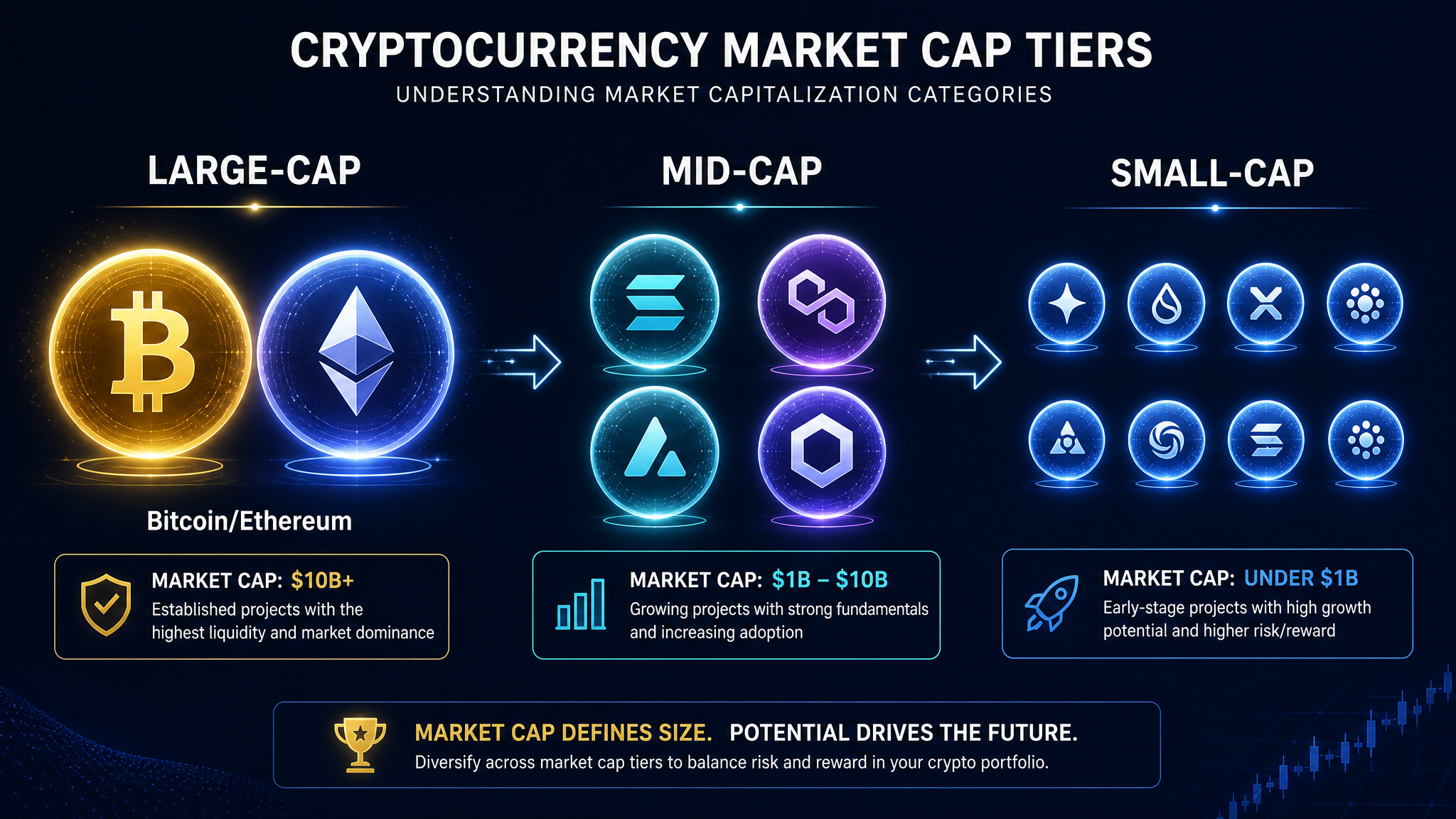
Market cap = current price × circulating supply. It's the most reliable way to compare the size of different cryptocurrencies. A coin priced at $0.001 with 1 trillion tokens in circulation has a higher market cap than a coin priced at $100 with only 1,000 tokens. Price alone means nothing without context.
Cryptos are generally grouped into three tiers:
- Large-cap (over $10B): Bitcoin, Ethereum. More stable, more liquid, lower risk.
- Mid-cap ($1B–$10B): Established altcoins with real use cases. Higher growth potential, higher risk.
- Small-cap (under $1B): Early-stage projects. Can 10x — or go to zero. Treat these as high-risk bets, not core holdings.
Bull Market vs. Bear Market
A bull market is a sustained period of rising prices and optimism. A bear market is the opposite — falling prices, fear, and capitulation. Crypto cycles tend to be more extreme than traditional markets. Bitcoin has dropped 80%+ in bear markets and risen 1,000%+ in bull runs. Knowing which phase you're in shapes your strategy.
Altcoin
Any cryptocurrency that isn't Bitcoin. Ethereum, Solana, XRP, Cardano — all altcoins. The term comes from "alternative coin." Some altcoins have genuine utility and strong fundamentals; others are pure speculation. Do your research before buying any altcoin, especially low-cap ones.
Liquidity
Liquidity measures how easily you can buy or sell an asset without significantly moving its price. Bitcoin is highly liquid — you can sell $1 million worth without much price impact. A small-cap altcoin might be illiquid — selling even $10,000 could crash the price 20%. Low liquidity = higher risk of getting stuck in a position.
The Slang You'll Hear Constantly
HODL
Born from a 2013 Bitcoin forum post where someone drunkenly typed "I AM HODLING" instead of "holding," HODL became the battle cry of long-term crypto believers. It means holding your crypto through volatility rather than panic-selling. Whether it's a strategy or a cope depends on what you're holding.
FOMO and FUD
FOMO (Fear of Missing Out) is the anxiety that drives people to buy at the top of a rally because they don't want to miss gains. It's responsible for more losses than any bear market. FUD (Fear, Uncertainty, Doubt) is negative information — sometimes legitimate, sometimes deliberately spread to manipulate prices downward. Both are emotional traps. Recognize them.
DYOR
Do Your Own Research. The most important phrase in crypto. No influencer, no Telegram group, no Reddit post should replace your own analysis. Read whitepapers. Check tokenomics. Look at who's building the project. Verify claims independently. The crypto space rewards the curious and punishes the credulous.
Whale
An investor holding enough crypto to move markets. A Bitcoin whale might hold 1,000+ BTC. When whales buy or sell, prices move. On-chain analytics tools like Whale Alert track large wallet movements — useful for spotting potential price action before it happens.
Rug Pull
A scam where developers launch a project, attract investment, then drain the liquidity pool and disappear. The token price collapses to zero overnight. Rug pulls are common in DeFi and meme coin spaces. Red flags: anonymous team, no audit, locked liquidity for only 30 days, promises of guaranteed returns.
DeFi, Staking, and the Crypto Ecosystem
DeFi (Decentralized Finance)
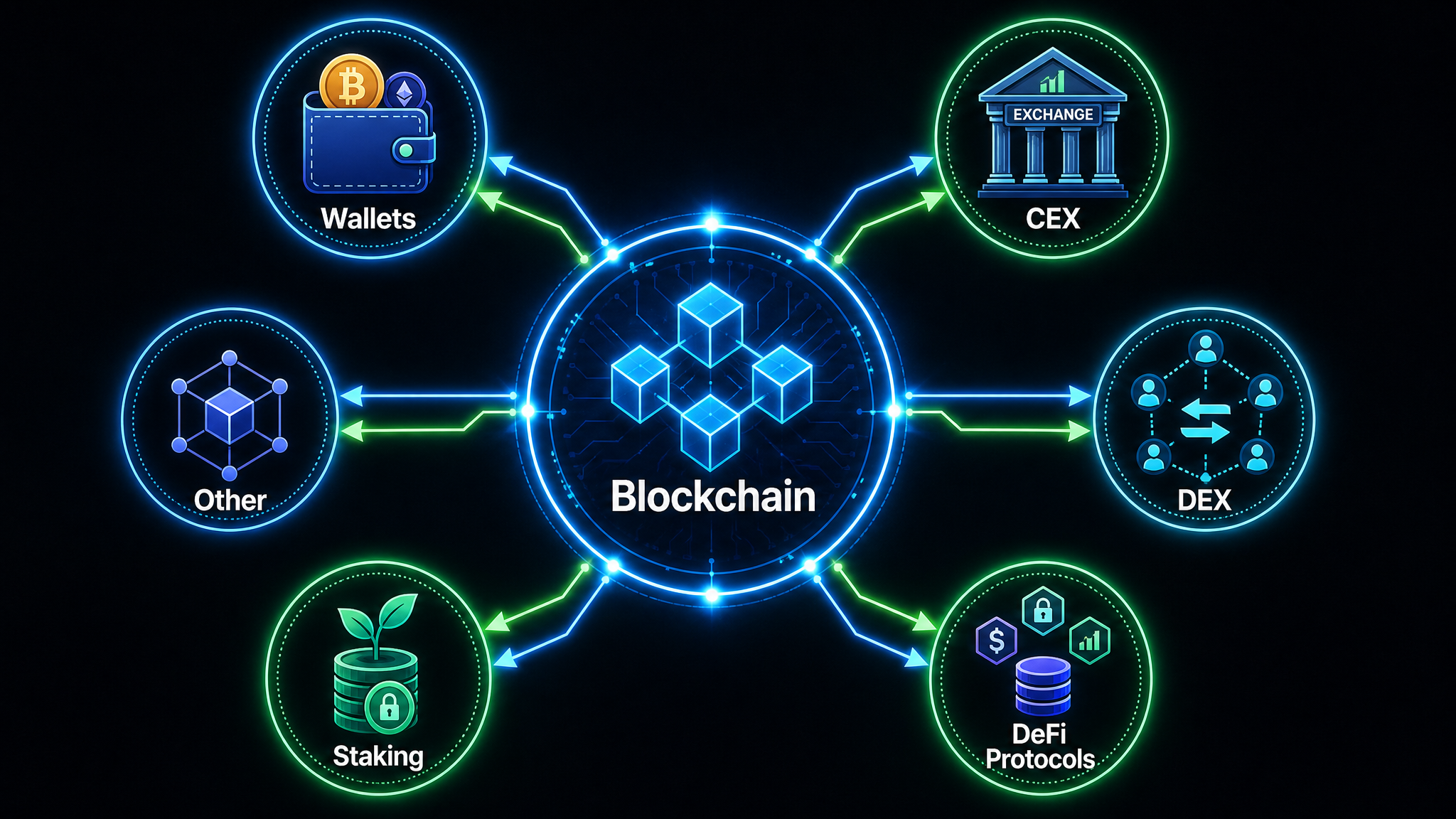
DeFi is the umbrella term for financial services built on blockchains using smart contracts — no banks, no brokers, no intermediaries. You can lend, borrow, trade, and earn yield directly from your wallet. Protocols like Aave, Uniswap, and Compound handle billions in daily volume. The tradeoff: smart contract bugs and hacks are real risks. Never put money into DeFi you can't afford to lose.
Staking
Staking means locking up your crypto to help validate transactions on a Proof of Stake blockchain. In return, you earn staking rewards — typically 3–15% APY depending on the network. Ethereum staking currently yields around 3–4% annually. Solana validators earn more. The catch: your funds are locked during an "unbonding period" (days to weeks) and can't be sold immediately.
Gas Fees
Gas fees are transaction costs paid to validators for processing your transaction on a blockchain. On Ethereum, gas fees fluctuate based on network congestion — they can be $2 during quiet periods or $50+ during peak activity. Layer 2 networks like Arbitrum and Base dramatically reduce gas costs, often to fractions of a cent.
CEX vs. DEX
A CEX (Centralized Exchange) is a company-run platform like Coinbase or Kraken. You create an account, complete KYC verification, and trade through their order books. Convenient, regulated, insured in some cases. A DEX (Decentralized Exchange) like Uniswap runs on smart contracts — no account needed, no KYC, you trade directly from your wallet. More privacy, more control, but also more complexity and no customer support if something goes wrong.
NFT (Non-Fungible Token)
An NFT is a unique digital asset recorded on a blockchain. Unlike Bitcoin (where every coin is identical and interchangeable), each NFT is one-of-a-kind. NFTs can represent digital art, music, gaming items, event tickets, or real-world asset ownership. The 2021 NFT boom saw JPEGs selling for millions; the market has since cooled significantly. The underlying technology still has legitimate use cases beyond speculative art.
Putting It All Together: Your Beginner Action Plan
Understanding crypto terms is step one. Here's how to apply this knowledge:
- Start with large-caps: Bitcoin and Ethereum before anything else. They're the most liquid, most researched, and most likely to survive long-term.
- Secure your assets: If you're holding more than a few hundred dollars, move it off exchanges into a personal wallet. The Trezor Model T offers top-tier security with an intuitive touchscreen interface.
- Learn before you earn: Before touching DeFi or altcoins, understand what you're doing. For a structured approach to learning crypto trading, Icoinpro offers step-by-step training that has helped thousands of beginners.
- Ignore the noise: FOMO and FUD are constant. Build a strategy based on research, not Twitter sentiment.
- Never share your seed phrase: Not with support agents, not with friends, not with anyone. Ever.
Key Takeaways
- Blockchain is a decentralized, immutable ledger — the foundation of all crypto.
- Market cap (not price) is the right metric for comparing cryptocurrencies.
- Your seed phrase is the master key to your crypto — protect it like cash.
- HODL, FOMO, FUD, and DYOR are the four emotional pillars of crypto culture — understand them to avoid costly mistakes.
- DeFi, staking, and gas fees are core concepts you'll encounter the moment you move beyond basic buying and selling.
- CEX for convenience, DEX for control — know when to use each.
Want structured training instead of piecing it together yourself?
Self-education works, but it's slow. The course that accelerated my learning the most gave me a daily framework — real market analysis, real setups, real accountability.
The program I recommend to people who ask me is this crypto trading course — it\'s the one I point friends and family to when they\'re serious about learning. Daily lessons, live analysis, and a community that actually helps.
Affiliate link — I may earn a commission at no extra cost to you. I only recommend what I genuinely use.
Disclaimer: The information provided on this website is for educational and informational purposes only. It should not be considered financial or investment advice. Cryptocurrency investments carry significant risk. Always do your own research and consult with a qualified financial advisor before making investment decisions.
Free Crypto Insights
Get weekly trading tips, market analysis, and exclusive strategies delivered to your inbox.