How to Buy Your First Crypto in 2026: A Beginner's Step-by-Step Guide
Affiliate Disclosure: This article may contain affiliate links. We may earn a commission at no extra cost to you. All opinions are our own.
Marcus Chen
Senior Crypto Analyst & Educator
Certified Blockchain Professional | Former Wall Street Analyst
Marcus Chen is a cryptocurrency analyst and educator with over 8 years of experience in digital asset trading. He has helped thousands of beginners navigate the crypto markets through practical, actionable education.
This article contains affiliate links. We may earn a commission at no extra cost to you if you make a purchase through these links. See our affiliate disclosure for details.
How to Buy Your First Crypto in 2026: A Beginner's Step-by-Step Guide
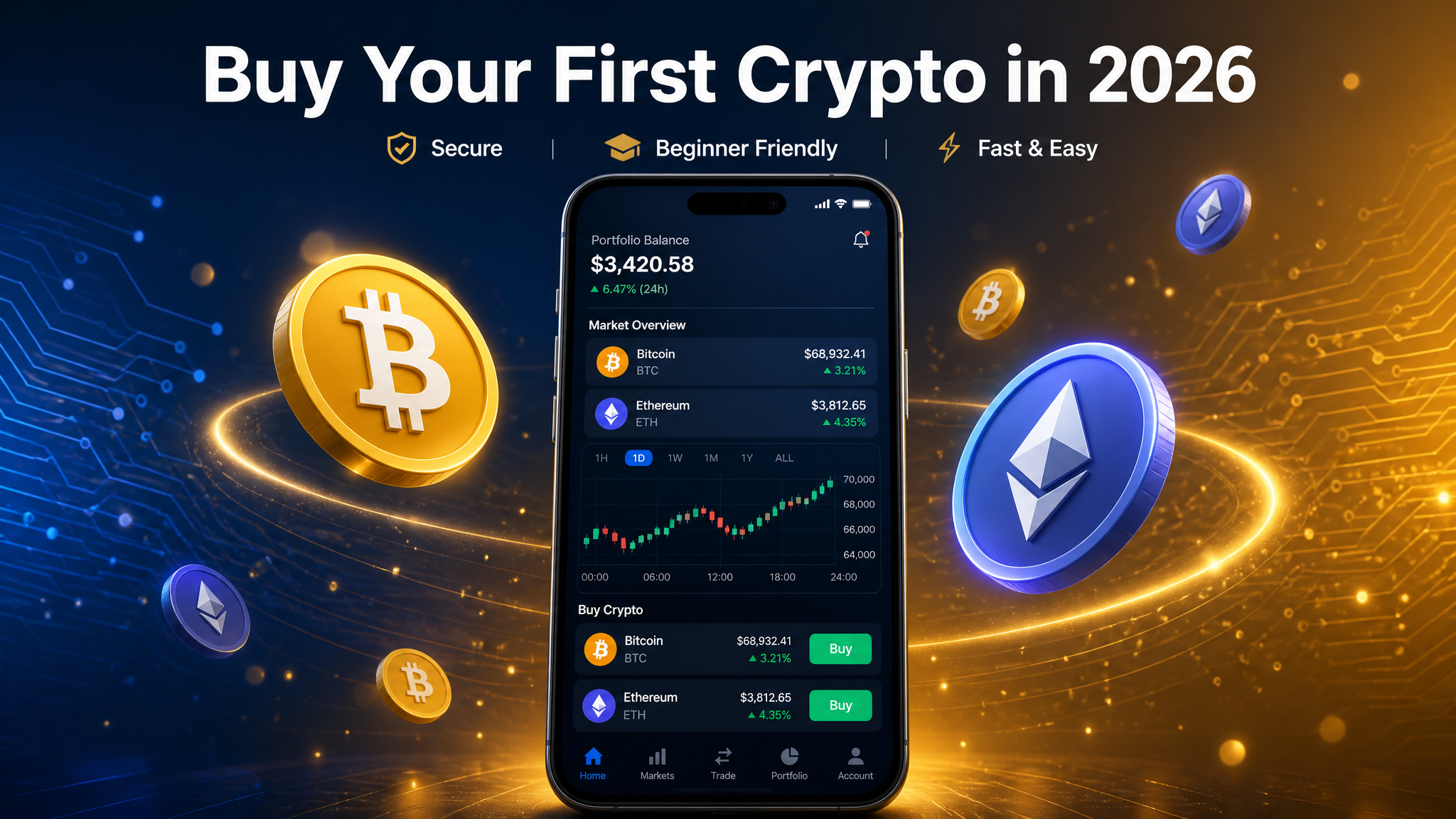
Buying your first crypto in 2026 is genuinely easier than it was five years ago — but easier doesn't mean risk-free. The exchanges are more polished, the regulations are clearer, and you can get started with as little as $10. What hasn't changed is the need to understand what you're doing before you put real money on the line. This guide walks you through every step: picking a platform, securing your account, making your first purchase, and storing your assets safely. No jargon overload, no hype — just the practical stuff that actually matters.
Disclaimer: This content is for informational purposes only and should not be considered financial advice. Cryptocurrency investments carry significant risk. Always do your own research (DYOR) before making any investment decisions.
Why 2026 Is a Reasonable Time to Start
The regulatory picture has improved substantially. The U.S. GENIUS Act and Europe's MiCA framework have brought clearer rules for exchanges and stablecoins, which means the platforms you use are more accountable than they were during the 2022 exchange collapses. Spot Bitcoin and Ethereum ETFs are now mainstream, institutional money is flowing in steadily, and the infrastructure — wallets, on-ramps, Layer 2 networks — has matured considerably.
None of that makes crypto a "safe" investment. Bitcoin still swings 10–20% in a week without blinking. But the ecosystem around it is more trustworthy than it's ever been, which lowers the operational risk for beginners who follow sensible practices.
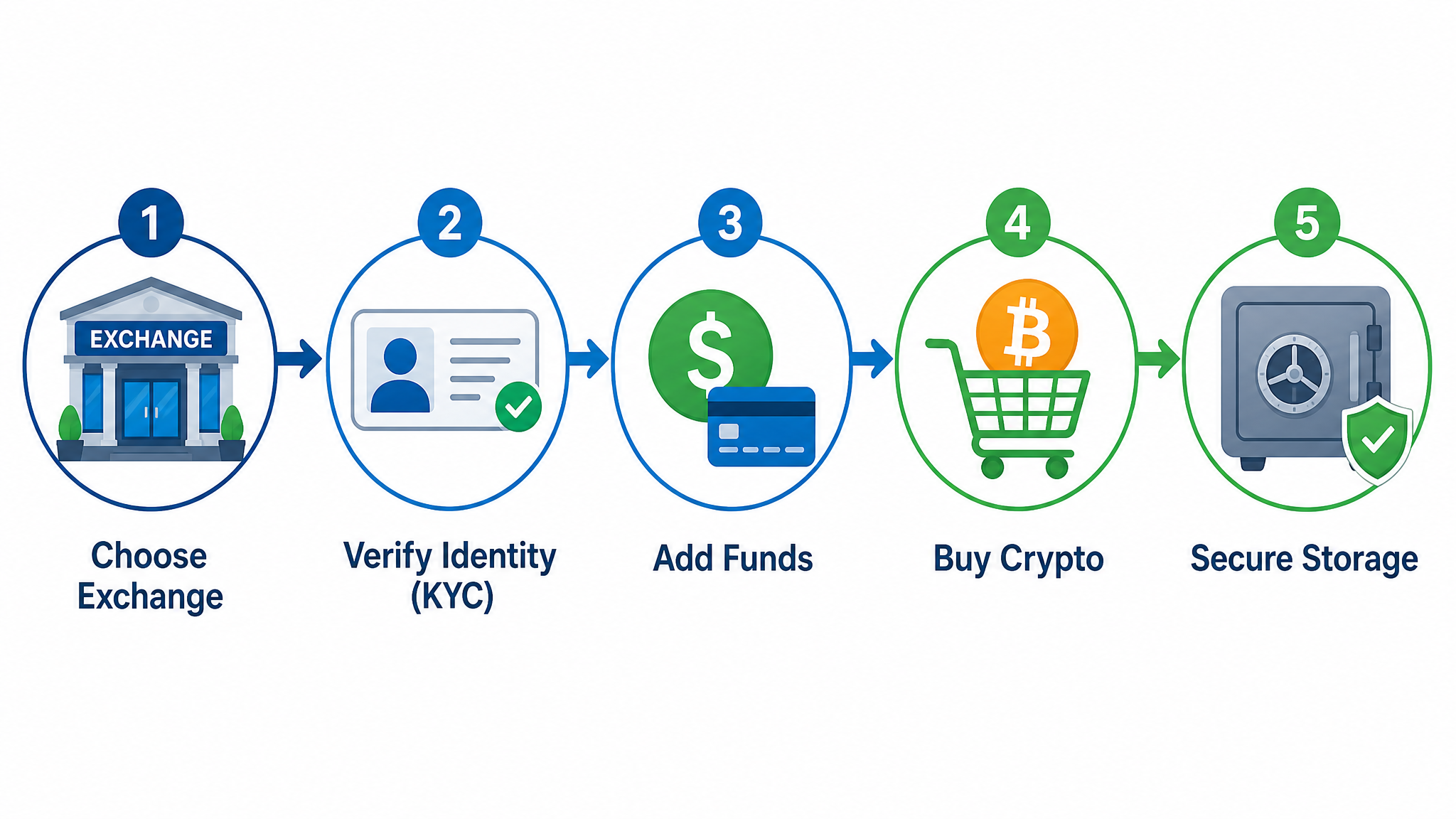
Step 1: Choose the Right Exchange
Your first stop is a centralized exchange (CEX). Think of it as the brokerage account of the crypto world — it handles custody, order matching, and the conversion between your local currency and digital assets.
For U.S. residents in 2026, the most beginner-friendly options are Coinbase, Kraken, and Gemini. All three are regulated, have strong security track records, and offer clean mobile apps. Coinbase is the most intuitive for absolute beginners. Kraken has slightly lower fees and more advanced features if you want to grow into them. Gemini is known for its compliance-first approach and is a solid choice if regulatory peace of mind is your priority.
What to look for in any exchange:
- Regulatory compliance — Is it registered with FinCEN? Does it hold state money transmitter licenses?
- Insurance and reserves — Does it publish proof-of-reserves? Is customer crypto held 1:1?
- Fee structure — Spot trading fees typically run 0.5–1.5% for beginners. Watch for spread markups on "simple buy" interfaces.
- Coin selection — For starters, you only need Bitcoin and Ethereum. Don't let a massive altcoin list distract you.
Avoid offshore exchanges with no clear regulatory home, especially if they're offering unusually high yields or bonuses to sign up. Those red flags haven't gone away.
Step 2: Create and Secure Your Account
Once you've picked an exchange, the signup process is straightforward but has a few critical security steps you shouldn't skip.
KYC Verification
Every regulated exchange requires Know Your Customer (KYC) verification. You'll upload a government-issued ID and take a selfie. This typically takes 5–30 minutes. It's not optional — it's the law, and it protects you too, since it means the platform is accountable to regulators.
Two-Factor Authentication (2FA)
Enable 2FA immediately. Use an authenticator app like Google Authenticator or Authy — not SMS. SIM-swap attacks are still a real threat in 2026, where a scammer convinces your carrier to transfer your phone number to their device. An authenticator app breaks that attack vector entirely.
Strong, Unique Password
Use a password manager (Bitwarden is free and excellent) to generate a long, random password for your exchange account. Never reuse passwords across sites. A data breach on an unrelated service can expose your crypto account if you do.
Step 3: Fund Your Account
Most exchanges accept bank transfers (ACH in the U.S.), debit cards, and wire transfers. ACH is the cheapest option — usually free or very low cost — but takes 1–5 business days to clear. Debit cards are instant but carry a 1.5–3.5% fee. For your first purchase, a small ACH transfer of $50–$200 is a sensible starting point.
One thing beginners often miss: some exchanges place a hold on newly deposited funds for 3–7 days before you can withdraw crypto. You can usually buy immediately, but you can't move the coins off the exchange until the hold clears. Plan accordingly.
Step 4: Make Your First Purchase
Start with Bitcoin (BTC) or Ethereum (ETH). Not because they're guaranteed to go up, but because they're the most liquid, most researched, and most institutionally supported assets in the space. Once you understand how the market works, you can explore further.
Market Orders vs. Limit Orders
A market order buys immediately at the current price. Simple, fast, and what most beginners use. A limit order lets you set a target price — your order only fills if the market reaches that level. For small amounts, market orders are fine. For larger purchases, a limit order can save you a few dollars on slippage.
Dollar-Cost Averaging (DCA)
Rather than putting everything in at once, consider spreading your purchases over time. Buying $50 of Bitcoin every week for 10 weeks, for example, smooths out the impact of price swings. Most exchanges let you set up automatic recurring buys. This strategy won't maximize gains in a bull market, but it dramatically reduces the risk of buying at a local peak.
For a structured approach to learning crypto trading beyond just buying and holding, Icoinpro offers step-by-step training that has helped thousands of beginners understand market mechanics, chart reading, and risk management.
Step 5: Understand Storage — Hot Wallets vs. Cold Wallets
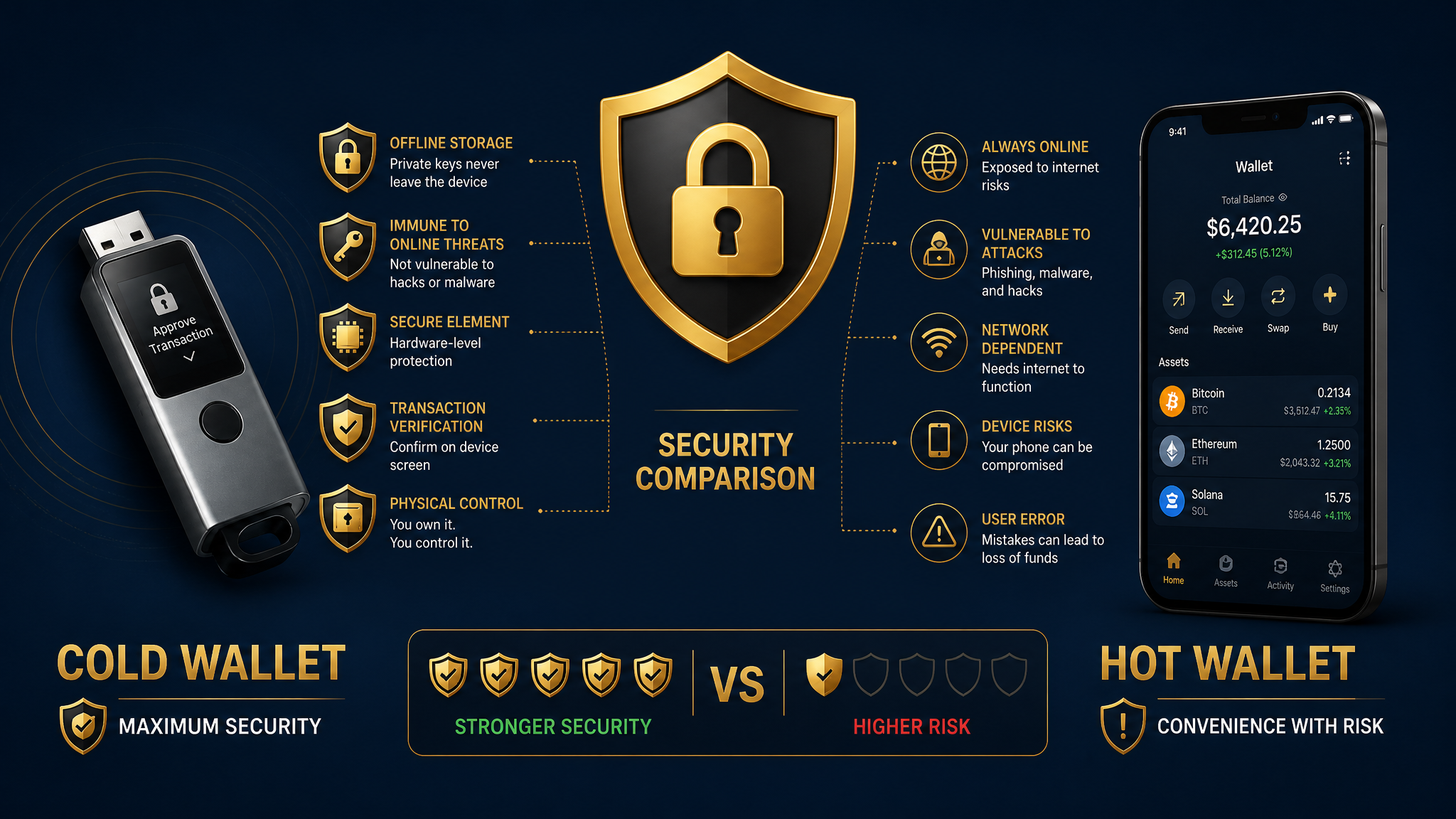
This is where many beginners make a costly mistake: leaving everything on the exchange indefinitely. Exchanges are convenient, but they're also targets. If an exchange gets hacked, freezes withdrawals, or goes bankrupt, your funds could be at risk. The crypto mantra "not your keys, not your coins" exists for a reason.
Hot Wallets (Software)
Hot wallets are apps connected to the internet — MetaMask, Exodus, Phantom. They're free, easy to use, and great for smaller amounts you actively use. The tradeoff is that they're online, which means they're theoretically accessible to malware or phishing attacks if you're not careful.
Cold Wallets (Hardware)
Hardware wallets store your private keys offline on a physical device. Even if your computer is compromised, an attacker can't access your crypto without the physical device and its PIN. For any amount you'd be upset to lose, a hardware wallet is worth the investment.
Protect your crypto assets with a Ledger hardware wallet — the gold standard in cold storage security. The Ledger Nano X supports over 5,500 coins and connects via Bluetooth to your phone.
Alternatively, Trezor wallets have been trusted by millions since 2014 and offer an open-source firmware you can audit yourself — a meaningful advantage for security-conscious users.
The Seed Phrase: Your Master Key
When you set up any self-custody wallet, you'll receive a 12 or 24-word seed phrase. Write it down on paper. Store it somewhere physically secure — not in a photo on your phone, not in a cloud note, not in an email draft. Anyone who gets this phrase can drain your wallet instantly, from anywhere in the world. Treat it like the combination to a safe containing everything you own.
Common Beginner Mistakes to Avoid
Eight years of watching people enter this market has given me a clear picture of where things go wrong. Here are the patterns that repeat most often:
- Chasing viral coins. By the time a meme coin is trending on TikTok, the early buyers are already selling to you. Stick to assets with real utility and liquidity.
- Ignoring fees. A 3% debit card fee on a $500 purchase is $15 gone before the market even moves. Use bank transfers and the exchange's advanced trading interface to minimize costs.
- Sending to the wrong network. Sending USDC on Ethereum to an address expecting USDC on Solana can result in permanent loss. Always double-check the network before confirming a transaction. Send a small test amount first.
- Falling for fake support. No legitimate exchange will DM you on Discord or Telegram asking for your seed phrase or remote access to your screen. Ever. Full stop.
- Panic selling during corrections. A 20% drop feels catastrophic when you're new. It's routine in crypto. If you've invested only what you can afford to hold through volatility, you don't need to react to every price move.
How Much Should You Start With?
Financial guidance consistently suggests allocating no more than 1–5% of your total investable assets to crypto. For someone with $10,000 in savings, that's $100–$500. That's not a number designed to make you rich overnight — it's a number designed to let you learn the mechanics without catastrophic downside if things go wrong.
Once you've bought, held through a correction, and successfully moved assets to a wallet, you'll have a much clearer sense of your own risk tolerance. That's when it makes sense to revisit your allocation.
Key Takeaways
- Use a regulated exchange (Coinbase, Kraken, or Gemini for U.S. users) and complete KYC verification.
- Enable authenticator-app 2FA immediately — not SMS.
- Start with Bitcoin or Ethereum; use dollar-cost averaging to reduce timing risk.
- Move significant holdings to a hardware wallet; never share your seed phrase with anyone.
- Invest only what you can afford to lose, and ignore short-term price noise.
- Verify every transaction detail — blockchain transfers are irreversible.
Want structured training instead of piecing it together yourself?
Self-education works, but it's slow. The course that accelerated my learning the most gave me a daily framework — real market analysis, real setups, real accountability.
The program I recommend to people who ask me is this crypto trading course — it\'s the one I point friends and family to when they\'re serious about learning. Daily lessons, live analysis, and a community that actually helps.
Affiliate link — I may earn a commission at no extra cost to you. I only recommend what I genuinely use.
Disclaimer: The information provided on this website is for educational and informational purposes only. It should not be considered financial or investment advice. Cryptocurrency investments carry significant risk. Always do your own research and consult with a qualified financial advisor before making investment decisions.
Free Crypto Insights
Get weekly trading tips, market analysis, and exclusive strategies delivered to your inbox.