How to Do Crypto Tax Loss Harvesting in 2026: Cut Your Tax Bill Legally
Affiliate Disclosure: This article may contain affiliate links. We may earn a commission at no extra cost to you. All opinions are our own.
Marcus Chen
Senior Crypto Analyst & Educator
Certified Blockchain Professional | Former Wall Street Analyst
Marcus Chen is a cryptocurrency analyst and educator with over 8 years of experience in digital asset trading. He has helped thousands of beginners navigate the crypto markets through practical, actionable education.

Affiliate Disclosure: This article contains affiliate links. We may earn a commission at no extra cost to you if you make a purchase through these links. See our affiliate disclosure for details.
Disclaimer: This content is for informational purposes only and should not be considered financial advice. Cryptocurrency investments carry significant risk. Always do your own research (DYOR) before making any investment decisions.
How to Do Crypto Tax Loss Harvesting in 2026: Cut Your Tax Bill Legally
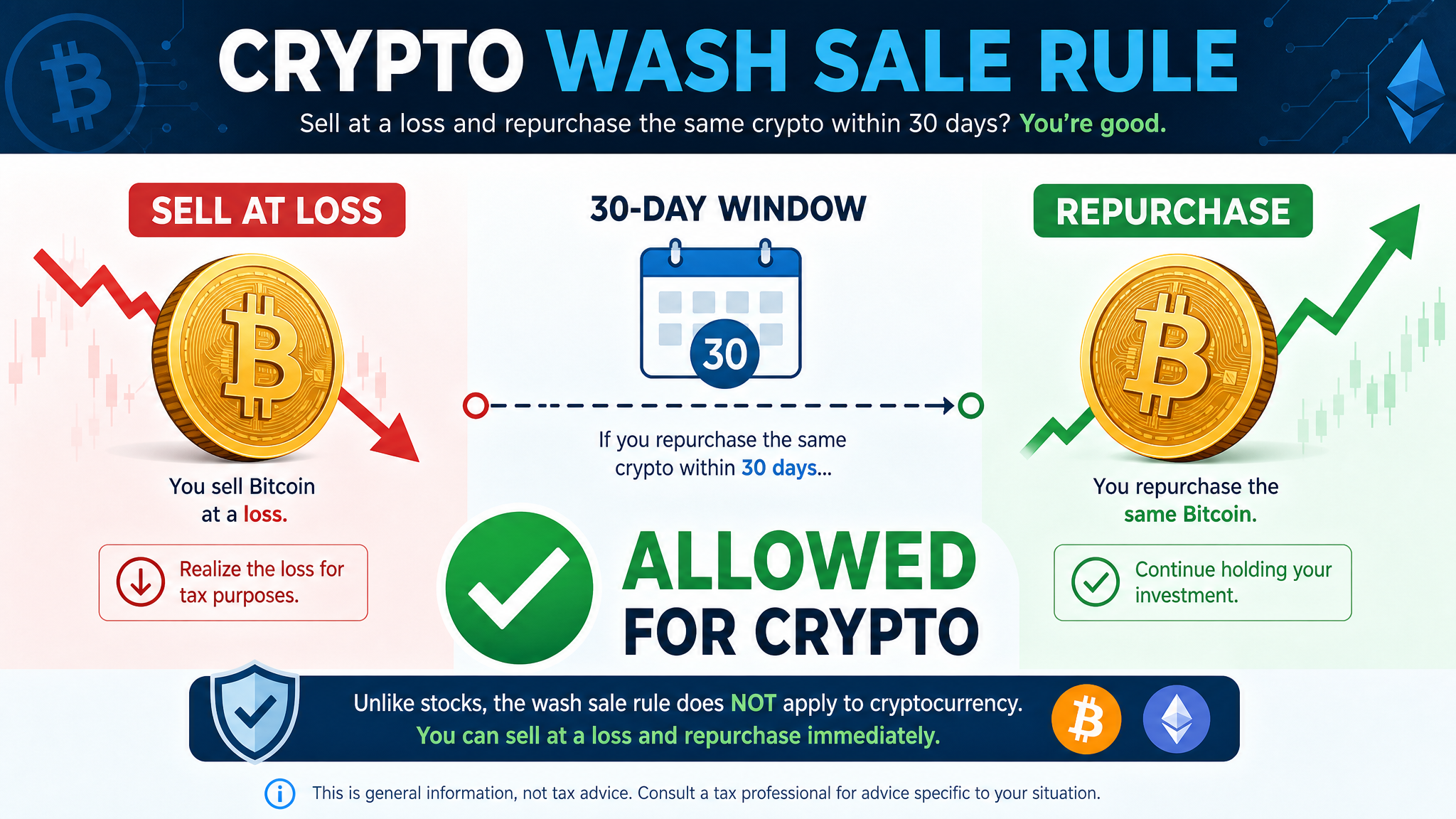
Crypto tax loss harvesting is one of the most underused legal strategies available to cryptocurrency investors in 2026 — and it could save you thousands of dollars before December 31. The concept is straightforward: you sell crypto assets that are sitting at a loss, lock in that loss for tax purposes, and use it to offset gains elsewhere in your portfolio. Unlike stocks, crypto is still exempt from the IRS wash sale rule, which means you can sell and immediately repurchase the same coin without losing the tax deduction. That's a powerful edge most investors aren't using.
With Bitcoin trading near $77,000 and Ethereum under pressure at around $2,400 as of late August 2026, plenty of altcoin positions are sitting in the red. That's not just bad news — it's an opportunity. Here's exactly how to execute crypto tax loss harvesting this year, step by step.
What Is Crypto Tax Loss Harvesting?
Tax loss harvesting means deliberately selling a losing investment to realize a capital loss. That loss then offsets your capital gains — reducing the amount of tax you owe. If your losses exceed your gains, you can deduct up to $3,000 against ordinary income annually, with any remaining losses carried forward indefinitely to future tax years.
For crypto investors, this strategy has an extra advantage: the IRS classifies digital assets as property, not securities. That means the wash sale rule — which prevents stock investors from claiming a loss if they repurchase the same security within 30 days — does not apply to spot cryptocurrency. You can sell ETH at a loss on Monday and buy it back Tuesday morning. The loss still counts.
One important caveat: this exemption does not apply to crypto ETFs like spot Bitcoin ETFs. Those are securities and are subject to standard wash sale restrictions. Sell your Bitcoin ETF shares at a loss and repurchase within 61 days, and the IRS will disallow the deduction.
Why 2026 Is a Good Year to Harvest Losses
August 2026 has been a mixed bag for crypto markets. Bitcoin dominance sits near 59%, which tells you capital is consolidating in BTC rather than flowing into altcoins. Many mid-cap and small-cap tokens are down 30–60% from their 2025 highs. If you bought Solana at $280, Avalanche at $45, or any number of DeFi tokens during last year's bull run, you're likely sitting on unrealized losses right now.
Those losses are worth something — but only if you realize them before December 31. Unrealized losses don't reduce your tax bill. Realized ones do.
There's also a legislative angle to consider. H.R. 9172, introduced in June 2026, is the latest attempt to extend wash sale rules to digital assets. It hasn't passed, but the window for this strategy may not stay open forever. Using it now, while it's clearly legal, is the smart move.
Step-by-Step: How to Execute Crypto Tax Loss Harvesting
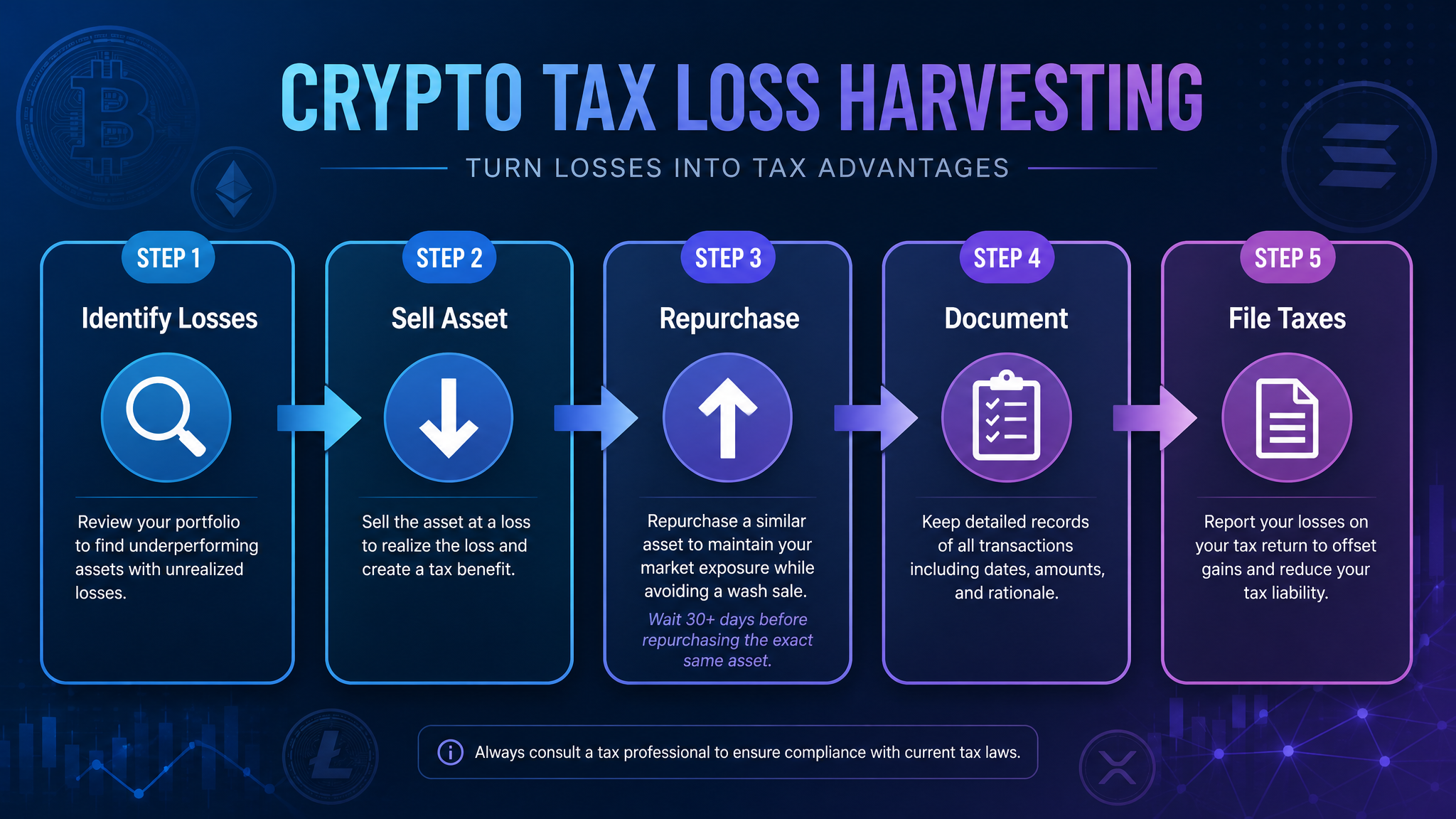
Step 1: Consolidate All Your Transaction Data
Before you can harvest losses, you need a complete picture of your portfolio across every exchange and wallet. This is where most people stumble. If you've been trading on Coinbase, Binance, Kraken, and using MetaMask for DeFi, your transaction history is scattered across multiple platforms.
Import everything into a crypto tax software tool. Koinly is the most widely recommended option for 2026 — it integrates with 700+ exchanges and blockchains, offers a free tier for portfolio tracking, and includes a built-in tax loss harvesting tool that flags your biggest loss opportunities. CoinTracker is another solid choice, especially if you're primarily on Coinbase. CoinLedger works well if you plan to export directly to TurboTax.
The goal here is accuracy. Missing transactions mean incorrect cost basis calculations, which can create problems with the IRS — especially now that brokers are required to report digital asset transactions via Form 1099-DA.
Step 2: Identify Your Unrealized Losses
Once your data is consolidated, look for positions currently trading below their cost basis. Prioritize short-term holdings (held less than one year) because short-term losses offset short-term gains, which are taxed at your ordinary income rate — potentially 22%, 24%, or higher depending on your bracket. That's more valuable than offsetting long-term gains taxed at 15% or 20%.
Make a list of candidates. For each one, note the current price, your cost basis, the unrealized loss amount, and whether it's short-term or long-term.
Step 3: Choose Your Cost Basis Method
Your cost basis method determines which specific "tax lots" you're selling when you dispose of an asset. The IRS allows several methods for crypto:
- FIFO (First In, First Out): Sells your oldest coins first. Often results in larger gains if prices have risen over time.
- HIFO (Highest In, First Out): Sells your highest-cost lots first, maximizing realized losses and minimizing gains. Generally the best choice for tax loss harvesting.
- Specific Identification: You choose exactly which lots to sell. Maximum flexibility, but requires detailed records.
HIFO is usually the winner for harvesting purposes. If you bought ETH at $3,200 in January and again at $2,100 in March, HIFO sells the $3,200 lot first — locking in a larger loss if ETH is now at $2,400.
Pick your method before you start selling and stick with it consistently. Switching methods mid-year can create accounting headaches.
Step 4: Execute the Sales
Sell the underperforming assets on your exchange. Keep it simple — market orders work fine for liquid assets. For smaller altcoins with thin order books, use limit orders to avoid slippage eating into your realized loss.
After selling, you have two choices: stay in cash, or immediately repurchase the same asset to maintain your market exposure. Since the wash sale rule doesn't apply to spot crypto, repurchasing immediately is perfectly legal and lets you stay invested while still capturing the tax deduction.
Some investors prefer to wait a few days or rotate into a correlated asset (selling SOL and buying AVAX, for example) as a conservative approach — in case future legislation applies wash sale rules retroactively. That's a personal risk tolerance call.
Step 5: Document Everything
For each harvesting transaction, record:
- The asset sold and the amount
- Sale date and proceeds
- Original purchase date and cost basis
- Realized loss amount
- Transaction hash (for on-chain trades)
- Exchange or wallet used
You'll report these on Form 8949 and Schedule D when you file your taxes. Your crypto tax software should generate these forms automatically, but having your own records is essential if the IRS ever questions a deduction.
How Much Can You Actually Save?
Let's run a real scenario. Say you have $15,000 in short-term capital gains from trading Bitcoin earlier this year. You're in the 24% tax bracket, so you'd owe $3,600 in federal taxes on those gains.
But you also have $12,000 in unrealized losses across three altcoin positions. You sell them, realizing those losses. Now your net short-term gain is just $3,000, and your tax bill drops to $720 — a savings of $2,880.
If your losses exceed your gains entirely, you can deduct up to $3,000 against your ordinary income this year, and carry the rest forward. A $20,000 loss with no offsetting gains saves you $720 this year (at 24%) and carries $17,000 forward to offset future gains.
The math gets even better if you're in a higher bracket. At 37%, that same $12,000 in harvested losses saves you $4,440 in federal taxes.
Common Mistakes to Avoid
Ignoring transaction fees: Every sale and repurchase costs money. Gas fees on Ethereum, trading fees on exchanges — these add up. Make sure the tax savings outweigh the transaction costs. For small positions (under $500 in losses), it often doesn't pencil out.
Forgetting DeFi transactions: Swapping tokens on Uniswap, providing liquidity, and claiming staking rewards are all taxable events. Your DeFi losses count too — but only if you've tracked them properly. This is where a tool like Koinly earns its subscription fee.
Selling crypto ETF shares and repurchasing within 30 days: As mentioned, spot Bitcoin ETFs are securities. The wash sale rule applies. If you sell your IBIT shares at a loss and buy them back within 61 days, the loss is disallowed.
Waiting until December: Tax loss harvesting works best when you monitor your portfolio throughout the year. Prices can recover — if you wait until late December and your losing positions have bounced back, the opportunity is gone.
Tools to Make This Easier
Manual tracking across dozens of wallets and exchanges is a nightmare. These tools automate the heavy lifting:
- Koinly: Best overall. Free tax loss harvesting scanner, 700+ integrations, HIFO support. Paid plans from $49/year.
- CoinTracker: Best for Coinbase users. Official Coinbase tax partner, polished dashboard. Plans from $199/year for harvesting features.
- CoinLedger: Best for TurboTax integration. Strong error reconciliation tools.
- ZenLedger: US-focused, good human support, dedicated harvesting reports.
For a structured approach to understanding crypto trading and tax strategy, Icoinpro offers step-by-step training that has helped thousands of beginners navigate both trading and the tax implications of their crypto activity.
And once you've harvested those losses and locked in your gains, make sure your long-term holdings are stored securely. Protect your crypto assets with a Ledger hardware wallet — the gold standard in cold storage security.
Key Takeaways
- Crypto tax loss harvesting lets you sell losing positions to offset capital gains — legally reducing your tax bill.
- The IRS wash sale rule does not apply to spot cryptocurrency (but does apply to crypto ETFs).
- Use HIFO cost basis method to maximize realized losses.
- You can deduct up to $3,000 of net losses against ordinary income annually; excess carries forward indefinitely.
- The December 31 deadline is firm — unrealized losses don't count.
- Use crypto tax software (Koinly, CoinTracker, CoinLedger) to track transactions and identify opportunities.
- Legislative proposals to extend wash sale rules to crypto exist but haven't passed as of mid-2026.
Want to understand the deeper economics behind Bitcoin and crypto as an asset class? The Bitcoin Standard is essential reading for every crypto enthusiast looking to build long-term conviction alongside smart tax strategy.
Want structured training instead of piecing it together yourself?
Self-education works, but it's slow. The course that accelerated my learning the most gave me a daily framework — real market analysis, real setups, real accountability.
The program I recommend to people who ask me is this crypto trading course — it\'s the one I point friends and family to when they\'re serious about learning. Daily lessons, live analysis, and a community that actually helps.
Affiliate link — I may earn a commission at no extra cost to you. I only recommend what I genuinely use.
Disclaimer: The information provided on this website is for educational and informational purposes only. It should not be considered financial or investment advice. Cryptocurrency investments carry significant risk. Always do your own research and consult with a qualified financial advisor before making investment decisions.
Free Crypto Insights
Get weekly trading tips, market analysis, and exclusive strategies delivered to your inbox.