Crypto Security for Beginners: How to Keep Your Crypto Safe in 2026
Affiliate Disclosure: This article may contain affiliate links. We may earn a commission at no extra cost to you. All opinions are our own.
Marcus Chen
Senior Crypto Analyst & Educator
Certified Blockchain Professional | Former Wall Street Analyst
Marcus Chen is a cryptocurrency analyst and educator with over 8 years of experience in digital asset trading. He has helped thousands of beginners navigate the crypto markets through practical, actionable education.
Crypto Security for Beginners: How to Keep Your Crypto Safe in 2026
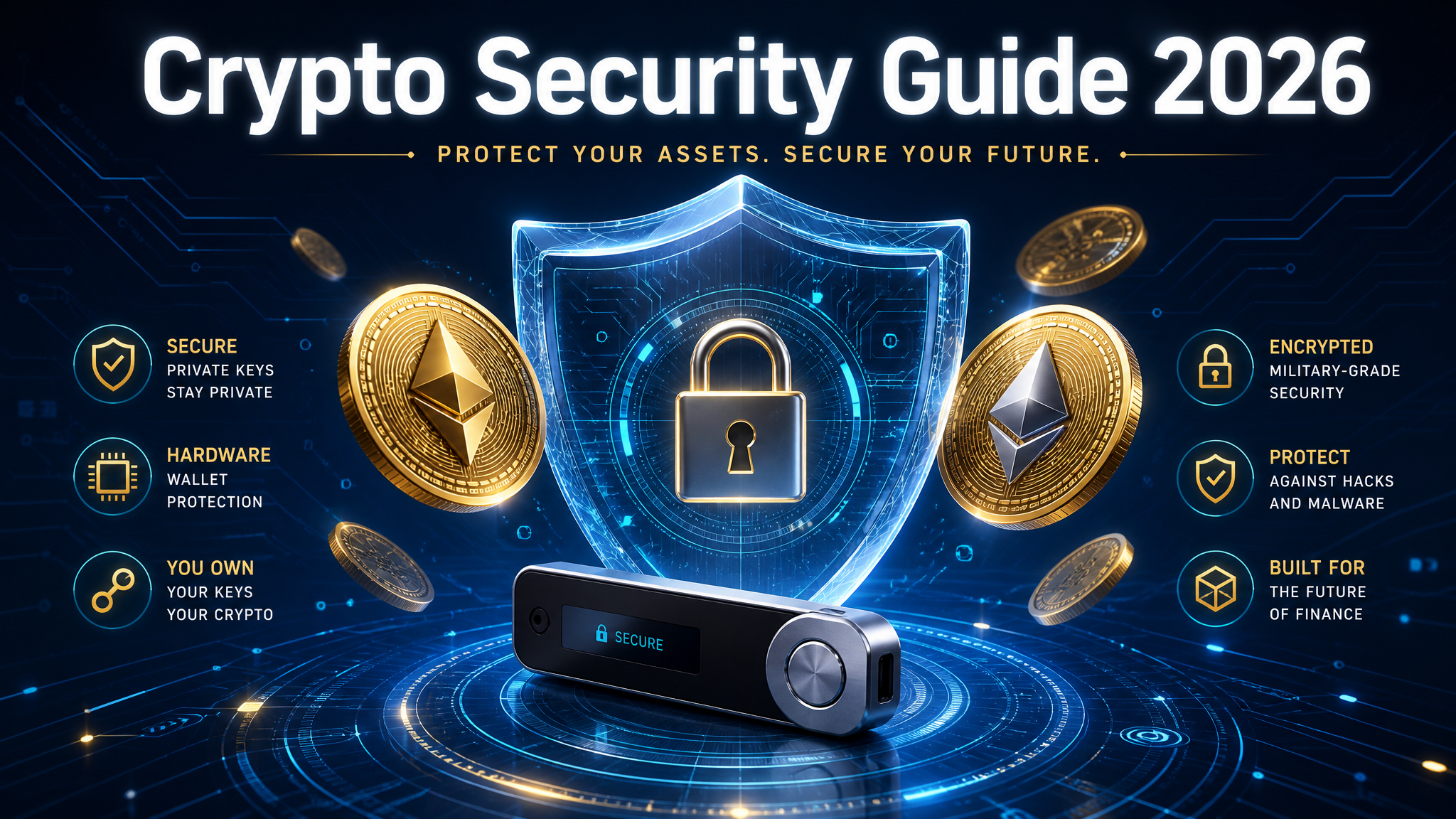
Crypto security in 2026 is not optional — it's the difference between keeping your assets and losing everything overnight. With over 820 million global crypto users and scammers deploying AI-powered deepfakes, phishing bots, and wallet-draining smart contracts, the threat landscape has never been more sophisticated. The good news? Protecting yourself doesn't require a computer science degree. It requires understanding a handful of core principles and applying them consistently.
This guide walks you through everything a beginner needs to know: what private keys and seed phrases actually are, why hardware wallets matter, how to spot scams before they cost you, and the simple two-wallet strategy that security professionals use themselves.
Why Crypto Security Is Different From Traditional Finance
When your bank account gets hacked, you call the bank. They investigate, reverse the transaction, and restore your funds. Crypto doesn't work that way. Blockchain transactions are irreversible by design. There's no customer support line, no fraud department, no chargeback. If someone drains your wallet, those funds are gone — permanently.
That's not a flaw. It's a feature of a trustless, decentralized system. But it places the entire burden of security on you. Understanding this shift in responsibility is the first step every beginner must take.
In 2026, the stakes are higher than ever. The average crypto theft incident now involves losses of $47,000 according to blockchain analytics firms. And the methods have evolved: AI-generated voice clones impersonating exchange support, fake wallet apps in official app stores, and "approval phishing" attacks that trick you into signing transactions that hand over control of your entire wallet.
Private Keys and Seed Phrases: The Foundation of Crypto Ownership
Here's something most beginners get wrong: your crypto wallet doesn't actually store your coins. Your Bitcoin, Ethereum, or any other token lives on the blockchain. What your wallet stores is a private key — a cryptographic secret that proves you own those assets and authorizes you to move them.
Think of it like this: the blockchain is a giant public ledger. Your wallet address is like a mailbox number — anyone can see it and send funds to it. Your private key is the physical key to that mailbox. Whoever holds the key controls the funds. Full stop.
What Is a Seed Phrase?
Most modern wallets use a seed phrase (also called a recovery phrase or mnemonic) — a sequence of 12 or 24 common English words generated when you first set up your wallet. This phrase is a human-readable representation of your master private key. It can regenerate your entire wallet, including all addresses and balances, on any compatible device.
Lose your phone? No problem — restore your wallet on a new device using your seed phrase. But if someone else gets those 12 or 24 words, they can do the same thing. And they will drain every cent before you even realize what happened.
The golden rule: your seed phrase is the only thing that matters. Guard it like the combination to a vault containing everything you own.
How to Store Your Seed Phrase Safely
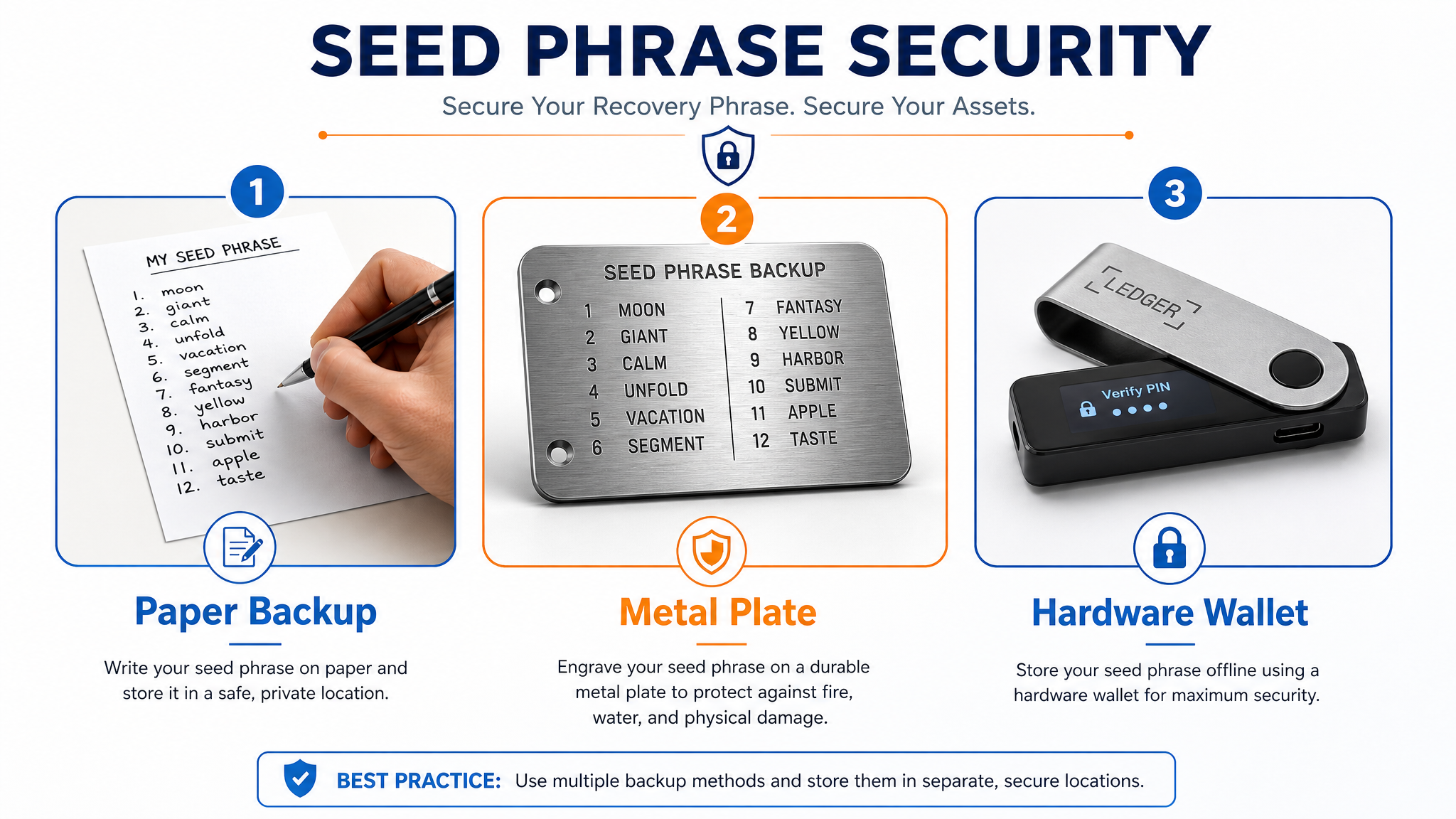
- Write it down by hand on paper immediately when your wallet generates it. Verify every word and its order.
- Never store it digitally. No screenshots. No cloud notes. No email drafts. No password managers. Malware, cloud breaches, and account takeovers can expose any digital copy.
- Store it in multiple physical locations. A house fire or flood can destroy a single copy. Keep backups in two or three separate, secure places.
- Consider metal backup plates. For significant holdings, stamping your seed phrase onto stainless steel or titanium provides fire and water resistance that paper can't match.
- Never share it with anyone. Not with "support agents." Not with friends. Not with anyone claiming to help you recover funds. Legitimate services will never ask for your seed phrase.
Hot Wallets vs. Cold Wallets: Know the Difference
Not all wallets carry the same risk. The crypto community broadly divides them into two categories based on internet connectivity.
Hot Wallets (Software Wallets)
Hot wallets are apps — mobile apps like Trust Wallet or MetaMask, or browser extensions. They're connected to the internet, which makes them convenient for daily transactions, DeFi interactions, and quick trades. The tradeoff is exposure: any device connected to the internet is a potential attack surface.
Hot wallets are fine for small amounts you actively use. Think of them like a physical wallet in your pocket — you wouldn't carry $50,000 in cash around town. Apply the same logic here.
Cold Wallets (Hardware Wallets)
Hardware wallets are physical devices — USB-like gadgets that store your private keys completely offline. When you want to send crypto, you connect the device, confirm the transaction on its screen, and the key never touches your internet-connected computer. Even if your laptop is infected with malware, the attacker can't steal keys they can never access.
The leading options in 2026 are the Ledger Flex (featuring a CC EAL6+ certified Secure Element chip) and the Trezor Safe 5 (fully open-source firmware). Both require physical confirmation of every transaction, making remote theft essentially impossible.
Protect your crypto assets with a Ledger hardware wallet — the gold standard in cold storage security.
Looking for reliable crypto storage? Trezor wallets have been trusted by millions since 2014.
The Two-Wallet Strategy
Security professionals use a simple framework: one hot wallet for daily activity, one cold wallet for long-term savings. Here's how it works in practice:
- Hot wallet: Keep only what you need for active trading or DeFi — maybe $200–$500 worth. If it gets compromised, the damage is limited.
- Cold wallet: Store the bulk of your holdings here. Only connect it when you need to move significant funds.
This separation means a single security failure can't wipe you out. It's the crypto equivalent of keeping most of your money in a savings account and a small amount in your checking account.
Exchange Security: What Happens When You Leave Crypto on a Platform
Centralized exchanges like Coinbase, Kraken, and Binance are custodial — they hold your private keys on your behalf. This is convenient, but it introduces counterparty risk. If the exchange gets hacked, goes bankrupt, or freezes withdrawals, your funds could be inaccessible or lost entirely. The FTX collapse in 2022 wiped out billions in customer funds. It wasn't the last such event.
That said, exchanges are fine for active trading. Just follow these rules:
- Enable two-factor authentication (2FA) using an authenticator app (Google Authenticator, Authy). Avoid SMS-based 2FA — SIM-swap attacks can bypass it.
- Use a unique, strong password for every exchange. A password manager helps here.
- Whitelist withdrawal addresses if the exchange supports it. This prevents attackers from sending funds to new addresses even if they access your account.
- Don't leave large amounts on exchanges long-term. Move significant holdings to self-custody.
Recognizing and Avoiding Crypto Scams in 2026
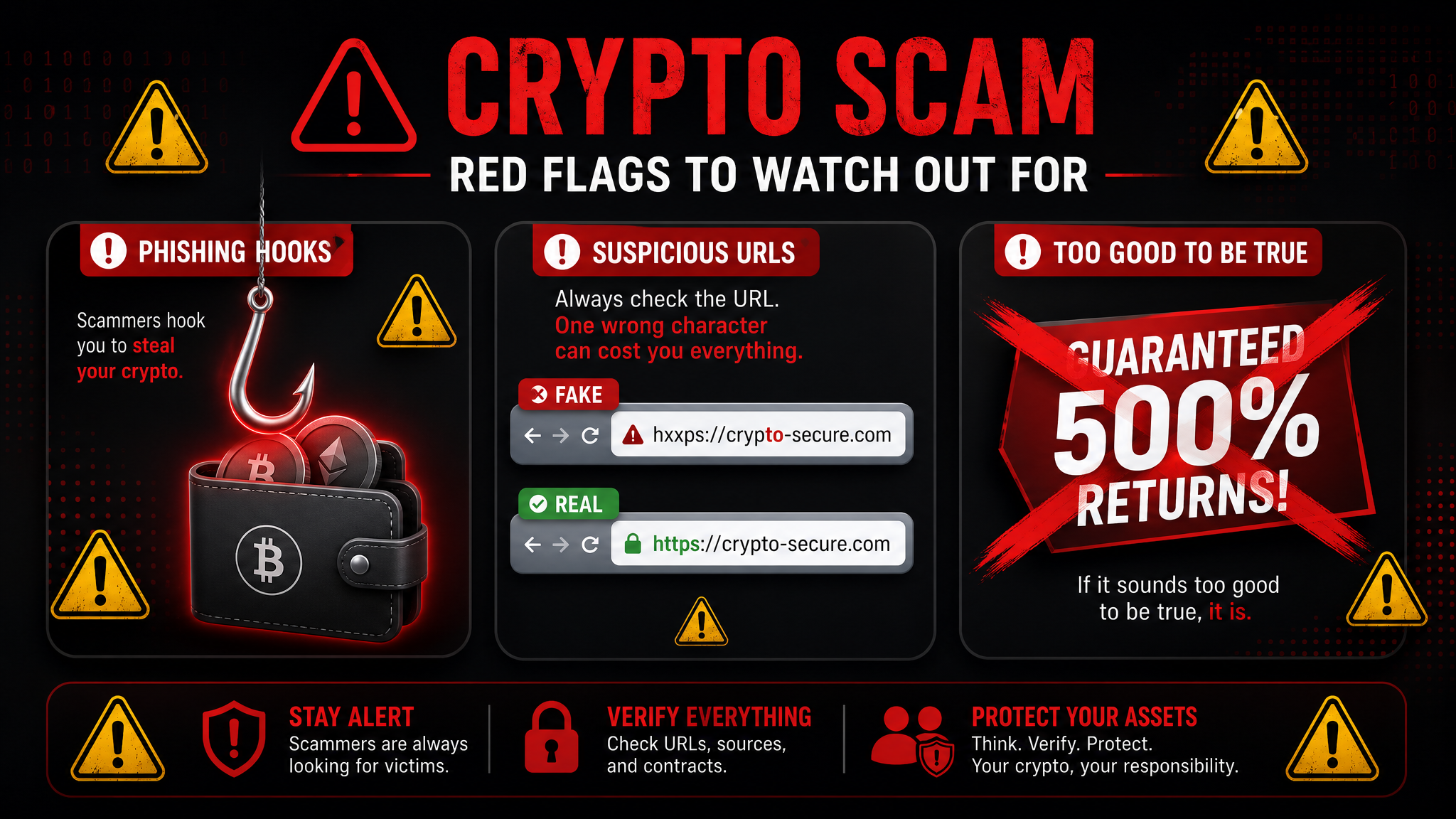
Scammers have gotten frighteningly good. AI-generated deepfake videos of Elon Musk or Vitalik Buterin promoting fake giveaways circulate on social media daily. Fake exchange websites with near-perfect domain spoofing (coinbas3.com instead of coinbase.com) fool even experienced users. And "pig butchering" romance scams — where fraudsters build weeks-long relationships before introducing a fake investment platform — have cost victims billions.
Red Flags That Should Stop You Cold
- Guaranteed returns. No legitimate investment guarantees profits. "Risk-free 30% monthly returns" is a Ponzi scheme, full stop.
- Urgency pressure. "Act now or miss out" is a manipulation tactic. Legitimate opportunities don't evaporate in 10 minutes.
- Anyone asking for your seed phrase or private key. This is always a scam. Always. No exceptions.
- Unsolicited investment advice. Random DMs on Telegram, Discord, or Twitter offering to "help you invest" are almost universally scams.
- Withdrawal fees on "profits." Fake platforms show you growing balances, then demand a "tax" or "fee" to withdraw. The withdrawal never comes.
Wallet Drainers and Approval Phishing
One of the most dangerous attack vectors in 2026 is approval phishing. You connect your wallet to what looks like a legitimate DeFi site. You sign a transaction. But instead of a simple swap, you've just granted a malicious smart contract unlimited permission to transfer all your tokens. Your wallet empties within seconds.
Defenses:
- Use wallets that support Clear Signing — they translate transaction data into plain English so you can see exactly what you're authorizing.
- Regularly audit and revoke token approvals using tools like revoke.cash.
- Bookmark legitimate DeFi sites. Never click links from social media or DMs.
- When in doubt, don't sign.
Practical Security Checklist for Beginners
Here's a quick-reference checklist to run through when you're getting started:
- ✅ Write down your seed phrase on paper — never digitally
- ✅ Store seed phrase backups in two separate physical locations
- ✅ Enable 2FA on all exchanges using an authenticator app
- ✅ Use unique passwords for every platform
- ✅ Move significant holdings to a hardware wallet
- ✅ Keep only small amounts in hot wallets
- ✅ Bookmark your exchange and DeFi sites — never click links
- ✅ Regularly revoke unused token approvals
- ✅ Never share your seed phrase or private key with anyone
- ✅ Verify wallet addresses character by character before sending
Building Your Knowledge Foundation
Security is a mindset, not a one-time setup. The crypto space evolves fast, and so do the threats. Staying informed is part of the job. For a structured approach to learning crypto trading and security fundamentals, Icoinpro offers step-by-step training that has helped thousands of beginners build confidence and competence in the space.
Key Takeaways
- Your seed phrase is everything. Store it offline, in multiple locations, and never share it.
- Use the two-wallet strategy: hot wallet for daily use, hardware wallet for savings.
- Hardware wallets eliminate remote theft risk by keeping private keys offline.
- Enable authenticator-app 2FA on every exchange — not SMS.
- Guaranteed returns and seed phrase requests are always scams. No exceptions.
- Revoke unused token approvals regularly to prevent wallet drainers.
- Crypto transactions are irreversible — prevention is your only protection.
Want structured training instead of piecing it together yourself?
Self-education works, but it's slow. The course that accelerated my learning the most gave me a daily framework — real market analysis, real setups, real accountability.
The program I recommend to people who ask me is this crypto trading course — it\'s the one I point friends and family to when they\'re serious about learning. Daily lessons, live analysis, and a community that actually helps.
Affiliate link — I may earn a commission at no extra cost to you. I only recommend what I genuinely use.
Disclaimer: The information provided on this website is for educational and informational purposes only. It should not be considered financial or investment advice. Cryptocurrency investments carry significant risk. Always do your own research and consult with a qualified financial advisor before making investment decisions.
Free Crypto Insights
Get weekly trading tips, market analysis, and exclusive strategies delivered to your inbox.