Best DeFi Protocols in 2026: Top 7 Platforms Ranked for Every Crypto User
Affiliate Disclosure: This article may contain affiliate links. We may earn a commission at no extra cost to you. All opinions are our own.
Marcus Chen
Senior Crypto Analyst & Educator
Certified Blockchain Professional | Former Wall Street Analyst
Marcus Chen is a cryptocurrency analyst and educator with over 8 years of experience in digital asset trading. He has helped thousands of beginners navigate the crypto markets through practical, actionable education.

Disclaimer: This content is for informational purposes only and should not be considered financial advice. Cryptocurrency investments carry significant risk. Always do your own research (DYOR) before making any investment decisions.
This article contains affiliate links. We may earn a commission at no extra cost to you if you make a purchase through these links. See our affiliate disclosure for details.
Best DeFi Protocols in 2026: Top 7 Platforms Ranked for Every Crypto User
The best DeFi protocols in 2026 aren't just surviving — they're processing billions in daily volume while traditional banks still charge you $35 for a wire transfer. Whether you want to earn yield on idle crypto, borrow against your holdings without selling, or swap tokens without handing your assets to a centralized exchange, decentralized finance has a protocol built for exactly that. The hard part is knowing which ones are worth your trust and your capital.
This guide cuts through the noise. We've ranked the top 7 DeFi protocols by TVL, security track record, yield potential, and ease of use — so you can find the right fit whether you're just getting started or you're already running complex multi-chain strategies.
What Makes a DeFi Protocol Worth Using in 2026?
Not all DeFi protocols are created equal. After a year that saw the sector's total TVL drop roughly 39% from January highs, the protocols that held their ground did so for specific reasons: deep liquidity, battle-tested smart contracts, and governance structures that didn't implode under pressure.
When evaluating any DeFi platform, focus on four things:
- TVL (Total Value Locked): A rough proxy for trust and liquidity depth. Higher TVL generally means more users have staked real money on the protocol's security.
- Audit history: How many independent security audits has the protocol undergone? Have any vulnerabilities been found and patched?
- Time in market: Protocols that have operated through multiple market cycles — including the 2022 crash and the 2024 recovery — have proven their resilience.
- Yield source: Is the yield coming from real economic activity (borrower interest, trading fees) or from token inflation? The former is sustainable; the latter isn't.
With that framework in mind, here are the seven protocols that consistently rise to the top.
1. Lido — Best for Liquid Staking ETH
Lido remains the largest DeFi protocol by TVL in 2026, holding somewhere between $20 billion and $26 billion depending on ETH's price on any given day. The concept is simple: you deposit ETH, Lido stakes it on your behalf, and you receive stETH — a liquid token that earns staking rewards while remaining usable across the broader DeFi ecosystem.
That last part matters. Regular ETH staking locks your assets. With Lido, your stETH can be deposited into Aave as collateral, used in Curve liquidity pools, or held in your wallet while it quietly appreciates. Current staking APY hovers around 3.5–4.5%, which isn't flashy, but it's real yield backed by Ethereum's consensus mechanism.
Best for: Long-term ETH holders who want yield without locking up liquidity.
Risk level: Low-medium. Smart contract risk exists, but Lido has been audited extensively and has operated without a major exploit since launch.
2. Aave — Best Lending and Borrowing Protocol
Aave is the gold standard for decentralized lending. It operates across 21+ EVM-compatible chains, with TVL typically ranging between $14 billion and $19 billion. The mechanics are straightforward: deposit crypto as collateral, borrow against it at variable or stable rates, or simply supply assets to earn interest from borrowers.
What sets Aave apart from competitors is its monolithic pool architecture — all assets in a given market share liquidity, which means deeper pools and more reliable rates. Aave V3 introduced efficiency mode (e-mode), which lets users borrow at higher LTV ratios when collateral and debt are correlated assets (like stETH and ETH). That's a meaningful capital efficiency upgrade for sophisticated users.
Supply APYs on stablecoins like USDC and USDT typically run 4–8% on Aave, driven by real borrower demand. That's not a promotional rate — it's what the market is actually paying.
Best for: Anyone who wants to earn yield on stablecoins or borrow crypto without selling their holdings.
Risk level: Low-medium. Aave has been audited by multiple firms and has a strong track record, though liquidation risk is real for borrowers in volatile markets.

3. Uniswap — Best Decentralized Exchange
Uniswap processes more DEX volume than any other protocol. Full stop. Its automated market maker (AMM) model has become the infrastructure backbone of DeFi — when a new token launches, it almost always creates a Uniswap pool first. Uniswap v4, which introduced concentrated liquidity and hooks, has made it significantly more capital-efficient for liquidity providers willing to actively manage their positions.
For regular users, Uniswap is simply the most reliable place to swap tokens across Ethereum and its L2 networks (Arbitrum, Base, Optimism). Fees are transparent, slippage is predictable on liquid pairs, and there's no KYC, no withdrawal limits, and no counterparty risk from a centralized entity.
Liquidity providers on concentrated ranges in major pairs (ETH/USDC, for example) can earn 15–40% APY in fee income during high-volume periods — though impermanent loss is a real consideration that requires active management.
Best for: Token swaps, liquidity provision, and anyone who wants DEX access without centralized custody.
Risk level: Low for swappers. Medium-high for LPs due to impermanent loss.
4. Morpho — Best for Advanced Lending Efficiency
Morpho has quietly become one of the most interesting protocols in DeFi. Its "Morpho Blue" architecture uses isolated, modular lending markets rather than the shared-pool model of Aave. This means each market has its own risk parameters — a bad debt event in one market doesn't contaminate others.
TVL has grown to between $7.4 billion and $10.8 billion, and the protocol has attracted institutional capital specifically because of its risk isolation properties. Curated vaults — managed by risk teams like Gauntlet and Block Analitica — let users deposit into pre-configured strategies without needing to manage individual market positions themselves.
For advanced users, Morpho offers higher capital efficiency than Aave in specific scenarios, particularly for correlated asset pairs. The tradeoff is complexity — you need to understand which vault you're depositing into and who's managing the risk parameters.
Best for: Intermediate to advanced DeFi users who want optimized lending yields with modular risk control.
Risk level: Medium. Isolated markets reduce systemic risk, but individual market parameters still require due diligence.
Ready to master crypto trading? Check out Icoinpro's comprehensive trading course.
5. Pendle Finance — Best for Yield Trading
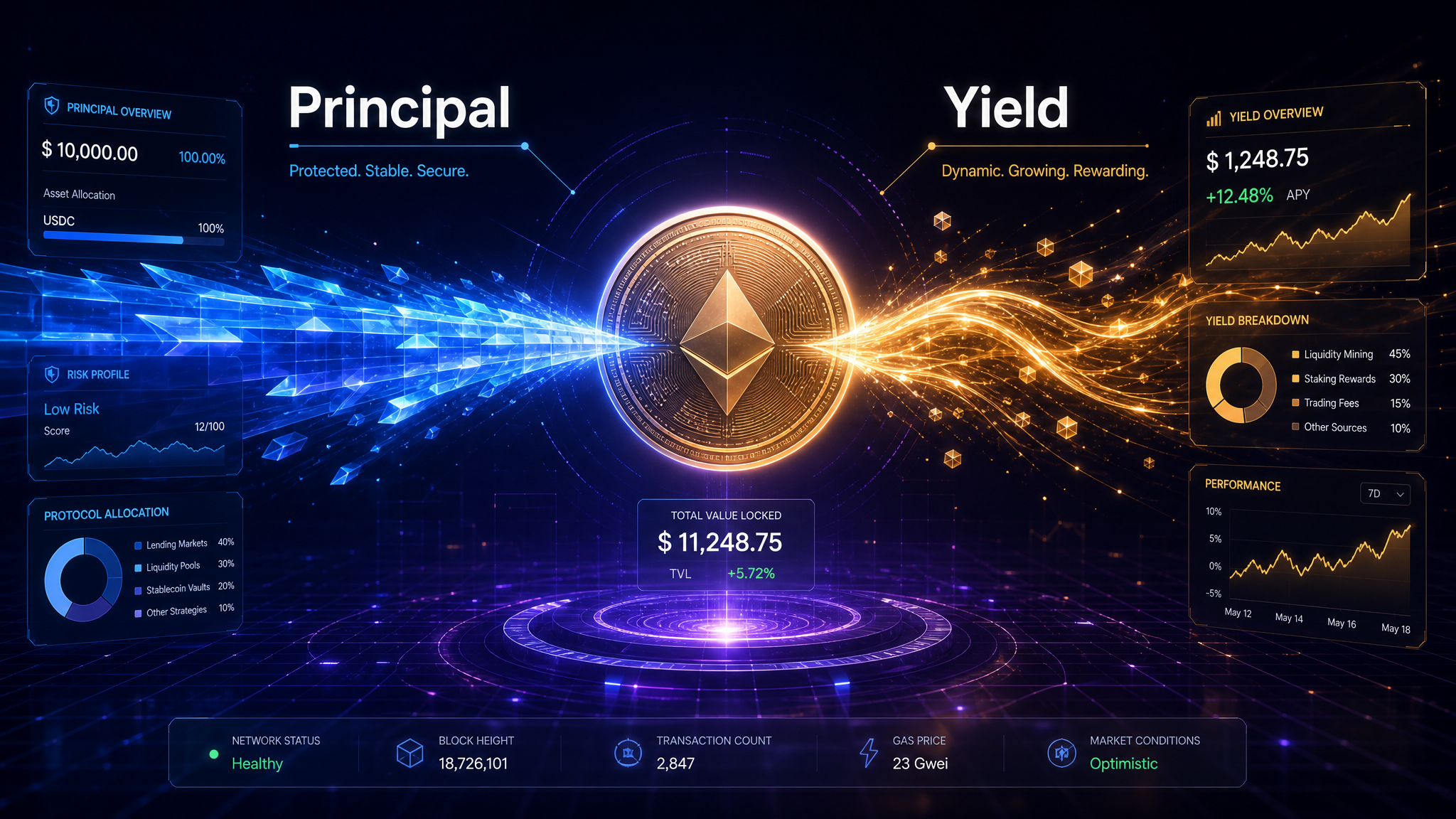
Pendle is the protocol that lets you do something genuinely novel: trade future yield. It splits yield-bearing assets (like stETH or Aave's aUSDC) into two components — the principal token (PT) and the yield token (YT). You can buy the PT at a discount to lock in a fixed rate, or buy the YT to speculate on yield going higher.
In practice, this means you can lock in a fixed 8% APY on your stablecoins for six months, regardless of what happens to variable rates. Or you can take a leveraged bet that Ethereum staking yields will rise. Neither of these strategies existed in DeFi three years ago.
Pendle has seen explosive growth in 2026, driven by institutional demand for fixed-rate DeFi exposure. The interface has improved significantly — it's still not beginner-friendly, but it's no longer the impenetrable spreadsheet it once was.
Best for: Intermediate to advanced users who want fixed-rate yield or want to speculate on yield movements.
Risk level: Medium-high. The mechanics are complex, and YT positions can expire worthless if yield drops.
6. EigenLayer — Best for Restaking and Shared Security
EigenLayer introduced a concept that's reshaping how Ethereum's security model works: restaking. Instead of your staked ETH only securing Ethereum, EigenLayer lets you "restake" it to also secure additional services — called Actively Validated Services (AVS) — and earn additional yield for doing so.
The appeal is straightforward: you're already staking ETH, so why not earn extra yield by extending that security to other protocols? Current restaking yields through EigenLayer and liquid restaking protocols like Ether.fi add roughly 1–3% on top of base staking rewards, depending on which AVS you're securing.
The risk is equally straightforward: slashing. If an AVS you're securing misbehaves, your restaked ETH can be slashed. This is a newer, less battle-tested risk surface than traditional staking, and it requires careful selection of which AVS to support.
Best for: ETH stakers who want to maximize yield and understand the additional slashing risks.
Risk level: Medium-high. Restaking adds yield but also adds a new layer of smart contract and slashing risk.

7. Sky (formerly MakerDAO) — Best for Stablecoin Strategies
Sky — the rebranded MakerDAO — is the protocol that created DAI, the original decentralized stablecoin. Now operating as USDS, the stablecoin infrastructure Sky provides underpins a significant portion of DeFi's credit system. TVL typically sits in the $5–6 billion range, and the protocol has been operating since 2017 — making it one of the oldest and most battle-tested in the space.
The core use case: deposit collateral (ETH, wBTC, or tokenized real-world assets), generate USDS against it, and deploy that USDS elsewhere in DeFi to earn yield. It's essentially a decentralized credit line. Sky's Savings Rate (DSR equivalent) currently offers around 5–6% on USDS deposits, which is competitive with traditional money market funds.
Sky has also been aggressively integrating real-world assets — tokenized US Treasuries and private credit — as collateral, which has diversified its risk profile and attracted institutional capital.
Best for: Users who want stablecoin yield, decentralized credit lines, or exposure to RWA-backed DeFi.
Risk level: Low-medium. Sky is one of the most audited protocols in DeFi, though governance risk and collateral liquidation risk remain.
How to Choose the Right DeFi Protocol for You
The honest answer is that most serious DeFi users end up using several of these protocols together. A common stack looks something like this:
- Stake ETH on Lido → receive stETH
- Deposit stETH into Aave as collateral → borrow USDC
- Deploy USDC into Pendle for fixed-rate yield
- Swap tokens as needed on Uniswap
Each protocol handles one piece of the puzzle. The key is understanding what you're doing at each step — and what can go wrong. Smart contract risk, liquidation risk, and impermanent loss are real. None of these protocols are FDIC-insured. Start small, understand the mechanics before committing significant capital, and always keep some assets in cold storage.
Protect your crypto assets with a Ledger hardware wallet — the gold standard in cold storage security.
Key Takeaways
- Lido is the go-to for liquid ETH staking — earn yield without locking up your assets.
- Aave leads decentralized lending with 21+ chain support and deep liquidity.
- Uniswap is the most reliable DEX for token swaps and liquidity provision.
- Morpho offers advanced lending efficiency with isolated market risk.
- Pendle unlocks fixed-rate yield and yield speculation — powerful but complex.
- EigenLayer lets ETH stakers earn extra yield through restaking, with added risk.
- Sky provides stablecoin infrastructure and decentralized credit lines backed by RWAs.
- Always verify current TVL and yields on DefiLlama before committing capital — these numbers move fast.
For a structured approach to learning crypto trading, Icoinpro offers step-by-step training that has helped thousands of beginners navigate DeFi and beyond.
DeFi moves fast. Your trading skills need to keep up.
Whether you're yield farming or trading tokens, the fundamentals of reading charts, managing risk, and timing entries apply everywhere in crypto. Those skills are worth developing properly.
The program I recommend to people who ask me is this crypto trading course — it\'s the one I point friends and family to when they\'re serious about learning. Daily lessons, live analysis, and a community that actually helps.
Affiliate link — I may earn a commission at no extra cost to you. I only recommend what I genuinely use.
Disclaimer: The information provided on this website is for educational and informational purposes only. It should not be considered financial or investment advice. Cryptocurrency investments carry significant risk. Always do your own research and consult with a qualified financial advisor before making investment decisions.
Free Crypto Insights
Get weekly trading tips, market analysis, and exclusive strategies delivered to your inbox.