Pendle Finance Strategy Guide 2026: How to Earn Fixed Yield and Speculate on DeFi Rates
Affiliate Disclosure: This article may contain affiliate links. We may earn a commission at no extra cost to you. All opinions are our own.
Marcus Chen
Senior Crypto Analyst & Educator
Certified Blockchain Professional | Former Wall Street Analyst
Marcus Chen is a cryptocurrency analyst and educator with over 8 years of experience in digital asset trading. He has helped thousands of beginners navigate the crypto markets through practical, actionable education.
Pendle Finance Strategy Guide 2026: How to Earn Fixed Yield and Speculate on DeFi Rates
The Pendle Finance strategy landscape has quietly become one of the most sophisticated corners of DeFi — and in 2026, it's attracting serious capital from both retail power users and institutional desks. If you've been stacking stETH or USDe and watching your variable yield bounce around unpredictably, Pendle offers something genuinely different: the ability to lock in a fixed return, speculate on rate movements with leverage, or even tokenize perpetual futures funding rates. This guide breaks down exactly how to use Pendle's PT and YT mechanics to your advantage, with four concrete strategies you can implement today.
What Is Pendle Finance and Why It Matters in 2026
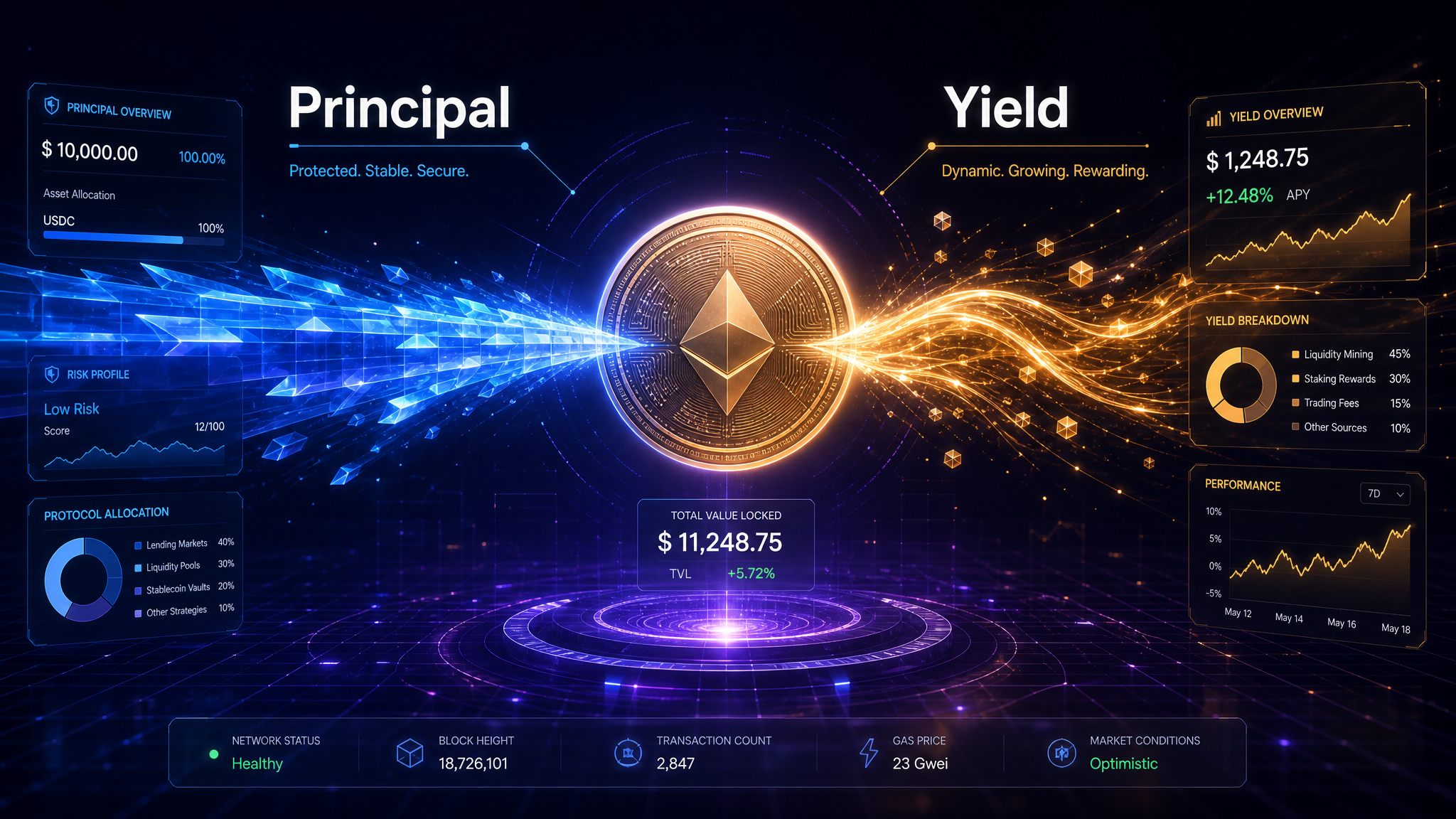
Pendle Finance is a decentralized yield-tokenization protocol built on Ethereum (with deployments on Arbitrum, BNB Chain, Optimism, and now Monad). The core idea is deceptively simple: take any yield-bearing asset — stETH, USDe, sUSDe, weETH — and split it into two separate tokens representing the principal and the future yield. Trade them independently.
Why does this matter? Because DeFi yields are notoriously volatile. One week you're earning 12% APY on a stablecoin vault; the next week it's 4%. Pendle lets you step off that rollercoaster. You can sell your future yield upfront (locking in a fixed rate) or buy someone else's yield exposure (betting rates will rise). It's essentially a fixed-income market built on top of DeFi — something that didn't really exist before Pendle.
By October 2026, Pendle's stablecoin pools have reached over $6 billion in year-to-date nominal trading volume. The protocol has expanded to Monad (launched October 8, 2026), launched USDG (a U.S. Treasury bill-backed stablecoin), and introduced a "No-Yield" tokenization mechanism that broadens its addressable market beyond traditional yield-bearing assets. It's become the go-to for anyone serious about yield engineering rather than yield chasing.
How Pendle Tokenization Works: PT, YT, and SY Explained
Before jumping into strategies, you need to understand the three token types Pendle uses. It sounds technical, but the logic is clean once you see it.
Principal Tokens (PT): Your Fixed-Yield Bond
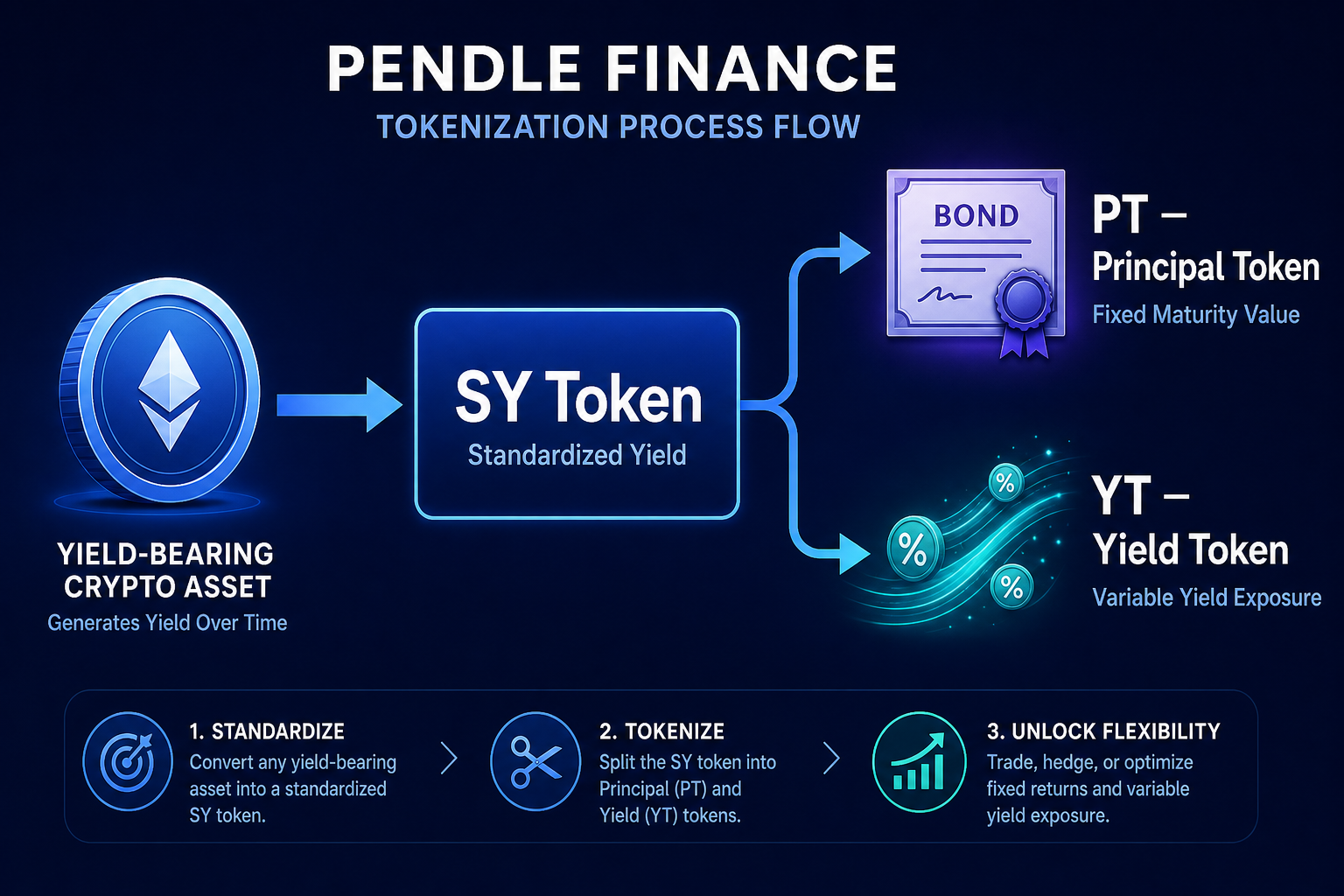
When you deposit a yield-bearing asset into Pendle, it first gets wrapped into a Standardized Yield (SY) token — a universal interface that normalizes how different protocols report yield. The SY token is then split into two components.
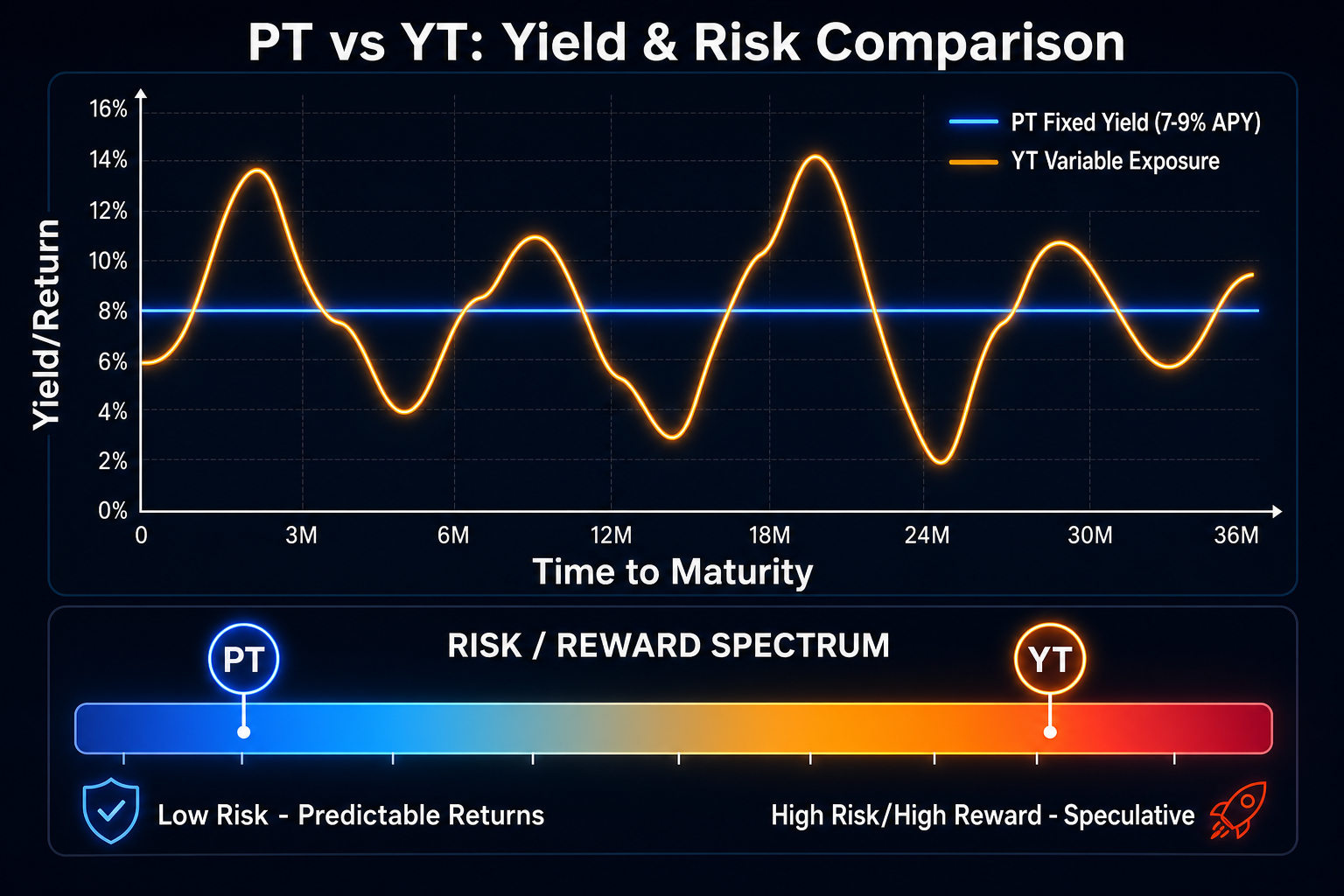
The Principal Token (PT) works like a zero-coupon bond. It trades at a discount to the underlying asset and redeems 1:1 at a fixed maturity date. Say you buy PT-stETH expiring December 2026 at a 6% discount. Hold it to maturity and you pocket that 6% as a fixed return — regardless of what happens to Ethereum staking rates in the meantime. No variable rate risk. No surprises.
Yield Tokens (YT): Leveraged Rate Speculation
The Yield Token (YT) is the other half of the split. It represents the right to collect all future yield generated by the underlying asset until the maturity date. YT is inherently leveraged and time-decaying — it approaches zero as maturity nears, similar to an options contract.
Here's the leverage angle: if you buy YT-stETH for $0.05 per token and Ethereum staking rates double, your YT could be worth $0.10 or more. You've doubled your money on a rate move, not a price move. But if rates fall or stay flat, your YT decays toward zero. High risk, high reward — this is not a passive play.
Strategy 1: Lock In Fixed Yield with Principal Tokens
This is Pendle's most straightforward use case and the one that makes the most sense for capital-preservation-minded DeFi users.
How it works: Navigate to app.pendle.finance, select a pool (e.g., PT-USDe or PT-sUSDe), and buy the PT at its current discount. The implied fixed APY is displayed directly on the interface — in mid-2026, PT-USDe pools have been offering 7–9% fixed APY, compared to the variable 5–12% you'd get holding USDe directly.
Real example: You have $10,000 in USDe earning a variable 8% APY. You swap into PT-USDe expiring December 2026 at an implied 8.5% fixed APY. For the next few months, you earn exactly 8.5% — no matter what happens to Ethena's yield. If USDe rates drop to 4% in October (which has happened before), you're still earning 8.5%. That's the value proposition.
Best for: Stablecoin holders who want predictable yield, treasury managers, anyone who thinks DeFi rates will fall.
Want to accelerate your trading journey? Explore Icoinpro's daily trading signals and education platform.
Strategy 2: Speculate on Rising Rates with Yield Tokens
YT trading is where Pendle gets genuinely exciting — and genuinely dangerous. This strategy is for traders who have a strong conviction that DeFi yields are about to spike.
The setup: Buy YT tokens when you believe the underlying yield will rise significantly before maturity. Because YT is priced at a fraction of the underlying asset, you get leveraged exposure to rate movements.
Example: YT-weETH expiring December 2026 trades at $0.04 per token. You buy $1,000 worth (25,000 YT). If weETH yields jump from 6% to 12% APY, the YT price could move to $0.08+, doubling your money. If yields stay flat, you lose most of your $1,000 as the YT decays.
Risk management: Never allocate more than 5–10% of your DeFi portfolio to YT speculation. Treat it like buying call options — size accordingly. Set a mental stop-loss at 50% of your entry and stick to it.
Airdrop farming: Many protocols give points to YT holders. In 2025–2026, YT-sUSDe delivered Ethena points at 3–5x the rate of holding sUSDe directly — a legitimate use case even if you're neutral on rate direction.
Strategy 3: Pendle Boros — Tokenizing Perpetual Funding Rates
Pendle's V3 platform, Boros, launched in late 2025 and targets a completely different market: the $150 billion daily perpetual futures funding rate ecosystem. This is where Pendle gets institutional.
Perpetual futures funding rates are notoriously volatile. When the market is bullish, longs pay shorts 0.01–0.1% every 8 hours. When sentiment flips, the rate reverses. Boros lets you tokenize these funding cash flows the same way Pendle V2 tokenizes staking yields.
How traders use Boros:
- Funding rate hedgers: If you run a delta-neutral strategy that earns funding rates, you can sell your future funding income via Boros PT to lock in a fixed rate. No more worrying about funding flipping negative.
- Rate speculators: Buy Boros YT when you expect funding rates to spike — typically during bull market euphoria when longs are paying heavily.
- Institutional desks: Use Boros to hedge funding rate exposure on large perpetual positions, similar to how traditional finance uses interest rate swaps.
Boros liquidity is growing, and the addressable market is enormous. Watch this space — especially as Pendle explores "Permissioned Markets" for institutional participants requiring KYC-integrated environments.
Strategy 4: Looping PT on Aave for Leveraged Fixed Yield
This is the most complex strategy in this guide — and the one with the highest potential returns (and risks). It combines Pendle's PT with Aave's lending market to create a leveraged fixed-yield position.
The mechanics:
- Buy PT-stETH on Pendle (e.g., earning 7% fixed APY)
- Deposit PT-stETH as collateral on Aave (Aave supports select Pendle PTs as collateral)
- Borrow ETH or stablecoins against your PT collateral
- Use borrowed funds to buy more PT-stETH
- Repeat 2–3 times to build a leveraged position
The math: If PT-stETH yields 7% fixed and you can borrow ETH at 3% on Aave, your net spread is 4%. With 2x leverage, that becomes ~8% on your initial capital. With 3x leverage, ~12%. The fixed rate on the PT means your yield side is locked — the variable risk is on the borrowing cost.
Critical risks: If Aave's borrowing rates spike above your PT yield, your spread compresses or disappears. If stETH depegs, your collateral drops and you face liquidation. Use conservative LTV ratios (50–60% max) and monitor your health factor daily.
Serious about security? The Ledger Nano X keeps your private keys offline and safe — essential when managing complex multi-protocol DeFi positions.
October 2026 Updates: What's New on Pendle
Pendle has been busy in Q3–Q4 2026. Here's what's changed since this guide was first published:
- Monad Expansion (October 8, 2026): Pendle launched on the Monad blockchain with two initial yield markets — Agora AUSD and Upshift earnAUSD — backed by up to $100,000 in weekly rewards to bootstrap liquidity.
- USDG Stablecoin: Pendle launched USDG in late September 2026, a regulated U.S. Treasury bill-backed stablecoin that integrates institutional fixed-income infrastructure into its DeFi stack.
- No-Yield Tokenization: Following a September 22 announcement, Pendle now allows assets without inherent yields to be split into PT and YT. This dramatically broadens the protocol's addressable market.
- sPENDLE Governance Transition: The legacy vePENDLE mechanism is being phased out in favor of sPENDLE, reflecting the protocol's evolution toward newer staking mechanics.
- Analytics Dashboard: A new analytics platform launched in late September 2026 provides real-time tracking of protocol revenue, staking statistics, and token buyback activity across both Pendle V2 and Boros.
- Stablecoin Volume Milestone: Pendle's stablecoin pools reached over $6 billion in year-to-date nominal trading volume by late September 2026.
Risk Management: What Can Go Wrong on Pendle
Pendle's sophistication comes with specific failure modes. Know these before deploying capital.
1. YT time decay: YT tokens expire worthless at maturity. If you buy YT and the underlying yield doesn't move in your favor, you lose your entire investment. This is not a bug — it's the design. Treat YT like options: only risk what you can afford to lose entirely.
2. Underlying asset risk: Pendle doesn't backstop the assets it wraps. If stETH depegs or USDe loses its peg, both PT and YT lose value. The protocol itself is fine — but your position isn't. Diversify across multiple underlying assets.
3. Smart contract risk: Pendle has been audited multiple times and has a strong security track record, but no DeFi protocol is immune to exploits. Don't put your entire net worth in any single protocol.
4. Liquidity risk: Some Pendle pools have thin liquidity, especially for less popular assets or longer maturities. Large trades can suffer significant slippage. Check pool depth before entering.
5. Maturity management: PT tokens must be redeemed at or after maturity. If you forget to redeem, your funds sit idle. Set calendar reminders for all your PT maturity dates.
Step-by-Step: How to Get Started on Pendle Finance
Here's the practical path to get started:
- Get a compatible wallet: MetaMask, Rabby, or any WalletConnect-compatible wallet works. Make sure you have ETH for gas (Arbitrum is cheapest).
- Bridge to Arbitrum: Most Pendle liquidity lives on Arbitrum. Use the official Arbitrum bridge or a cross-chain aggregator like Li.Fi.
- Acquire a yield-bearing asset: Get stETH (via Lido), USDe (via Ethena), or weETH (via ether.fi) — these have the deepest Pendle pools.
- Visit app.pendle.finance: Connect your wallet and browse available pools. Filter by asset type and maturity date.
- Choose your strategy: Buy PT for fixed yield, buy YT for rate speculation, or provide liquidity to earn trading fees plus PENDLE token rewards.
- Monitor your position: Check your PT maturity dates, YT decay rate, and (if looping) your Aave health factor regularly.
For a structured approach to learning crypto trading, Icoinpro offers step-by-step training that has helped thousands of beginners build the foundation needed before tackling advanced DeFi strategies like Pendle.
Key Takeaways
- Pendle Finance splits yield-bearing assets into Principal Tokens (PT) and Yield Tokens (YT), enabling fixed-rate and speculative DeFi strategies.
- PT tokens function like zero-coupon bonds — buy at a discount, redeem at par on maturity, earn a fixed APY regardless of market conditions.
- YT tokens offer leveraged exposure to yield rate movements — high risk, high reward, and they expire worthless at maturity.
- Pendle Boros extends this model to perpetual futures funding rates — a major innovation for institutional DeFi users.
- October 2026 updates: Monad expansion, USDG stablecoin launch, No-Yield tokenization, and sPENDLE governance transition are reshaping the protocol.
- Always manage maturity dates, underlying asset risk, and position sizing carefully — Pendle rewards discipline.
Frequently Asked Questions: Pendle Finance 2026
Q: What is the sPENDLE transition and how does it affect me?
Pendle is phasing out its legacy vePENDLE governance mechanism in favor of sPENDLE. If you hold vePENDLE, monitor official Pendle announcements for migration timelines and any impact on your voting power and fee-sharing rights. The transition reflects the protocol's maturation and move toward more sustainable staking mechanics.
Q: What is Pendle's USDG stablecoin?
USDG is a regulated, U.S. Treasury bill-backed stablecoin launched by Pendle in late September 2026. It integrates institutional fixed-income infrastructure into the DeFi stack, allowing users to earn yield on a stablecoin backed by real-world government securities. It can be used in Pendle's PT/YT framework like other yield-bearing stablecoins.
Q: What is Pendle's No-Yield tokenization?
Announced September 22, 2026, No-Yield tokenization allows assets without inherent yields to be split into PT and YT tokens. This dramatically expands Pendle's addressable market beyond traditional yield-bearing assets, potentially enabling yield markets for a much wider range of crypto assets.
Q: Is Pendle available on Monad?
Yes. Pendle launched on Monad on October 8, 2026, with two initial yield markets: Agora AUSD and Upshift earnAUSD. The protocol allocated up to $100,000 in weekly rewards to bootstrap liquidity on the new chain.
Q: How does Pendle compare to traditional fixed-income investing?
Pendle's PT tokens function similarly to zero-coupon bonds — you buy at a discount and receive par value at maturity. The key differences: DeFi yields are generally higher than traditional bonds (though more volatile), there's no credit risk from a government or corporation (but there is smart contract risk), and maturities are typically shorter (weeks to months rather than years). See our Crypto Liquidity Mining 2.0 guide for complementary DeFi yield strategies.
DeFi moves fast. Your trading skills need to keep up.
Whether you're yield farming or trading tokens, the fundamentals of reading charts, managing risk, and timing entries apply everywhere in crypto. Those skills are worth developing properly.
The program I recommend to people who ask me is this crypto trading course — it\'s the one I point friends and family to when they\'re serious about learning. Daily lessons, live analysis, and a community that actually helps.
Affiliate link — I may earn a commission at no extra cost to you. I only recommend what I genuinely use.
Disclaimer: The information provided on this website is for educational and informational purposes only. It should not be considered financial or investment advice. Cryptocurrency investments carry significant risk. Always do your own research and consult with a qualified financial advisor before making investment decisions.
Free Crypto Insights
Get weekly trading tips, market analysis, and exclusive strategies delivered to your inbox.