Best Ethereum Layer 2 Networks in 2026: Arbitrum, Base, Optimism and More Compared
Affiliate Disclosure: This article may contain affiliate links. We may earn a commission at no extra cost to you. All opinions are our own.
Marcus Chen
Senior Crypto Analyst & Educator
Certified Blockchain Professional | Former Wall Street Analyst
Marcus Chen is a cryptocurrency analyst and educator with over 8 years of experience in digital asset trading. He has helped thousands of beginners navigate the crypto markets through practical, actionable education.
This article contains affiliate links. We may earn a commission at no extra cost to you if you make a purchase through these links. See our affiliate disclosure for details.
Best Ethereum Layer 2 Networks in 2026: Arbitrum, Base, Optimism and More Compared
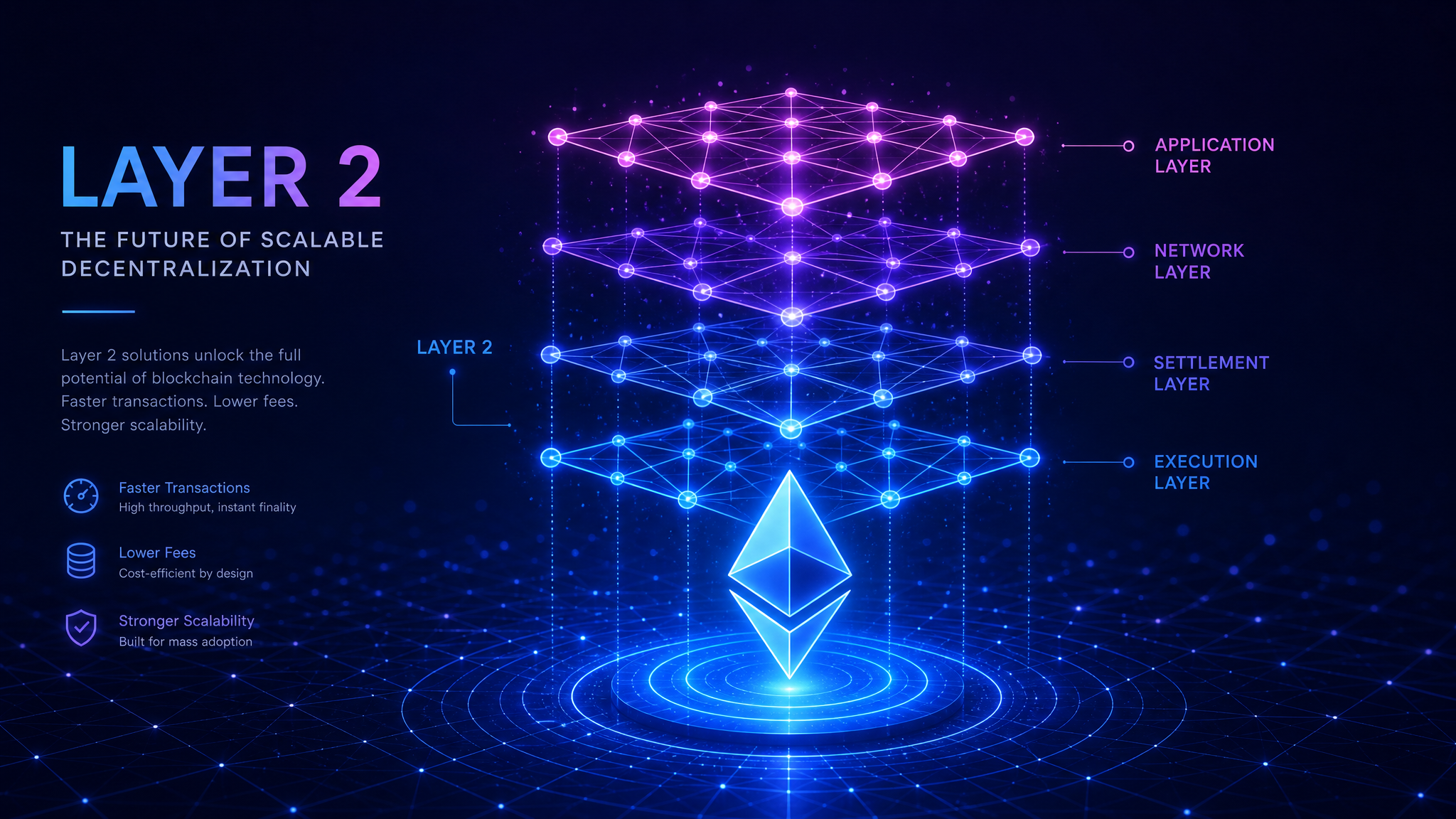
The best Ethereum layer 2 networks in 2026 have fundamentally changed how people use crypto — slashing fees from $20+ on mainnet to literal cents, while keeping Ethereum's security underneath. If you've been paying $15 gas fees to swap tokens, you're leaving money on the table. The L2 ecosystem now holds over $48 billion in total value locked, and picking the right network can mean the difference between a smooth DeFi experience and a frustrating, expensive one.
This guide cuts through the noise. We'll cover the top six Ethereum L2s — what they're actually good at, where they fall short, and which one fits your specific situation.
- Best for DeFi power users: Arbitrum One
- Best for beginners & everyday use: Base
- Best for ecosystem builders: Optimism
- Best ZK rollup for security: Scroll
- Best for institutional settlement: zkSync Era
- Best for compute-heavy apps: Starknet
Why Layer 2 Networks Matter More Than Ever in 2026
Ethereum mainnet is still the settlement layer — the bedrock. But nobody actually transacts there anymore if they can help it. After the Dencun upgrade (EIP-4844) in 2024, L2 fees dropped by 80–90% overnight. A standard token swap that cost $8–$20 on mainnet now runs $0.02–$0.06 on most major L2s. That's not a rounding error. That's a structural shift.
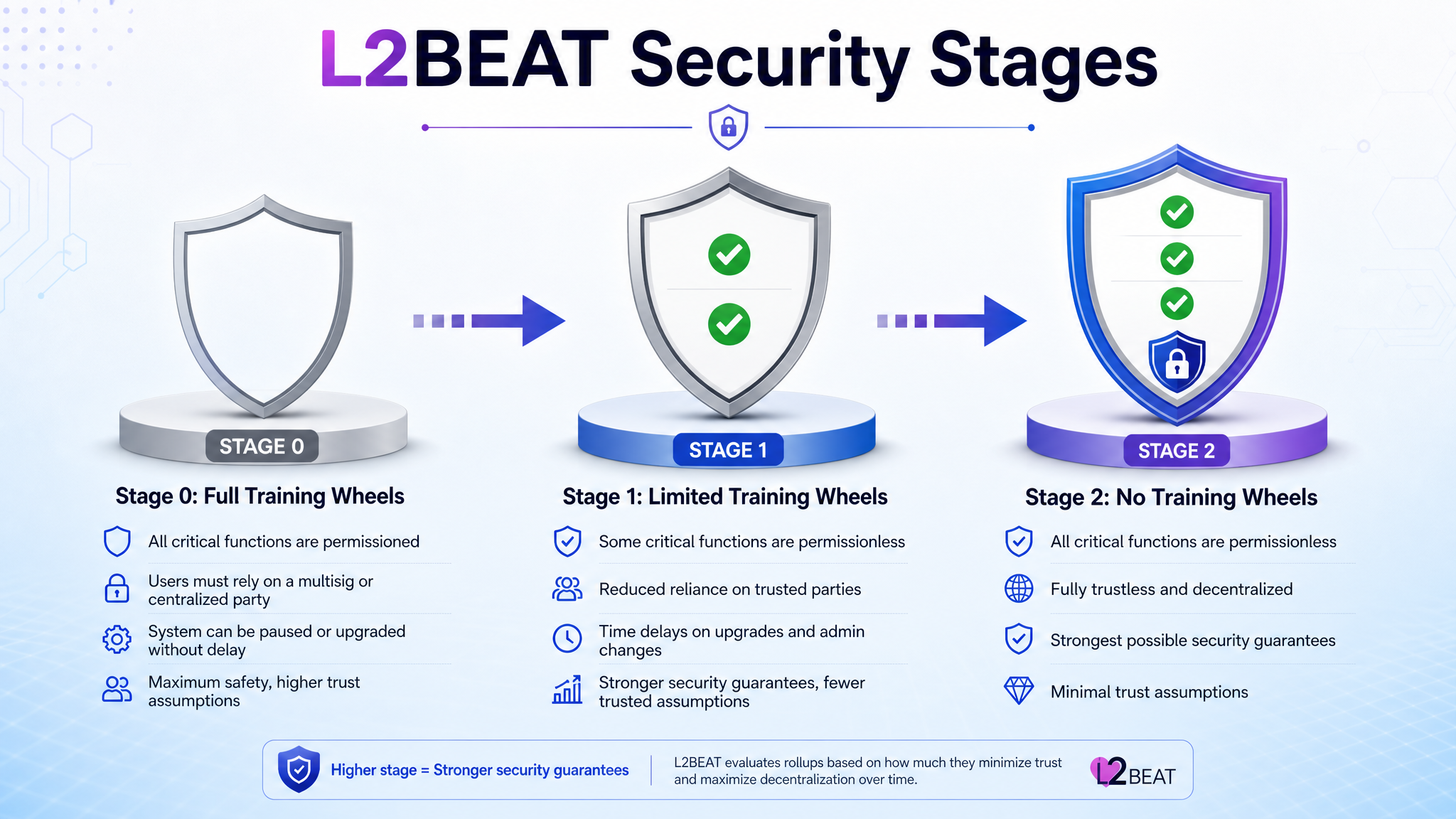
The L2 market has also matured in terms of security. The L2BEAT "Stage" framework now gives users a clear signal: Stage 1 means the network has live, permissionless fraud or validity proofs — you can exit to Ethereum without asking anyone's permission. Stage 0 means the team still holds override keys. That distinction matters a lot when you're parking serious capital.
Here's the current landscape at a glance:
- Total L2 TVL: ~$48 billion (mid-2026)
- Arbitrum + Base market share: ~70–77% of all L2 liquidity
- Average L2 transaction fee: $0.02–$0.06
- Stage 1 networks: Arbitrum, Base, Optimism, Scroll, Starknet
1. Arbitrum One — Best for DeFi Power Users
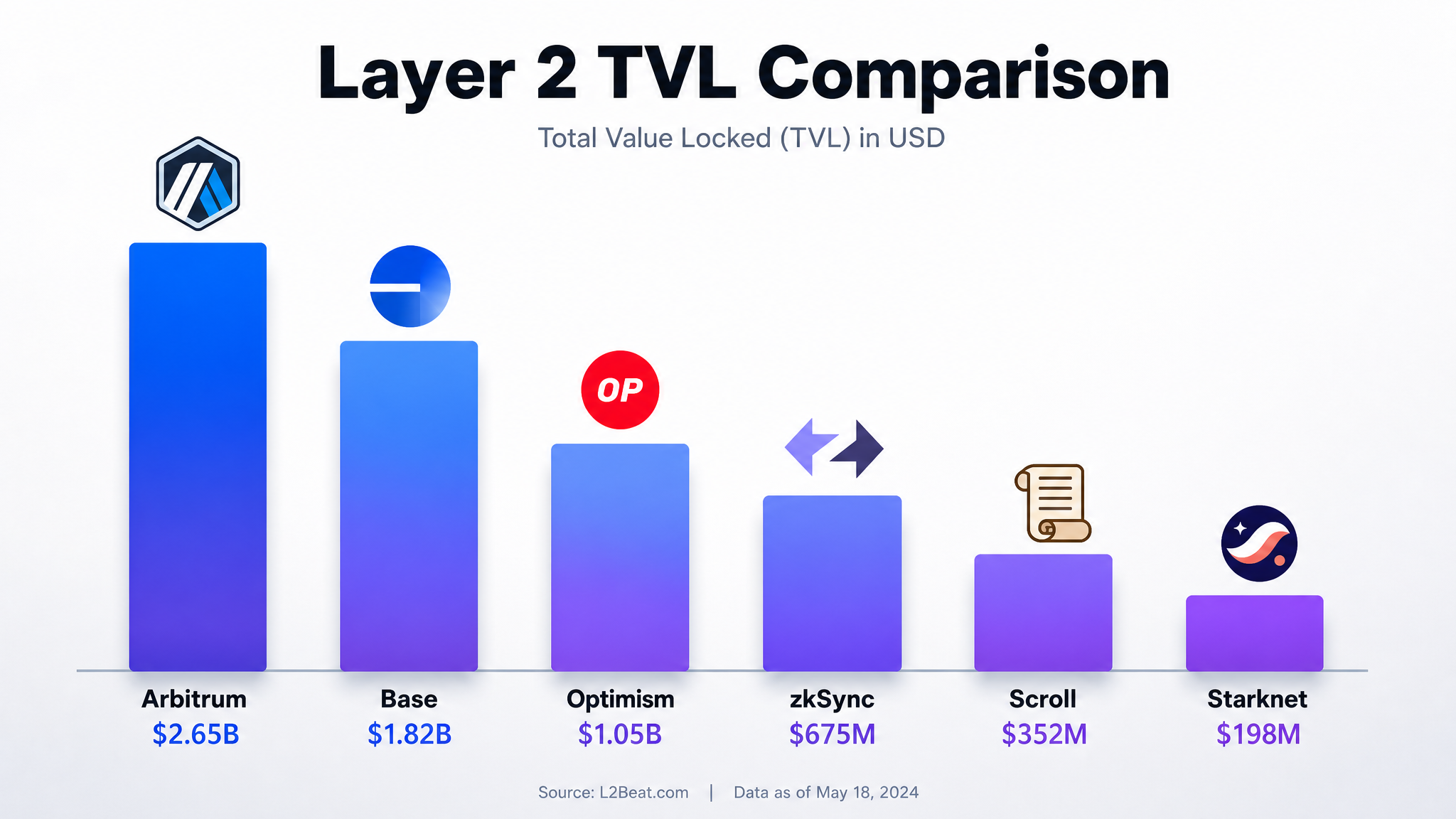
Arbitrum One is the undisputed king of DeFi liquidity on L2. It holds roughly $13.8–$16.9 billion in TVL — about 40–44% of the entire L2 market. That's not just a number. Deep liquidity means tighter spreads, less slippage, and more protocol options when you're executing complex strategies.
The ecosystem here is stacked. GMX for perpetuals, Aave V3 for lending, Uniswap for spot trading, Pendle for yield tokenization — all running with the deepest pools on any L2. If you're doing anything beyond basic swaps, Arbitrum is where the serious money lives.
The Stylus upgrade is a genuine differentiator. It lets developers write smart contracts in Rust, C, and C++ via WebAssembly — not just Solidity. That opens the door to compute-intensive applications like real-time options pricing engines and high-frequency order books that simply weren't practical before. It's a technical moat that competitors haven't matched.
Security: Stage 1 on L2BEAT, with fully permissionless fraud proofs. Any participant can challenge a fraudulent state transition and exit to Ethereum mainnet without Offchain Labs' permission. For large capital allocators, this matters.
Fees: ~$0.03–$0.05 per transaction. Throughput runs 40–62 TPS under normal conditions.
Best for: DeFi traders, yield farmers, anyone running complex multi-protocol strategies. If you're managing $10K+ in DeFi positions, Arbitrum's liquidity depth is hard to beat.
Watch out for: The 7-day withdrawal window for native bridge exits. Use third-party bridges like Across or Hop to bypass this (costs 0.05–0.20% but saves days of waiting).
2. Base — Best for Beginners and Everyday Use
Base is Coinbase's L2, and that distribution advantage is enormous. Over 110 million verified Coinbase users can onboard to Base with minimal friction — no separate wallet setup, no confusing bridge UI. That's why Base leads all L2s in daily active addresses (~400,000) and transaction throughput (89 TPS).
By mid-2026, Base holds roughly $10.7–$11.2 billion in TVL and has processed over 6.36 billion cumulative transactions. The stablecoin market cap on Base alone hit $4.9 billion. These aren't speculative numbers — they reflect genuine, sustained usage.
The network has also become a hub for "AgentFi" — autonomous AI agents managing over $12.6 billion in liquidity for yield harvesting and portfolio rebalancing. That's a new category of on-chain activity that Base is uniquely positioned to capture given its low fees and high throughput.
Security: Stage 1, built on the OP Stack. Shares security infrastructure with the broader Optimism Superchain.
Fees: ~$0.02 per transaction — among the cheapest of any major L2.
Best for: Crypto newcomers, casual DeFi users, anyone who already uses Coinbase. Also excellent for social apps, NFTs, and micro-transaction use cases.
Watch out for: Ecosystem depth is still catching up to Arbitrum for complex DeFi. If you need the deepest liquidity pools, Arbitrum still wins. Also, no native BASE token yet — though prediction markets put the probability of a 2026 launch at 69%.
Want to accelerate your trading journey? Explore Icoinpro's daily trading signals and education platform — useful whether you're trading on Base or any other L2.
3. Optimism — Best for Ecosystem Builders
Optimism's real value in 2026 isn't OP Mainnet itself — it's the OP Stack. This open-source framework powers the "Superchain": a network of interoperable chains including Base, Zora, Mode, and World Chain that share security, governance, and bridging standards.
OP Mainnet holds ~$5.6 billion in TVL, which sounds modest compared to Arbitrum, but that misses the point. Optimism's strategic play is infrastructure. When Base generates sequencer revenue, a portion flows back to the Optimism ecosystem through the Retroactive Public Goods Funding (RPGF) model. It's a different kind of value accrual.
For developers, the OP Stack is the easiest path to launching your own L2 or L3 with shared security and interoperability baked in. If you're building a protocol and want to own your sequencer revenue while staying connected to a broader ecosystem, Optimism is the natural choice.
Security: Stage 1. The Superchain vision includes shared security guarantees across all OP Stack chains.
Fees: ~$0.03–$0.04 per transaction. Throughput around 34 TPS on OP Mainnet.
Best for: Protocol developers, DAOs, projects that want to launch their own chain. Also solid for users who want to participate in the broader Superchain ecosystem.
4. Scroll — Best ZK Rollup for Security-Conscious Users
Scroll is the ZK rollup that's actually reached Stage 1 — a distinction that matters. Most ZK rollups are still at Stage 0, meaning the team retains override keys. Scroll has deployed live validity proofs and allows permissionless exits to Ethereum. That's a meaningful security upgrade over competitors.
Scroll holds ~$2.1 billion in TVL and runs at roughly $0.06 per transaction — slightly higher than optimistic rollups, but you get faster finality. ZK proofs don't require a 7-day challenge window. Once a proof is verified on Ethereum, your withdrawal is final. For users who move large amounts frequently, that speed matters.
The network is EVM-compatible, meaning existing Solidity contracts deploy without modification. That's a practical advantage over Starknet's Cairo language, which requires rewriting contracts from scratch.
Security: Stage 1 — the only major ZK rollup to achieve this as of mid-2026.
Fees: ~$0.06 per transaction. Lower throughput (~14–28 TPS) due to proof generation overhead.
Best for: Users who prioritize cryptographic security guarantees and faster withdrawal finality. Good for institutional users moving significant capital.
5. zkSync Era — Best for Institutional Settlement
zkSync Era has pivoted hard toward institutional use cases in 2026. Projects like Deutsche Bank's Project Dama 2 are building on zkSync for privacy-sensitive tokenized asset settlement. That's a different market than retail DeFi — and zkSync is leaning into it.
The network holds ~$4.1 billion in TVL and uses SNARK-based validity proofs for fast finality. The ZK Stack framework lets institutions launch their own ZK-powered chains with custom privacy settings — a compelling pitch for banks and asset managers who need compliance-friendly infrastructure.
Security: Stage 0 — the team retains multisig override capability. This is the main caveat for retail users. For institutional deployments with their own chain, this is less of a concern since they control the governance.
Fees: ~$0.03–$0.05 per transaction on the public network.
Best for: Institutional users, tokenized asset platforms, developers building privacy-preserving applications. Less ideal for retail DeFi given the Stage 0 security rating.
6. Starknet — Best for Compute-Heavy Applications
Starknet uses STARK proofs and the Cairo programming language — a combination that enables extremely efficient computation for complex on-chain logic. Think advanced on-chain gaming, ZK-native identity systems, and cryptographic operations that would be prohibitively expensive on other networks.
The tradeoff is developer friction. Cairo is not Solidity. Existing EVM contracts don't port over — you're rewriting from scratch. That limits the ecosystem compared to EVM-compatible chains, but the protocols that do build on Starknet tend to be technically sophisticated and purpose-built for the environment.
Starknet holds ~$1.5 billion in TVL and has reached Stage 1 security. Throughput is in the 14–28 TPS range, with fees around $0.03–$0.05.
Best for: Developers building compute-intensive applications, ZK-native protocols, advanced gaming. Not the right choice if you just want to swap tokens or farm yield.
The Security Question: L2BEAT Stages Explained
This deserves its own section because it's the most misunderstood aspect of L2 selection. The L2BEAT Stage framework measures how much you have to trust the team running the network:
- Stage 0: The team can pause, upgrade, or override the system unilaterally. You're trusting them not to rug you. This includes zkSync Era and Linea.
- Stage 1: Live proof systems are deployed. Users can exit to Ethereum without the operator's permission. A security council can still intervene in emergencies, but the window is limited. This includes Arbitrum, Base, Optimism, Scroll, and Starknet.
- Stage 2: Full decentralization — no team override possible. No major L2 has reached this yet as of mid-2026.
For most retail users, Stage 1 is sufficient. For large capital allocators, the distinction between Stage 0 and Stage 1 is material. Don't park $500K on a Stage 0 network without understanding what that means.
Protect your crypto assets with a Ledger hardware wallet — the gold standard in cold storage security — regardless of which L2 you use. Your private keys should always stay offline.
Actionable Takeaways
- Stop paying mainnet fees. If you're still transacting on Ethereum mainnet for routine DeFi, you're overpaying by 100–500x. Bridge to an L2 today.
- Match the L2 to your use case. Arbitrum for DeFi depth, Base for simplicity, Scroll for ZK security. Don't use a hammer when you need a scalpel.
- Check L2BEAT before committing large capital. The Stage rating tells you exactly how much trust you're placing in the team. Stage 1 is the current standard.
- Use third-party bridges for speed. Native bridges have 7-day delays on optimistic rollups. Across, Hop, and Stargate offer near-instant bridging for a small fee.
- Keep your private keys secure. L2s inherit Ethereum's security at the protocol level, but your wallet security is still your responsibility.
For a structured approach to learning crypto trading across L2 ecosystems, Icoinpro offers step-by-step training that has helped thousands of beginners navigate DeFi and trading strategies.
About the Author
Marcus Chen is a Certified Blockchain Professional and former Wall Street analyst with 8+ years of experience in cryptocurrency markets and decentralized finance. He has analyzed hundreds of blockchain protocols and DeFi strategies, helping retail investors navigate the rapidly evolving crypto landscape with data-driven, practical guidance.
DeFi moves fast. Your trading skills need to keep up.
Whether you're yield farming or trading tokens, the fundamentals of reading charts, managing risk, and timing entries apply everywhere in crypto. Those skills are worth developing properly.
The program I recommend to people who ask me is this crypto trading course — it\'s the one I point friends and family to when they\'re serious about learning. Daily lessons, live analysis, and a community that actually helps.
Affiliate link — I may earn a commission at no extra cost to you. I only recommend what I genuinely use.
Disclaimer: The information provided on this website is for educational and informational purposes only. It should not be considered financial or investment advice. Cryptocurrency investments carry significant risk. Always do your own research and consult with a qualified financial advisor before making investment decisions.
Free Crypto Insights
Get weekly trading tips, market analysis, and exclusive strategies delivered to your inbox.