How to Use Solana Liquid Staking in 2026: Earn More SOL with mSOL, jitoSOL & bSOL
Affiliate Disclosure: This article may contain affiliate links. We may earn a commission at no extra cost to you. All opinions are our own.
Marcus Chen
Senior Crypto Analyst & Educator
Certified Blockchain Professional | Former Wall Street Analyst
Marcus Chen is a cryptocurrency analyst and educator with over 8 years of experience in digital asset trading. He has helped thousands of beginners navigate the crypto markets through practical, actionable education.
Disclaimer: This content is for informational purposes only and should not be considered financial advice. Cryptocurrency investments carry significant risk. Always do your own research (DYOR) before making any investment decisions.
This article contains affiliate links. We may earn a commission at no extra cost to you if you make a purchase through these links. See our affiliate disclosure for details.
How to Use Solana Liquid Staking in 2026: Earn More SOL with mSOL, jitoSOL & bSOL
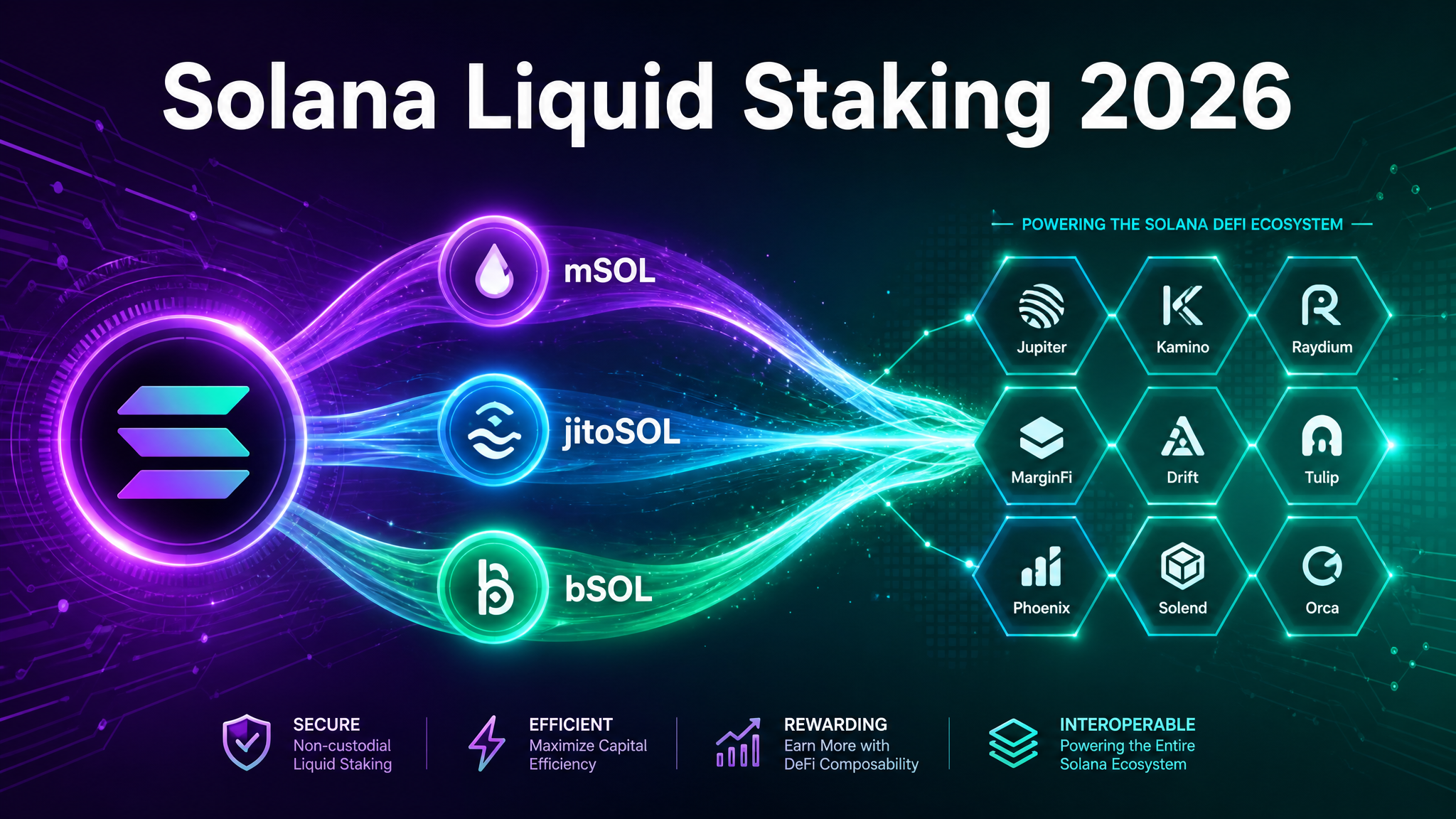
Solana liquid staking has quietly become one of the most efficient yield strategies in crypto — and in 2026, it's more accessible than ever. Instead of locking your SOL in a native stake account for days or weeks, liquid staking lets you earn 7–9% APY while keeping your assets fully deployable in DeFi. You get a yield-bearing token (like mSOL, jitoSOL, or bSOL) that represents your staked position, and you can use that token to lend, provide liquidity, or borrow against it — all while the base staking rewards keep compounding underneath.
If you're holding SOL and doing nothing with it, you're leaving real money on the table. This guide breaks down exactly how Solana liquid staking works, which protocols are worth using in 2026, and how to get started in under 10 minutes.
What Is Solana Liquid Staking?
Native Solana staking works like this: you delegate your SOL to a validator, the validator helps secure the network, and you earn roughly 6–7% APY in staking rewards. The catch? Your SOL is locked. Unstaking takes one full epoch — about 2–3 days — and during that window, you can't touch it.
Liquid staking solves that problem. You deposit SOL into a smart contract-managed stake pool, and in return you receive a Liquid Staking Token (LST). That LST is a receipt that automatically accrues staking rewards, typically reflected in its price appreciation relative to SOL. So if you deposit 10 SOL and receive 9.8 mSOL today, that 9.8 mSOL will be worth more SOL six months from now — because the underlying stake pool keeps earning rewards and the exchange rate shifts accordingly.
The real power? You can use that LST immediately. Deposit it into a lending protocol, provide liquidity on a DEX, or use it as collateral to borrow stablecoins. Your staking rewards keep running in the background while your capital does double duty.
Why Liquid Staking Beats Native Staking for Most SOL Holders
For most retail holders, native staking is fine — but it has real limitations. You're tied to a single validator, you can't react quickly to market moves, and your capital is completely idle beyond the staking yield itself.
Liquid staking changes the math. Here's a quick comparison:
- Native staking: ~6.5% APY, 2–3 day unstaking delay, capital locked
- Liquid staking (base): ~7–8% APY, instant exit via DEX swap, capital stays liquid
- Liquid staking + DeFi: 10–15%+ total APY by deploying LSTs into lending or liquidity pools
The flexibility premium is significant. When Bitcoin dropped 18% in a single week in late July 2026, liquid stakers could exit their positions in seconds via Jupiter. Native stakers had to wait out the epoch. That optionality has real value — especially in a market that still moves fast.
The Top Solana Liquid Staking Protocols in 2026
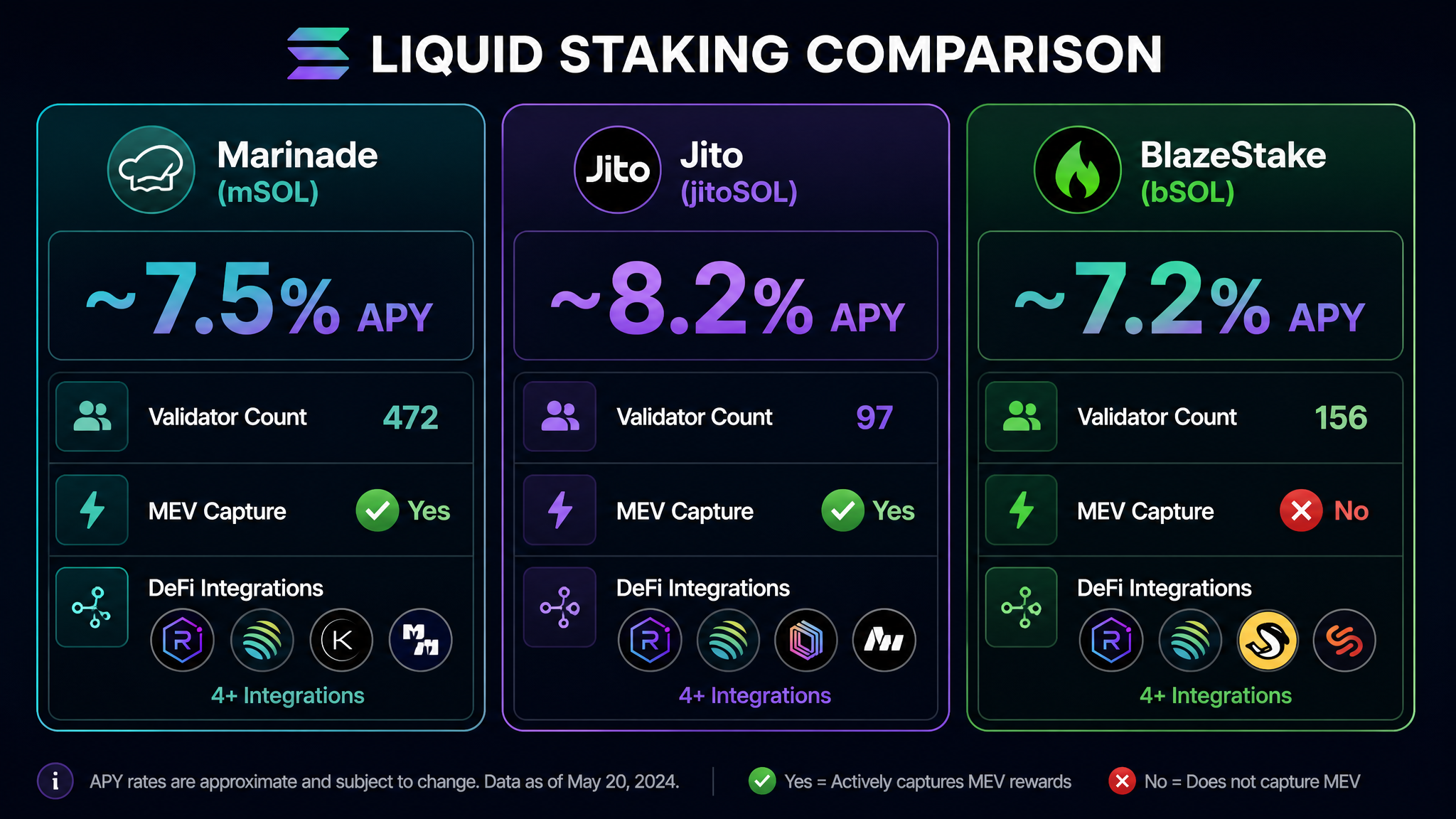
Three protocols dominate the Solana liquid staking landscape. Each has a different philosophy and yield profile.
Marinade Finance (mSOL) — The OG
Marinade was the first liquid staking protocol on Solana, launching in 2021, and it's still the most battle-tested option. When you deposit SOL into Marinade, you receive mSOL. The protocol delegates your stake across a curated set of validators using an algorithmic scoring system that weights performance, decentralization, and commission rates.
Current APY: approximately 7.2–7.8%. Marinade also runs a "Native" staking option where you keep your SOL in your own wallet (no smart contract custody) while still earning optimized validator rewards — a useful middle ground for security-conscious holders.
Best for: holders who want the most established protocol with the deepest DeFi integrations. mSOL is accepted as collateral on Kamino, MarginFi, and several other Solana lending markets.
Jito (jitoSOL) — MEV-Boosted Yield
Jito is the most interesting protocol in the Solana staking ecosystem right now. It runs a specialized validator client that captures MEV (Maximal Extractable Value) — the extra profit validators can earn by reordering transactions in a block. That MEV gets distributed back to jitoSOL holders on top of standard staking rewards.
The result: jitoSOL typically yields 7.8–8.5% APY, consistently outperforming mSOL by 50–80 basis points. In a market where every basis point matters, that adds up. On a 100 SOL position at current prices (~$145/SOL), the difference between 7.5% and 8.2% APY is roughly $100 per year.
Best for: yield-maximizers who want the highest base APY and are comfortable with a slightly newer protocol. Jito has grown to become the second-largest liquid staking protocol on Solana by TVL.
BlazeStake (bSOL) — Decentralization First
BlazeStake takes a different approach: it delegates across 200+ validators, with a strong emphasis on supporting smaller, independent validators that larger protocols often ignore. This makes bSOL the most decentralization-friendly option — and Solana's health as a network depends on that validator diversity.
APY: approximately 7.0–7.5%, with auto-compounding built in. BlazeStake also offers competitive fees (0.1% deposit fee, no withdrawal fee) and has been audited multiple times. If you care about the long-term health of the Solana network and want to put your stake where your values are, bSOL is worth considering.
Step-by-Step: How to Liquid Stake SOL with Jito
Here's exactly how to get started. I'll use Jito as the example since it offers the best yield, but the process is nearly identical for Marinade and BlazeStake.
What you need: A Phantom or Solflare wallet with SOL, plus a small amount of SOL for transaction fees (0.001–0.005 SOL per transaction).
- Go to jito.network and connect your wallet. The interface is clean — you'll see your SOL balance and the current jitoSOL APY displayed prominently.
- Enter the amount of SOL you want to stake. Keep at least 0.05 SOL in your wallet for future transaction fees. If you're staking 10 SOL, enter 9.95.
- Review the exchange rate. You'll see something like "10 SOL → 9.73 jitoSOL." That's not a loss — jitoSOL trades at a premium to SOL because it's already accumulated rewards. When you unstake later, you'll get back more SOL than the jitoSOL face value.
- Click Stake and approve the transaction in your wallet. The transaction typically confirms in under 1 second on Solana.
- You now hold jitoSOL. Your rewards start accruing immediately. You can check the current exchange rate anytime on the Jito dashboard to see how your position has grown.
To unstake: You have two options. Swap jitoSOL back to SOL on Jupiter (instant, small slippage) or use Jito's native unstaking (2–3 day epoch wait, no slippage). For amounts under $10,000, the Jupiter swap is usually the better choice.
How to Use Your LST in DeFi to Stack More Yield
This is where liquid staking gets genuinely interesting. Once you hold jitoSOL, mSOL, or bSOL, you can deploy it in DeFi to earn additional yield on top of your base staking rewards.
Option 1: Lending on Kamino or MarginFi. Deposit your LST as collateral and earn lending interest (typically 1–3% additional APY) while your staking rewards keep running. You can also borrow SOL or stablecoins against your LST position — useful if you want liquidity without selling your stake.
Option 2: Liquidity provision on Meteora or Orca. Provide liquidity to a jitoSOL/SOL pool and earn trading fees on top of staking rewards. The impermanent loss risk is minimal since both assets are correlated (jitoSOL is just SOL + yield). Typical additional APY from fees: 2–5%.
Option 3: Looping (advanced). Deposit jitoSOL as collateral, borrow SOL, convert that SOL to more jitoSOL, and repeat. This amplifies your staking yield but also amplifies your liquidation risk if SOL's price drops sharply. Only attempt this if you understand health factors and liquidation mechanics.
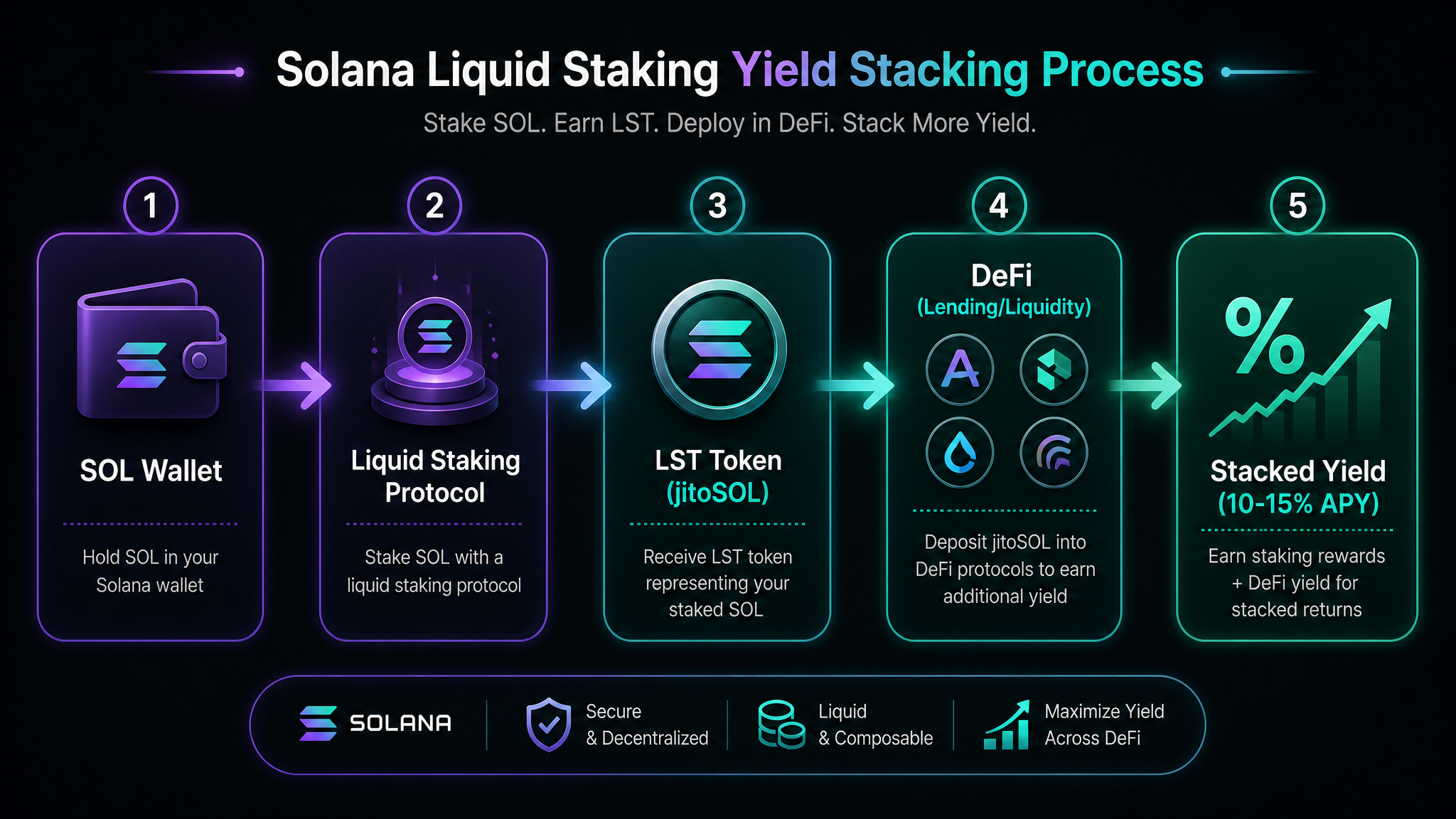
For most holders, Option 1 (lending) is the sweet spot: low complexity, meaningful yield boost, and you maintain full control of your position. A 100 SOL position earning 8% base jitoSOL APY plus 2% lending yield equals 10% total — without any directional trading risk.
Want to go deeper on DeFi yield strategies? Icoinpro's comprehensive trading course covers DeFi mechanics, yield optimization, and risk management in detail — a solid foundation if you're new to these strategies.
Risks You Need to Know Before Staking
Liquid staking is lower-risk than most DeFi strategies, but it's not risk-free. Here's what to watch:
Smart contract risk. Your SOL is held in protocol smart contracts. If there's a bug or exploit, funds could be at risk. Marinade, Jito, and BlazeStake have all been audited multiple times, but no smart contract is 100% bulletproof. Stick to the established protocols and don't chase obscure new entrants offering 20%+ APY.
De-pegging. During extreme market stress, LSTs can trade at a discount to their underlying SOL value on secondary markets. This is usually temporary and arbitraged away quickly, but if you need to exit during a panic, you might get slightly less than the "true" value. The native unstaking route avoids this but takes 2–3 days.
Validator slashing. If a validator behaves maliciously, their stake can be slashed. Liquid staking protocols spread risk across many validators, which significantly reduces this exposure compared to delegating to a single validator yourself.
Tax implications. In the US, swapping SOL for an LST may be a taxable event (it's a token swap). Staking rewards are typically treated as ordinary income when received. Keep records and use crypto tax software to track your positions accurately.
One thing that's non-negotiable: keep your LSTs in a self-custody wallet, not on an exchange. Protect your private keys with a hardware wallet — the Ledger Nano X supports Solana and all major LSTs, keeping your keys offline and safe from exchange hacks or insolvencies.
Key Takeaways
- Solana liquid staking lets you earn 7–9% APY on SOL while keeping your assets liquid and deployable in DeFi
- The three main protocols are Marinade (mSOL), Jito (jitoSOL), and BlazeStake (bSOL) — Jito offers the highest yield via MEV capture
- Getting started takes under 10 minutes: connect your wallet, deposit SOL, receive your LST
- Stack additional yield by lending your LST on Kamino or MarginFi (adds 1–3% APY with minimal extra risk)
- Key risks: smart contract bugs, temporary de-pegging, and tax events on swaps — manage these with established protocols and a hardware wallet
- Liquid staking is one of the most capital-efficient strategies available to SOL holders in 2026 — native staking is leaving yield on the table
If you're serious about building a crypto income strategy beyond just holding, liquid staking is a logical first step. For a broader education on how DeFi, trading, and yield strategies fit together, Icoinpro offers step-by-step training that has helped thousands of beginners build real crypto skills. And for the foundational economics behind why assets like SOL have value in the first place, The Bitcoin Standard remains essential reading for every serious crypto investor.
DeFi moves fast. Your trading skills need to keep up.
Whether you're yield farming or trading tokens, the fundamentals of reading charts, managing risk, and timing entries apply everywhere in crypto. Those skills are worth developing properly.
The program I recommend to people who ask me is this crypto trading course — it\'s the one I point friends and family to when they\'re serious about learning. Daily lessons, live analysis, and a community that actually helps.
Affiliate link — I may earn a commission at no extra cost to you. I only recommend what I genuinely use.
Disclaimer: The information provided on this website is for educational and informational purposes only. It should not be considered financial or investment advice. Cryptocurrency investments carry significant risk. Always do your own research and consult with a qualified financial advisor before making investment decisions.
Free Crypto Insights
Get weekly trading tips, market analysis, and exclusive strategies delivered to your inbox.