How to Prepare for the Ethereum Glamsterdam Upgrade in 2026
Affiliate Disclosure: This article may contain affiliate links. We may earn a commission at no extra cost to you. All opinions are our own.
Marcus Chen
Senior Crypto Analyst & Educator
Certified Blockchain Professional | Former Wall Street Analyst
Marcus Chen is a cryptocurrency analyst and educator with over 8 years of experience in digital asset trading. He has helped thousands of beginners navigate the crypto markets through practical, actionable education.
How to Prepare for the Ethereum Glamsterdam Upgrade in 2026
The Ethereum Glamsterdam upgrade is the most significant protocol change hitting the network in late 2026 — and whether you hold ETH, run a node, or build dApps, knowing what to do (and what not to do) could save you real money and headaches. The good news? For most people, preparation takes about five minutes. For validators and developers, it's a bit more involved. This guide breaks it all down.
What Is the Ethereum Glamsterdam Upgrade?
Glamsterdam is a hard fork combining two Ethereum improvement tracks: the execution-layer "Amsterdam" upgrade and the consensus-layer "Gloas" update. It follows the Fusaka upgrade and targets three core problems that have nagged Ethereum for years — block-building inefficiency, high state-access costs, and the reliance on off-protocol middleware for MEV management.
Public testnets began deploying Glamsterdam in October 2026, with mainnet activation expected before year-end. The Ethereum Foundation confirmed the timeline on October 8, 2026, via the official roadmap page.
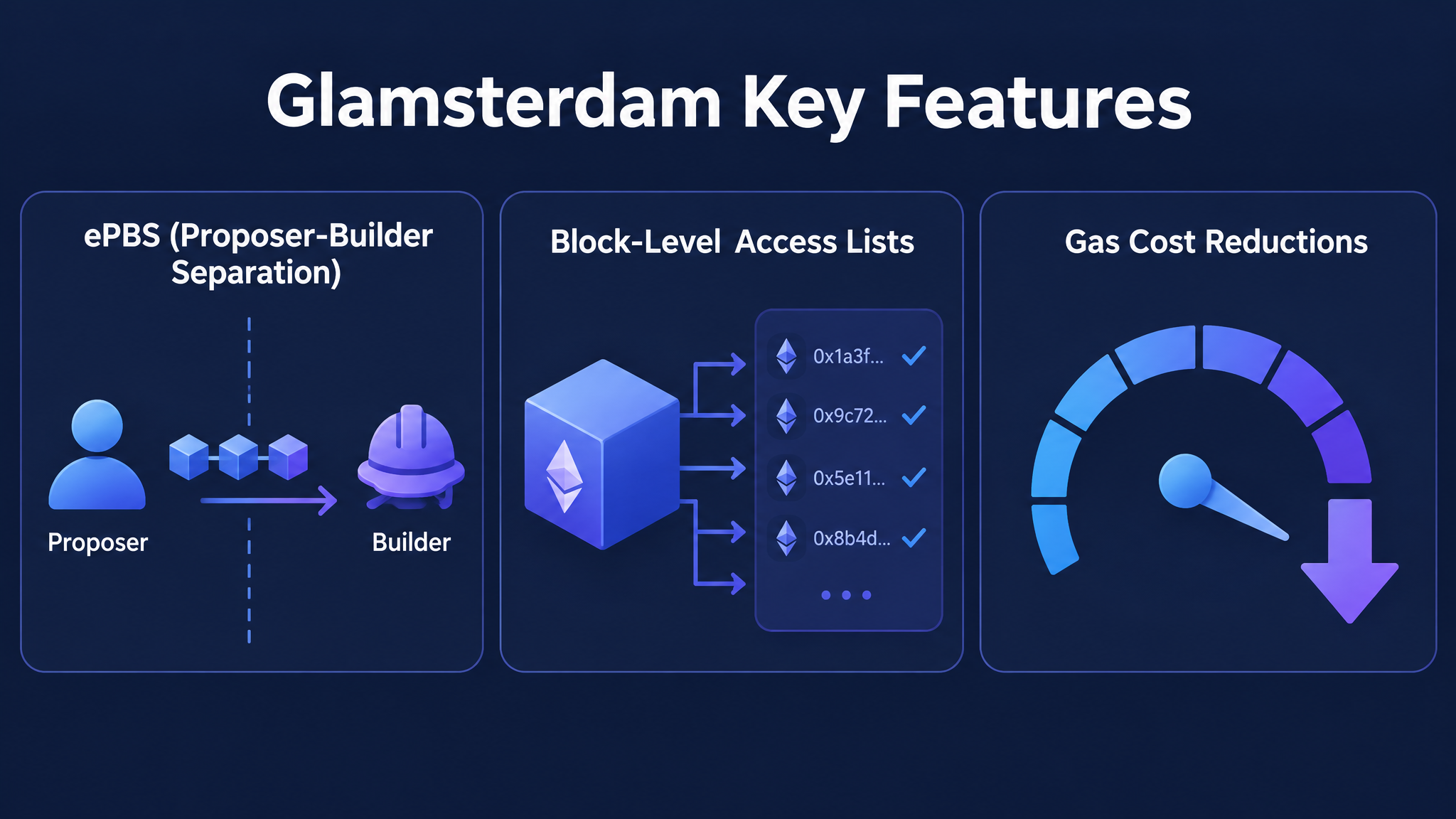
Three headline changes define this upgrade:
- Enshrined Proposer-Builder Separation (ePBS, EIP-7732): Formalizes the separation of block-building and block-proposing roles inside the protocol itself, replacing the current MEV-Boost middleware dependency. The payload propagation window expands from ~2 seconds to ~9 seconds, enabling larger, more efficient blocks.
- Block-Level Access Lists (BALs, EIP-7928): Maps which accounts and storage slots each block touches, enabling parallel transaction processing and dramatically faster node sync.
- Gas Repricing (EIP-8037, EIP-8038, EIP-2780): Aligns state-creation and state-access fees with real hardware costs. Standard ETH transfers between existing accounts could become up to 71% cheaper.
Who Needs to Do What: A Quick Reference
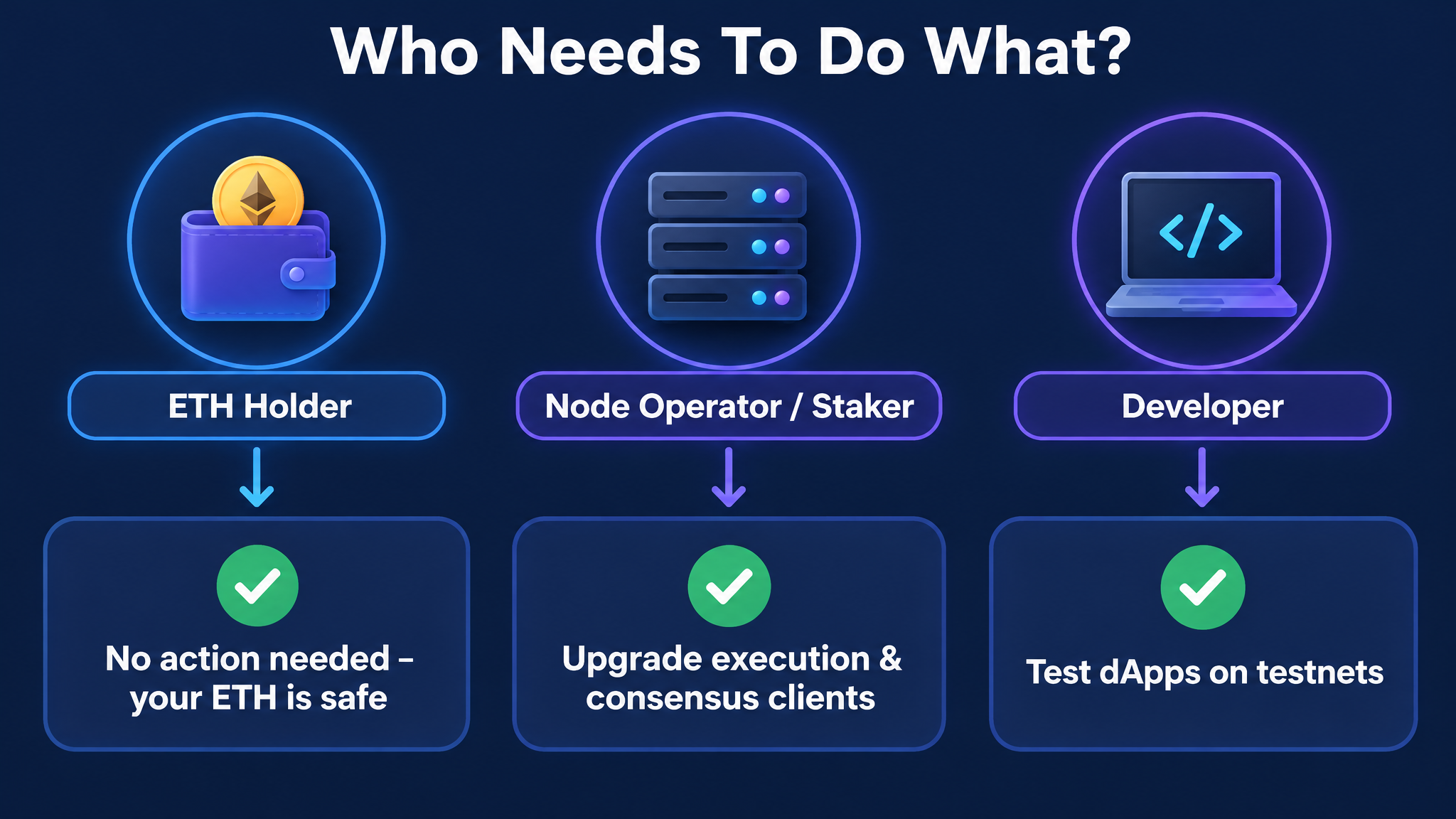
Before getting into the step-by-step, here's the honest summary: most Ethereum users need to do absolutely nothing. The upgrade is automatic at the protocol level. But if you fall into the validator or developer category, there are specific actions required before mainnet activation.
Step 1: ETH Holders — Verify You're Not Being Scammed
If you hold ETH on an exchange or in a self-custody wallet, your only job is to do nothing — and to ignore anyone telling you otherwise.
Every major Ethereum upgrade triggers a wave of scams. Phishing sites pop up claiming you need to "migrate" or "upgrade" your ETH tokens to receive the new version. You don't. There is no new token. Your ETH balance is unaffected. Your private keys don't change. Nothing moves unless you move it yourself.
Practical steps for ETH holders:
- Bookmark the official Ethereum Foundation site (ethereum.org) and check announcements only there.
- Ignore any DMs, emails, or social posts claiming you need to take action on your ETH.
- If you use a hardware wallet, keep your firmware updated — but do this through the manufacturer's official app only, not a third-party link.
Speaking of hardware wallets — if you're holding meaningful ETH and it's sitting on an exchange, this upgrade is a good reminder to move it to cold storage. Protect your crypto assets with a Ledger hardware wallet — the gold standard in cold storage security.
Step 2: Node Operators and Validators — Update Your Clients
This is where the real work happens. If you run an Ethereum validator or full node, you must update both your execution layer (EL) client and your consensus layer (CL) client to Glamsterdam-compatible versions before mainnet activation. Failing to do so means your node will fork off the main chain and stop earning rewards.
Which Clients Need Updating?
Every major client pair needs a Glamsterdam-compatible release:
- Execution layer: Geth, Nethermind, Besu, Erigon, Reth
- Consensus layer: Prysm, Lighthouse, Teku, Nimbus, Lodestar
Client teams typically release compatible versions 2–4 weeks before mainnet activation. Watch the official client GitHub repositories and the Ethereum Cat Herders' upgrade tracker for release announcements.
Step-by-Step: Updating Your Node
- Check your current client versions. Run your client's version command (e.g.,
geth versionorlighthouse --version) to see what you're running. - Monitor release channels. Subscribe to GitHub releases for your specific EL and CL clients. The Ethereum Foundation's blog (blog.ethereum.org) will also announce when Glamsterdam-compatible releases are available.
- Test on the Glamsterdam testnet first. Before upgrading mainnet, spin up a testnet node and verify your setup works correctly. The Glamsterdam testnet was announced September 28, 2026.
- Back up your validator keys. Before any client update, ensure your keystore files and withdrawal credentials are backed up securely offline.
- Update execution client. Follow your client's standard upgrade procedure — typically pulling the new binary or Docker image and restarting the service.
- Update consensus client. Same process for your CL client. Ensure both clients are running and synced before the upgrade block.
- Verify sync status. After updating, confirm both clients are synced and your validator is attesting correctly via your monitoring dashboard (e.g., beaconcha.in).
ePBS and the New Payload Timeliness Committee
Glamsterdam introduces a new validator duty: the Payload Timeliness Committee (PTC). Under ePBS, a subset of validators is selected each slot to attest to whether the execution payload arrived on time. This is a new responsibility that your consensus client handles automatically — but your infrastructure needs to be responsive enough to participate.
If you're running a validator on a low-spec machine or with high network latency, now is the time to audit your setup. The expanded 9-second payload window helps, but validators with consistently poor connectivity may see reduced rewards under the new system.
Step 3: Developers — Audit Your Contracts and Test on Testnet
Most smart contracts don't need redeployment after Glamsterdam. The upgrade is backwards-compatible at the contract level. But there are specific scenarios where your contracts could behave differently:
Gas Assumption Audits
If your contracts rely on hardcoded gas stipends or make assumptions about the cost of specific operations, Glamsterdam's gas repricing (EIP-8037 and EIP-8038) could break them. State-creation operations become more expensive; state-access operations are repriced to reflect actual hardware costs.
Common patterns to audit:
- Contracts that forward a fixed gas amount to external calls (e.g.,
call{gas: 2300}()) - Contracts that estimate gas costs internally for fee calculations
- Contracts that interact heavily with storage slots in tight loops
Contract Size Limits
EIP-7954 increases the maximum contract size from 24 KiB to 64 KiB. If you've been working around the old limit with proxy patterns or contract splitting, you now have more room. This doesn't require any action, but it opens up architectural options for future deployments.
Testing Checklist for Developers
- Deploy your contracts to the Glamsterdam testnet.
- Run your full test suite against the testnet environment.
- Pay special attention to any function that uses
gasleft()or hardcoded gas values. - Test any contract that creates new storage slots at scale — state-creation costs are increasing.
- Verify that your frontend correctly handles the new gas estimates returned by nodes post-upgrade.
For developers building DeFi protocols or trading infrastructure, understanding the full implications of Glamsterdam takes time. Want to accelerate your trading journey? Explore Icoinpro's daily trading signals and education platform — it covers both technical and market fundamentals that matter for protocol-level changes like this.
What Glamsterdam Means for Gas Fees
The gas repricing in Glamsterdam is a double-edged sword. Standard ETH transfers between existing accounts could get up to 71% cheaper — that's a meaningful reduction for everyday users. But operations that create new state (deploying contracts, creating new storage slots) will cost more, reflecting the real long-term cost of storing data on the network.
For DeFi users, the practical impact depends heavily on which protocols you use and how they're structured. Protocols that frequently create new storage entries (certain AMM designs, NFT minting contracts) may see higher costs. Protocols optimized for reading existing state may see lower costs.
The Block-Level Access Lists (BALs) also enable a new class of optimization: because nodes can now process transactions in parallel, block builders can pack more transactions into each block without sacrificing safety. Over time, this should translate to lower base fees during periods of moderate network demand.
Scam Awareness: What to Watch For
Every Ethereum upgrade brings a fresh wave of social engineering attacks. Here's what's circulating ahead of Glamsterdam:
- "ETH 2.0 Migration" scams: There is no ETH 2.0 token migration. This scam has existed since the Merge and resurfaces with every upgrade.
- Fake "Glamsterdam airdrop" sites: No airdrop is associated with this upgrade. Any site claiming otherwise is a phishing attempt.
- Fake client update links: Always download client updates directly from official GitHub repositories. Never click update links from Discord DMs or Twitter/X posts.
- Validator "migration" services: No third-party service is needed to migrate your validator. Your client software handles the upgrade automatically once updated.
If you're serious about protecting your crypto assets through protocol upgrades and beyond, the Trezor Model T offers top-tier security with an intuitive touchscreen interface — keeping your private keys completely offline regardless of what happens at the protocol level.
Timeline: What to Expect
Based on the Ethereum Foundation's October 8, 2026 roadmap update and the September 28 testnet announcement:
- October 2026: Public testnet deployments ongoing. Client teams testing Glamsterdam-compatible releases.
- November 2026 (estimated): Glamsterdam-compatible client releases for all major EL and CL clients.
- Late 2026 (estimated): Mainnet activation. Exact block number to be announced by Ethereum core developers.
These timelines are estimates. Ethereum upgrades have historically slipped by weeks or months when testing reveals unexpected issues. Follow the Ethereum Foundation blog and the AllCoreDevs call summaries for the most current information.
Key Takeaways
- ETH holders: Do nothing. Ignore anyone claiming you need to migrate or upgrade your tokens — it's a scam.
- Node operators and validators: Update both your execution layer and consensus layer clients to Glamsterdam-compatible versions before mainnet activation. Test on the testnet first.
- Developers: Audit contracts that use hardcoded gas values or create significant new state. Test on the Glamsterdam testnet. No redeployment needed for most contracts.
- Gas fees: Standard ETH transfers could get up to 71% cheaper. State-creation operations will cost more. DeFi impact varies by protocol design.
- Timeline: Mainnet activation expected late 2026. Monitor official Ethereum Foundation channels for the exact block number.
DeFi moves fast. Your trading skills need to keep up.
Whether you're yield farming or trading tokens, the fundamentals of reading charts, managing risk, and timing entries apply everywhere in crypto. Those skills are worth developing properly.
The program I recommend to people who ask me is this crypto trading course — it\'s the one I point friends and family to when they\'re serious about learning. Daily lessons, live analysis, and a community that actually helps.
Affiliate link — I may earn a commission at no extra cost to you. I only recommend what I genuinely use.
Disclaimer: The information provided on this website is for educational and informational purposes only. It should not be considered financial or investment advice. Cryptocurrency investments carry significant risk. Always do your own research and consult with a qualified financial advisor before making investment decisions.
Free Crypto Insights
Get weekly trading tips, market analysis, and exclusive strategies delivered to your inbox.