How to Use Hyperliquid DEX in 2026: Your Complete Perpetual Trading Guide
Affiliate Disclosure: This article may contain affiliate links. We may earn a commission at no extra cost to you. All opinions are our own.
Marcus Chen
Senior Crypto Analyst & Educator
Certified Blockchain Professional | Former Wall Street Analyst
Marcus Chen is a cryptocurrency analyst and educator with over 8 years of experience in digital asset trading. He has helped thousands of beginners navigate the crypto markets through practical, actionable education.

Frequently Asked Questions
Is Hyperliquid available to US traders?
As of September 2026, Hyperliquid is actively pursuing regulatory approval to offer perpetual futures to US-based customers. Currently, US users may face geo-restrictions on certain features. Check the official Hyperliquid site for the latest availability in your jurisdiction.
What is the HYPE token used for?
HYPE is Hyperliquid's native token used for governance, staking, and as a utility sink for builders launching outcome markets (HIP-4 requires 500,000 HYPE staked). The protocol directs 99% of revenue to automated HYPE buybacks and burns, creating deflationary pressure.
How does Hyperliquid compare to dYdX?
Both are on-chain perpetuals platforms, but Hyperliquid has captured 60–70% of the on-chain perp market vs. dYdX's smaller share. Hyperliquid's HyperCore engine offers sub-second finality and zero-gas trading, while dYdX operates as a Cosmos app chain with cross-margin capabilities favored by institutional traders.
What are confidential perpetual contracts on Hyperliquid?
Launched in partnership with NEAR Protocol in September 2026, confidential perps obscure wallet attribution so your trading activity isn't publicly visible on-chain. This feature targets institutional traders who need privacy to avoid front-running and information leakage.
What is the October 2026 HYPE token unlock?
On October 6, 2026, 23.80% of the total HYPE supply unlocks for core contributors. This is a significant event that could create selling pressure on the HYPE token. Traders should monitor price action and funding rates around this date.
How to Use Hyperliquid DEX in 2026: Your Complete Perpetual Trading Guide
If you've been trading crypto on centralized exchanges and wondering whether how to use Hyperliquid is worth figuring out — the short answer is yes, and the learning curve is shorter than you think. Hyperliquid has quietly become the dominant decentralized perpetual exchange in 2026, capturing nearly 32% of the entire perp DEX market with over $172 billion in 30-day volume. That's not a niche experiment anymore. That's a serious trading venue.
This guide walks you through everything: wallet setup, depositing funds, placing your first perpetual trade, managing risk, and even earning passive income through the platform's liquidity vaults. Whether you're a DeFi newcomer or a seasoned trader tired of KYC requirements, this is your roadmap.
What Is Hyperliquid and Why It Matters
Hyperliquid is a Layer 1 blockchain built specifically for high-performance trading. Unlike most DEXs that bolt trading onto a general-purpose chain, Hyperliquid's HyperCore engine runs a fully on-chain Central Limit Order Book (CLOB) — the same architecture used by professional trading desks on Wall Street. The result? Sub-second finality, up to 100,000 orders per second, and zero gas fees on trades.
The numbers back it up. As of June 2026, HYPE (the native token) hit an all-time high of $75.48, the platform has 1.4 million users, and it generates roughly $694 million in annualized fee revenue. Ninety-seven percent of those fees go toward buying and burning HYPE — a tokenomics model that creates direct demand pressure as volume grows.
The key difference from a centralized exchange? You keep your private keys. Your funds sit in smart contracts you control, not on a company's balance sheet. No KYC, no withdrawal freezes, no "we're pausing withdrawals for maintenance" surprises.
Step 1 — Setting Up Your Wallet
Compatible Wallets
Hyperliquid works with any EVM-compatible wallet. The most popular choices in 2026 are:
- MetaMask — the default for most DeFi users, widely supported
- Rabby Wallet — better transaction simulation and security warnings
- Coinbase Wallet — good for beginners already in the Coinbase ecosystem
You can also log in via email, which auto-generates a blockchain address. Convenient, but for serious trading, a proper wallet gives you more control.
Connecting to Hyperliquid
Always navigate directly to app.hyperliquid.xyz — bookmark it now. Phishing sites mimicking the interface are a real threat. Once there:
- Click "Connect Wallet" in the top right corner
- Select your wallet provider and approve the connection
- Sign a gas-less transaction to enable trading — this creates a local API key so you don't need a wallet popup for every single order
That signing step trips up a lot of first-timers. It's not a transaction that costs money — it's just authorization. Once done, your trading experience feels as smooth as any centralized exchange.
Protect your crypto assets with a Ledger hardware wallet — the gold standard in cold storage security. Even if you're actively trading on Hyperliquid, keeping your long-term holdings in cold storage is non-negotiable.
Step 2 — Depositing Funds
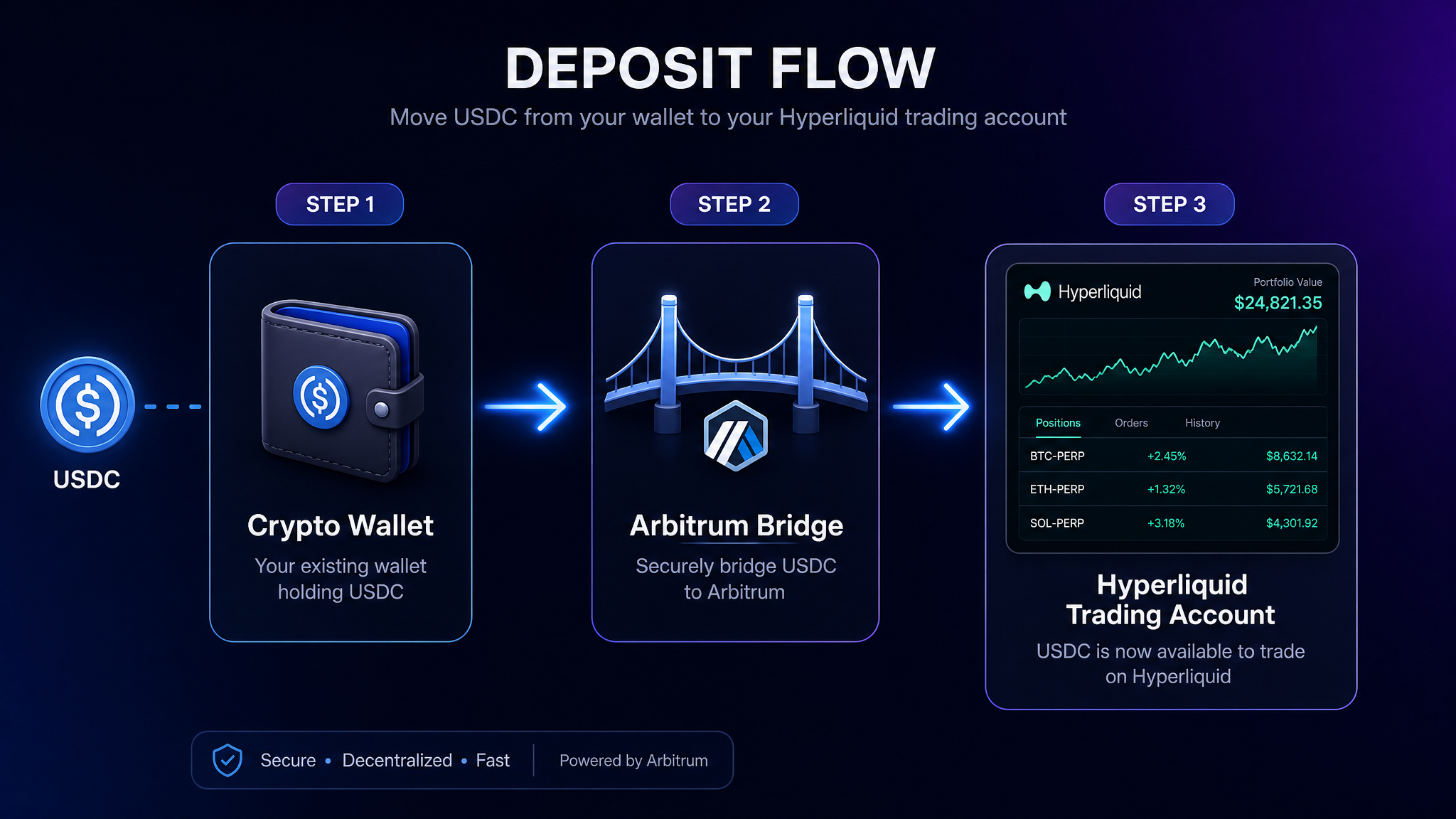
Depositing USDC via Arbitrum
Hyperliquid's primary deposit method uses the Arbitrum network. Here's the exact flow:
- Make sure you have USDC on Arbitrum (you can buy it on Coinbase or bridge from Ethereum)
- Have a small amount of ETH on Arbitrum for the one-time deposit gas fee (usually under $0.50)
- In the Hyperliquid app, click "Deposit" and enter your USDC amount
- Approve the transaction in your wallet
- Funds typically appear in your Hyperliquid account within 30–60 seconds
After that initial deposit, all trading on Hyperliquid is completely gas-free. No per-trade fees eating into your P&L.
Bridging Other Assets
You can also deposit BTC, ETH, SOL, and other assets directly from their native chains. Once deposited, you'll swap them for USDC (the platform's quote currency) before trading perpetuals. The spot market on Hyperliquid handles this cleanly — just use the swap interface before heading to the perps section.
Step 3 — Trading Perpetuals on Hyperliquid
Understanding the Interface
The trading interface will feel familiar if you've used Binance Futures or Bybit. You get a TradingView chart, a live order book, recent trades, and your positions panel — all in one view. The main difference is that everything you see is happening on-chain in real time.
Key sections to know:
- Order Book — live bids and asks, updated in milliseconds
- Positions — your open trades with unrealized P&L
- Orders — pending limit orders and stop orders
- Portfolio — account balance, margin usage, and available collateral
Placing Your First Trade
Let's say you want to go long on ETH with 5x leverage. Here's the exact sequence:
- Select ETH-PERP from the market dropdown
- Choose "Long" (green button) or "Short" (red button)
- Set your leverage — start with 2x–5x until you understand how liquidations work
- Enter your position size in USDC or as a number of contracts
- Choose order type: Market (instant fill) or Limit (set your price)
- Review the estimated liquidation price shown below the order form
- Click "Place Order" and confirm in your wallet (only needed once per session)
Fees are straightforward: 0.045% for taker orders (market orders), 0.015% for maker orders (limit orders). Compare that to Binance's 0.04% taker fee — Hyperliquid is competitive, and you're not handing custody of your funds to anyone.
Leverage, Margin Types, and Fees
Hyperliquid offers up to 50x leverage on major pairs like BTC and ETH. That's powerful — and dangerous if misused. A 10x leveraged position gets liquidated with a 10% adverse move. At 50x, that's just 2%.
Funding rates settle every hour (not every 8 hours like most CEXs), which means your cost of holding a position is more granular and predictable. Check the current funding rate before entering — if you're going long and funding is highly positive, you're paying longs to hold the position.
Ready to master crypto trading? Check out Icoinpro's comprehensive trading course. Understanding leverage mechanics, risk management, and market structure before trading with real money can save you from costly mistakes.
Step 4 — Managing Risk Like a Pro
Stop Loss and Take Profit Orders
This is where most beginners fail. They open a leveraged position and don't set a stop loss, then watch a 15% drawdown wipe out their account. Don't be that person.
On Hyperliquid, you can set stop loss and take profit orders directly from the position panel:
- Click on your open position
- Select "Add SL/TP"
- Enter your stop loss price (where you'll exit if wrong) and take profit price (where you'll lock in gains)
- These orders sit on-chain and execute automatically — no need to babysit the screen
A practical rule: never risk more than 1–2% of your total account on a single trade. If you have $5,000 in your account, your stop loss should be set so you lose no more than $50–$100 if the trade goes against you.
Cross vs Isolated Margin
Hyperliquid offers two margin modes:
- Cross Margin — your entire account balance backs all positions. More efficient use of capital, but one bad trade can affect all your positions.
- Isolated Margin — each position has its own dedicated collateral. You can only lose what you allocated to that specific trade. Better for beginners.
Start with isolated margin. Once you understand how liquidations work and you're comfortable managing multiple positions, you can explore cross margin for capital efficiency.
Step 5 — Earning Passive Income on Hyperliquid
HLP Vault — Provide Liquidity
Don't want to actively trade? The Hyperliquid Liquidity Provider (HLP) vault lets you deposit USDC and earn a share of trading fees and liquidation premiums. The vault automatically runs market-making and liquidation strategies — you just deposit and collect.
Returns vary with market conditions. During high-volatility periods with heavy liquidations, the vault can generate significant returns. During quiet markets, yields are more modest. Think of it as a DeFi money market with trading-fee upside.
HYPE Staking
Staking HYPE tokens with network validators earns you a portion of protocol fee revenue. Given that 97% of trading fees go toward buying HYPE (with some directed to stakers), this creates a compounding effect: more platform volume → more fee revenue → more HYPE demand → higher staking rewards.
To stake: navigate to the "Staking" section in the app, choose a validator, enter your HYPE amount, and confirm. Unstaking has a cooldown period, so factor that into your liquidity planning.
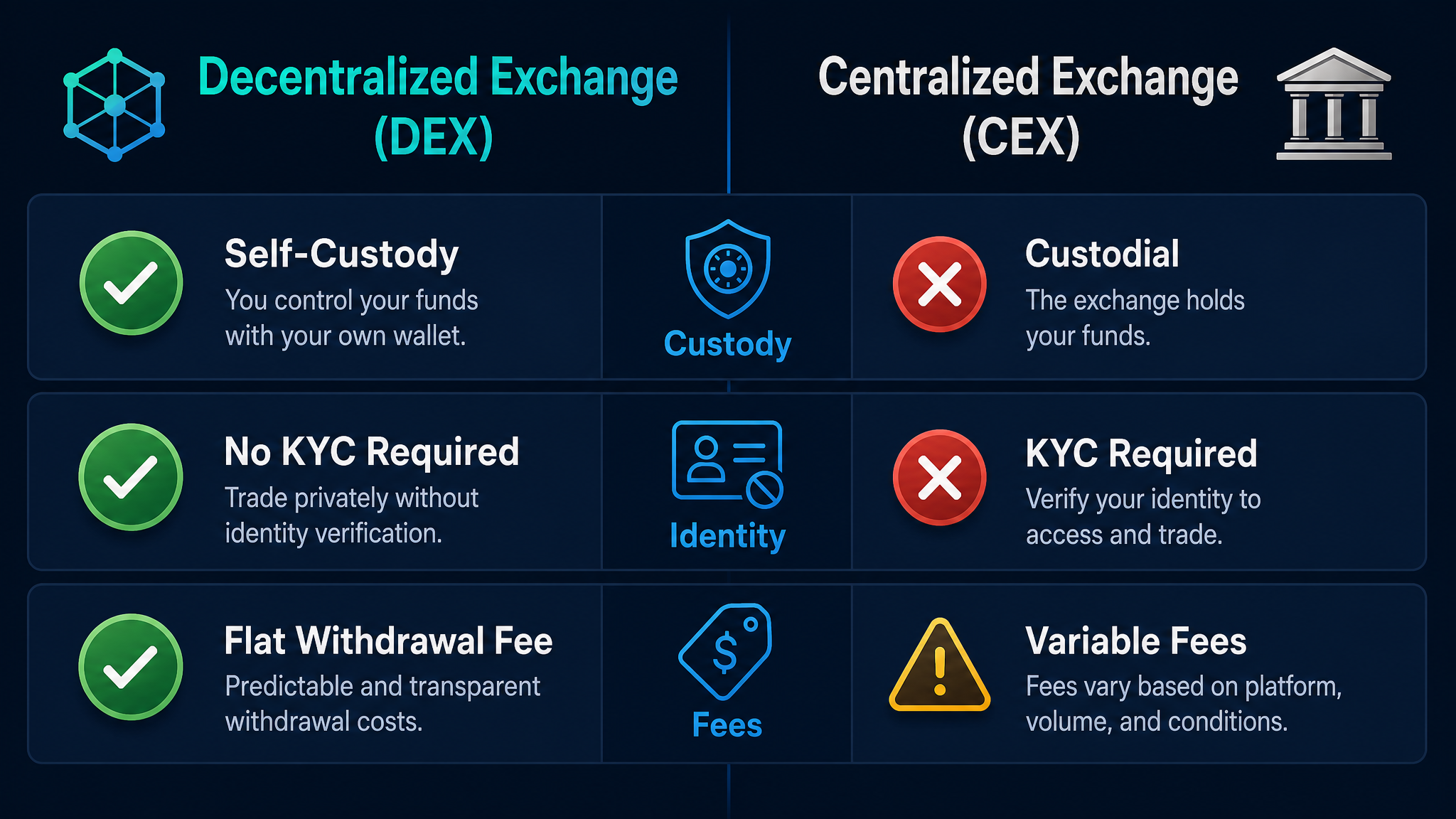
Hyperliquid vs Centralized Exchanges: Is It Worth the Switch?
Here's the honest comparison most guides skip:
| Feature | Hyperliquid | CEX (e.g., Binance) |
|---|---|---|
| Base Taker Fee | 0.045% | 0.04%–0.055% |
| Withdrawal Fee | 1 USDC (flat) | $2–$15 (variable) |
| Custody | Self-custody | Exchange holds funds |
| KYC Required | No | Yes |
| Funding Cadence | Hourly | Every 8 hours |
| Gas Fees on Trades | None | None |
The fee difference is marginal for casual traders. The real advantages are self-custody and no KYC — which matter enormously if you've ever had an exchange freeze your account or demand documents you'd rather not submit.
The Trezor Model T offers top-tier security with an intuitive touchscreen interface. Pair it with Hyperliquid's self-custody model and you've got a genuinely robust setup for serious crypto trading.
Security Best Practices
A few non-negotiables before you put real money in:
- Bookmark the URL — always use app.hyperliquid.xyz, never click links from Twitter DMs or Discord
- Verify transaction details — before signing anything in your wallet, read what you're approving
- Revoke unused approvals — use revoke.cash periodically to clean up old token permissions
- Withdraw profits regularly — don't leave more on the platform than you need for active trading
- Use a hardware wallet — for your long-term holdings, keep them in cold storage, not connected to any dApp
Key Takeaways
- Hyperliquid is the #1 decentralized perpetual exchange in 2026, with 32% market share and $172B+ in monthly volume
- Setup takes under 10 minutes: connect an EVM wallet, deposit USDC via Arbitrum, and you're trading
- Fees are competitive with CEXs (0.045% taker), with the added benefit of self-custody and no KYC
- Always set stop loss orders — leveraged trading without risk management is gambling, not trading
- Passive income options include the HLP vault (liquidity provision) and HYPE staking
- Security hygiene matters: bookmark the URL, verify transactions, and use a hardware wallet for long-term holdings
About the Author
Marcus Chen is a Senior Crypto Analyst & Educator with 8+ years of experience in digital asset markets. A Certified Blockchain Professional and Former Wall Street Analyst, Marcus has guided thousands of investors through the complexities of DeFi, perpetual trading, and crypto portfolio management. His analysis combines on-chain data with institutional-grade market structure insights.
Disclaimer: This content is for informational purposes only and should not be considered financial advice. Cryptocurrency investments carry significant risk. Always do your own research (DYOR) before making any investment decisions.
This article contains affiliate links. We may earn a commission at no extra cost to you if you make a purchase through these links. See our affiliate disclosure for details.
DeFi moves fast. Your trading skills need to keep up.
Whether you're yield farming or trading tokens, the fundamentals of reading charts, managing risk, and timing entries apply everywhere in crypto. Those skills are worth developing properly.
The program I recommend to people who ask me is this crypto trading course — it\'s the one I point friends and family to when they\'re serious about learning. Daily lessons, live analysis, and a community that actually helps.
Affiliate link — I may earn a commission at no extra cost to you. I only recommend what I genuinely use.
Disclaimer: The information provided on this website is for educational and informational purposes only. It should not be considered financial or investment advice. Cryptocurrency investments carry significant risk. Always do your own research and consult with a qualified financial advisor before making investment decisions.
Free Crypto Insights
Get weekly trading tips, market analysis, and exclusive strategies delivered to your inbox.