Crypto Liquidity Mining 2.0: How to Maximize LP Returns with Active Management in 2026
Affiliate Disclosure: This article may contain affiliate links. We may earn a commission at no extra cost to you. All opinions are our own.
Marcus Chen
Senior Crypto Analyst & Educator
Certified Blockchain Professional | Former Wall Street Analyst
Marcus Chen is a cryptocurrency analyst and educator with over 8 years of experience in digital asset trading. He has helped thousands of beginners navigate the crypto markets through practical, actionable education.
Crypto Liquidity Mining 2.0: How to Maximize LP Returns with Active Management in 2026
Active liquidity management has quietly become one of the most powerful — and most misunderstood — advanced strategies in DeFi. If you're still parking capital in a wide-range pool and hoping for the best, you're leaving serious money on the table. In 2026, the gap between passive and active liquidity providers has never been wider, and understanding how to close that gap is the difference between earning 8% APY and earning 40%+.
This guide breaks down how active LP management works, why it outperforms passive strategies, and the tools you need to implement it — whether you're on Uniswap v4, Curve, or another major AMM.
Why Passive LP Strategies Are Losing Ground
The original promise of liquidity mining was simple: deposit two tokens, earn trading fees, collect rewards. For a while, that worked. But the DeFi landscape has changed dramatically.
Research published in 2026 on Uniswap v3 and v4 pools shows a clear "active-passive gap" — passive LPs who set wide price ranges consistently underperform the aggregate pool return. Why? Two reasons:
- Adverse selection: Arbitrageurs trade against stale prices in your pool, effectively extracting value from you every time the market moves.
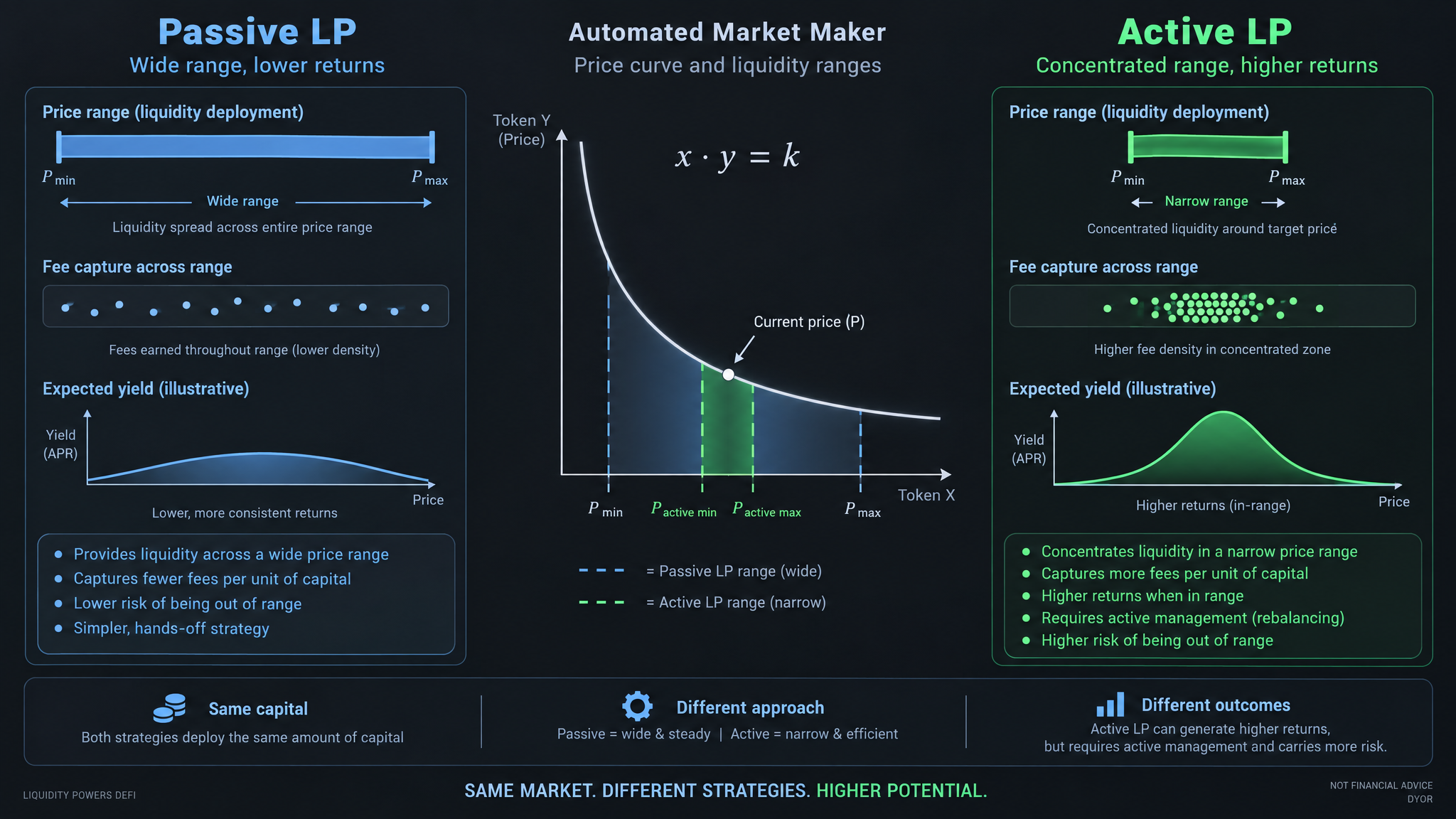
- Capital inefficiency: Wide ranges mean most of your capital sits idle outside the active trading range, earning zero fees.
On Ethereum mainnet, this gap is especially pronounced. Shorter block times on Layer 2s like Arbitrum and Base reduce the advantage of high-frequency active management — but even there, passive LPs trail active ones over any meaningful time horizon.
In short: passive liquidity provision in 2026 means subsidizing arbitrageurs.
What Active LP Management Actually Means
Active management doesn't mean you're glued to a screen 24/7. It means your liquidity position adapts to market conditions rather than sitting static.
There are three core components:
1. Concentrated Price Ranges
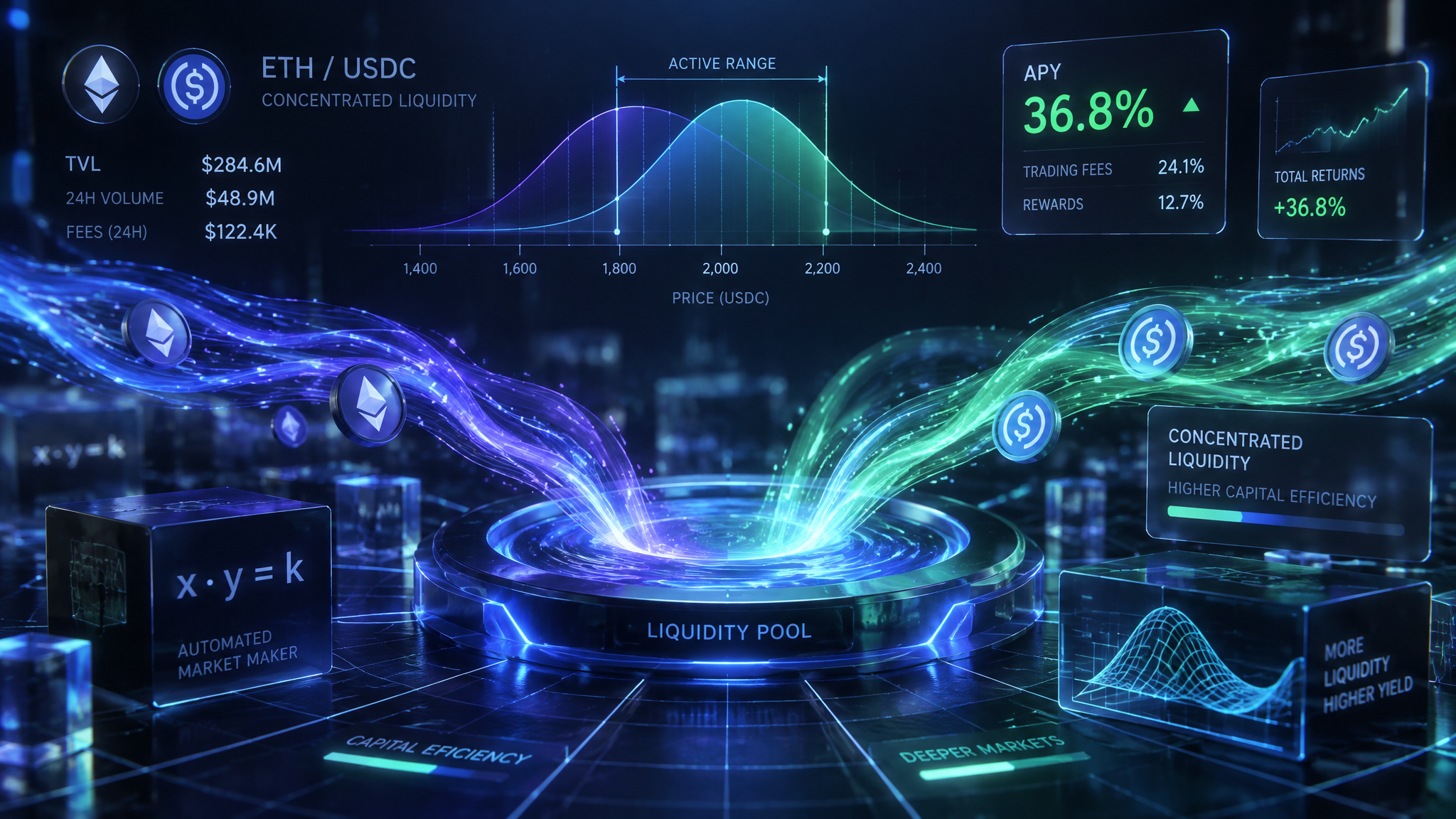
Uniswap v3 introduced concentrated liquidity — the ability to deploy capital within a specific price band rather than across the entire curve. If ETH is trading at $3,200 and you set a range of $3,000–$3,500, 100% of your capital earns fees within that band. A passive LP spreading capital from $0 to infinity might have only 5–10% of their capital active at any given time.
The math is stark. A $10,000 position in a 10x concentrated range earns roughly the same fees as a $100,000 passive position — assuming price stays in range. That's the upside. The downside is that if price moves outside your range, you stop earning entirely and face full impermanent loss on one side of the pair.
2. Dynamic Rebalancing
The key to making concentrated liquidity work is rebalancing when price moves out of range. This is where most retail LPs fail — they set a range, forget about it, and wonder why they're not earning fees.
Active management means either:
- Manually monitoring and resetting your range when price moves significantly
- Using automated vault protocols that handle rebalancing algorithmically
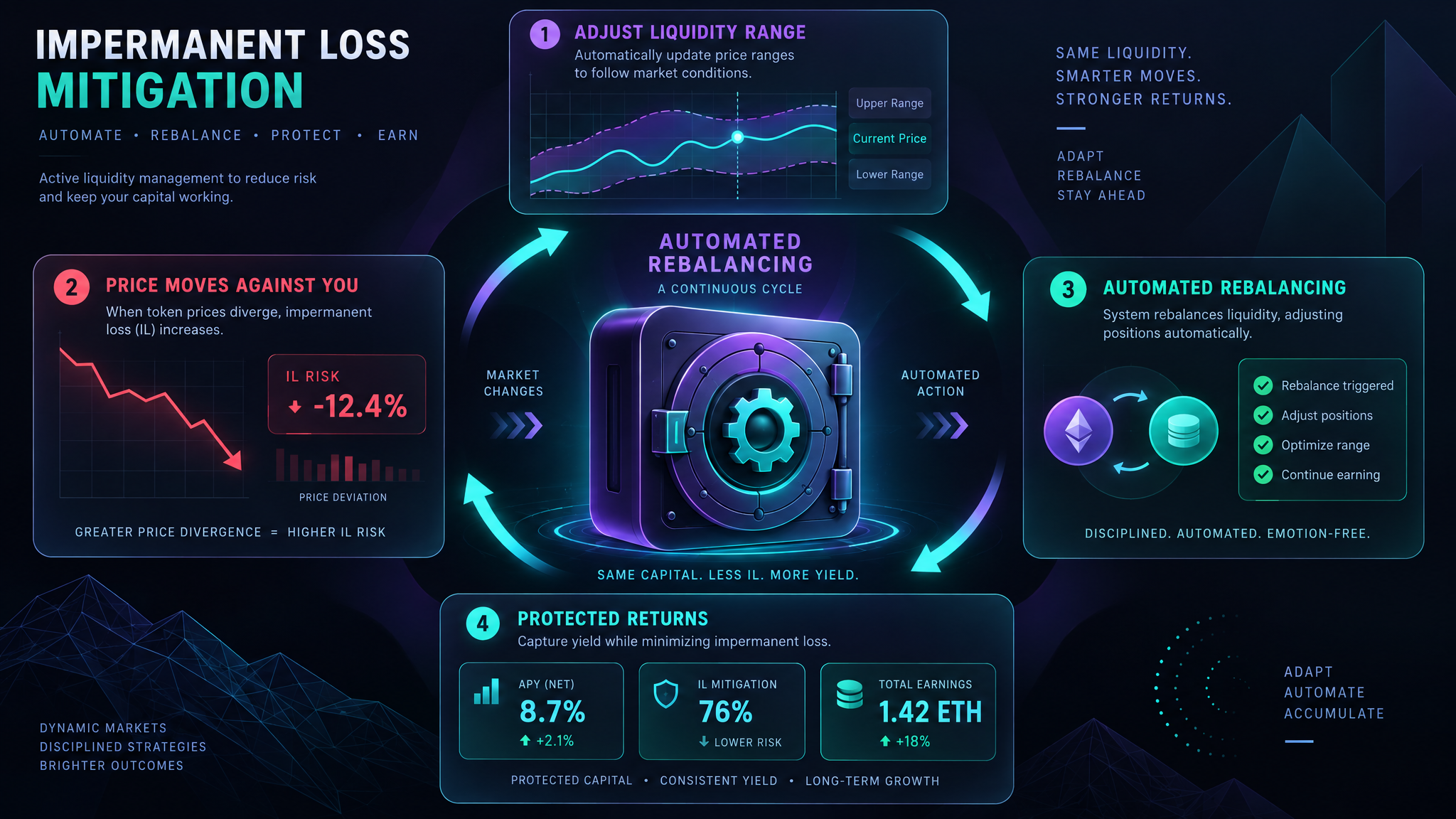
The second option has become the dominant approach in 2026. Protocols like Gamma Strategies, Arrakis Finance, and the "Bunni layer" built on Uniswap v4 hooks automate the entire rebalancing process. You deposit once, and the protocol continuously adjusts your range to stay centered around the current price.
3. Fee Tier Selection
Not all pools are equal. Uniswap v4 offers multiple fee tiers — typically 0.01%, 0.05%, 0.3%, and 1%. The right tier depends on the asset pair:
- Stablecoin pairs (USDC/USDT): 0.01% or 0.05% — high volume, tight spreads
- Major pairs (ETH/USDC): 0.05% or 0.3% — balance between volume and fee capture
- Volatile altcoin pairs: 0.3% or 1% — lower volume but higher per-trade fees compensate
Passive LPs often default to the most popular pool without considering whether the fee tier matches their risk tolerance and the pair's volatility profile.
Uniswap v4 Hooks: The Game Changer for Active LPs
Uniswap v4's biggest innovation isn't the singleton architecture (though that cuts gas costs significantly). It's hooks — programmable logic that executes at specific points in the pool lifecycle.
For active LPs, hooks unlock capabilities that simply didn't exist before:
Dynamic Fee Hooks
A dynamic fee hook automatically widens the spread during high-volatility periods. When the market is moving fast and arbitrage risk is elevated, the pool charges higher fees to compensate LPs. When volatility is low, fees compress to attract more volume. This is essentially automated adverse selection protection.
Automated Rebalancing Hooks
Some hook implementations trigger automatic range rebalancing when price moves beyond a threshold. Instead of your position going out of range and sitting idle, the hook reshapes the liquidity distribution in real time. This is the "set it and forget it" version of active management — and it's genuinely powerful.
MEV Capture Hooks
Here's one most LPs don't know about: certain hooks are designed to capture arbitrage value and redistribute it back into the pool. Instead of arbitrageurs extracting value from LPs, the hook intercepts that flow and converts it into additional yield. Early implementations have shown meaningful improvements in LP returns on high-volume pairs.
Ready to master crypto trading? Check out Icoinpro's comprehensive trading course.
Impermanent Loss: The Real Risk and How to Manage It
Impermanent loss (IL) is the elephant in the room for every LP strategy. It's not a bug — it's a fundamental feature of how AMMs work. When the price of your deposited assets diverges from the ratio at deposit time, you end up with less value than if you'd simply held the tokens.
The good news: active management significantly reduces IL exposure. Here's how:
Tight Range + Frequent Rebalancing
Counterintuitively, very tight ranges with frequent rebalancing can reduce net IL compared to wide passive positions. The logic: you're constantly resetting your position to the current price, so you never accumulate large divergence losses. The cost is gas fees for rebalancing — which is why this approach works best on L2s where gas is cheap.
Correlated Asset Pairs
IL is minimized when the two assets in your pair move together. ETH/stETH, USDC/USDT, or BTC/WBTC pairs have very low IL because the assets are highly correlated. The tradeoff is lower fee income — but for capital preservation, these pairs are excellent.
IL Protection Protocols
Some protocols offer explicit IL protection mechanisms. If you maintain your position for a minimum period (often 30–100 days), the protocol compensates you for any IL incurred. These programs are funded by protocol treasuries or insurance pools. They're not universal, but worth seeking out when available.
Hedging with Perpetuals
Advanced LPs hedge their IL exposure using perpetual futures. If you're providing ETH/USDC liquidity, you can short ETH perps in proportion to your delta exposure. This creates a near-delta-neutral position where you earn fees without directional risk. The cost is the funding rate on the short — which is often less than the fee income you're generating.
Automated Vault Protocols: The Practical Path
For most DeFi participants, building and maintaining a custom active LP strategy from scratch isn't realistic. That's where automated vault protocols come in.
These platforms handle the complexity for you:
- Gamma Strategies: One of the oldest and most battle-tested active LP managers. Offers automated rebalancing across Uniswap v3/v4 and other AMMs. Transparent fee structure, solid track record.
- Arrakis Finance: Focuses on institutional-grade liquidity management. Their PALM (Protocol Automated Liquidity Management) product is used by major DeFi protocols to manage their own treasury liquidity.
- Bunni v2: Built natively on Uniswap v4 hooks. Offers "lazy liquidity" — positions that automatically reshape without requiring manual intervention or gas-heavy rebalancing transactions.
- Beefy Finance: More accessible for retail users. Auto-compounds fee income and handles basic rebalancing. Lower ceiling on returns but much simpler UX.
When evaluating any vault protocol, check three things: smart contract audit history, total value locked (TVL) as a proxy for battle-testing, and the fee structure (management fees + performance fees can eat into returns significantly).
Protect your crypto assets with a Ledger hardware wallet — the gold standard in cold storage security.
Choosing the Right Chain for Active LP Management
Chain selection matters more than most people realize. Here's the breakdown:
Ethereum Mainnet
Highest liquidity, most established pools, but gas costs make frequent rebalancing expensive. Best for large positions ($50K+) where gas is a small percentage of capital. The active-passive gap is widest here, meaning active management has the most alpha to capture.
Arbitrum and Base
The sweet spot for most active LPs. Gas costs are low enough to rebalance frequently, liquidity is deep on major pairs, and Uniswap v4 is fully deployed. Research shows the active-passive gap is smaller here than on mainnet — but active management still outperforms meaningfully.
Solana (Orca, Raydium)
Solana's concentrated liquidity pools (CLMM) on Orca and Raydium offer similar mechanics to Uniswap v3. Ultra-low fees make frequent rebalancing trivial. The ecosystem is less mature than Ethereum's, but SOL-based pairs have shown strong fee income during bull markets.
Real Numbers: What Active LP Management Actually Returns
Let's ground this in reality. Across major active LP vault protocols in 2026, typical annualized returns on major pairs look like this:
- ETH/USDC (Arbitrum, active managed): 15–35% APY depending on volatility
- BTC/ETH (Base, active managed): 10–25% APY
- Stablecoin pairs (USDC/USDT, active managed): 8–15% APY
- Volatile altcoin pairs (active managed): 30–80% APY — but with significantly higher IL risk
Compare that to passive wide-range positions on the same pairs, which typically earn 3–8% APY. The active premium is real and consistent.
One caveat: these numbers assume price stays within a reasonable range. During extreme market moves (30%+ in a week), even active management can't fully protect against IL. Position sizing and diversification across multiple pairs remain essential.
Step-by-Step: Getting Started with Active LP Management
Here's a practical framework for implementing this strategy:
- Start with a vault protocol. Don't try to manually manage concentrated liquidity positions until you understand the mechanics deeply. Gamma or Beefy on Arbitrum is a good starting point.
- Choose correlated pairs first. ETH/stETH or USDC/USDT minimizes IL while you learn. Once comfortable, move to more volatile pairs for higher returns.
- Size appropriately. Active LP management works best when gas costs are less than 0.5% of your position size per rebalancing event. On Arbitrum, this means positions of $2,000+ are viable.
- Track your real returns. Use a portfolio tracker that accounts for IL, not just fee income. Many LPs overestimate returns by ignoring IL. Tools like APY.vision or Revert Finance give you the full picture.
- Hedge if needed. For large positions in volatile pairs, consider a small perpetual short to offset delta exposure. Even a 25% hedge can meaningfully reduce drawdown during market corrections.
Want to accelerate your trading journey? Explore Icoinpro's daily trading signals and education platform.
Key Takeaways
- Passive LP strategies are systematically underperforming in 2026 due to adverse selection and capital inefficiency.
- Active management — through concentrated ranges, dynamic rebalancing, and smart fee tier selection — can 3–5x your LP returns on the same capital.
- Uniswap v4 hooks enable automated dynamic fees, rebalancing, and MEV capture that weren't possible before.
- Vault protocols like Gamma, Arrakis, and Bunni handle the complexity for you — start there before going fully manual.
- Always track real returns including IL, not just fee income. The full picture is what matters.
- Layer 2s like Arbitrum and Base offer the best risk-adjusted environment for active LP management due to low gas costs and deep liquidity.
DeFi moves fast. Your trading skills need to keep up.
Whether you're yield farming or trading tokens, the fundamentals of reading charts, managing risk, and timing entries apply everywhere in crypto. Those skills are worth developing properly.
The program I recommend to people who ask me is this crypto trading course — it\'s the one I point friends and family to when they\'re serious about learning. Daily lessons, live analysis, and a community that actually helps.
Affiliate link — I may earn a commission at no extra cost to you. I only recommend what I genuinely use.
Disclaimer: The information provided on this website is for educational and informational purposes only. It should not be considered financial or investment advice. Cryptocurrency investments carry significant risk. Always do your own research and consult with a qualified financial advisor before making investment decisions.
Free Crypto Insights
Get weekly trading tips, market analysis, and exclusive strategies delivered to your inbox.