How to Bridge Crypto Between Blockchains in 2026: A Step-by-Step Guide
Affiliate Disclosure: This article may contain affiliate links. We may earn a commission at no extra cost to you. All opinions are our own.
Marcus Chen
Senior Crypto Analyst & Educator
Certified Blockchain Professional | Former Wall Street Analyst
Marcus Chen is a cryptocurrency analyst and educator with over 8 years of experience in digital asset trading. He has helped thousands of beginners navigate the crypto markets through practical, actionable education.

This article contains affiliate links. We may earn a commission at no extra cost to you if you make a purchase through these links. See our affiliate disclosure for details.
How to Bridge Crypto Between Blockchains in 2026: A Step-by-Step Guide
Knowing how to bridge crypto between blockchains is one of the most practical skills you can develop in 2026. Whether you want to move ETH from Ethereum mainnet to Arbitrum to save on gas, or shift USDC from Solana to Base to chase a yield opportunity, bridging is the connective tissue of the multi-chain world. It sounds technical. It doesn't have to be.
Disclaimer: This content is for informational purposes only and should not be considered financial advice. Cryptocurrency investments carry significant risk. Always do your own research (DYOR) before making any investment decisions.
What Is a Crypto Bridge — and Why Does It Matter?
Blockchains are isolated by design. Ethereum doesn't natively know what's happening on Solana. Arbitrum can't read Polygon's state. Each chain is its own sovereign ledger. That's great for security, but it creates a fragmentation problem: your assets are stuck wherever you put them.
A crypto bridge solves this. It's a protocol that lets you move tokens from one blockchain to another. The mechanics vary — some bridges lock your tokens on the source chain and mint a "wrapped" equivalent on the destination, others burn and re-mint natively, and some use pre-funded liquidity pools to settle transfers almost instantly.
In 2026, bridging has become dramatically more user-friendly. Wallets like MetaMask and Rabby now embed bridge aggregators directly. Platforms like Jumper Exchange (powered by Li.Fi) scan 20+ bridge protocols simultaneously and surface the cheapest, fastest route in seconds. You don't need to understand the plumbing to use it — but knowing the basics helps you avoid costly mistakes.
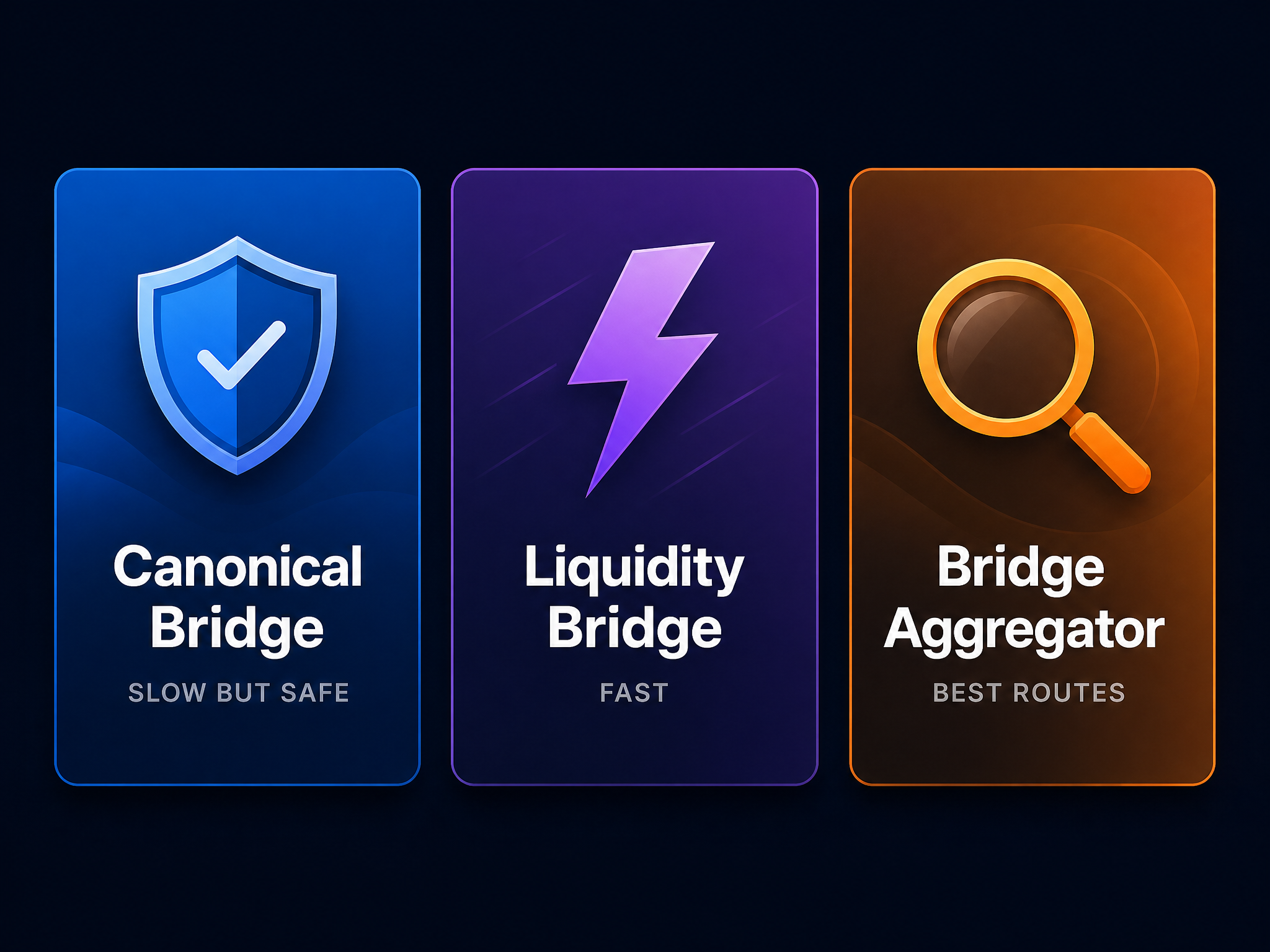
The Three Types of Crypto Bridges You'll Encounter
1. Canonical (Official) Bridges
These are built and maintained by the blockchain's own development team. The Arbitrum Bridge, Base Bridge, and Optimism Gateway are canonical bridges. They're the safest option because they inherit the security of the parent chain. The tradeoff? Withdrawals back to Ethereum mainnet can take up to 7 days due to the "challenge period" built into optimistic rollup architecture.
2. Third-Party Liquidity Bridges
Protocols like Across Protocol, Stargate (LayerZero), and Hop Exchange maintain pre-funded liquidity pools on multiple chains. When you deposit on one side, you receive from the pool on the other — often in under 60 seconds. Faster, but you're trusting an additional smart contract layer. Always check audit history before using any third-party bridge.
3. Bridge Aggregators
Aggregators like Jumper Exchange don't bridge directly — they query multiple bridges and DEXs simultaneously, then route your transaction through the best path. Think of them as the "Google Flights" of cross-chain transfers. For most users, this is the right starting point.
How to Bridge Crypto: Step-by-Step
Let's walk through a real example: moving 100 USDC from Ethereum mainnet to Arbitrum using Jumper Exchange.
Step 1: Set Up Your Wallet
You'll need a non-custodial wallet — MetaMask, Rabby, or Coinbase Wallet all work. Make sure you have a small amount of ETH on Ethereum mainnet to cover gas fees. Even if you're bridging USDC, the gas is paid in ETH. This trips up a lot of beginners.
Step 2: Go to the Official Bridge Interface
Navigate directly to jumper.exchange — type it manually or use a bookmark. Never click bridge links from Twitter, Discord, or search ads. Phishing sites that mimic bridge interfaces are one of the most common crypto scams in 2026. The URL bar is your first line of defense.
Step 3: Connect Your Wallet
Click "Connect Wallet" and select your wallet provider. Approve the connection request in your wallet. You should see your address appear in the top-right corner of the interface.
Step 4: Define Your Transfer
Select the source chain (Ethereum), source token (USDC), destination chain (Arbitrum), and destination token (USDC). Enter the amount — let's say 100 USDC. Jumper will immediately surface multiple route options, ranked by output amount, speed, and the underlying bridge protocol used.
Step 5: Do a Test Transaction First
Before moving 00, move . Seriously. A test transaction costs almost nothing and confirms that your wallet is connected correctly, the route is functional, and the destination address is right. Skip this step and you're gambling with your capital.
Step 6: Review Fees and Execute
The fee breakdown will show source chain gas, bridge protocol fees, and any DEX swap fees if the route involves a token swap. For a simple USDC-to-USDC bridge on Ethereum to Arbitrum, expect total costs of – depending on network congestion. Confirm the transaction in your wallet.
Step 7: Verify Receipt on the Destination Chain
Most bridges settle in 30–90 seconds. Switch your wallet to the Arbitrum network and check your balance. If the tokens don't appear, you may need to manually add the USDC token contract address to your wallet. Jumper's built-in tracker shows real-time status — use it if anything seems delayed.
Ready to master crypto trading? Check out Icoinpro's comprehensive trading course.
Critical Safety Rules for Bridging Crypto
Bridges have been the target of some of the largest hacks in crypto history — the Ronin Bridge exploit (25M), the Wormhole hack (20M), and the Nomad bridge attack (90M) all happened because of smart contract vulnerabilities. The landscape is safer in 2026, but caution is still warranted.
- Only use audited bridges. Check that the protocol has undergone multiple independent security audits. Across Protocol, Stargate, and the canonical chain bridges all have strong audit histories.
- Avoid infinite token approvals. When a bridge asks to spend your tokens, approve only the amount you're bridging — not "unlimited." Use Revoke.cash periodically to clean up stale approvals.
- Keep gas on the destination chain. If you bridge all your ETH to Arbitrum, you'll have ETH on Arbitrum to pay for transactions. But if you bridge only USDC and forget to keep some ETH on Arbitrum, you'll be stuck — you can't move your USDC without gas. Jumper's "Gas Refuel" feature can help with this.
- Verify the destination address on your hardware wallet screen. If you're moving significant amounts, use a Ledger or Trezor to sign the transaction. The device screen shows the actual destination address — your computer screen can be spoofed by malware.
Protect your crypto assets with a Ledger hardware wallet — the gold standard in cold storage security.
Best Crypto Bridges in 2026: Quick Comparison
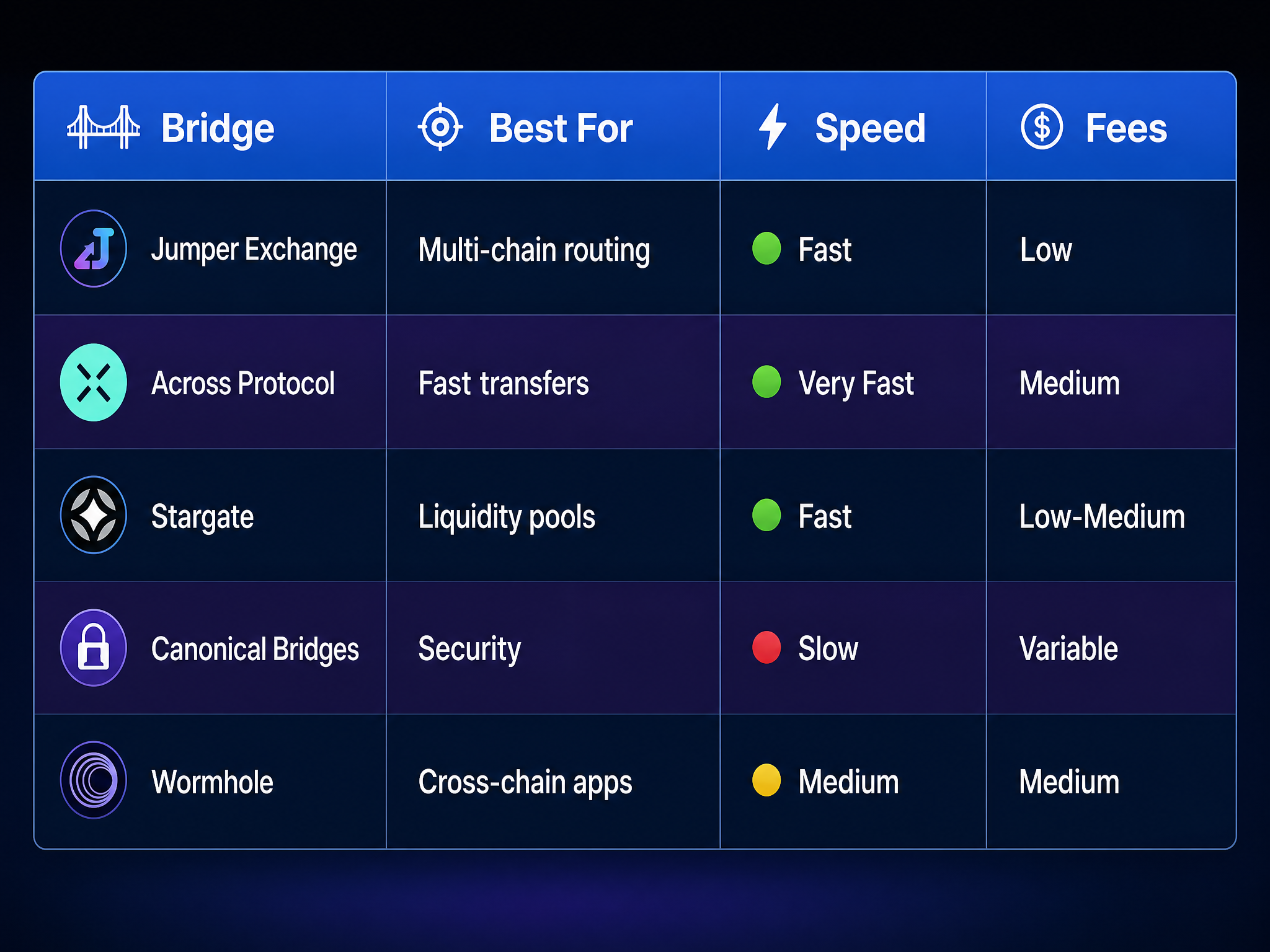
Here's a quick breakdown of the most reliable options:
- Jumper Exchange (Li.Fi): Best for most users. Aggregates 20+ bridges, supports 60+ chains, includes gas refuel. Start here.
- Across Protocol: Fastest for ETH ↔ L2 transfers. Relayer-fronted model means near-instant settlement. Fees typically 0.04–0.06%.
- Stargate (LayerZero): Strong for stablecoin transfers across EVM chains. Native asset delivery — no wrapped tokens.
- Canonical Bridges (Arbitrum, Base, Optimism): Safest option. Use for large amounts where you can wait 7 days for L1 withdrawals.
- Wormhole (Portal): Best for non-EVM transfers, especially Ethereum ↔ Solana.
Common Bridging Mistakes to Avoid
Sending to the Wrong Network
This is the #1 mistake. If you send ETH to an Arbitrum address but select "Ethereum" as the destination network on the bridge, your funds land on Ethereum mainnet — not Arbitrum. Always double-check the destination chain before confirming. The token and the network are two separate selections.
Forgetting About Withdrawal Delays
Canonical optimistic rollup bridges have a 7-day challenge period for withdrawals back to Ethereum. If you need liquidity quickly, use a third-party bridge like Across instead — it bypasses the delay using a relayer model.
Using Unaudited Bridges for Large Amounts
New bridges launch constantly. Some are legitimate; some are exit scams. Never use a bridge that launched less than 6 months ago for amounts above 00. Stick to established protocols with proven track records and multiple audits.
Bridging Costs: What to Expect
Fees vary significantly by route and market conditions. Here's a realistic breakdown for common transfers in 2026:
- Ethereum to Arbitrum (USDC, 00): ~.50–.00 total (gas + bridge fee)
- Ethereum to Solana (ETH via Wormhole): ~– (higher due to cross-VM complexity)
- Arbitrum to Base (USDC, 00): ~/bin/bash.10–/bin/bash.50 (L2-to-L2 is cheap)
- Polygon to Ethereum (USDC, 00): ~– (canonical bridge is free but slow; third-party adds fee)
L2-to-L2 transfers are the cheapest. Anything touching Ethereum mainnet costs more due to base layer gas. If you're moving small amounts frequently, stick to L2 ecosystems and minimize mainnet interactions.
Actionable Takeaways
- Use Jumper Exchange as your default bridge aggregator — it finds the best route automatically across 60+ chains.
- Always do a small test transaction before moving significant capital.
- Keep native gas tokens on the destination chain before bridging.
- Use canonical bridges for large amounts where security matters more than speed.
- Revoke stale token approvals regularly using Revoke.cash.
- For amounts above ,000, sign transactions on a hardware wallet to verify the destination address on-device.
For a deep dive into Bitcoin's monetary philosophy, grab a copy of The Bitcoin Standard.
Frequently Asked Questions
Is bridging crypto safe?
It's safer than it was in 2021–2022, but not risk-free. Stick to audited, established bridges and follow the security practices outlined above. Never bridge more than you can afford to lose on a new or unverified protocol.
How long does bridging take?
Third-party bridges like Across typically settle in 30–90 seconds. Canonical optimistic rollup bridges take 7 days for withdrawals back to Ethereum mainnet. L2-to-L2 transfers via aggregators usually complete in under 2 minutes.
Do I pay taxes on bridging?
In most jurisdictions, bridging is not a taxable event if you're moving the same token (e.g., ETH on Ethereum to ETH on Arbitrum). However, if the bridge involves a token swap, that swap may be taxable. Consult a crypto tax professional for your specific situation.
What's the cheapest way to bridge crypto?
L2-to-L2 transfers are cheapest — often under /bin/bash.50. For mainnet-involved transfers, use Jumper to compare routes and pick the lowest-fee option. Bridging during off-peak hours (weekends, late night UTC) also reduces gas costs.
Frequently Asked Questions: Crypto Bridging 2026
What is the safest crypto bridge in 2026?
Wormhole and Across Protocol are consistently rated among the safest options. Wormhole leads in cross-chain messaging depth and has been approved by the Uniswap DAO Bridge Assessment Committee. Across Protocol is preferred for Ethereum-to-L2 routes due to its near-instant finality.
What is intent-based bridging?
Intent-based bridging replaces manual multi-step processes with a results-oriented model. You specify the desired outcome and a network of Solvers competes to fulfill the request atomically. This approach, standardized by ERC-7683, is becoming the dominant bridging paradigm in 2026.
What is the Rail/Layer/App bridge stack?
The 2026 bridge architecture has evolved into three tiers: Rails (transport protocols like LayerZero V2, Wormhole, CCTP), Layers (orchestration protocols like Across and LiFi), and Apps (user-facing interfaces like Jumper). Most users interact only with the App layer.
Are crypto bridges still getting hacked in 2026?
Bridge security has improved significantly following the hack epidemic of 2025. The industry has shifted toward decentralized validation, atomic settlement, and rigorous code audits. Smart contract risk never disappears entirely - always use established, audited bridges.
What is CCTP V2?
Circle Cross-Chain Transfer Protocol V2 has matured in 2026, offering a fast-path that dramatically reduces latency for native USDC transfers between chains. It is the preferred choice for regulated institutional flows.
DeFi moves fast. Your trading skills need to keep up.
Whether you're yield farming or trading tokens, the fundamentals of reading charts, managing risk, and timing entries apply everywhere in crypto. Those skills are worth developing properly.
The program I recommend to people who ask me is this crypto trading course — it\'s the one I point friends and family to when they\'re serious about learning. Daily lessons, live analysis, and a community that actually helps.
Affiliate link — I may earn a commission at no extra cost to you. I only recommend what I genuinely use.
Disclaimer: The information provided on this website is for educational and informational purposes only. It should not be considered financial or investment advice. Cryptocurrency investments carry significant risk. Always do your own research and consult with a qualified financial advisor before making investment decisions.
Free Crypto Insights
Get weekly trading tips, market analysis, and exclusive strategies delivered to your inbox.